Sermon: Epiphany VII — How Enemies Become Friends

Enemy Watch

SERMON: How Enemies Become Friends (Epiphany VII)

You have heard that it was said, ‘An eye for an eye and a tooth for a tooth.’ But I say to you, Do not resist an evildoer. But if anyone strikes you on the right cheek, turn the other also; and if anyone wants to sue you and take your coat, give your cloak as well; and if anyone forces you to go one mile, go also the second mile. Give to everyone who begs from you, and do not refuse anyone who wants to borrow from you.

You have heard that it was said, ‘You shall love your neighbor and hate your enemy.’ But I say to you, Love your enemies and pray for those who persecute you, so that you may be children of your Father in heaven; for he makes his sun rise on the evil and on the good, and sends rain on the righteous and on the unrighteous. For if you love those who love you, what reward do you have? Do not even the tax collectors do the same? And if you greet only your brothers and sisters, what more are you doing than others? Do not even the Gentiles do the same? Be perfect, therefore, as your heavenly Father is perfect.

• Matthew 5:38-48

• • •

This morning’s Gospel contains teaching from Jesus that many of us may find a hard time relating to immediately. I would guess that most of us don’t have a lot of real enemies. I presume that most of us don’t regularly find ourselves in the kinds of intense conflict situations Jesus talks about in this passage. We live in a relatively peaceful community where people get along, and even if you’re not close to someone or don’t like them, you’ve learned to be cordial.

Now I recognize that there are times in life when public interpersonal conflicts happen and that they can seem overwhelming — for example, I think of the young people here today. When we are in middle school or high school, and hormones and emotions run high and some kids try to deal with their feelings by bullying others and forming cliques that look down on other groups of kids and make fun of them — that can be a time of life when this teaching rings true. What Jesus says here can have a lot of relevance if you’re one of the kids that’s getting picked on.

However, when Jesus spoke these words, the people who heard him knew exactly what he was talking about. Israel was under occupation by Roman armies. Soldiers walked the streets and intimidated Jewish citizens regularly. Jesus gives three examples of the kinds of conflicts they faced every day as they went about their lives.

  • First he talks about the physical intimidation the soldiers would practice. To show they were in charge, sometimes soldiers would strike people they considered insolent in the face with the back of their right hand. In that culture it was a cruel insult to hit someone like that — it meant, “I’m superior and you’re inferior and you should stay in your place.”
  • Second, Jesus mentions financial intimidation. Rich and influential people trying to curry favor with the Romans would drag poorer folks into court and ruin them financially in order to gain even more power and standing for themselves. They wouldn’t stop until they took the shirt off your back.
  • Third, Jesus speaks about the military again. The Roman soldiers had a right, by law, to force someone to carry their equipment for a mile. They could just tap a person — any person — walking down the street, and make them do it. They were limited to one mile. That was the limit. Still, if an intimidating Roman soldier said you had to do it, carrying his gear a mile out of your way could be quite an inconvenience and it was just another shameful reminder of who was in charge and who wasn’t.

Can you imagine the frustration of living in those kinds of circumstances? Can you understand how angry and bitter the Jewish people would have been tempted to become? Can you feel how they must have hungered and thirsted for justice and fair treatment? How they must have resented those invaders in their land, how they must have wanted to see vengeance every day, to see a Roman soldier have the tables turned on him, to get what he deserved for the way they were being treated? They must have lived with a continual slow burn of suppressed rage in the pits of their stomachs every day, only imagining what it would be like to see their enemies get their due.

Oh, revenge fantasies can be so sweet, can’t they? Don’t we all just love it, at the end of the movie, when the bad guys get what’s coming to them? Don’t we truly enjoy it when someone who’s been dishing it out gets a taste of his own medicine?

We live on a main street in Franklin with a low speed limit. Just up the road from our house there is a bend in the road. People ignore the speed limit regularly and come flying down that hill and around that corner. If you’re standing on the sidewalk or getting ready to cross the street or pull your car out from the driveway, it can get pretty scary.

The other day a young woman came and zipped by about 15-20 miles over the limit as I was setting the trash cans at the curb. I jumped back and stared at her and gestured for her to slow down. Just then a police car pulled out from an alley across the street, turned his lights on and chased her down a few blocks away.

Man, I was jumping up and down and celebrating like Rocky! What a great feeling that was! Justice! The evildoer was caught and punished! My sense of righteousness was satisfied! In that moment, all was right with the world.

Now that is one form of justice. Jesus talks about it here, in verse 38: “You have heard that it was said, ‘An eye for an eye and a tooth for a tooth.’” This is the principle of equal justice, of payment in kind. Lex talionis is the official phrase for it. When there is an offense committed, the punishment should correspond in degree and kind to that offense. That’s what it means, an eye for an eye, and a tooth for a tooth. A speeding ticket for speeding. It is why we use a set of scales to represent justice. There’s a balance to be sought; the punishment should fit the crime.

When this kind of justice began to be practiced in the world, it was a great advance over the kinds of punishments that were meted out before then, punishments that went far beyond the crime. It might not be an eye for an eye, but and eye as well as an arm and a leg for an eye. It might even be the death sentence for an insult. It wasn’t retributive justice, equal justice; instead this kind of punishment gave full rein to inhumane cruelty and vengeance. So an eye for an eye was a way of limiting cruel and unusual punishments.

But as helpful as that was, now Jesus comes along and offers us something even better than that. A new kind of justice. A justice that is about something more than merely preventing vengeance from running wild. The justice that Jesus talks about is designed to go beyond making someone pay the appropriate penalty for what they’ve done. Rather, it is designed to actually redeem and restore the one who committed the offense.

During the Civil War, hatred became entrenched between the North and South. People in the North criticized Abraham Lincoln for suggesting the rebels and their families should be treated with compassion. His critics reminded Lincoln that there was a war going on, the Confederates were the enemy, and they should be destroyed. But Lincoln wisely responded, “Do I not destroy my enemies when I make them my friends?”

This is the approach Jesus commends to us here. And he reminds us that this is the approach God himself takes. The sun rises on good people and wicked people alike. God sends nourishing rains on the just and unjust alike. God loves all people, not just a chosen few. God is kind and generous to all, and patient toward all of our shortcomings and wrongdoings.

Jesus reminds us of this through his teaching here. But folks, Jesus went far beyond that. Jesus demonstrated this very teaching about a better kind of justice. He not only advocated redemptive justice rather than retributive justice, he practiced it. He showed us how to act so that there is a chance of the enemy becoming a friend.

  • Those very Roman soldiers who bullied the Jewish citizens back then arrested Jesus and struck him repeatedly on the face. But he did not cower or retaliate. He stood before them and offered the other cheek. His nonviolent response and refusal to strike back showed that, in reality, they had no power over him.
  • Those very rich and powerful people who hauled the poor into court and stole the shirts off their backs had Jesus arrested, falsely accused him, and called for his execution. They stripped him of his garments and gambled for his clothes. He let them have it all and was willing to be shamed so that he could hold a mirror up to them to show them their shameful actions.
  • And then, those soldiers forced Jesus to carry something much heavier and more intimidating than their gear. They dropped the beam of a cross on his bloodied shoulders and forced him to carry it the extra mile to his own execution.

And as it all happened, Jesus showed consistent love toward his enemies. He prayed for those who persecuted him. He rained forgiveness down on the just and unjust alike. He loved, and loved, and kept on loving until his work was perfectly completed.

The Gospel writers testify that a Roman soldier witnessed all of this and said, “Truly this was the Son of God!” And so mercy triumphed over judgment, justice was turned into an act of redemption, and an enemy became a friend.

When Jesus tells us, at the end of this passage, “Be perfect, therefore, as your heavenly Father is perfect,” this is what he is talking about. He is not insisting that everyone be morally perfect, obeying all the right rules, getting all “A’s” on our report cards from God because we’re sinless and spotless boys and girls who do everything right and never do anything naughty. This is not about moral perfection.

It is rather about becoming complete in love. When Jesus says, “Be perfect, therefore, as your heavenly Father is perfect,” he is inviting us to follow him, to live in him and so to become people who will learn to love, and love, and keep on loving everyone, even those who don’t deserve it, even when it might cost us everything.

This is redemptive justice. This is how the world is saved. This is how enemies become friends.

Amen.

Pic & Cantata of the Week (Sexagesima)

Thirsty

(Click on picture to see larger image)

• • •

EPIPHANY VII (Sexagesima Sunday)

Bach Cantata BWV 18, “For as the rain cometh down, and the snow from heaven”

Sexagesima Sunday) is the name for the second Sunday before Ash Wednesday in the Gregorian Rite liturgical calendar of the Roman Catholic Church, and also in that of some Protestant denominations, particularly those with Anglican and Lutheran origins.

Bach wrote three cantatas for this Sunday: BWV 18, 181, 126.

BWV 18, “For as the rain cometh down, and the snow from heaven,” is an early Bach cantata (1713). Ryan Turner of Emmanuel Music describes its importance in Bach’s musical development:

Soon after arriving in Weimar in 1713 Bach discovered the Italian concerti that he was to arrange for keyboard solo. These Italian works were to be very influential in the development of his international style. The Sinfonia that opens our cantata is Bach’s first original foray into the Italian concerto form. The movement for the unusual combination of four violas and continuo shows complete mastery of the Italianate style that he had seen in the Vivaldi models that had so impressed him.

The Gospel for that Sunday was Luke 8:4-15, the parable of the sower. Richard Stokes’s text emphasizes the life-giving power of God’s Word from Isaiah 55 and the enemies of God’s Word, who continually seek to rob it of its effectiveness in the world. Before the final chorale, a soprano aria states the believer’s desire to honor God’s Word above all (My soul’s treasure is God’s word”).

Today, we will ignore the sung parts, and give us all an opportunity to meditate on God’s Word as we listen to the beautiful opening Sinfonia from this day’s cantata.

Saturday Brunch, February 18, 2017, Stolen Humor Edition

Hello, friends, and welcome to the weekend. Ready for some brunch?

In eight hours this will all be poop

This week I am going to unabashedly steal some jokes. Interspersed throughout our brunch, like sips of mimosa, will be some of the best late night humor. Let’s start here.

Famed Watergate reporter Carl Bernstein told CNN yesterday that the Trump administration is trying to cover up its ties to Russia. Bernstein wouldn’t identify his source, but did say [shows photo of Mitch McConnell] he goes by the name Loose Throat.

Secretary of State Rex Tillerson today said that Russia must respect its international commitments toward Ukraine — and then he winked so hard he accidentally swallowed his eyebrow.

The makers of the board game Monopoly have announced that they are dropping the thimble token in favor of new pieces in the shape of emojis and hashtags. Although, if you’re trying to modernize Monopoly, maybe start with Oriental Avenue. We call it Asian-American Avenue now.

Seth Meyers

The Academy Awards are almost here. One category I love is special effects.  Technically, the Oscar for Best Visual Effects has only been around since 1963. Before that, there was a category for Best Special Effects, an award that was shared by the visual and sound effects teams. But going back to the beginning of the Academy of Motion Picture Arts and Sciences, effects were recognized as a crucial part of filmmaking and in 1927, Wings received a special honor for “Engineering Effects.”This supercut pulls together all the past winners into a nice little reminder of how much has changed in the field, and how much visual effects changed the way movies are made.

Which is your favorite?

There is so much going on in the world right now. Not just in the world, there’s a lot going on in the universe. For those of you who are looking to get off the planet, astronomers at the Carnegie Institution discovered more than 100 potential planets that may be habitable, which means we’re one step closer to finding a planet with intelligent life.

It’s exciting, especially for members of the scientific community — this is on the level of, like, a-woman-brushing-up-against-them-on-the-subway exciting.

This might not be the best time to make contact with aliens. They say, “Take us to your leader.” What do we do at that time? “Our leader’s a little busy on Twitter right now. How about we take you to Oprah? She’s nice, you’ll like her.”

Jimmy Kimmel

Cspan polled a large group of historians to rank all the U. S. presidents. They have done this before, but this was the first time, of course, Barak Obama was included. Obviously, historians usually like to wait a while before making judgments like this, but for the moment they put Obama in as number 12. Surprised? Here is the top twenty. Any you strongly agree or disagree with?

1. Abraham Lincoln
2. George Washington
3. Franklin Delano Roosevelt
4. Teddy Roosevelt
5. Dwight Eisenhower
6. Harry Truman
7. Thomas Jefferson
8. John F. Kennedy
9. Ronald Reagan
10. Lyndon Johnson
11. Woodrow Wilson
12. Barack Obama
13. James Monroe
14. James Polk
15. Bill Clinton
16. William McKinley
17. James Madison
18. Andrew Jackson
19. John Adams
20. George H.W. Bush

At the box office this past weekend, “Lego Batman” beat out the sequel to “Fifty Shades of Grey.” When asked for comment, the movie “Fifty Shades” said, “That’s OK, I like being dominated.”

Astronomers say they now know the approximate weight of the Milky Way. They found this out by adding 10 pounds to the Milky Way’s weight on its Tinder profile.

Conan O’Brian

Yale University announced Saturday it will change the name of one of its twelve residential colleges, after years of controversy. Calhoun College will be now be named after  computer scientist Grace Murray Hopper, a mathematician who earned Yale degrees in the 1930s, invented a pioneering computer programming language and became a Navy rear admiral.

Of course the controversy isn’t over Hopper, but erasing the name of Calhoun, who was a Senator, Vice-President, and ardent advocate of slavery (he called it not a necessary evil but a “positive good”. Critics wonder if the university will re-name itself, since Elihu Yale was, in fact, a slave-trader.

What do you think, friends? Good move on Yale’s part, or erasing history?

In his press conference, Trump claimed to have had the biggest electoral win since Reagan, and when a reporter pointed out that was false, Trump responded with — and I quote — “I’ve seen that information around.” Around? He saw this information “around?” What, like it was tacked to a bulletin board next to guitar lessons and a picture of a lost cat?

He said Hillary Clinton’s name 11 times during this press conference. Why is he still talking about Hillary Clinton? The election is over! Even lovesick teenage boys are like, “Move on, man. Let her go.”

Conan O’ Brien

For years now a powerful gene-editing tool called Crispr-Cas9 has allowed researchers to snip, insert and delete genetic material. It has led to plans for experimental treatments of adult patients with cancer, blindness and other conditions as early as this year. These types of genetic alterations are not inherited, of course.

This week, however, an influential science advisory group formed by the National Academy of Sciences and the National Academy of Medicine on Tuesday lent its support to a once-unthinkable proposition: the modification of human embryos to create genetic traits that can be passed down to future generations.

This type of human gene editing has long been seen as an ethical minefield. For one thing, we probably don’t know enough about the humane genome to predict the future impact of present manipulations. Researchers also fear that the techniques used to prevent genetic diseases might also be used to enhance intelligence, for example, or to create people physically suited to particular tasks, like serving as soldiers. Further, they fear will be an inevitable push to engineer traits like strength, beauty and intelligence, perhaps eventually creating a dystopian social divide between those who can afford enhancements and those who cannot.

One concern driving the decision was the likelihood that the new technology would be adopted in countries like China, where some pioneering research on editing human embryos — without the intent to gestate them — has already occurred.

Your thoughts?

Those of you who have kids, or if you’re a weirdo adult with a dollhouse, probably know there’s a new American Girl Doll on the way. For the first time ever, this American Girl is a boy. His name is Logan Everett [shows doll photo]. I already don’t like him. He looks like the football player who joins the drama club just to pick up chicks.

Logan sells for $115. I’m not paying $115 to buy my daughter a creepy little boyfriend for her crib.

There are about 40 different American Girl Dolls but only one boy. He’s basically the Bachelor of the American Girl universe – they should have named him Nick.

Jimmy Kimmel

Lent, which begins next Wednesday, helps prepare us for Easter. Part of that preparation often includes fasting as a form of spiritual discipline—a practice that dates back to the early church. Lent traditionally lasts for 40 days (excluding Sundays), a time frame established after the Council of Nicea in 325 A.D.

Catholics (61%) remain most likely to observe Lent, according to a LifeWay survey. Protestants (20%) and those with evangelical beliefs (28%) are less likely.

How about you? Are you practicing Lent, and, if so, how?

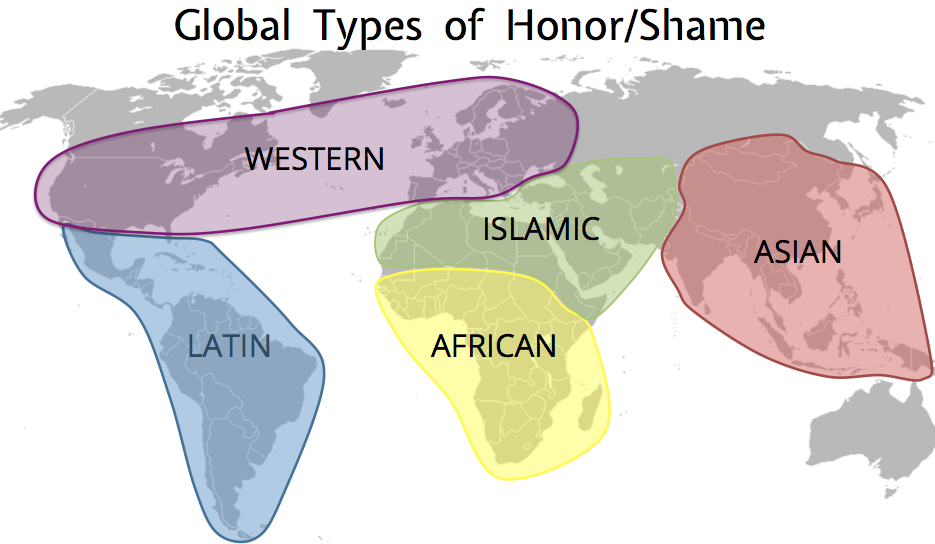
I came across this interesting graphic and explanation about the different kinds of shame cultures around the world. How does this resonate with what you have observed?
Global Types of Honor:Shame

Explanation of the 5 Regions of Honor-Shame

  1. Western shame tends to be more private and personal. It is an internal, psychological emotion often rooted in the fragmentation and alienation of modern life. Shame is not so much community scorn (though social media is bringing this aspect out more and more), but low self-esteem. Read more.
  2. Latin notions of honor, at least for men, often depend upon being macho. Honor-shame are uniquely linked to race and economic class in South American. Read more. Recall also that the countries of southern Europe are Latin-based, so share some similarities.
  3. Islamic culture highly esteems the Koran, Mohammed, the ummah, and even the Arabic language, as symbolic representations of honor. Muslims feel personally disrespected if any of these are disgraced. Middle Eastern cultures tend to compete aggressively for honor, so can feel justified using violence to defend their honor (i.e., honor killings, terrorism).
  4. African cultures give a high value to ancestry and have a strong community orientation. Properly honoring the living dead is a crucial part of African religion/culture.
  5. In Asian cultures, the notion of “face” is paramount. One can lose, keep, save, and gain “face.” People’s response to shameful situations tends to be more passive, because shaming someone else brings shame upon oneself, hence the extreme politeness.

Israel Prime Minister Benjamin Netanyahu said today that there is no greater supporter of the Jewish state than President Trump. Said Trump, “Absolutely, I love Florida. Fantastic Jewish state.”

Defense officials are reporting that a Russian spy ship has been spotted patrolling 30 miles off the coast of the United States. Said one U.S. official [shows photo of Trump], “Oh, that’s my Uber.”

Taco Bell has announced plans to offer a $600 wedding service at its flagship restaurant in Las Vegas. And this is cool — the burritos are conveniently wrapped in divorce papers.

Seth Meyer

Online-dating site OkCupid is adding a feature for polyamorous people. The new setting allows users who are listed as “seeing someone,” “married,” or “in an open relationship” on the platform to link their profiles and search for other people to join their relationship.

According to the company’s data, 24 percent of its users are “seriously interested” in group sex. Forty-two percent would consider dating someone already involved in an open or polyamorous relationship. Both numbers represent increases of 8 percentage points from five years ago. The number of people who say they are solely committed to monogamy, meanwhile, has fallen to a minority of all users, 44 percent, down from 56 percent in 2010.

The Church of England’s crucial vote on gay marriage has been thrown into doubt after the Bishop of Coventry admitted he accidentally voted against the report and several others may have made the same mistake.The Right Reverend Dr Christopher Cocksworth apologised for the mistake last night, which he said was because of “a moment of distraction and some confusion over the voting process”.

It has since emerged that some members have suggested that other clergy had made the same mistake.

The Grammys were incredible — you want to talk about bold performances, CeeLo Green came to the Grammys dressed head-to-toe in gold. He looks like he escaped from a secret room in Trump Tower.

Yesterday an official government tweet was posted for Black History Month, celebrating civil rights activist W.E.B. Du Bois. There were two problems with the tweet. One was Du Bois’ name was spelled wrong — and the other problem was the tweet was posted by the Department of Education. Now, I know Republicans don’t believe there should be a Department of Education but this seems like the wrong way to prove it.

But it gets worse: They tweeted an apology for their mistake. It says, “Our deepest apologizes.” Well, apologizes accepted.

I don’t know who at the Department of Education wrote this tweet, but whoever it is should have been held back a year. Or at least make them go back and repeat Black History Month.

James Corden

Liberty University is in the news again. And, again, it has nothing to do with Jesus. They are taking flak for speaker line-up for their men’s conference in March.

So the speakers include a man famous for acting as a clueless redneck, a race-car driver, an accused rapist (Roethlisberger) and the leader of a ministry being sued for covering up sexual abuse of boys (White). Okay, then.

There were demonstrations across the country today to protest the president’s immigration policy. Immigrants were encouraged to skip work today for what they called “a day without immigrants,” or as Steve Bannon calls it, “a good start.”

There were marches in Philadelphia and Austin, Washington. Here in L.A., with no immigrants — we have a lot of immigrants here in L.A. — people were forced to babysit their own children. Arnold Schwarzenegger had to impregnate a meter maid today. It was awful.

Jimmy Kimmel

Below are pictures of what is called the Aurland Lookout, in Norway. More pictures are here.

Wanna see a map of the hometown of every character in Homer’s Iliad? Of course you do. Click on the map for a larger view, or go here for an expandable version.

We just learned from multiple intelligence sources that Trump aides were, quote, “in constant touch with senior Russian officials during the campaign.” Constant Touch, by the way, is also Trump’s Secret Service code name.

Trump held a press conference today because in the middle of all this insanity, Israeli Prime Minister Benjamin Netanyahu visited the White House. As a courtesy, Trump asked his staff to put a 24-hour hold on retweeting neo-Nazis. That’s just good manners.

Stephen Colbert

Jazz pianist and vocalist Barbara Carroll died Sunday at age 92 after a career that spanned seven decades. She began recording in the late 1940s, when a female jazz musician was still considered quite a novelty, and continued to record until her latest CD, “Barbara Carroll Plays Birdland,” was released last December. We conclude our brunch with this video of Carrol at the Algonquin Hotel, May 25, 2008. With bassist Jay Leonhart, she performs her signature closing song, “Old Friends” by Stephen Sondheim.

Michael Spencer 101

Note from CM: It occurred to me that some of our newer readers and folks who are passing by might not know that this blog was the brain-child of Michael Spencer, who became known as “The Internet Monk.” As you’ll see below, the site is so named because of his affection for Thomas Merton of Gethsemani Abbey near Bardstown, KY. Michael built something special in this site, and that’s why we determined to carry it on when Michael died after a four-month struggle with cancer, April 5, 2010.

We try to return to the archives and pull out gems from his writings regularly. Today, I thought it might be beneficial for some to learn/recall some of his biography. Michael wrote this in 2009.

• • •

Every so often, it seems like a good idea to get the basic facts about your Internet Monk straight. I do this mainly for the sake of commenters and others who sometimes make factual errors. I’m often stunned at the weird things people believe and say about me, what I do and what is my real-life ministry.

My name is Dennis Michael Spencer. I go by Michael. I prefer not to be called Mike. I have gone by Dennis occasionally, such as in college.

I’m 52, born in 1956.

I’m the campus minister and Bible teacher for a large Christian school in southeastern Kentucky, I’ve been here for almost 17 years. Most of my students are not Christians. Many are internationals.

I preach 9-12x a month to approximately 300+ students and staff, sometimes in daily chapel and sometimes on Sundays. I teach 4 classes of Bible and one section of AP English IV every weekday. I teach English III in the summer.

Speaking publicly is easy for me, but it’s harder as I get older. It’s odd that I make my living talking, because for the first 14 years of my life I was a tremendous stutterer.

Before this job, I was a pastor for 4 years and a full time youth ministry specialist for 13 years. I worked for 5 SBC different churches in various staff positions and for one as a pastor.

I graduated from Kentucky Wesleyan College with majors in Philosophy and Psychology, and a minor in English.

I graduated from the Southern Baptist Theological Seminary with an M.Div. I did 34 hours of a D. Min, but didn’t finish the thesis or get the degree.

Denise and I have been married for 30 years. We have two children- a married daughter and a son who will be married in May ’09.

We have two cats and one dog. The dog is half Cairn terrier/half Scottish terrier. She’s called Maize.

I’m a member of a Southern Baptist Church. I worship each week (morning and evening) at the worship gatherings our school provides for our students. I’ve taught an adult Bible study for 16 years. Once a month I worship with St. Patrick’s Anglican Church in Lexington.

I’ve always lived in Kentucky. I’m originally from Owensboro, Kentucky and I graduated from public school there. I became a Christian at age 15 and was a member of a large fundamentalist SBC church where my uncle was a prominent pastor.

I was ordained into the Gospel ministry by my church in 1980.

I did a lot of youth ministry consulting back in the day. For 12 years, I was the preaching supply minister for a PCUSA church in Manchester, Ky. I really enjoyed that experience and miss it a lot.

I was awarded a pastoral sabbatical in the summer of ’08 by the Louisville Institute.

I’m not a Calvinist. I am a Reformation-appreciating Christian. I’m more about the solas than I am the TULIP. I have a great deal of respect for Calvinists and would be part of a “Founders” church if I had the option. I like the way they do church, worship and missions.

I sing pretty well. I play guitar better than average, but haven’t in a while. I’m passionate about baseball, particularly the Cincinnati Reds and the minor league Louisville Bats and Lexington Legends.

I think I’m a good communicator in words or in person, but I’m also deeply aware of my failures to communicate and all the sins that relate to my use/abuse of words.

I’m something of an amateur Shakespeare scholar. I know a lot about Kentucky monastic writer Thomas Merton.

Lord, I believe. Help my unbelief.

I’m always looking for an experience of Christian community that I’ll never find. I call that the “evangelical wilderness,” and call myself a “post-evangelical.” A “post-evangelical” wants to combine the best of evangelicalism with the broader, deeper, more ancient Christian tradition.

I have no idea what the future holds, but I plan to keep teaching, preaching and writing as long as I’m able.

Adam and the Genome 2: Chapter 1- Evolution as Scientific Theory

Adam and the Genome 2: Chapter 1- Evolution as Scientific Theory

We continue our review of the book, Adam and the Genome: Reading Scripture after Genetic Science, by Dennis Venema and Scot McKnight. Today, chapter 1.

Dennis begins this chapter by reminiscing about his childhood love of science.  He grew up in northern British Columbia (that’s in Canada for those of you from Rio Linda) and spent a lot of time outdoors with his father and brother.  He developed a great love and wonder for the natural world and a desire to know it better. While other kids wanted to be policeman and fireman, he wanted to be a scientist.  He notes:

“Real science, as I understood it from my private-Christian-school workbooks, matched up perfectly with what God said about creation in His Word.  “Darwin” and “evolution” were evil, of course—things that atheist scientists believed despite their overwhelming flaws, because those scientists had purposefully blinded their eyes to the truth.  I distinctly remember that even hearing those words said out loud felt like hearing someone curse, and not mildly.”

It is important to note this, because many feel that people believe in evolution because they have been “brainwashed” by secular liberals, whether raised by secular parents or from teachers in secular schools.  But Dennis’ “brainwashing” was the opposite typical of fundamentalist or conservative evangelical variety.  Since his parents couldn’t afford private Christian college he was off to the “secular” university with prayers from his pastor and congregation that he would not lose his faith in the process.  And it still wasn’t until after graduate school that he finally came to terms with evolution.  The process that began to persuade him was earning an honors degree and writing a research thesis. In his own words:

“It changed everything.  I was working on an open scientific question, one without a canned textbook answer.  To address the question, I needed to understand the principles of developmental cell biology, genetics, and how gene products work at the molecular level.  I was designing experiments to test hypotheses, and troubleshooting them to get them to work properly.  For the first time I was doing real science, and I was hooked.”

And this was the epiphany that many of us who are scientists have had: that science is a slow, step by step process of understanding the underlying principles that tie the facts together into a coherent whole.  In the common parlance a “theory” is just a guess or a speculation i.e. “I have a theory that aliens helped build the pyramids”.  But in science a theory is what facts grow up to be.  A theory is the explanatory framework for why the facts are the way they are.

So when the average uninformed Christian says, “Evolution is just a theory”, they mean that in the common parlance.  But in science evolution is a theory the way gravity is a theory.  No, we don’t know exactly how or why gravity operates the way it does, dimples in the space-time continuum and all that, but we know the theory explains how bodies of mass are attracted to each other.  Think evolution is just a theory, fine, think gravity is just a theory, step off a cliff and you’ll quickly (at 32 feet per second per second) find that the theory is not falsified.  Wait, don’t you mean—proved?  No, and this is the next very important point Dennis makes.

Scientific hypotheses (theories in infanthood) are never “proved” they are only “not falsified”.   They are not falsified until the next experiment is done, the next prediction is made, and the next discovery is uncovered.  If, based on your hypothesis, you predict A should happen, and then you find B happened, you must, if you are a good scientist, go back and modify your hypothesis to take B into account.  So then a hypothesis that is not falsified after many, many predictions and tests eventually grows up to be “a broad explanatory framework  that has withstood repeated experimentation and that makes accurate predictions about the natural world: in other words, a theory (page 4)”. 

So a scientist never “believes” in evolution, they simply accept it provisionally, as the best current explanation for the facts at hand.  This is where many apologists for evolution go off the rails, as I’ve seen time after time, in discussions.  The theory of evolution has abundant proof for over 150 years, they’ll say.  Their interlocutor will come back and say, give me one shining example of absolute proof of evolution. And the evo-apologist will flail around with “homo Naledi” or “Lucy” or archaeopteryx.  Then the interlocutor will scorn, that’s your PROOF; Lucy was an ape, archaeopteryx was a bird, you’ve proven NOTHING.  And you know what, they are right, you haven’t PROVEN anything.  You, and they for that matter, have failed to reject the hypothesis.  That is all.  But it is enough.  Because time after time, bone after bone, fossil after fossil, gene after gene the hypothesis has failed to be rejected.  So there is no knock-down, slam-dunk evidence for evolution there is only the slow, cumulative, failure to reject the hypothesis.

Another problem that it seems has recently gone from bad to worse is the reporting of science in the media.  The media loves to spout the headline of “overturn previous theories” or “changes everything we though we knew”, but, as Dennis points out, this is so often misleading.  Of course, these headlines are often about dietary science, which has become, let’s be frank, a racket.  Dietary research is naturally interesting to everyone since we all want to lose weight and stay healthy, but is very difficult to do right, and very easy to exploit.  The very term “snake oil salesman” refers to the peddling of a dietary supplement.

Dennis then recounts the infamous story of Johannes Bohannon, PhD and the study published in the spring of 2015 about how eating chocolate would help you lose weight.  The story caught fire and spread around the world but the real experiment was to see if a weak study with obvious flaws could be published and grab media attention.  The lead author of the study revealed after the fact:

“I am Johannes Bohannon, Ph.D. Well, actually my name is John, and I’m a journalist. I do have a Ph.D., but it’s in the molecular biology of bacteria, not humans. The Institute of Diet and Health? That’s nothing more than a website. 

Other than those fibs, the study was 100 percent authentic. My colleagues and I recruited actual human subjects in Germany. We ran an actual clinical trial, with subjects randomly assigned to different diet regimes. And the statistically significant benefits of chocolate that we reported are based on the actual data. It was, in fact, a fairly typical study for the field of diet research. Which is to say: It was terrible science. The results are meaningless, and the health claims that the media blasted out to millions of people around the world are utterly unfounded.” 

“I Fooled Millions into Thinking Chocolate Helps Weight Loss”

So it’s no wonder that the public gets confused about real science and fake science.  The media does the public a great disservice by this type of reporting, but let’s be honest: “Overturns all previous theories” is going to sell better than: “Incremental advancement to a large body of prior knowledge”, as Dennis points out.

Dennis then covers the “two books” understanding; the view that nature and Scripture are each books authored by God.  All truth is God’s truth.  It’s His creation, His universe; therefore whatever we discover to be true must, by foundational presupposition, be His truth.  God is revealed in his creation.  Psalm 19:1 declares: “The heavens declare the glory of God; and the firmament sheweth his handiwork.”  Romans 1:20 tells us: “For the invisible things of him from the creation of the world are clearly seen, being understood by the things that are made, even his eternal power and Godhead…”  This is often called “General Revelation.”  God is revealed to us in the Bible, His Special Revelation.  John 5:39 says: “Search the scriptures; for in them ye think ye have eternal life: and they are they which testify of me.”  Therefore, between God’s General Revelation (nature) and His Special Revelation (the Bible) there must be perfect harmony.

The study of God’s general revelation is what we call science.  The study of God’s special revelation is what we call theology.  But because of epistemological and hermeneutical limitations we have neither perfect understanding of nature nor perfect understanding of the Bible.  Hence conflict is not only to be expected, it is inevitable.

Dennis then recounts the Galileo/Copernicus geocentric vs. heliocentric controversy.  The basic issues that were on the table for them are the same as they are now; the truth of the new science versus it’s perceived threat to the authority of the Bible.  He gives a long quote by Jonathon Edwards who held that when science and scripture are in tension, the science must give way to the Bible because it is the “higher authority”.  But then Edwards gives a scientific argument that since we can feel earthquakes we ought to be able to “feel” if the earth is moving around the sun.  Edwards quote:

“Nay, truly, if the earth were hurl’d about in a Circle (as these persons assert) we should feel it to our sorrows, for we should not be able to keep our ground, but must necessarily be thrown off, and all Houses and other Buildings would be thrown down, being forcibly shake off from the Circumference of the Earth, as things that are laid on a Wheel are flung off by it when it turns around.”

And one of the key predictions of heliocentrism is stellar parallax.  If the earth circles the sun once a year then as its position in space shifts, we should observe shifts in how the stars are positioned relative to one another.

As Edwards was aware, the hypothesis made a prediction, the prediction could not be verified, the hypothesis was therefore falsified.  Except… in the 1600’s what was unknown was just how far the stars were from the earth.

Then in 1838 Friedrich Bessel made the first successful parallax measurement ever, for the star 61 Cygni, using a Fraunhofer heliometer at Königsberg Observatory.

Now, scientists failed to reject the hypothesis and heliocentrism was held to be the best explanation of the facts.  As Dennis says:

“In the 1600’s, pretty much all Christians were geocentrists, with only rare exceptions.  From the 1900’s through to the present day, the situation is reversed (yes, there are still Christian geocentrists out there, though they are extremely few in number).  The shift, then, was a gradual one, with plenty of opportunity for gradual theological change within the church along the way.  And what of Edward’s strong assertion that if heliocentrism is true, then Scripture is false?  Well, it seems that few believers see it that way today.”

Dennis then deals with tetrapod (four footed) evolution.  If one goes back in the fossil record there was a time when no tetrapods existed, only abundant fish.  Evolutionary biology predicts, counterintuitively, that tetrapods are descendants of fish.  Fish are aquatic, have gills, and lack limbs.  Tetrapods breathe air, have limbs, and are generally terrestrial.

They couldn’t be more different.

Yet there are lines of evidence that seem to force the biologist’s hand.  All tetrapods, like fish, are vertebrates (have a backbone).  There are no invertebrate tetrapods.  When amphibians first appear in the fossil record they bear resemblance to the lobe-finned lungfish (that persist to this day).  Lungfish have both gills and an air sac to breathe with and they have fleshy limbs and bones within their fins.  As we move forward in the fossil record the animals we find appear more amphibian like and less fish like.

Have we proved that fish evolved into amphibians?  No, but we have failed to reject the hypothesis that early amphibians share a common ancestor with lungfish.

Dennis then uses as his second example, another counterintuitive prediction that some tetrapods, after having adapted to a terrestrial environment, nonetheless returned to the sea i.e. whale evolution.

Did critics find this ridiculous?  Of course they did.  Consider this quote from Robert B. Seeley:

“Thus Mr. Darwin, while he finds it impossible to believe the plain words of Moses that on the fifth day, “God created whales”—“sees no difficulty” in believing that a race of bears, by contracting the habit of swimming, gradually lost their legs, and were “developed” into whales of a hundred times their own bulk!  And this sort of trash is called “science”! … Let us look, for a moment, at this whale, or bear, or bear-whale.  What says Geological Science to it?  Geology replies that she finds bears in the crust of the earth, and many of them; and that she also finds whales.  But that the whale-bear, or creature which was developing from a bear into a whale, she never met with.  And, not finding it, she no more believes in it than in a phoenix or roc.  In a word, Geology, which is really a science, declares Mr. Darwin’s bear-whale to be a rank imposter.”

And this charge is still made today by creationists: there are no transitional fossils.  But one characteristic of the modern cetacean skull is a distinctive thickened portion covering the middle ear, a structure known as the involucrum.  This characteristic feature, thought only to occur in cetaceans, was found in a small hoofed mammal, Indohyus, an extinct species that lived in India 48 million years ago.  Indohyus belongs to a group of mammals know as artiodactyls or “even-toed” hoofed mammals, of which species like deer, cows, and hippos are modern day examples.  Curiously, Indohyus had features consistent with semi-aquatic lifestyle, like thicker bones for ballast like hippos. Another feature of artiodactyls is a particular ankle bone, the astragalus.  A second group of artiodactyls from the same region, the Pakicetids have the astragalus and the involucrum and heavy thick bones.  Relatives of the Pakicetids, the Ambulocetids, also come from this region, except these artiodactyls were semi-aquatic marine predators. They probably would have looked like giant otters.

Later in the fossil record we find Protocetids that have skeletal features indicative of a more fully aquatic lifestyle.  The nostrils in Protocetids are not at the tip of the snout but are shifted back along the skull, and the hind limbs appear not to be able to bear the full weight of the mammal, much like a modern sea lion. And so on.   Do we know for certainty that these creatures are ancestors of whales?  No, it all could be a series of remarkable coincidences.  But again, given this fossil evidence, we have again failed to reject the hypothesis that whales, dolphins, and porpoises descend from terrestrial tetrapod ancestors.  Dennis ends this chapter with:

“It’s common for people, upon seeing such evidence for the first time, to begin to reflect on the immense probability of such large changes taking place repeatedly within a lineage.  How could a mutation so large occur to change one animal from one form to another without killing it?  How would such an animal breed with anything, unless these rare, massive mutations just happened to occur with a male and female in the same generation?  Isn’t this all wildly improbable?

Well, yes, such a process would be wildly improbable—so improbable, in fact, that no scientist thinks it could ever happen.  This does not pose a problem for evolution, however, because this is not how evolution works.  How it does, in fact, work is the topic we will turn to next.”

The Myth of the Decline Narrative

Wrigley Building, Chicago July 2016

Sometimes I wonder what people are seeing. I also wonder why they are so ignorant of history.

Various groups rely upon a tried-and-true method to make their case and gain adherents and power. It’s called playing the “decline narrative” card.

The decline narrative follows a simple formula:

  • First, things used to be so much better. There was a “good old days” in which the world was better off.
  • Second, we’ve been on a downhill slide ever since those halcyon days.
  • Third, certain people/groups came along and introduced things contrary to what those good old days were about. The world has never been the same, things are getting worse and worse, and those people/groups are at fault.
  • Fourth, we are now at a moment of crisis. Unless we do something to “take back” what was ours and recapture the glory of days past from those who have stolen it from us, it will be the end of the world.

The decline narrative is essentially the “soterian gospel” of revivalism writ large. It’s Eden and exile, “the world” and Armageddon and the one true way out. It seems to be the way many Americans are programmed to think.

This decline seems particularly incongruous to me here in 2017, although it has been embraced by a large number of people and has, at times, yielded dramatic results. Just ask the current resident at 1600 Pennsylvania Avenue.

In contrast to this decline narrative, I was planning to write a post showing how, over the course of my lifetime, there have been so many crazy, dangerous, and disturbing events and swings that we can not, in any way, honestly speak of a decline narrative. However, as I began to write, I realized I could not even get past my first year of life — 1956.

In many minds, “1956” sounds like it would fall smack within the boundaries of “the good old days.” And it was indeed, perhaps the pinnacle of the “classic 1950’s” in WASP culture, with soaring birth rates, economic good times, a focus on normalcy and family, and a religious boom. However, when I read about the events that took place in 1956, I realize, in many ways, that time was every bit as fraught with danger and dysfunction as our own time. Indeed, if I had to set forth a theory of progress/decline, I would have to say that we have made a great deal of real, substantial progress in our lives, our culture, and our world since 1956.

In 1956, the year I was born, there was continuous conflict in the Middle East. Egypt pledged to recapture Palestine. The UN censured Israel for attacking Syria, violating the Palestine Armistice. There were dangerous tensions over the Suez Canal throughout the year, first occupied by the British, then taken over by Egypt. Later in the year, during the so-called Suez Canal Crisis, Israel launched an invasion of Egypt’s Sinai Peninsula, and later, Great Britain and France sent troops once again in an attempt to take over. Egyptian airfields were bombed. The conflict ended when the U.N. sent in its first-ever peacekeepers. Gaza was occupied by the Israeli army. The Israeli flag was hoisted on Mt. Sinai.

In 1956 the first Islamic republic, Pakistan, was born. The French invaded Algeria. Ongoing anti-colonial movements from Britain and France caused persistent tensions throughout Africa. In South Africa the government ordered over 100,000 non-whites to leave their homes in Johannesburg in order to make room for whites. Later, Nelson Mandela and more than 150 others were arrested in South Africa for treason in opposing apartheid.

In South America, seven Army trucks loaded with dynamite exploded in middle of Cali, Columbia killing more than a thousand and destroying 2,000 buildings

The fight for civil rights by blacks in the U.S. was getting more contentious. Someone exploded a stick of dynamite on Martin Luther King’s front porch. The first black student admitted to University of Alabama was expelled In Montgomery, where there were tumultuous bus boycotts in 1956. The Supreme Court affirmed Brown vs. Board of Education. The Court also ended busing segregation. The United Methodist Church outlawed race segregation. Mobs in Texas prevented black high school students from enrolling, and in Tennessee the National Guard was called out to prevent similar conflicts. Various cities desegregated their schools. Singer Nat King Cole was attacked at a Birmingham concert. There were bus boycotts in Florida. W.A. Criswell, the leading preacher in the Southern Baptist Convention, addressed an evangelism conference and proclaimed that true ministers of the gospel must passionately resist government mandated desegregation because it is “a denial of all that we believe in.”

The Cold War between the U.S. and the U.S.S.R. was escalating. While the U.S. was conducting nuclear and hydrogen bomb tests in the South Pacific, the Kremlin announced that they were developing a ballistic missile to deliver an H-bomb. The U.S. government seized and shut down a U.S. Communist newspaper, The Daily Worker. There was a failed coup in Cuba, but later in the year Fidel Castro left Mexico in his quest to liberate the country. The Soviets invaded Hungary and violently put down an uprising; 200,000 refugees fled.

As the French withdrew, the first American soldier died in Viet Nam. Cambodia elected a Communist president and the U.S.S.R. officially recognized Laos.

There were terrible transportation accidents, including a train crash in Los Angeles that killed 30, one in which two passenger jets collided over the Grand Canyon, killing 128, and the sinking of the ocean liner Andrea Doria.

Americans were blocked by a travel ban from going to China. Sixteen U.S. Naval airmen were shot down and killed by Chinese jet fighters over the East China Sea as they engaged in an espionage mission.

The U.S. economy was strong in 1956. Main concerns involved declining farm income and an alarming shortage of public schools and classrooms for the rapidly increasing population, which both the federal and state governments worked to address. That year saw the beginning of the largest public works program in U.S. history to that point: the construction of the interstate highway system. It was not all smooth sailing, for example in the summer 650,000 steel workers went on strike during a month-long work action.

President Eisenhower was re-elected as POTUS by a landslide. To many, he was the face of peace and prosperity. However, increasingly volatile issues such as civil rights were largely ignored in the presidential campaign.

The Melbourne Olympics took place despite boycotts and withdrawals by many nations, protesting the Soviet invasion of Hungary, the Suez crisis, and the inclusion of Taiwan in the Games.

In religion, Catholic-Protestant relations were strained by bitter altercations on issues such as parochial schools and public funding, and birth control.

On the cultural front in the U.S., Elvis Presley had a break-out year, with his first recording session for RCA, three appearances on the Ed Sullivan Show, during which he was filmed from the waist up because of moral concerns. On Sunday, December 2, 1956, The Rev. Carl Elgena told his Des Moines, Iowa, congregation that “Elvis Presley is morally insane” and “by his actions he’s leading other young people to the same end.” He warned the over 800 members in the pews of the Grand View Park Baptist Church that “the belief of unholy pleasure has sent the morals of our nation down to rock bottom and the crowning addition to this day’s corruption is Elvis Presleyism.” Other preachers condemned rock-n-roll music as “a musical fad which is leading its young devotees back to the jungle and animalism.” “Beatniks” such as Allen Ginsberg and Jack Kerouac were advocating freedom and hedonism, sexual freedom and homo/bisexuality. The Catholic Church banned its people from viewing films they considered immoral, such as And God Created Woman and Baby Doll.

In November 1956, Dr. Martin Luther King delivered a sermon called, “Paul’s Letter to American Christians.” Way back then, he questioned whether America was truly making progress or declining.

But America, as I look at you from afar, I wonder whether your moral and spiritual progress has been commensurate with your scientific progress. It seems to me that your moral progress lags behind your scientific progress. Your poet Thoreau used to talk about “improved means to an unimproved end.” How often this is true. You have allowed the material means by which you live to outdistance the spiritual ends for which you live. You have allowed your mentality to outrun your morality. You have allowed your civilization to outdistance your culture. Through your scientific genius you have made of the world a neighborhood, but through your moral and spiritual genius you have failed to make of it a brotherhood. So America, I would urge you to keep your moral advances abreast with your scientific advances.

Concerns about the vulnerability of the U.S. and the Soviet threat in 1956 were so acute that Congress adopted “In God We Trust” as the official motto for the nation. Representative Charles Edward Bennett of Florida cited the Cold War when he introduced the bill in the House, saying “In these days when imperialistic and materialistic communism seeks to attack and destroy freedom, we should continually look for ways to strengthen the foundations of our freedom.”

It was a dangerous, volatile world. Some things were better, some worse. Many folks were satisfied with life as it was, others were raising alarms.

The more things change…

For Valentine’s Day: The Coffee Cups

Coffee Love. Photo by Brendan Rankin

The night was long, his sleep restless. Two or three times he reached across the bed to feel her warmth. He reached and reached.

Once, her absence bothered him so much he got up, put on his robe and walked downstairs. He sat in his chair and listened to himself breathe. An occasional car drove by the house, sending a wave of light across the ceiling. The air was chill. He looked down at his wrinkled hands, blue in the midnight, and saw his wedding ring. Too tired to cry, he sighed, stood up and trudged to the kitchen.

He grabbed a small glass from a cupboard above the sink and filled it with water. Taking a small sip, he stared out the window on the clear, bright, windless night. Dew shimmered on the grassy lawn where the tree shadows did not reach. He alone saw it while the world slept. The night. The shadows. The glistening grass.

Not that he didn’t try to see more. But try as he might, he could not envision her face. Gone so soon? After fifty-five years of seeing each other every day! Every morning, he would arise and go to this very kitchen. He would fix the coffee, turn on the machine, and set out two coffee cups on the counter, one for him and one for her. After retrieving the newspaper, he would go to his chair and read it while the coffee brewed.

Soon, her soft footsteps would sound on the stairs, and he would look up to greet her, precede her into the kitchen, pour out two cups — black — and they would sit at the table together to start the day. As rituals go, it wasn’t complicated or profound. Still, he was glad they began most mornings face to face.

How was it then, that he could not picture her pretty face now? Less than a week after laying her in the ground? Pictures of her were everywhere throughout the house, but he couldn’t see them, couldn’t see into them. He picked them up often and held them in his hands. He leafed through the photo albums of their trips. He traced their life together through them: from the time she was a schoolgirl, to that sexy young mother standing in the yard with a baby on her hip; she who had been the life of so many parties, his dance partner, lover, Valentine, “mom” on all the Christmases and birthdays and vacations and outings through the years, until the day she became “grandma” and her hair turned white and she was the petite one with sparkling eyes, like dew in the moonlight, in the front row of the large family portrait. He gazed often and hard at this evidence, yet couldn’t make sense of it. His vision blurred, his mind fogged, his chest heaved.

Who knows how long he stood there in the night? Out the window, the shadows had shifted, and a wave of weariness crashed over him. He set the glass in the sink and made his way back upstairs. He crawled into bed, pulled the warm, heavy covers up to his chin, and slept for the few hours of darkness that remained.

He awoke as usual, swung his legs over the edge of the bed, put on his slippers, picked his robe off the chair, and tied the belt around his waist. He made his way to the bathroom and performed his morning toilet. He ran warm water over his glasses and rubbed them with soapy fingers, washing away the dust and smears. Drying them, he placed them on his nose and looked at the old man in the mirror. He had made it another day.

The morning shone brightly through the living room windows as he went downstairs. Going into the kitchen, he slid open a drawer and separated a new coffee filter from its box. He went to the freezer and retrieved the bag of coffee beans, dumped some into the grinder and then ground them up fine. Measuring out just the right amount, he scooped the fragrant coffee into the filter and placed it carefully in the basket of the pot. He poured the water into the reservoir and closed the top. Reaching up, he grabbed two coffee cups off the shelf and placed them on the counter.

Then he went to retrieve the morning paper.

• • •

Photo by Brendan Rankin at Flickr. Creative Commons License

Daniel Jepsen: Loving God According to our Personality

Chillin’ Bear 2014

Loving God According to our Personality
By Daniel Jepsen

I struggled with this title; the term personality is more elastic than a spandex jumpsuit, and the phrase loving God is not much more definitive.  But my main point is this: We rightly express our devotion to God differently than other people because of the unique ways we have been shaped by God.  

Anyone who has wandered through a forest or spent time snorkeling at a reef begins to realize how much God loves variety.  Even flowers and trees of the same species are different from each other, and every snowflake has its own unique shape.  If this is true of God’s expression of Himself in creation, will not it also be true of His New Creation, of which we are a part?

When all things are fulfilled, I believe the differences of our personalities, unencumbered by social conformity and our desire to fit in, will be more pronounced than now, not less. We will not be drops of water lost in the ocean of God.  We will be unique masterpieces reflecting His work.

Even now we should embrace our differences. What great artist designs only cookie-cutter shapes?  How then can we not see our uniqueness as the special creation of God?  How can we not see how the uniqueness of the other person’s walk with God is something beautiful and valuable?  Let us cease trying to make others in our image; His image is quite sufficient, and has enough hues and facets to embrace all His children.

In particular, we should embrace and celebrate the different ways Christians express their devotion to God, according to their temperament, personality and history.  Allow me to express how I see some common patterns (though their combinations and particular expressions will be almost infinite):

  • Colorful Parrot 2014

    Intellectuals love God by forming their mind according to truth. They have an inner drive to know more about God and His world, and abhor shallow or misleading teaching.  Books, magazines, and lectures are the tools God uses to shape the intellectual. For the intellectual all truth is God’s truth, and in learning of His Word and His world they are drawn towards Him.

  • Activists love God by working for righteousness and societal justice.  They are impatient with a faith that does not express itself in transforming the world around them, and feel closest to God when fighting His battles.  Their deepest desire is to see “Your will be done on earth, even as it is already done in heaven”.
  • Servants love God by loving those made in God’s image.  Like the activist, the servant cannot imagine a God-devotion divorced from action; unlike the activist, this action will more likely be in personally serving those in need. They long to be the hands and feet of Christ to the suffering and needy.
  • Mystics love God through an inner ardor that others may not understand. In fact, the mystic may not understand the waxing and waning of their passion, just as a married couple may not always understand the same waxing and waning of their romance.  But the mystic desire to love God in a way similar to a romantic love (indeed, for a mystic, human romantic love is a foretaste and symbol of the divine romance).  Nothing brings the mystic more pleasure than to sit in utter silence for hours before God, contemplating the beauty of God, and praying words of adoration and surrender.
  • Enthusiasts find their love for God best expressed in exciting or intense corporate worship. He or she feeds off the enthusiasm of other believers and revels in God’s mystery and supernatural power. This, in turn, often ushers in surrender and submission to God. New and creative expressions of worship are prized by the enthusiast.
  • Naturalists worship God through nature. The beauty and majesty of creation speak to them of the beauty and majesty of the Creator, and they often feel closest to God while simple contemplating a mountain lake or a magnificent sunset. For the naturalist, the physical creation is indeed a revelation of God, and they fully understand Wordworth’s admonition, “let nature be your teacher”.
  • Talking Giraffe 2014

    Traditionalists eschew the new for the familiar; they find great meaning and spiritual beauty in the patterns of the past.  Reciting a creed used for 1500 years, singing a hymn used by God’s people for centuries: these connect the traditionalist to the stream of Church history, and make them feel united to something greater than themselves or their own time and place. For this person, submitting to such tradition is an act of godly humility. A traditionalist is not always High-Church; A Baptist or Church of Christ adherent can find their own traditions as meaningful as an Anglican’s, even if of more recent vintage.

  • Sensates worship God through their senses and take seriously the sentiment that “beauty is truth, and truth is beauty”.   For this person, art and music are the portals to heaven, the way that God shines in a dark world.  They find the architecture and appointments of their house of worship greatly affect their worship to God, and nothing brings them greater spiritual fulfillment than to embrace, or even create, beauty. A sensate who also values tradition will be very devoted to liturgy.

Not for a minute would I suggest this list is exhaustive or definitive.  Nor do I think most people fit neatly into only one temperament.  My point is that in 2000 years of Christian tradition, a number of equally valid ways of loving God and following Christ have become evident. At best, these streams of tradition will balance and correct each other, for each has its own strengths and weaknesses.  At the very least, let us embrace the fact that not every Christian has to look and think like we do, and not every church worship God in the same way.  God is always bigger than our church, and bigger than our understanding of what it means to love Him.

For Christ plays in ten thousand places
Lovely in form, and lovely in eyes not his

(Gerard Manley Hopkins)

Where would you place yourself? Or would you come up with different categories?

Pic & Cantata of the Week: Epiphany VI (Septuagesima)

Waterfall – Maine Botanical Gardens 2014

(Click on picture to see larger image)

• • •

EPIPHANY VI (Septuagesima Sunday)

Bach Cantata BWV 84, “I am content with my fortune”

Septuagesima Sunday is an observance that was dropped from the calendar which was revised following Vatican II, but the name is still in use in the traditional calendars. Septuagesima is the name given to the third from the last Sunday before Lent in the Catholic and Anglican churches, and the Lutheran Church Year continues using the name. The term is used to mark the first Sunday in the the period known as the “Pre-Lenten” season or Shrovetide, which lasts until Ash Wednesday. The next two Sundays are called Sexagesima and Quinquagesima, the latter sometimes also called Shrove Sunday.

Bach wrote three cantatas for this Sunday: BWV 144, 92, and 84.

The latter is a good example of a simple yet robust cantata by Bach. As Simon Crouch observes: “One of Bach’s supreme gifts was to make so much out of what seems so little. Here is a good example. The cantata for solo soprano, BWV 84 has the very straightforward structure of aria, recitative, aria, recitative, chorale. None of the movements has a complicated orchestration or musical structure and the total duration is typically under fifteen minutes. The effect, however, is delightful.”

This cantata uses an anonymous text based on a poem by Picander in its first four movements and a chorale by Amilie Juliane von Schwarsburg-Rudolstadt from as its final movement. The theme is the blessedness of resting in God’s goodness and being content with God’s gifts. The simplicity and delightfulness of this cantata provides us a good opportunity to post a recording of the entire work today. Enjoy this lovely recording by the Collegium Vocale, directed by Philippe Herreweghe.

I am content with the fortune
that my dear God bestows on me.
If I am not to have the comfort of riches,
then I thank Him for little gifts
and am also not worthy of these.

God indeed owes me nothing,
and if He gives me something,
then He shows me that He loves me;
I can earn nothing for myself from Him,
for whatever I do is my duty.
Yes! Even though my deeds seem good,
yet I have really set nothing right at all.
But a person is so impatient
that he is often troubled
when dear God doesn’t give to him in abundance.
Hasn’t He, for a long time now,
nevertheless fed and clothed us
and in the future will blessedly
raise us to His glory?
It is enough for me,
that I needn’t go hungry to bed.

I eat my little bit of bread with joy
and heartily leave to my neighbor his own.
A peaceful conscience, a happy spirit,
a thankful heart, that gives praise and thanks,
increases its blessing, sweetens its need.

In the sweat of my brow
I will meanwhile enjoy my bread,
and when my life’s course,
the evening of my life, is concluded,
then God will hand out the pennies to me,
then heaven will stand open.
O! If I have this gift
as my gracious reward,
then I need nothing else.

Meanwhile I live contented in You
and die without any trouble,
I am satisfied with what God plans,
I believe and am completely certain:
through Your grace and Christ’s blood
you will make my end a good one.

Saturday Brunch, February 11, 2017

Hello, friends, and welcome to the weekend. Ready for some brunch? Let’s start with some lighter fare.

First, some sporting news. Congratulations to the New England Patriots for another [yawn] Super Bowl win. After the game the Patriots [yawn] were congratulated by Donald Trump. And the Falcons got a card from Hillary saying, “Welcome to my world, fellas.”

Of course, the Falcons were ahead by 25 points in the third quarter. Then their defense left with Mark Wahlberg, and the Brady Bunch came storming back. I don’t think Atlanta has been that burned since 1864.

Hey, did you know that Pope Francis sent a personalized video message in Spanish, addressing the players? The message was played on the jumbotrons in the stadium, with over 70,000 people watching.

In the video, Pope Francis said sporting events like the Super Bowl are “symbolic of peace” because it can show that it’s possible to build a “world of encounter and of peace.” He added that participation in sports teaches people to go beyond their own self-interests besides sacrifice and fidelity to rules. The Pope then invoked his blessing upon the match saying he hoped it would be a sign of peace, friendship and solidarity for the world.

Tom Brady had some fine passes in the game, but nothing like this football pass for 564,664 yards:

As you may have remembered (unless you are a man) this Tuesday is Valentine’s Day. So for our male readers, we are here to help out. Because we know you haven’t bought a present for your special someone yet, have you? So, just in time for two-day shipping, here are some actual gifts you can buy for your girl on Amazon:

  • A Quart of Wolf Urine. Because sometimes the quality of the wolf urine at Walmart is just not up to her standards, and milking the wolves yourself is too much of a hassle.
  • Uranium Ore. Men, do you want you wife to have to buy her Uranium from a van-full of sketchy Libyans in the mall parking lot? Do ya? I didn’t think so!
  • Birth Control is Sinful in the Christian Marriages and also Robbing God of Priesthood Children!! Mixing profound theology with creative grammar, this book  will remind her of her purpose in your marriage (“Keep those Priesthood Children coming!”)
  • Mr. Sniffles Egg Seperator. Just trust me on this one: she will love it!
  • A Duck Press. Are you tired of seeing her getting delicious duck juice all over the trash compactor? Now you can buy her, for a mere $2,100, a dedicated duck press. The reviews on the product mention that one should only use it on dead ducks (good to know).
  • Farting Fanny Piggy Bank. Women just love flatulence humor. And now you can get her to save money, too. Every time she drops a coin in the slot she will be rewarded!
  • Land Cruiser/Tank. Just imagine how much more effective her Black Friday shopping will be with this baby!

All right, enough of this nonsense.

After over 60 years, a new Dead Sea Scroll Cave has been discovered. This would be the 12th. Although the cave has been looted at some point, and any scrolls removed, it is still a very important find. Some manuscript scraps were found, along with six jars identical to the jars found in several of the other Qumran caves. These ceramic jars were designed to contain scrolls. There is speculation that they have also found a 13th cave, which is still sealed (and thus unlooted) which may contain scrolls.

Over 100 evangelical leaders have signed onto a letter published in a full-page ad in Wednesday’s edition of The Washington Post that signals their opposition to President Donald Trump’s moratorium on refugee resettlement. Signers included Max Lucado, Tim Keller, and Ed Stetzer

“As Christian pastors and leaders, we are deeply concerned by the recently announced moratorium on refugee resettlement. Our care for the oppressed and suffering is rooted in the call of Jesus to ‘love our neighbor as we love ourselves,'” the evangelical leaders wrote in an open letter to Trump and Vice President Mike Pence that was published on Page A18. “In the story of the Good Samaritan (Luke 10:25-37), Jesus makes it clear that our ‘neighbor’ includes the stranger and anyone fleeing persecution and violence, regardless of their faith or country.”

And then there’s this: Lifeway Christian Store will no longer sell a music CD because it includes the word “penis”.  Here is the offending lyric from rapper Sho Baraka:

I was an insecure boy who just thought he was a genius
But always pissed off, that’s because I thought with my penis
It’s all strategic, I’m just asking us the reason
Share my faith on the track, I’m just exorcising demons.

Now, to be fair, it is very difficult to rhyme with “genius”.  And Baraka says that the retailer has a double standard. Other books sold on their shelves use anatomical references. For instance, “Sheet Music,” a sex manual intended for Christian couples, contains 45 uses of the word “penis,” along with euphemisms like “Mr. Happy.”

Heterodox Academy is a coalition of 400 professors who desire to promote thought diversity and free speech. They just finished a long study on “speaker dis-invitation”, that is, where a campus speaker is not allowed to give the speech they had been invited for. This mainly occurs for political reasons, of course. Students or faculty find the speakers viewpoints disqualify them from presenting. But what is interesting is where the dis-invitations are coming from. The study noted that

…”from 2000 to 2009, speaker disinvitation attempts from the left of the speaker and from the right of the speaker were roughly equal.”

“Yet, from 2010 onward there is a noticeable increase in disinvitations attempts from the left of the speaker, relative to disinvitation attempts from the right of the speaker.”

“When disinvitation attempts are unsuccessful, moderate and substantial event disruptions are almost exclusively from the left of the speaker.”

Surprised?

Who says the New York Times doesn’t get or care about religion? Well, researching for this column, I went to their “Religion and Belief” archives, and found a whopping one whole article for the month of February, and that article really wasn’t about religion at all (it chronicled Steve Bannon’s respect for an  Italian political philosopher).  Apparently “all the news that’s fit to print” does not include something so obscure and rare as religious practice.

Wanna see an 8K time-lapse of the seasons in Norway? Trust me, you do.

Wednesday was National Kite Flying Day. Yes, that’s right, February 8 is the day we are encouraged to got out and fly a kite. Isn’t this like having National Snowball Fight Day on July 20th? Trump keeps talking about fixing America, right? START HERE, Donald!

Robert F, take note. The Enterprise-Tocsin, a weekly newspaper based in Indianola, Miss., has been turning some of its police reports into haiku. Why? There is no “why” in Haiku, silly. Here are some examples; others can be found on their twitter feed.

Driving one-twenty
In wrong lane, running from cops
Will this end safely?

Ice machine open
Many quarters disappear
Cold drinks ill-gotten.

Domestic dispute
Quickly escalates Sunday
Raw meat strewn on floor.

Sosnovka, a small village in Siberia, had no church. Resident Alexander Batyokhtin fixed that. At least until spring. Alexnder spent nearly two months building a village church entirely out of snow. He worked on the chapel every day, even when temperatures plunged below minus 22 degrees Fahrenheit, and used 424 cubic feet of snow to make it. The video takes less than a minute:

You REALLY don’t want to view these pictures of Spring fashion trends for men. Just . . . don’t.

87 Million for “Wrongful Births”? The Sunday Times reports the National Health Service paid that amount to more than 16 families in the past five years after a High Court judge ruled that doctors had been negligent in their cases.

Most of the cases involved problems with antenatal screening and doctors’ failure to detect abnormalities or inform parents about the risks of their baby having a disability. All of the cases said they would have had abortions if they had known about their child’s disabilities before birth. The claims included children with Down syndrome, microcephaly and a wide range of other conditions, according to the reports.

The Christian Institute reports more about one of the cases:

The mother had undergone ten ultrasounds during the course of her pregnancy, but two doctors were found to have failed to carry out their duties correctly in two of them.

The couple’s daughter is now eight years old and has microcephaly, which affects the size of her head.

Her mother would have aborted her if she was aware of the condition, but says she loves her deeply now.

“But…but… Jesus wants me to be wealthy…” A unemployed Lakeland, Florida, man faces a five-year prison sentence and a fine of up to $250,000 after making a $7 billion fraudulent wire transfer because Jesus Christ chose him to be wealthy, according to court documents.  The defendent, John Haskew, argued that Jesus Christ created wealth for everyone. Using this scheme, Haskew believed that he could obtain the wealth “that Jesus Christ created for him and that belonged to him.” . The article notes that Haskew’s excuse earned him several eye rolls from law enforcement authorities, who apparently had never heard of Creflo Dollar.

I found out this week I have a disease. Or sin. Or social condition. I’m not really sure how it’s supposed to be classified. And you may have it also. It’s called, “Amatonormativity”. It’s symptom? The person with Amatonormativity feels that romantic relationships should primarily be between only two people at a time. Or, as Carrie Jenkins helpfully explains in The Week:

Amatonormativity is a name for the attitude that privileges lives based around a focal monogamous romantic relationship. What gets called “romantic” isn’t just about classification; it’s about marking out those relationships and lives we value most…

Our ideals of “romantic” love regulate not just our expectations about sex but also our conceptions of family and the nature of parenthood.

Ultimately, what we call “romantic” is a philosophical issue that touches on the core of who we (think we) are, and what we value. I believe that the “romantic-ness” of romantic love is largely socially constructed, and as such malleable. We collectively write the “script” that determines the shape of the privileged (“romantic”) relationship style. This script has changed, and will continue to change.

As you may sense, this “privileging” of monogamy bothers Jenkins greatly:

We must get beyond this. We need to question the limits we have placed on what counts as a “romantic” relationship. Freedom to love — the right to choose one’s own relationships without fear, shame or secrecy — is critical, not just for individuals but for us all collectively. Non-conformity is the mechanism that reshapes the social construct to better represent who we are, and who we want to be. Instead of forcing our relationships to conform to what society thinks love is, we could force the image of love to conform to the realities of our relationships.

But it won’t be easy. If the love of a polyamorous triad is seen as “romantic” and hence as valuable as the love of a monogamous couple, then the triad should have the same social and legal privileges as the couple. How could we deny them the right to be co-parents? How could we defend the legal or financial benefits of monogamous marriage, or the lack of legal recourse for anyone fired for being polyamorous? These are the privileges by which we signal to monogamous couples and nuclear family units that theirs are the most socially valuable social configurations.

The battle for same-sex marriage is so 2014. Now we are moving onto bigger (literally) things. After all, if we re-define marriage to include “polyamorous triads” by what logic should we stop at the “triad” part?   What could go wrong?

Well, friends, that’s it for this week. I leave you with Variations on a Shaker Hymn, part of Aaron Copeland’s Appalachian Spring. Enjoy!