How Do You Celebrate Pentecost?

By Chaplain Mike

There are four major holidays in the Christian Year:

  • Christmas
  • Good Friday
  • Easter
  • Pentecost

We all know about Christmas. Not only is the story poignant and heart-warming (who doesn’t love a baby?), but it also fits with seamless perfection into our nuclear family-oriented, consumerist culture. Thanks especially to Charles Dickens, Clement Moore, Bing Crosby, Frank Capra, and the vast Christmas retail-industrial complex, we American Christians not only enjoy Christmas, we base a large portion of our national retail economy on it.

As for the two holidays that fall on Holy Week—if Spring Break (the real “holy week” for many in our culture) doesn’t interfere—many Christians go to Good Friday commemorations. Some liturgical traditions even hold three-hour services to mark the time Jesus spent on the cross. And no doubt Easter Sunday gets a fair amount of attention. But even though it has traditionally been THE holy day for the church over history, in our culture Easter comes in second place by quite a distance. The songs just aren’t as catchy as those Christmas tunes. Easter baskets can’t trump presents under the tree. The Easter Bunny vs. Santa Claus? You gotta be kiddin’ me, it’s no contest. Still, most everybody likes and gets dressed up for Easter.

But what about Pentecost?

Continue reading “How Do You Celebrate Pentecost?”

Updated Internet Monk FAQs (part two)

By Chaplain Mike

UPDATE: The FAQ page has now been fully updated. It may be found in the menu at the top of the page, and is now called FAQS/RULES.

We are in the process of updating the Internet Monk FAQ page, in order that our readers may understand who we are now and how we intend to operate to carry on Mike Spencer’s legacy.

In part one, I gave some basic information about who I am and what my theological perspectives are. In addition, I reinforced the guidelines for participating as a commenter on IM.

By the way, the picture on the right that I’ve chosen to illustrate the FAQs here portrays one aspect of monastic life. To show that they were monks, the men had the back of their heads shaved bald. They called this being “tonsured.” That’s what the standing monk is doing with that scary looking knife.

Contrary to some suggestions, this picture does not signify:

  1. Chaplain Mike taking the knife to obstreperous commenters, or
  2. Obstreperous commenters taking the knife to Chaplain Mike, or
  3. Chaplain Mike taking the knife to Jeff Dunn, or
  4. Jeff Dunn taking the knife to Chaplain Mike, or
  5. An unnamed monk who is a Cubs fan taking the knife to another who is an unnamed Reds fan because he is jealous today that they are in first place, while the Cubs have sunk all the way to fifth place because they can’t even beat the stinkin’ Pittsburgh Pirates while the Reds go out and take two of three from the Cardinals who have again somehow found a way to be the best team in the NL Central, in my view primarily because they have Albert Pujols and a great pitching staff, which they have in part because they have a good pitching coach, which the Cubs absolutely do not have (and I’ve been complaining about this for years) and the evidence is that Cubs pitchers can’t throw strikes!—they throw way too many pitches and walk too many batters, and anyway even if they only give up a few runs, the Cubs hitters are so inconsistent that you never know if they are going to score 20 runs or get shut out, but they usually get shut out, and even when they score a few runs, they make critical errors or the bullpen can’t hold the other team because, once again, they can’t throw strikes! and everyone knows that walks are what kills you and I don’t understand why big league pitchers can’t throw strikes! and get ahead of hitters, but anyway, good for the Reds, I’m actually kind of rooting for them this year because they were Michael Spencer’s favorite team, and besides, Dusty Baker, the Reds manager, got hosed in Chicago by the Cubs fans and media when the problem all along has been pitchers who can’t throw strikes! and hitters who can’t hit when it counts, and for heaven’s sake it’s been since 1945 since the Cubs even made it to the World Series and the last one they won was in 1908, and I’m starting to doubt if I’ll ever see a Cubs championship in my lifetime, and I’ve kind of resented Reds fans over the years because they used to have the Big Red Machine, who always beat the tar out of the Cubs, and for heaven’s sake the Reds went to the World Series in 1961 and then four times in the 1970’s, and then they went back in 1990, and I mean, is that right?—that’s 6 times in my lifetime, and the Cubs haven’t even been there once. But anyway, I’m not upset about it enough to take a knife to a Reds fan, for heaven’s sake, although sometimes I’d like to take one to the Cubs pitching coach and some of their pitchers. Throw strikes!

Ahem…back to the FAQs.Continue reading “Updated Internet Monk FAQs (part two)”

Appearances of the Risen Christ, 13

By Chaplain Mike

We are marking the Great Fifty Days of Easter with a series of devotional thoughts on the post-resurrection appearances of Jesus.

Today we look at a unique narrative in John’s story of Jesus’ resurrection and appearances, from John 21:1-14 (CEV).

Text

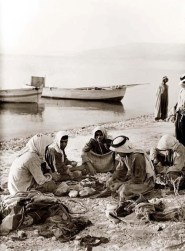
Jesus later appeared to his disciples along the shore of Lake Tiberias. Simon Peter, Thomas the Twin, Nathanael from Cana in Galilee, and the brothers James and John, were there, together with two other disciples. Simon Peter said, “I’m going fishing!” The others said, “We will go with you.” They went out in their boat. But they didn’t catch a thing that night. Early the next morning Jesus stood on the shore, but the disciples did not realize who he was. Jesus shouted, “Friends, have you caught anything?”

“No!” they answered.

So he told them, “Let your net down on the right side of your boat, and you will catch some fish.”

They did, and the net was so full of fish that they could not drag it up into the boat.

Jesus’ favorite disciple told Peter, “It’s the Lord!” When Simon heard that it was the Lord, he put on the clothes that he had taken off while he was working. Then he jumped into the water. The boat was only about a hundred yards from shore. So the other disciples stayed in the boat and dragged in the net full of fish.

When the disciples got out of the boat, they saw some bread and a charcoal fire with fish on it. Jesus told his disciples, “Bring some of the fish you just caught.” Simon Peter got back into the boat and dragged the net to shore. In it were one hundred fifty-three large fish, but still the net did not rip.

Jesus said, “Come and eat!” But none of the disciples dared ask who he was. They knew he was the Lord. Jesus took the bread in his hands and gave some of it to his disciples. He did the same with the fish. This was the third time that Jesus appeared to his disciples after he was raised from death.

Continue reading “Appearances of the Risen Christ, 13”

Updated Internet Monk FAQs (part one)

By Chaplain Mike

We will update the Internet Monk FAQ page in the near future, but I thought it would be worthwhile today to give us all a reminder of some of the basics and “rules” around here.

I will include Michael Spencer’s original answers (MS) so that you can:

  1. Contrast mine (CM) with his where we differ, and
  2. See the standards that will carry on unchanged on the site.

Continue reading “Updated Internet Monk FAQs (part one)”

Sunday’s Gospel: Unity—God’s Love in Action

By Chaplain Mike

Each Sunday, we present devotional thoughts based upon the Gospel reading from the Revised Common Lectionary.

Today is the seventh Sunday in Easter.
Today’s Gospel is John 17:20-26
(NRSV).

Gospel Text

I ask not only on behalf of these, but also on behalf of those who will believe in me through their word, that they may all be one. As you, Father, are in me and I am in you, may they also be in us, so that the world may believe that you have sent me. The glory that you have given me I have given them, so that they may be one, as we are one, I in them and you in me, that they may become completely one, so that the world may know that you have sent me and have loved them even as you have loved me. Father, I desire that those also, whom you have given me, may be with me where I am, to see my glory, which you have given me because you loved me before the foundation of the world. ‘Righteous Father, the world does not know you, but I know you; and these know that you have sent me. I made your name known to them, and I will make it known, so that the love with which you have loved me may be in them, and I in them.

Continue reading “Sunday’s Gospel: Unity—God’s Love in Action”

iMonk Classic: Too Much Heaven? (part 3)

Classic iMonk Post
by Michael Spencer

Today we conclude our review of Michael Spencer’s three-part series, originally posted in April, 2008.

I think it’s telling that the two most prolific evangelism programs in evangelicalism both approach their audience with questions that Jesus never used.

  • “Do you know that God loves you and has a wonderful plan for your life?”
  • “If you were to die tonight, and God were to asked you, why should I let you into my heaven, what would be your answer?”

According to Mark, Jesus did not approach his world with a question at all, but with a proclamation.

Now after John was arrested, Jesus came into Galilee, proclaiming the gospel of God, and saying, “The time is fulfilled, and the kingdom of God is at hand; repent and believe in the gospel.” (Mark 1:14-15)

His first public sermon was much the same: a proclamation of the arrival of the Kingdom of God.

And he came to Nazareth, where he had been brought up. And as was his custom, he went to the synagogue on the Sabbath day, and he stood up to read. And the scroll of the prophet Isaiah was given to him. He unrolled the scroll and found the place where it was written,

The Spirit of the Lord is upon me,
because he has anointed me
to proclaim good news to the poor.
He has sent me to proclaim liberty to the captives
and recovering of sight to the blind,
to set at liberty those who are oppressed,
to proclaim the year of the Lord’s favor.

And he rolled up the scroll and gave it back to the attendant and sat down. And the eyes of all in the synagogue were fixed on him.  And he began to say to them, “Today this Scripture has been fulfilled in your hearing.” (Luke 4:16-21)

Evangelicalism is a religion of decisions and transactions. Jesus proclaims the arrival of the reign of God. There are decisions to be made, but reducing the Gospel to a decision to accept “God’s plan for my life” or giving the right answer to the question of how to go to heaven seems to have moved well past what Jesus was doing in his earthly ministry.

The decisions most often presented to Jesus’ hearers were: (1) the decision to recognize the reality of the Kingdom of God, and (2) the decision to recognize Jesus as the Messiah who is bringing that Kingdom into the world.

As useful as John 3:16 is as a summary of the Gospel, it is not an entirely useful summary of Jesus as we meet him in the synoptic Gospels. “Eternal life” is the life of God available in the present, It is John’s version of saying “The Kingdom of God is upon you.”

In passages where Jesus seems to be inviting “decision,” he is in reality inviting a reordering of life based on recognition of the Kingdom of God and recognizing the Messiah as God with us. N.T. Wright has rightly pointed out that this is a proclamation telling us about a whole new world, and our response to it truly amounts to entering or refusing a “new creation” that is “born again” through Jesus.

Where is heaven in this? Certainly not absent, but even more certainly not central or prominent. Jesus invites sinners to believe they are forgiven. He invites all persons into a Kingdom of grace and into the missio dei. The Kingdom of God will eventual overturn all the fallen, pretentious kingdoms of men. “Heaven” is the reign of God seen from the Godward side, and we pray that it will come on earth as God answers the prayer that his will is done “on earth as it is in heaven.”

Inviting people to reserve a place in heaven is shortchanging the Gospel, and creates the problem of justifying the demands of the Kingdom of God in the interim. In the Great Commission, Jesus calls us to evangelism that invites persons to become disciples, obeying all that he commanded. This is not a second level of “fine print.” It is the Kingdom of Heaven and Jesus the Messiah as they are to be presented to the world.

The most important question for many of us is how to place the cross of Jesus in the context of the entire offer of the Kingdom while keeping the Kingdom message of Jesus in its prominent place.

A text like 2 Corinthians 5 seems to get this balance correct.

For the love of Christ controls us, because we have concluded this: that one has died for all, therefore all have died; and he died for all, that those who live might no longer live for themselves but for him who for their sake died and was raised. From now on, therefore, we regard no one according to the flesh. Even though we once regarded Christ according to the flesh, we regard him thus no longer. Therefore, if anyone is in Christ, he is a new creation. The old has passed away; behold, the new has come. All this is from God, who through Christ reconciled us to himself and gave us the ministry of reconciliation; that is, in Christ God was reconciling the world to himself, not counting their trespasses against them, and entrusting to us the message of reconciliation. Therefore, we are ambassadors for Christ, God making his appeal through us. We implore you on behalf of Christ, be reconciled to God. For our sake he made him to be sin who knew no sin, so that in him we might become the righteousness of God.

To the extent that our status as persons “unreconciled” to God is a barrier to entering the new creation, Christ has reconciled us. In fact, that reconciliation is spoken of as a past fact from God’s side and only a question from our side, i.e. will we enter into a reconciled relationship and become ambassadors of reconciliation.

The death of Christ as our substitute and sacrifice is the focus of that mediation. In a sense, the cross is central in our reconciliation, but Christ and the Kingdom of God are central in the Christian message. There is no conflict here at all, as the cross shows us how it is possible for Christ to say “it has pleased the Father to give you the Kingdom.”

The promises of God come to us by the mediation of Jesus. That mediation exists in Jesus as a person, but is focused for us in the event of the cross, where the power of the Kingdom defeats the powers of evil and demonstrates the love of God in taking sin and death upon himself that we might walk in newness of life in the reign of God.

When Paul says he “knows nothing” but the cross, he is not setting up a tension between cross and Kingdom. He is simply saying there is only one Messiah: the crucified one. As astonishing as it sounded to the ears of Jews, Greeks and Romans, God’s cornerstone of the Kingdom was the stone that was rejected, cursed and nailed to the cross.

So the resurrection and the ascension of Jesus demonstrate that this crucified messiah is the victorious, vindicated King. He has brought the Kingdom to us through incarnation, suffering, death and resurrection. He is the “door,” the “way, truth and life.” He is the one who, having taken all our burdens upon himself can now invite us into the Kingdom of heaven, the new creation, and the new Jerusalem.

All of this underlines that our evangelism needs to preach Jesus, and not as a means to an end, but as the center of all that God offers to us. Christ is the Gospel. Jesus = salvation in every sense. At any moment we encounter Christ in the Gospel we are, in this one person, experiencing both Kingdom and Cross, reconciliation and invitation to discipleship, acceptance and Great Commission, missio dei as our purpose and as good news to each one of us.

Present Jesus Christ in the fullness of the Gospel presentation: mediator, kingdom-bringer, reconciler, teacher, Lord, discipler; and you will have presented all the evangel.

Saturday Ramblings

Presented by Adam Palmer

Greetings, all. Jeff Dunn, the Grand Rambler of the iMonastery is on assignment in Colorado this week and has left it to me, his trusty apprentice, to present this week’s offering of Saturday Ramblings. To wit:

People are actually signing up to spend a year and a half living in a shipping container in Russia for a fake “Mars mission” led by the European Space Agency. The ESA selected the first half of the crew this week, which includes a Frenchman and a Colombian-Italian, who will undergo all sorts of astronaut training and tests without the heady benefit of becoming an actual astronaut.

HarperCollins announced this week that best-selling author Sarah Palin will return to the bookshelves this fall with a book “inspired by the ‘thousands of everyday Americans’ she met on [her recent] book tour.” The upcoming volume is titled America By Heart: Reflections on Family, Faith and Flag. Depending on your opinion of the polarizing Mrs. Palin, that title will fill you with either warm fuzzies or severe dread.

End-times alarmists in Poland were surely sounding the Komeback Klaxons when Warsaw received a biometric ATM, courtesy of BPS SA Bank. Instead of swiping a magnetic card to access their money, account holders need “nothing more than their index fingers and their PIN numbers.” The machine scans their finger veins to verify their identity and is clearly discriminatory to Captain Hook.

Speaking of technology, film critic Roger Ebert did us all a favor this week and posted this insightful news piece about the way high definition television will change the way we watch movies. The catch: he wrote it June 12, 1988. The photo of the state-of-the-art GE “Performance Television” is well worth the click-through.

Birthdays. Filmmakers George Lucas, Robert Zemeckis, and Sofia Coppola (two of those people have won Academy Awards–and it isn’t who you think); influential musicians David Byrne of Talking Heads and Bono of some band; artist Salvador Dali; famous Christian Stephen Baldwin; legendary stately lady Katharine Hepburn; funnyman and faux pundit Stephen Colbert; and, in a grand twist of irony, the birth control pill turned 50 this week… on Mother’s Day.

Finally, in anticipation of tomorrow’s church services, the folks in the media department at North Point Church released this self-mocking video this week. In the immortal words of Homer Simpson: it’s funny ’cause it’s true:

A Disputed “Justification” Text

By Chaplain Mike

Since we’ve been talking about N.T. Wright lately, and examining some Scriptures together, I thought it might be timely to look at one text that became a point of controversy in the debate about justification between the more traditional Reformed view and the so-called New Perspective on Paul (NPP), at least as Wright represents it—2 Corinthians 5:21.

This has always been a favorite verse of mine. I have long considered it to be one of those great summary texts, which express the Gospel message in a nutshell. Here it is in the ESV translation:

For our sake he (God) made him (Christ) to be sin who knew no sin, so that in him we might become the righteousness of God.

After looking more carefully at these words and their context, I recently realized that I differ with both perspectives.

Continue reading “A Disputed “Justification” Text”

Appearances of the Risen Christ, 12

By Chaplain Mike

We are marking the Great Fifty Days of Easter with a series of devotional thoughts on the post-resurrection appearances of Jesus.

Today we look at the final narrative in Luke’s story of Jesus’ resurrection and appearances, from Luke 24:50-53 (NASB).

Text

And He led them out as far as Bethany, and He lifted up His hands and blessed them. While He was blessing them, He parted from them and was carried up into heaven.

And they, after worshiping Him, returned to Jerusalem with great joy, and were continually in the temple praising God.

Thoughts

Luke provides a unique ending to his Gospel—a brief account of the Ascension. He does not tell the full story of everything that took place on that momentous occasion here (that is reserved for Acts 1), but summarizes Jesus’ departure from this world and the response of his disciples. In doing so:

Luke emphasizes the priesthood of Jesus.
Can’t you just picture our risen Lord, raising his hands in the traditional gesture of pronouncing a benediction? Can’t you hear him say, “May the Lord bless you and keep you…”? As a minister concludes a worship service, pronouncing God’s blessing and then sending the church into the world to serve as God’s blessed people sharing God’s blessings, so Jesus concludes his earthly life and ministry.

Luke emphasizes the worship of God’s people.
Note the “worship” words in this text: blessing, worshiping, joy, temple, praising. Having been blessed by their Lord, the disciples worship Jesus, are filled with joy, gather in the temple, and express their praises to God. The mission upon which they will soon embark is rooted in worship. They have experienced the living presence of Jesus, received his word of blessing, witnessed his exaltation to heaven, and bowed before him in adoration. Their movement into the world will be informed and inspired by this gathering.

These verses briefly describe the incalculable privileges of living as Easter people under the rule of our ascended and enthroned Lord.

A passage from Paul outlines the blessings and dynamic possibilities now operative in the world through Jesus’ death, resurrection, and ascension to heaven.

All praise to God, the Father of our Lord Jesus Christ, who has blessed us with every spiritual blessing in the heavenly realms because we are united with Christ. (Ephesians 1:3)

I also pray that you will understand the incredible greatness of God’s power for us who believe him. This is the same mighty power that raised Christ from the dead and seated him in the place of honor at God’s right hand in the heavenly realms. Now he is far above any ruler or authority or power or leader or anything else—not only in this world but also in the world to come. God has put all things under the authority of Christ and has made him head over all things for the benefit of the church. And the church is his body; it is made full and complete by Christ, who fills all things everywhere with himself. (Ephesians 1:19-23)

As Luke will make clear in Acts, here Paul reminds us of the significance of the Ascension for our faith. The fact that Jesus ascended to heaven, and is seated at God’s right hand, does not mean he is absent, as though he went on a journey to some place far away. As N.T. Wright reminds us, “heaven” is better understood as another dimension of existence rather than as a distant place, and the purpose for Jesus “going away” was not to leave us but to designate that he is now exalted above all things, ruler of all..

Basically heaven and earth in biblical cosmology are not two different locations within the same continuum of space or matter.  They are two different dimensions of God’s good creation.  And the point about heaven is twofold.   First, heaven relates to earth tangentially so that the one who is in heaven can be present simultaneously anywhere and everywhere on earth:  the ascension therefore means that Jesus is available, accessible, without people having to travel to a particular spot on earth to find him.  Second, heaven is, as it were, the control room for earth; it is the CEO’s office, the place from which instructions are given.  “All authority is given to me,” said Jesus at the end of Matthew’s gospel, “in heaven and on earth.”  (Surprised by Hope, p. 111).

So, Jesus “disappeared” from the earthly dimension, the place where we live and access life through our senses, and entered into the heavenly dimension, “the heavenly places” as Ephesians calls it. This heavenly realm, though invisible to us, is nevertheless all around us, and Jesus is now enthroned there, which is to say, he has taken the place of authority and rule over the entire universe. And, he is with us!

So, we delight in the privilege of living in Jesus’ blessing. Of offering him our worship. Of moving into the world with joy to announce the Good News.

Prayer

Remember, O Lord, what you have wrought in us and not what we deserve; and, as you have called me to your service, make me worthy of your calling; through Jesus Christ our Lord, who lives and reigns with you and the Holy Spirit, one God, now and for ever. Amen.

(Prayer appointed for the week from The Divine Hours)