First snow, it came early this morning So I’m up and out of bed Visions of a real slow goin’ Start runnin’ through my head First snow, there ain’t nothing like The sudden change that winter brings But it looks so pretty that it makes me want to sing…
La la la la la, the sky is falling down La la la la la, and sticking to the ground La la la la la, what a change that winter brings I’ll stoke my stove and see you in the spring
White limbs in a magic forest That surrounds me as I drive Stillness, that gentle feelin’ Makes me glad that I’m up and alive First snow, there ain’t nothin’ like The sudden change that winter brings And in the silence I can hear my heart begin to sing…
La la la la la, the sky is falling down La la la la la, and sticking to the ground La la la la la, what a change that winter brings I’ll stoke my stove and see you in the spring
Michael and the Boar’s Head Tavern folks once upon a time had an Advent site. Here is a sample from it — one of Michael’s observant reflections about evangelical churchianity in the Christmas season.
• • •
We’re still waiting
Watched a children’s Christmas program in Northern Ky today. It was familiar to me because a local church in our area brought it to our school last year.
The King is coming to our town. Who is this king? Reporters want to know. The mayor wants to know. It’s not the King of Rock and Roll. (Enter Elvis impersonator.) It’s not King Tut. It’s not King Kong.
No, it’s Jesus. He’s a better King than all these others, and if you accept him, you can go to heaven.
Great choreography, costumes, sets, production.
No Biblical story of Jesus at all. None. Nothing coming near to it.
Jesus totally displaced from the Biblical story, and only known in comparison to….to….I don’t really know what.
Everyone had a good time, and as I said, the kids were great. The church worked hard to make the show happen and on the one song that somehow managed to relate to Jesus Christ, they were very sincere.
We’re still waiting for Jesus in church saturated America. Not to be born, as much as to come back to us after we’ve tossed him out in favor of something more interesting and entertaining.
May the lights of advent light our way to rediscover Jesus Christ this advent season.
Sermon: Advent III Jesus Commends the Doubter (Matt 11:2-11)
Truly I tell you, among those born of women no one has arisen greater than John the Baptist…
• Matthew 11:11
• • •
Jesus gives great praise to John the Baptist in today’s Gospel. He commends him as a strong man of truth, a prophet of God, a specially chosen messenger to prepare the way for the Messiah. “Among those born of women no one has arisen greater than John the Baptist,” Jesus says. We should be impressed by John. We should venerate him, honor him, and look up to him.
Having said that, I want you to notice that Jesus proclaimed these words of commendation at one of the lowest moments in John’s life. In this very same text — where Jesus praises John up one side and down the other — we discover that John was struggling with doubt.
John found himself in prison when Jesus praised him, and I’m sure it was a challenge for him to stay positive and not get discouraged. Our Gospel text tells us that John was so out of sorts and and his mind in such turmoil that he sent messengers to ask Jesus if he was really the One, the coming Messiah, the King God had promised.
This great servant of God found himself locked in a prison cell of doubt.
Imagine that.
Who had devoted his life to preparing Israel for the coming of her Messiah? John.
Who had introduced Jesus to the public? John.
Who had said Jesus was so great that he wasn’t worthy even to tie his sandal? John.
Who had baptized him? Who heard the voice from heaven affirming Jesus as God’s Son? Who had seen the Holy Spirit descending upon him as a dove? John.
Who had pointed to Jesus and proclaimed, “Behold! the Lamb of God who takes away the sins of the world!”? John.
Out of that same mouth, now we hear, “Are you the One? Or should we look for another?
We can’t be sure why John was struggling with doubts at that moment. Certainly being in prison couldn’t have helped. But, as Jesus says here, this was no weakling. This was no reed in the wind, easily swayed or broken.
Yet he found himself racked with doubts. I wonder why.
Perhaps it was because he had not seen Jesus do what he expected him to do. Perhaps John had anticipated more action, more results, more victories, more success. Maybe he expected more visible, public proofs that Jesus was king and that the kingdom of God was taking over —
If Jesus were truly a king wouldn’t he have raised an army by now?
Wouldn’t he have challenged the ruling powers more by now?
Wouldn’t there be more talk of revolution and resistance?
Wouldn’t renewal and reformation be sweeping through Jewish society?
Wouldn’t the Romans be shaking in their boots at the rising power of God’s people?
Maybe these were some of John’s thoughts and expectations. If Jesus was truly the King God promised, why hadn’t things started to change for Israel? It is possible that John was making the mistake that Israel made when she chose her first king.
The people of Israel chose Saul, a man who was strong, attractive, and charismatic; a man they thought would get things done. Saul would surely fight and defeat their enemies! Saul would certainly bring victory and glory and prosperity to their nation. They wanted results. They wanted them now. And they believed Saul would be the king who could get those results for them.
They didn’t realize, that God had a different king in mind for his people: David. Though David showed early promise, he was nowhere near the physical specimen Saul was. He was the runt of his family’s litter, he spent time tending sheep, he was a poet who played music. After Samuel anointed him, David spent more time running for his life, hiding in caves, and figuring out ways of surviving among his enemies than he did leading Israel in glorious victories. He ended up coming to the throne out of obscurity and suffering.
Now, in the days of Jesus, perhaps John was looking for a new Saul. But God sent a Son of David. John looked for action and power and visible results. Instead, he saw a homeless teacher traveling around Israel, hanging out with sinners, having dinner with them in their houses, teaching and feeding them on hillsides. And it wasn’t adding up.
Can you relate to John? Have you had expectations about life and God and what God would do that remain unfulfilled? Have you found yourself locked in that prison cell of doubt? Have you been perplexed or disappointed at times in your life of faith?
This leads me to ask: What do you and I expect when we look for God to work in our lives and in our world? Maybe, like John, we are expecting more progress, but we don’t see it. We trusted in Jesus and life just hasn’t turned out like we thought it would.
But maybe we’re looking for God in the wrong places and expecting the wrong things. Maybe we’ve been looking for a Saul to defeat our enemies, and what we got was a David, running for his life.
And perhaps that is the whole point. Perhaps God is to be found more in the small and obscure places, among the common folks and not the elite. Maybe he walks the hidden halls of hospitals and nursing homes, with disadvantaged children in inner city schools, in homeless shelters and soup kitchen lines, and in the run-down, dilapidated houses of the neighborhoods most people try to avoid.
Maybe, in fact, God doesn’t give a hoot about the kinds of results or victories or outcomes that we are looking for so eagerly.
Maybe Jesus really meant it when he said he came to bless the poor in spirit, those who mourn, the meek, and those who have been oppressed and who cry out for justice.
Maybe we are being called to really believe the good news as God has brought it to us. We might just find our salvation lying as a baby in a manger. Growing up in obscurity and walking the backroads of Israel without a place to lay his head. Touching and healing a leper. Confronting and rebuking the powerful. Hanging on a cross.
In fact, it just might be that God is present and working in the prison cell of doubt and fear that some of us — maybe even you — occupy today. And though you feel yourself to be least in the kingdom of heaven, or maybe even not worthy of being part of God’s kingdom, Jesus is, right at this very moment — your lowest moment — commending you as one greater than John the Baptist.
Hi, friends, and welcome to the weekend. Ready for brunch?
Well, it’s mid-December, and you know what that means: Superfluous college football bowl games, of course. This year there are 40 (count ’em) bowl games. Which, if my math is correct (an unlikely occurrence) translates into 80 teams playing in a bowl this year. Now, I’m not saying they don’t deserve it…I’m just saying this seems like its more and more about the money and sponsorship than about a team being bowl-worthy. Don’t believe me? Here are some names of this year’s bowls. Only two of these are made up:
Cheez-It Bowl
Academy Sports + Outdoors Texas Bowl
San Diego County Credit Union Holiday Bowl
Camping World Bowl
Military Bowl Presented by Northrop Grumman
Internet Monk Wandering in the Wilderness Bowl
Nova Home Loans Arizona Bowl
Tropical Smoothie Cafe Frisco Bowl
Bad Boy Mowers Gasparilla Bowl
Putin Crimea River Empire Expansion Bowl
This is the coolest and most informative graphic I have seen in a long while: The Deep Sea.
The Kensington Community Children’s Co-operative has ditched Santa for its end of year party, dubbed a ‘Celebration Picnic‘, and instead opted to bring in a ‘Sustainability Pirate’ for all the kids and their parents. Parent Kristoffer Paulsen isn’t happy about the change: “If anyone has any clues about the sustainability pirate and what drugs they were taking when they came up with that, I would like to know.
The childcare centre said that it’s to ensure that the event is inclusive for everyone.
Yes, I can see that. That’s what’s most important. Nevermind you are replacing a saint known for generosity and giving with a seafaring criminal known for murder, theft and kidnapping. As long as it’s inclusive murder, theft and kidnapping.
Speaking of criminals, these guys are on the GENIUS level. We’re talking Oceans 14 here:
U.S. officials misled the public on the Afghan war. Top American officials hid pessimistic assessments of how the 18-year military campaign in Afghanistan was going, according to documents published by The Washington Post. The Post said the documents had come from 2,000 pages of Pentagon interviews conducted from 2014 to 2018 in order to write a series of unclassified “Lessons Learned” reports. They were released after a long legal battle with the government’s watchdog for the war. “We didn’t have the foggiest notion of what we were undertaking,” said one retired general who helped oversee the war.
A Pentagon spokesman said “there has been no intent” by the Defense Department “to mislead Congress or the public.” He said that “most of the individuals interviewed spoke with the benefit of hindsight.”
Related: The Times found that there was little to show for the $2 trillion spent on the war, during which more than 38,000 Afghan civilians and 2,400 American soldiers have died.
Is Jewishness a race, religion or both? President Trump signed an executive order that would effectively define Judaism as a race or nationality, not just a religion, in an effort to compel colleges and universities to combat discrimination. The effect, if not the goal, would be to ban anti-Zionist, and perhaps Anti-Israel, critique.
Jared Kushner gives the rationale for this:
This new order adopts as its definition of anti-Semitism the language put forth in 2016 by the International Holocaust Remembrance Alliance, while also accounting for other forms of anti-Semitism.
For example, the alliance defines “the targeting of the state of Israel, conceived as a Jewish collectivity,” and those who deny “the Jewish people their right to self-determination, e.g., by claiming that the existence of a state of Israel is a racist endeavor” or those who compare “contemporary Israeli policy to that of the Nazis” as examples of anti-Semitism.
The Remembrance Alliance definition makes clear what our administration has stated publicly and on the record: Anti-Zionism is anti-Semitism.
There are at least two problems with this Executive Order. The first is articulated by one of the commentators on the Times Oped:
Kushner’s assertion that Jews will not be defined by nationality, but will be protected against discriminatory measures under the auspices of national characteristics is splitting hairs and makes it abundantly clear that he hasn’t read anything that address the distressing consequences of attributing Jewishness as a nationality in countries that have openly engaged in anti-Semitic behavior. This EO is a gift to white supremacists who now have another justification for categorizing Jewishness as a race, rather than people who adhere to a religious tradition.
The other problem is censorship. Any speech that could be construed as “Anti-zionist” or Anti-Israeli will now be viewed as racial bigotry. And make no mistake: college administrators will allow nothing that can possible be construed as racism. This EO may silence most criticism in universities of the nation of Israel or its policies.
Person of the year? Time magazine gave Greta Thunberg that honor.
Thoughts? Here’s mine on what the cover should have been:
Christmas is going to be awkward: Michigan man sprayed brother’s hunting area with deer repellent, DNR says.
“I do not enjoy walking in cities. As a semi-retired travel writer, I often find that people assume I enjoy my job. What could be more pleasurable, after all, than strolling along the Rue Lepic in Paris, or along Via Governo Vecchio in Rome, taking in the sights and panoramas and street cafés with all the gentle aestheticism of an old Baedecker guidebook?
“But, when I have done my job well, I have been miserable. Not because cities are bad for the soul, but because they are too punishingly good. I was a travel writer, after all, because I did not like myself when I was at home. I did not want to be my ordinary self, but to be the self I could be in relation to an imagined otherness: to be the sort of person who climbed mountains in the Caucasus, or clambered on ruins in Rome. Existing in new cities was supposed to be a kind of escape from who I was. Instead, it was an eternal, if ever-shifting, mirror of who I could not help but be. I found I was not the panama-hatted adventurers I’d read about imposing my word and will on the world like planting a flagpole. Instead, I was astoundingly vulnerable.
By the way, did you ever notice that queue is just the letter q followed by four silent letters? Or maybe they are just standing in line, waiting their turn.
A middle school in Manatee County, Florida, evacuated its students after someone sprayed too much Axe body spray. Another bus arrived at the smelly scene to pick up the students. A local EMS came to check out the students but thankfully, no one was transported to the hospital from having too much Axe body spray.
Walmart had to apologize for selling the following sweater on its website:
Yes, that’s Saint Nick doing a line of coke. Amazon still sells it. Sigh.
Bald Eagle versus large octopus: Who would you put your money on? A team of salmon fishermen can tell you: they had to rescue the bald eagle after it bought off more than it could chew. The eagle had dived into the water for its dinner, but likely didn’t realize what it was getting itself into:
I really wonder what was going through both creatures minds during all this.
Well, that’s it for now, friends. Have a great week, and don’t forget to set your DVR to record the Bad Boy Mowers Gasparilla Bowl. You’ll never forgive yourself.
There is no defending God. There is no proving his way is right. To do so would require that I understand God, that I can substantiate the claims of truth my faith calls me to hold.
I can explain what I believe well enough. I can demonstrate to a certain degree that my faith is reasonable and not the delusions of a crackpot. But I can’t prove anything. I can’t argue an airtight case. I can’t campaign for Jesus on a platform of certainty.
You see, all the “evidence” is ambiguous. It is capable of being interpreted in a variety of ways. What convinces one person to believe may lead another to have serious doubts.
Even the bedrock occurrence in the story of our faith — the resurrection of Jesus — was not what you would call a public event. It was unexpectedly discovered by a few common people in the hazy dawn of Easter morning. All of Jesus’ appearances were reserved for people who became his witnesses. It is their word we have to trust. I happen to be convinced that they were trustworthy and that they had no reason to invent a story so fantastic, but I can see why people might have doubts.
I suppose this is why some Christians feel the need to posit an inerrant Bible, a fully trustworthy revelation directly from the mouth of God that demonstrates in incontrovertible terms that it is TRUTH™. Thus, all we have to do is open up the book and — there it is! — a sure and certain foundation for our beliefs. However comfortable that might make believers feel, in reality it just creates another proposition Christians must defend. Proving the divine perfection of the Bible requires herculean efforts and, as centuries of dispute over Scripture’s nature, meaning, and interpretation show, the evidence here is muddy too.
So, I don’t really have an apologetic. At best, it’s ambiguous.
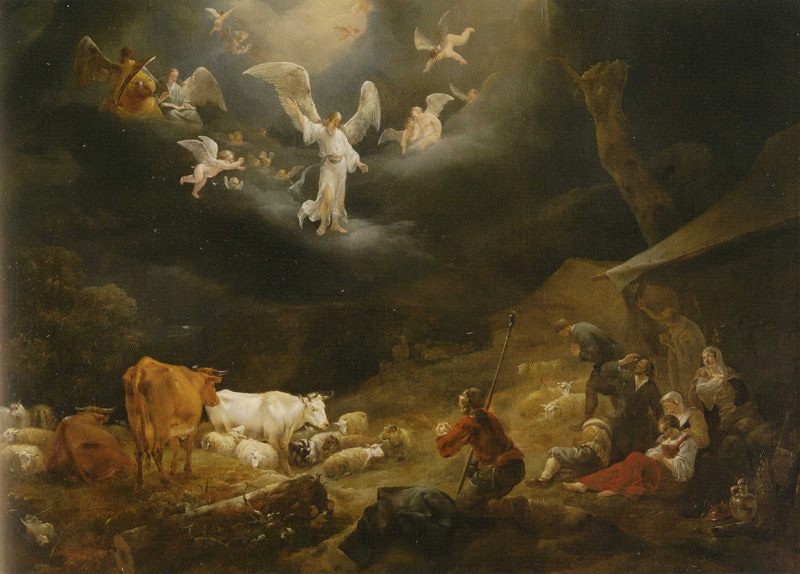
The other day I was thinking about the shepherds in Luke’s Christmas story. Surely they had a sense of certainty. Surely what they experienced was so unambiguous, so transformative, that they lived the rest of their lives in the assurance of faith. Surely God had proven himself to them. They beheld the angel hosts! They heard the gospel announced directly from heaven! They saw the baby Jesus in the flesh!
However, sometimes I wonder what happened next. The Gospel tells us they went back to work later that night. We never hear from them again. What was it like for the shepherds a week later? a month? ten or twenty years? I don’t know if they were around when Jesus went throughout Judea proclaiming the Kingdom. I’d like to think their faith was confirmed and strengthened over the years, perhaps by personal encounters with Jesus in his ministry.
On the other hand, it is possible they didn’t hear much about Jesus again, perhaps for the rest of their lives. If so, what would that long silence have communicated to them? Based on the angel’s message they would have expected, somewhere along the line, a Son of David to ascend the throne in Jerusalem, bringing lasting peace and relief from their enemies. An unambiguous fulfillment of God’s promise. But even if they did become part of the crowd and followed Jesus around Judea and Galilee, they never saw that happen, did they? How might they have reconciled that grand birth announcement with reality on the ground years later — an itinerant rabbi with nowhere to lay his head? And then, the cross? Some king. Some throne.
All this is pure speculation, of course, but I think it makes a point:
In my opinion, Christians (and I include myself) have been far too cocksure in talking about Jesus and our faith. As though it’s about having a sense of certainty that carries us blissfully through life. As though what we believe and the reasons we believe are so clear, so transparent, so unambiguous that we just can’t imagine others being unable to see it.
I had a spiritual awakening in high school, and it was prompted by relationships I developed with a group of Christian young people in school and church. What I liked about them was that they were real. I saw their imperfections and could blow holes through their arguments. But I couldn’t get past their joy, their belief that life was worth living in spite of problems and doubts. There was something that kept them moving forward to embrace the goodness of life and faith and hope and love. They were pitiful at trying to explain it, but it was there. Ultimately, I found I couldn’t resist the song their lives sang to me.
So this is what I keep coming back to. Sometime long ago, on a dark night I heard angels sing. I saw the face of the Savior. And it was real.
My experience wasn’t nearly as spectacular as the show the shepherds witnessed. However, it just as effectively got my attention and caused me to change direction in ways that I suppose were as crazy as leaving your job in the middle of the night to go see a stranger’s newborn baby, and claiming you heard the news from angels.
But then, like the shepherds, I had to return to life, plain old life, everyday life.
Through the years I’ve had reason to doubt over and over again whether that experience was real. I have wondered whether the promises I received were genuine, or whether it might not all have been some adolescent fantasy born of hormones, naiveté, and group dynamics. It can get awfully ambiguous at times.
Whether or not the shepherds ever saw Jesus again, I can testify that since my epiphany, every once and awhile along the way I have encountered him. Thing is, he’s never what I expect. He constantly confuses me and makes me scratch my head. The more I try to define what he’s all about or what he’s doing in my life, the more mixed up I become. And when I go to speak, I fumble around for words to explain him, to express what he means to me, to put my finger on the gifts with which he has so graciously filled my life.
He’s real, and that’s about the best I can do.
And there you have it. My ambiguous apologetic.
Maybe you were hoping you’d read something today that would nail it all down for you, relieve your doubts, answer your questions, make it all certain.
Review of “Love and Quasars: An Astrophysicist Reconciles Faith and Science” by Paul Wallace, Part 6.
Chapter 8 is entitled A Scientist Reads the Bible: How Science Enlarges Scripture. Wallace begins the chapter with the account of “Mad” Mike Hughes the California limo driver who launched himself with a homemade rocket to “see” that the Earth was curved, or not- as he was a flat-earther. Apparently, the Flat-Earth movement is growing, especially in America, and especially among millennials, but also around the world. Here is a basic summary of flat-earth beliefs.
A Flat Earth model depicting Antarctica as an ice wall surrounding a disc-shaped Earth.
Both Wallace and I cannot adequately express our dismay at this trend. My grandson brought a friend of his, who is a fan of the rapper “B.o.B.” over to the house. My grandson wanted his friend to speak to a geologist/scientist about his flat-earth beliefs. I patiently explained that he could verify the Earth’s curvature for himself by taking a pair of binoculars to any large body of water and watch a boat sail away from the shore. Through the binoculars, he would see the ship disappear hull first with the highest part of ship disappearing last. He replied that it was simply a matter of “perspective”. I explained, no, perspective is railroad tracks converging at a distance into a point, but because the ship was disappearing from bottom to top; that could only occur on a curved surface. On a flat surface the boat would shrink proportionally to a dot. He shrugged his shoulders and repeated it was all a matter of perspective, clearly not wanting to disrespect his friend’s grandfather, but remained convinced the Earth was flat. Sigh… did I mention how dismaying this trend is.
Hebrew cosmos
In my opinion, flat-earthers have no excuse. The phenomenon seems mostly psychological to me and generally related to conspiracy-theory psychology. But you know who had a good excuse? The writers of Genesis, that’s who. The first book of the Bible describes the cosmos as envisioned by ancient Israel, a cosmos centered on a flat earth. Because that’s what they observed, and they didn’t really have evidence to the contrary. Wallace notes that the difference between the biblical cosmos and the modern cosmos, with its black holes, quasars, fusion powered stars, galaxy upon galaxy, cosmic microwave background, radiation and billions of years cannot be overstated. And that also makes it hard to see why science matters at all when we read the Bible, and in a certain narrow sense, it doesn’t matter. Wallace says:
No matter what theory scientists come up with, if God ever loved us, God will love us still; if Jesus ever mattered, he will matter still; and if justice and reconciliation were ever our calling, they will be our calling still. It seems that the shape of the universe has nothing to do with our daily human experience of God and one another.
But we live in a scientific age. We read our Bibles not on a flat Earth under a transparent dome but on a spherical planet orbiting a star revolving about the center of a vast galactic pinwheel, turning among black holes and quasars. These are the things God has made.
We cannot set aside what we know and what we love when we sit down with Scripture, nor are we asked to. Jesus commands us to love God with all our mind as well as with our heart, soul, and strength. There is such a thing as the scientific love of God. Those who wish to take both faith and science seriously must hold the Bible in one hand and Scientific American in the other.
So he says science, in its proper context, deepens and enlarges everything it touches. Anyone can look up at the night sky and admire the beauty. But the astronomer sees the beauty and more. Something similar happens when a biblical scholar reads the Bible. Like the stars on a clear night, the words sit there on the page, freely available to all. But depth beyond depth is revealed to those who have read it closely for years, learned the original languages, studied the history and culture of the ancient Near East, and become acquainted with biblical theology and the history of biblical interpretation. The more you know, the more you see, the more questions occur to you, and the less satisfied you are with simplistic answers.
Wallace asks what happens when a scientist reads the Bible. Of course, it depends on the scientist. Some dismiss it outright, for Scripture has little to say about science as we know it today. But for the believing scientist there are a lively hosts of scientific extras. They aren’t essential to the core understanding but are bonuses, supplements, new and fun ideas neither demanded nor contradicted by his basic view of Scripture as a human record of Israel’s encounter with a real and loving God.
Wallace gives as an example Genesis 1:20-21, 24-25:
And God said, “Let the water teem with living creatures, and let birds fly above the earth across the vault of the sky.” 21 So God created the great creatures of the sea and every living thing with which the water teems and that moves about in it, according to their kinds, and every winged bird according to its kind. And God saw that it was good.
And God said, “Let the land produce living creatures according to their kinds: the livestock, the creatures that move along the ground, and the wild animals, each according to its kind.” And it was so. 25 God made the wild animals according to their kinds, the livestock according to their kinds, and all the creatures that move along the ground according to their kinds. And God saw that it was good.
Opabinia
He says we should notice that “the waters” and “the earth” bring forth living creatures. These verses suggest that God creates indirectly, using what was previously made. Wallace thinks this passage invites us to imagine evolution in all its weirdness and beauty. We are free to visualize life being brought forth deep in the waters, perhaps microorganisms thriving on hydrothermal vents on the ocean floor four billion years ago. We may envision euthycarciniods, distant ancestors of centipedes who left the sea 530 million years ago, beating even plants in life’s slow landward creep. The Middle Cambrian oddball Opabinia provides a colorful side note. This five-eyed, backward-mouthed, limbless, long-nosed, sea dwelling arthropod was one of the first and strangest animals to ever live.
But of course, Wallace notes, the authors of Genesis knew nothing of evolution or hydrothermal vents or euthycarciniods or Opabinia. God did not whisper these verses into their ears, knowing we would eventually figure out evolution and discover the secret truth of Scripture. Instead, they observed nature, saw that God had given it capacity to generate new things, and wove this insight into their creation story. Wallace concludes:
You may disagree with what I am doing here. You may think that it’s wrongheaded to drag evolution in to a discussion of Genesis because the book is really about relationships between God, humanity, and creation…
But I do not intend to replace standard understandings of Scripture with scientific ones. These examples show how science deepens, sharpens, or expands traditional meanings. Christians who love science are free to imagine new things when they come to Scripture, to create a king of scientific commentary on the Bible. These examples show how Scripture might be enlarged, and not reduced or replaced, by science.
One of the book’s strengths is its consistent rejection of a “theology of glory” for a “theology of the cross,” and its insistence on the Christian way as a way initiated and sustained by God’s grace from beginning to end. This leaves us free, as Erlander says, “to be weak, to be honest, to be interdependent, to be vulnerable, to LOVE.”
Here is an excerpt from Baptized We Live, a list of “forms of religion” that the Lutheran way finds wanting because they, in some form or fashion, depend upon something other than that amazing grace. I don’t necessarily find all of these equally persuasive with regard to Erlander’s point — some are certainly much stronger than others and I might state some differently. But I do find this to be a list that is worth putting out there for discussion, so I hope you’ll consider it and chime in today.
Erlander writes:
We share the NO of Jesus when we reject any form of religion which promotes or validates itself by human reason, human persuasion, human power, or by offering “cheap grace.”
We share the NO of Jesus when we reject:
religion which proves itself by miracles, answered prayer, worldly blessings, fulfilled prophecy or rational thought.
religious which validates itself by worldly standards of success, strength, effectiveness.
religion which uses worldly power techniques to make history come out right or to force society to fit a certain definition of “righteousness.”
religion which promises certitude, life without questions or risk — a security often provided by an infallible leader or an infallible book.
religion which asks us to only believe doctrines about God rather than introducing us to a living God who calls for radical change.
religion which offers the joy of “living with Jesus” without facing our sinful ways — our egotistical, over-consumptive, earth-destroying, people-oppressing patterns of life.
religion which offers personal salvation without living, serving, growing, struggling, and celebrating with the body of Christ, the church.
religion which avoids the pervasive Biblical themes of sharing food with the hungry, caring about the poor and oppressed, living as good stewards of God’s creation.
religion which fulfills our human need to have higher status than others, to be better than others, to have “outsiders” or “unbelievers” to despise.
religion which provides divine approval for the assumption of a particular nation, culture, society, economic system, or race.
religion which provides a way we can bargain for, work for, or earn our status as saved persons.
religion which teaches “going to heaven when I die” as the main reason to believe in God.
religion which avoids teaching that the crucifixion is both the sacrificial atoning act of Christ and the example of the way of Christ we are to follow.
Baptized into Christ, we reject, as he did, the theology of glory.
Jesus said YES to the way of the cross — the way of…
Here we are again, in the early days of December. We are not far away from welcoming the Christ-child at his birth.
As we face this season and event, here are some words from Brother Thomas Merton that make me think. For Christmas will come this year, just as it did long ago in Bethlehem. And, as on that occasion, some will be ready to welcome the infant King, while others will be unprepared.
“What is uncertain is not the ‘coming’ of Christ but our own reception of Him, our own response to Him, our own readiness and capacity to ‘go forth to meet Him.’” (Seasons of Celebration)
I love this quote.
This quote terrifies me.
I believe these words.
I cannot believe these words.
On the one hand, since we know the story so well and have celebrated the Christmas feast so often, it is not hard to feel that one is preparing to “go forth to meet him” by simply participating in the annual preliminaries. We all know such activity gives no guarantee that our hearts will be receptive. That should give us pause.
It is also scary when I remember that few, if any, went forth to meet him at his first coming. Certainly none went of their own initiative. It took a heavenly host of angels to get the drowsy shepherds’ attention. The magi would never have made their journey without a certain astrological alignment. Those who housed visitors in Bethlehem did not make room for him. Even those faithful people who were “ready” — Mary, Joseph, Anna, Simeon, and so on — were surprised when God broke in upon them.
I want to be ready. I long desperately to be ready. With God’s people I fill my heart with divine promises, lift up my prayers, sing carols, light candles, and decorate my home. I prepare a room for the Holy Family. Through confession and absolution I sweep it clean, and by the word of the gospel it is made ready. Within my heart and life I build a cradle in which the infant King can find rest. I watch out my window and prepare to go forth to meet him.
When suddenly — through the back door? — he appears! How did he get in? And how did I miss his arrival? What happened to my carefully prepared words of welcome? I am stunned to silence. Overwhelmed, I fall to my knees. My Savior is here, and I did not know it!
All my carefully devised hospitality plans are moot. There will be no going forth to meet him, for he has met me first. The greeting will not be my “Welcome!” but his “Fear not!” I will not be his host, but his favored guest. I planned a wonderful meal in his honor, but he sits down at the head of the table, breaks bread, blesses it, and gives it to me as though this were his home and he is feeding me.
And so, Brother Thomas, I hear what you are saying. But in the end, my response will always be uncertain, my readiness and capacity to “go forth and meet him” always overwhelmed by his epiphany — sudden, serendipitous, startling. Somehow, I think you know this too.
In this context, I am reminded of another quote:
Then the Lord you are seeking will suddenly come to his Temple. The messenger of the covenant, whom you look for so eagerly, is surely coming,” says the Lord of Heaven’s Armies. “But who will be able to endure it when he comes? Who will be able to stand and face him when he appears?” (Malachi 3:1-2, NLT)
[T]he prophetic word of Advent authorizes us to tell the truth about the world. As Edgar pronounces in the final scene of King Lear, “The weight of this sad time we must obey/ Speak what we feel, not what we ought to say.” John the Baptizer exemplifies this ethos: he speaks his mind, giving voice to the silent grumblings of the lower class and of God alike. He is an inconvenient note ringing out in the wilderness, embarrassing to the priestly class from which he is descended. His importunity and refusal of bland niceness is what prepares the way of the Lord. This is the face of Advent: mourning in lonely exile, crying out, “O Lord, come quickly! Vanquish the Devil and all his works!”
But even this season, when it is remembered, is all too often hijacked and sterilized, sawn off to fit a Procrustean bed of niceness. The advent wreath, a relatively novel development in the history of the church, celebrates hope, faith, joy, and peace, whereas traditionally it commemorated the four last things: death, judgment, heaven, and hell. These things are the outcomes of our works; all our trials are participations in them. Advent is more than the time of preparation for Christmas: it is the post-Nativity time given to us to contemplate the end seeded in that beginning. We look back in order to look forward. For as sure as the Lord was born to a virgin in Bethlehem, he will return to judge and restore.
As with so many other things, we sanitize what isn’t safe and therefore lose what is nutritious. Is the traditional Advent safe? No, but it is good….
…The only genuinely effective apologetic available to Christian faith is its forthright speaking (παρρεσια) about the distress and affliction that characterizes our world and our species’ pathological inability to effect lasting change to heal it. Bolstering the historical veracity of Christianity’s claims is useful, as is philosophically demonstrating its systematic coherence, but none of these things are the Sun of righteousness by which light is shone into darkness. We must tell the truth that will reverberate in every human heart searching for consolation. Every other school of thought will try to paint the world as not as bad as it seems: Christianity alone will insist, Yes, it is this bad — and yet that is not the whole story.










 One of the resources I use as a Lutheran to help people understand the tradition is a small book called

 The Internet Monk Archives