Some Thoughts On Brennan Manning (and The Furious Longing of God)

The Furious Longing of God by Brennan Manning

Justification by grace through faith is the theologian’s learned phrase for what Chesterton once called “the furious love of God.” He is not moody or capricious; he knows no seasons of change. He has a single relentless stance toward us: he loves us. He is the only God man has ever heard of who loves sinners. False gods — the gods of human manufacturing — despise sinners, but the Father of Jesus loves all, no matter what they do. But of course this is almost too incredible for us to accept. Nevertheless, the central affirmation of the Reformation stands: through no merit of ours, but by his mercy, we have been restored to a right relationship with God through the life, death, and resurrection of his beloved Son. This is the Good News, the gospel of grace.-Brennan Manning, The Ragamuffin Gospel.

I have owned every book that Brennan Manning has ever written.

As Christian books go, they are among the most divisive and provocative you’ll ever read or discuss. A reviewer of the current book at the discernment blog The Discerning Reader is typical of the kind of assessment Manning elicits from the Knights of Reformed Orthodoxy. I could use up blog space, but there’s no real point. You can read it for yourself. If you’ve spent much time around Manning, you’ll soon be able to write this kind of criticism in your sleep. It’s been going on for years.

I remember when one of my co-workers asked me for something good to read. I’d just finished Abba’s Child, a book quite similar to The Furious Longing of God, and I passed it on to her. In a couple of weeks, the book was returned with a note in between the pages. The note was angry, and like the review cited above, pronounced the book a waste of time.

Brennan isn’t for everyone. I learned that long ago. But he sure is for me, I can tell you that.Continue reading “Some Thoughts On Brennan Manning (and The Furious Longing of God)”

Liturgical Gangstas 12: Worship and Evangelism

UPDATE: Alan Creech has added his answer.

Welcome to IM’s popular feature, “The Liturgical Gangstas,” a panel discussion among different liturgical traditions represented in the Internet Monk audience.

Who are the Gangstas?

Father Ernesto Obregon is an Eastern Orthodox priest.
We have a new Gangsta! Rev. Joe Boysel is an AMiA priest and professor of Bible at Ohio Christian University in Circleville, Ohio. (Ask him about famous alumni.)
Dr. Wyman Richardson is a pastor of a First Baptist Church (SBC) and director of Walking Together Ministries, a resource on church discipline.
Alan Creech is a Roman Catholic with background in the Emerging church and spiritual direction.
Rev. Matthew Johnson is a United Methodist pastor.
Rev. William Cwirla is a Lutheran pastor (LCMS) and one of the hosts of The God Whisperers, which is a podcast nearly as good as Internet Monk Radio.

Here’s this week’s question: What is the relationship of the gathered church, especially in worship, to the work of personal evangelism? (Especially of adult unbelievers.)Continue reading “Liturgical Gangstas 12: Worship and Evangelism”

Recommendations and Review: The Next Evangelicalism by Soong-Chan Rah

The Next Evangelicalism by Soong-Chan Rah

Soong-Chan Rah is assistant professor of Church Growth and Evangelism at North Park Theological Seminary in Chicago. He has been a church planter and a consistent voice for recognizing the cultural captivity of the evangelical movement and recognizing the contributions of an ethnically and culturally diverse present-future evangelicalism.

I was interested in this book for two reasons. First, it intersects with some of what I have written in “The Coming Evangelical Collapse.” Secondly, it was cited by Leith Anderson in his criticisms of that article.Continue reading “Recommendations and Review: The Next Evangelicalism by Soong-Chan Rah”

Michael Bell: Taking Another Look at the “No Religion” Data

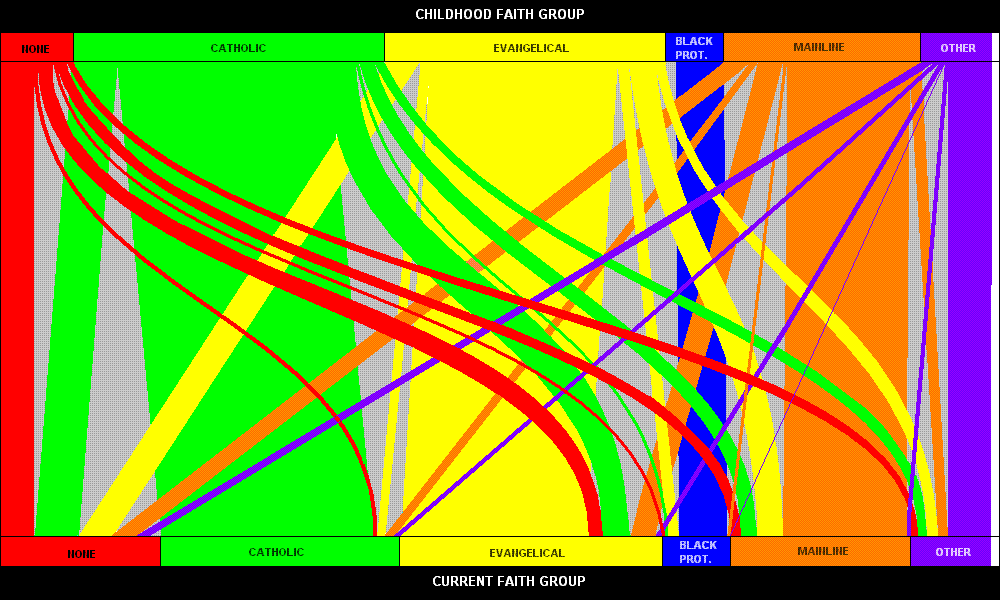
IM First Officer Michael Bell takes a second look at the “no religion” data in the Pew Forum Studies.

I have received a lot of interest and feedback on my last two posts on InternetMonk, concerning how and when people switch between their childhood religion and their current faith. For those who have not had the opportunity to read them, you can read them here and here.

religiousswitching2The question that I have been asked the most is about historical trends in the data. For example, from the graph that I provided you can see that about 50% of adults who were raised non-religious, subsequently joined a faith group. How has this changed over time? (For the purposes of this posting I am using the word “religious” in the way it has been used historically, that is, someone is religious if they are an adherent to a particular faith tradition.)

Bradley Wright, who teaches Sociology of Religion at the University of Connecticut, was kind enough to pass on a source of data where this was analyzed:

Fischer and Hout, in their recent book “Century of Difference” (2006) used General Social Survey data to analyze historical data about religion and childhood. For the most part, the graphs that they provide match up quite nicely with the chart that I provided. Historically, the outflows from Evangelical and Mainline Protestant church have been pretty constant over the last 100 years. Evangelicals have done a better job at retaining member than Mainline Protestants, and so over time have fared better. Typically about 75% of Evangelical 16 year olds will continue their Evangelical affiliation into adulthood. 25% will switch out, a number that is quite similar to what is seen in my chart. Catholics retention is not as strong as it used to be, but according to the Fischer and Hout data is now similar to that of Evangelicals.

ReligiousswitchingovertimeNoReligionContinue reading “Michael Bell: Taking Another Look at the “No Religion” Data”

Internet Monk Radio Podcast #141

podcast_logo.gifThis week: Technology sins. A Ethnically Diverse Evangelical Future.

Support the IM sponsors: New Reformation Press. New products available: New music and DVDs. Emmaus Retreat Center. A great place for your next group or individual retreat. The Devotional Christian. All the best online devotional resources in one place. E3 Sudan is church planting and training pastors in the Sudan.

CNN’s article on the changing racial face of America.
The Next Evangelicalism by Soong-Chan Rah

Intro music by Daniel Whittington. Exit Music by Randy Stonehill. Bumpers by Clay Spencer.

Want to support what I do? Use the Paypal button to make a donation.

A Few Book Ideas I’m Working On

I’m sure everyone knows I’m working on book proposals and hoping for good news soon. In the meantime, I wanted to share with you some of the book ideas I’ve got in my notebook. I have to make some decisions soon because I can’t write them all.

Let’s see what the reading public has to say.

The Snack: The Snack is the story of a man who receives a message from God in a Little Debbie oatmeal cake and is told by God to meet him at the Montgomery Biscuits’ stadium for a weekend series. There God appears to him as an umpire, a vendor and a little kid who keeps kicking his seat.Continue reading “A Few Book Ideas I’m Working On”

iMonk 101: Do You Trust The Abbreviated Jesus?

From November of ’08, one of my favorite meditations on Jesus. And you should pre-order Jared’s book. And read Ross Douthat’s column on Dan Brown.

The other day a strange feeling came over me.

Don’t get me wrong about what I’m about to say here. It was just a feeling. I’m not claiming any powers of discernment or certainty.

I got the distinct feeling there’s something wrong with a lot of people who say they are Jesus-followers/believers.

If you want to supply your own vocabulary, like “aren’t saved” or “aren’t Christians,” do so at your own risk. I’m not saying that. (There’s other blogs for that game, if you are burning to know.)

No, but it was as plain as daylight to me that when I hear a lot of people talk about Jesus, I feel like I am hearing….an abbreviation.Continue reading “iMonk 101: Do You Trust The Abbreviated Jesus?”

The Jesus Disconnect (5): The Processes of Discipleship

So how does the material in the “rest of the Gospels” come into the Christian life? What are the “processes of Discipleship” we see in the first half of the Gospels that should be integrated into faith in the crucified and risen one?

1. We should start with affirming the perspective we’ve gained. The Kingdom of God, which Jesus embodied, proclaimed, taught and practiced is only possible because Jesus is a mediator-King; a King who makes things right through death and resurrection, not through miracles and exorcisms. Hold these things together. See these two tracks in scripture: the establishment of God’s Kingdom and the victory of God’s messiah over evil, sin and death. Jesus death secures our place in his Kingdom, and his Kingdom insures his victory in the world.Continue reading “The Jesus Disconnect (5): The Processes of Discipleship”

Adjectives and Calvinists: A Killer Combination

No one….No one….excels at rhetoric like Calvinists. I’m sorry guys, love ya, but some of you are the biggest fan clubbers I’ve ever seen. Brian Mclaren doesn’t have this kind of devotion. And N.T. Wright can only dream.

Calvin’s birthday has given the rhetorical athletes a chance to really strut their stuff. I know we all can brag, but short of Catholics going on about the saints, do you ever hear anything quite like this? (Note: Please start “William Tell Overture.”)

Towering over the centuries of church history, there stands one figure of such monumental importance that he still commands attention and arouses intrigue, even five hundred years after his appearance on the world stage. Called “one of the truly great men of all time,” he was a driving force so significant that his influence shaped the church and Western culture beyond that of any other theologian or pastor. His masterful expositions of Scripture laid down the doctrinal distinctives of the Protestant Reformation, making him arguably the leading architect of the Protestant cause. His theological thunder defined and articulated the core truths of that history-altering movement in sixteenth-century Europe.

In turn, those lofty ideas helped fashion the founding principles of Western civilization, giving rise to the republican form of government, the ideals of public education, and the philosophy of free-market capitalism. A world-class theologian, a revered exegete, a renowned teacher, an ecclesiastical statesman, an influential Reformer — he was all of these and more. His name was John Calvin.

I think I need to buy a dictionary of adjectives. I’m feeling like I’ve been run over by a truck.