
Reformation Sunday 2017
Sermon & Cantata of the Week
On this historic Sunday, I am actually preaching one of Martin Luther’s sermons (edited). I will be preaching the second “Invocavit” sermon, from March 10, 1522. See the history of these sermons below. It comes from a critical time in the Reformation, about a year after the Diet of Worms, when Wittenberg was experiencing a lot of disturbance because leaders had come in while Luther was in exile at Wartburg and had started making changes in the mass and teaching lots of new doctrines. The people, not having had good instruction, became stirred up, often in ways that were not peaceable and conducive to the true freedom of the gospel. Luther returned from exile to teach order, love and concern for the weak, and the true nature of freedom in Christ.
Following this sermon, my all-time favorite piece by Bach. Just because it’s such a special day.
• • •
Introduction to the Invocavit Sermons
On Invocavit Sunday (the First Sunday in Lent), 1522, Martin Luther began a series of eight short sermons in which he taught the people of Wittenberg how the reformation of the Church should be carried out. It must be based on God’s clear Word and it must care for the conscience of the Christian.
About a year earlier, Luther had stood before the Emperor at the Diet of Worms. This was the famous event when he refused to recant and boldly confessed, “Here I stand. God help me.” Martin Luther had become the voice of truth, the inspiring leader of the Reformation. But following Worms, Luther had to be hidden away Wartburg Castle for his safety. Exiled from Wittenberg, he was unable to oversee what was happening in Wittenberg. While he was hidden away, his colleagues in the town pushed forward with their ideas for change.
Their efforts caused a lot of chaos and confusion throughout the year, including disturbances with mobs that became violent. When Luther heard about these troubles he was shocked. While he didn’t object in principle to most of the changes that had been advocated, he seriously objected to the spirit in which they were carried out. He rejected the use of coercion and saw in these measures the beginning of a new legalism. While Luther desired to throw off the shackles of papal tyranny, he would fight any attempt from his “own side” to set up new man-made laws. The Gospel and its gifts are free and they create freedom.
So, eventually Luther saw the need to return to Wittenberg and by mid-February he City Council asked him to do so. On Invocavit Sunday, the first Sunday in Lent, Martin Luther began a series of sermons that he preached each day for a week. He called the people of Wittenberg to repentance for their rash acts, and he instructed their consciences from the Word of God about the proper way of letting God bring about reform without them going overboard and creating an even worse situation.
Luther’s Second Sermon, Monday after Invocavit (March 10, 1522)
[Edited for Preaching on Reformation Sunday 2017]
We also constantly give thanks to God for this, that when you received the word of God that you heard from us, you accepted it not as a human word but as what it really is, God’s word, which is also at work in you believers. (1 Thessalonians 2:13)
Dear friends, you know the chief characteristics of Christians, that their whole life and being is faith and love. Faith is directed toward God, love toward others and one’s neighbor. This consists in such love and service for the other as we have received from God without our work and merit. Love must deal with our neighbor in the same manner as God has dealt with us; it must walk the straight road, straying neither to the left nor to the right.
In the things which are “musts” and are matters of necessity, such as believing in Christ, love nevertheless never uses force or undue constraint.
Now I say that the mass is an evil thing, and God is displeased with it, because the way it is being performed these days it is as if it were a sacrifice and work of merit. Therefore it must be abolished. Here there can be no question or doubt, any more than you should ask whether you should worship God. Here we are entirely agreed: the private masses must be abolished. As I have said in my writings, I wish they would be abolished everywhere and only the ordinary evangelical mass be retained. Yet, even though this is needful, Christian love should not employ harshness here nor force the matter.
It certainly should be preached and taught with tongue and pen that to hold mass in such a manner is sinful. However, no one should be dragged away from it by the hair! It should be left to God, and his Word should be allowed to work alone, without our work or interference. Why? Because it is not in my power or hand to fashion the hearts of men as the potter molds the clay and fashion them at my pleasure. I can get no farther than their ears; their hearts I cannot reach. And since I cannot pour faith into their hearts, I cannot, nor should I, force anyone to have faith. That is God’s work alone, which causes faith to live in the heart. Therefore we should give free course to the Word and not add our works to it. We have the jus verbi [the right to speak] but not the executio [the power to accomplish]. We should preach the Word, but the results must be left solely to God’s good pleasure.
Now if I should rush in and abolish it by force, there are many who would be compelled to consent to it and yet not know where they stand, whether it is right or wrong, and they would say: I do not know if it is right or wrong, I do not know where I stand, I was compelled by force to submit to the majority. And such compelling and commanding results in a mere mockery: an external show, fools-play, human ordinances, sham-saints, and hypocrites.
For where the heart is not good, I care nothing at all for the work. We must first win the hearts of the people. But that is done when I teach only the Word of God, preach the gospel, and say: Dear lords or pastors, abandon the mass, it is not right, you are sinning when you do it. But I would not make it a commandment for them, nor urge a general law. He who would follow me could do so, and he who refused would remain outside. In the latter case the Word would sink into the heart and do its work. Thus he would become convinced and acknowledge his error, and fall away from the mass; tomorrow another would do the same, and thus God would accomplish more with his Word than if you and I were to merge all our power into one heap.
You see, when you have won the heart, you have won the man — and that is the only way the thing will finally fall of its own weight and come to an end. If the hearts and minds of all are agreed and united, abolish it. But if all are not heart and soul for its abolishment — leave it in God’s hands, I beseech you, otherwise the result will not be good. Faith must not be chained and imprisoned, nor bound by an ordinance to any work. This is the principle by which you must be governed. Instead, simply keep your faith in God, pure and strong, so that this thing cannot hurt you.
Love, therefore, demands that you have compassion on the weak, as all the apostles had. In short, I will preach God’s Word, teach it and write it, but I will constrain no one by force, for faith must come freely without compulsion.
Take myself as an example. I opposed indulgences and all those who supported the corrupt practices of the Church, but never with force. I simply taught, preached, and wrote God’s Word; otherwise I did nothing. And while I slept, or drank Wittenberg beer with my friends Philip and Amsdorf, the Word so greatly weakened the papacy that no prince or emperor ever inflicted such losses upon it! I did nothing; the Word did everything. Had I desired to foment trouble, I could have brought great bloodshed upon Germany; indeed, I could have started such a game that even the emperor would not have been safe. But what would it have been? Mere fool’s play. I did nothing; I let the Word do its work.
What do you suppose is Satan’s thought when one tries to do something by kicking up a row? He sits back in hell and thinks: “Oh, what a fine game the poor fools are up to now!” But when we spread the Word alone and let it alone do the work, that distresses him. For God’s Word is almighty. It takes captive people’s hearts, and when their hearts are captured the work will fall of itself.
Let me cite a simple instance. In the days of the apostles there were Jewish and Gentile Christians, differing on the law of Moses with respect to circumcision. The former wanted to keep it, the latter did not. Then came Paul and preached that it might be kept or not. It was of no consequence. They should not make a “must” of it, but leave it to the choice of the individual; to keep it or not was immaterial. He did not issue a commandment.
So it was up to the time of Jerome, who came and wanted to make a “must” out of it, desiring to make it an ordinance and a law prohibiting circumcision. Then St. Augustine came and he was of the same opinion as St. Paul: it might be kept or not, as one wished. Ultimately, St. Jerome was successful in having it prohibited. After that came the popes, who also wanted to add something and they, too, made laws. Thus out of the making of one law grew a thousand laws. And now they have completely buried us under laws! And this is what will happen here, too; one law will soon make two, two will increase to three, and so forth.
So then, let us constrain no one by force, even concerning things that are necessary. Let us beware lest we lead astray those of weak conscience. Let us spread the Word alone and let it alone do its work. Let us seek to win hearts, not chain them down and burden them with laws and commandments.
• • •
Zion hears the watchmen sing,
her heart leaps for joy within her,
she wakens and hastily arises.
Her glorious Friend comes from heaven,
strong in mercy, powerful in truth,
her light becomes bright, her star rises.
Now come, precious crown,
Lord Jesus, the Son of God!
Hosanna!
We all follow to the hall of joy
and hold the evening meal together.
• • •
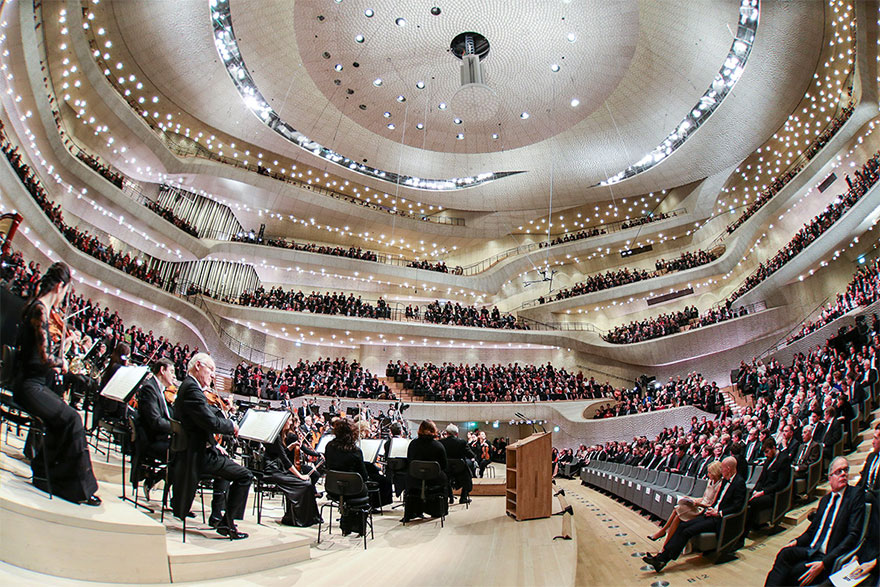
Photo by Neuwieser at Flickr. Creative Commons License












 , edited by Herbert F. Brokering.


 The Internet Monk Archives
