Saturday Brunch, May 30, 2020

Hello, friends, and welcome to the weekend. You know what we haven’t had for a while?  Brunch!!

As usual, I’m not going to bring up the subjects dominating the headlines. The Brunch focuses on the interesting (at least to me), the silly, and the un-reported. I also avoid mentioning a certain politician because, inevitably, the comment section gets nastier than Jabba the Hutt’s tighty-whities. If you want to comment about these things, please do your best to be constructive and kind.

But one picture stuck with me:

Facebook chooses polarization.  An internal Facebook analysis found that the platform was helping polarize the country, but senior executives decided to shelve the analysis and not take action, The Wall Street Journal reported. One presentation given to senior executives warned that “if left unchecked,” Facebook would feed users “more and more divisive content in an effort to gain user attention & increase time on the platform.”

Kevin Roose, a technology columnist at The Times, explains: “It raises the possibility that these presentations — and others like them — will come to be seen as a smoking gun for Facebook, the way that tobacco and oil companies had known about the hazards of their products years before they publicly admitted it.”

“DO NOT RECYCLE CANNONBALLS FROM ANY WAR!” That is the PSA Kent County Commissioner [MI] Phil Skaggs relayed in a Facebook post Tuesday evening. This after Grand Rapids police officers were dispatched to the Kent County recycling center at 12:20 p.m. Tuesday when workers came across what was described as a 6-inch, 6-pound shot-put ball on the processing line, according to the police report.Officers on site found the cannonball was live and likely a percussion-cap style detonator and subsequently evacuated the center, according to the report.

It must be a blow to learn that you’re not the daughter of a famous artist and that your mother was a bit of fibber in the same moment—especially if you’re a psychic and didn’t foresee either. Pilar Abel, a Spanish tarot card reader from Girona, won the right to exhume Salvador Dalí’s body in 2017 to run a DNA test to prove that she was his daughter. Her mother had told her that the artist was her father. Alas, the test showed there was no relation. “After the Madrid court ruled that Dalí was not related to her, Abel filed an appeal calling into question how his remains were handled. On Monday May 18, the Regional Court of Madrid dismissed this appeal, and ruled that Abel was liable for the costs for the exhumation. While no amount was cited, the bill had been previously been estimated to be around €7,000 ($7,678).”

Good question. Better answer.

Image may contain: text

YouTube was caught censoring content on behalf of the Chinese government. Certain phrases are automatically deleted, suggesting that the Youtube algorithms were set to exclude them. One of the phrases that were flagged for automatic deletion was “gongfei,” which means “communist bandit.” The phrase dates back to the Chinese civil war era.

Another phrase is “wumao,” which means “fifty cents.”This phrase is commonly used as a description of the internet trolls that the CCP uses to spread propaganda online; the joke being that the trolls are paid 50 cents per post that they write.

YouTube responded that the deletions were a “bug”. Sounds legit.

You’ve probably heard of the Ghanaian dancing pallbearers. If not, here is the original video that made them famous (and a source for countless memes).

I bring them up so I can bring this up: Montreal Police cruising through a crowded park playing the dancing pallbearers theme song:

A short history of band names:

You wouldn’t have thought that Starbucks’s pricing policy could influence rock history, but that’s what happened. In the early 1990s, when Mike Kroeger was working in one of its Canadian stores, a cup of coffee cost $1.95. So Kroeger spent all day handing customers their five cents change, saying: ‘Here’s your nickel back.’ When he later joined a band, and it needed a name, he simply combined the last two words into one.

Neil Tennant and Chris Lowe, on the other hand, had some friends who, because of their place of employment, were known as the ‘pet shop boys’.

ABBA use capitals not because the letters are the first of their four Christian names, but because there was a brand of canned fish called Abba. Lynyrd Skynyrd was a reference to Leonard Skinner, a teacher who’d told one of the band members to cut his hair.

Many bands use cultural references. Duran Duran tweaked Dr Durand Durand, a character in the film Barbarella, ‘Frankie Goes Hollywood’  was a newspaper headline in a pop art poster about Frank Sinatra taking up acting, while the Human League were characters in a sci-fi wargame.

Literature has given us, the Doors (as in The Doors of Perception by Aldous Huxley), The Fall (by Albert Camus) and Level 42 — the answer to the meaning of life, the universe and everything in The Hitchhiker’s Guide to the Galaxy.

Some bands even owe their names to other bands.  The Ramones were paying tribute to Paul McCartney, who used the pseudonym ‘Paul Ramon’ when checking into hotels. The Beatles themselves had been paying tribute to Buddy Holly, whose backing band was the Crickets.

If all else fails, go random. The Bay City Rollers wanted an American-sounding name, so literally threw darts at a map of the country. But thankfully discretion didn’t desert them completely. Before they hit Bay City, Michigan, they rejected somewhere in the Deep South called Stinking Creek.

And you thought your weekend stunk….The California Highway Patrol said a driver called dispatch around 1:30 a.m. asking for help after crashing into what was at the time an unidentified farm pond. Forty-eight minutes after the initial call, firefighters from the Cosumnes Fire Department found the driver and his vehicle, which was well submerged in the pond, CHP said. Officers later discovered that — on top of showing signs of intoxication — the driver had been trying to pull his vehicle out for about an hour before calling 911.

That’s two hours the driver spent in…. a liquefied excrement pond.

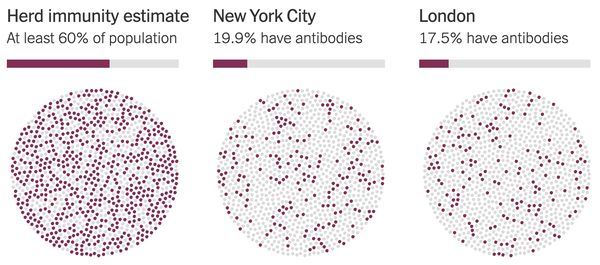
Herd immunity is still far off. London, Madrid and other cities around the world have only a small fraction of the coronavirus cases needed to achieve herd immunity, according to new studies. Experts believe herd immunity — after which new infections will no longer cause large outbreaks — is reached when between 60 percent and 80 percent of the population has contracted the virus.
Even New York, the city with the world’s highest known infection rate, is barely a third of the way there, according to the studies.
By The New York Times


Speaking of adapting to the Corona reality: Image

Image

These priests may have been inspired by Detroit’s Father Timothy R. Pelc, who took to the streets outside his church in order to bless Easter food with a holy pistol last month. Yes, he really did use holy water.

Image

Pelc says that even though he has baptisms scheduled for this week, he does “not intend to use the squirt gun,” saying, in true Catholic fashion, that he’s “retired it because I’ve enjoyed it so much.”

An explosive new book claims that Bill Clinton had an affair with Ghislaine Maxwell, the woman accused of procuring underage girls for notorious pedophile Jeffrey Epstein. In an excerpt of A Convenient Deathpublished in the New York Post, a source tells Alana Goodman and Daniel Halper how ‘[Bill] and Ghislaine were getting it on…that’s why he was around Epstein — to be with her.’ The source goes on to dismiss the idea that Clinton was sexually involved with children, saying the former president is ‘stupid but not an idiot.’ Conspiracy theorists everywhere will be sorely disappointed.

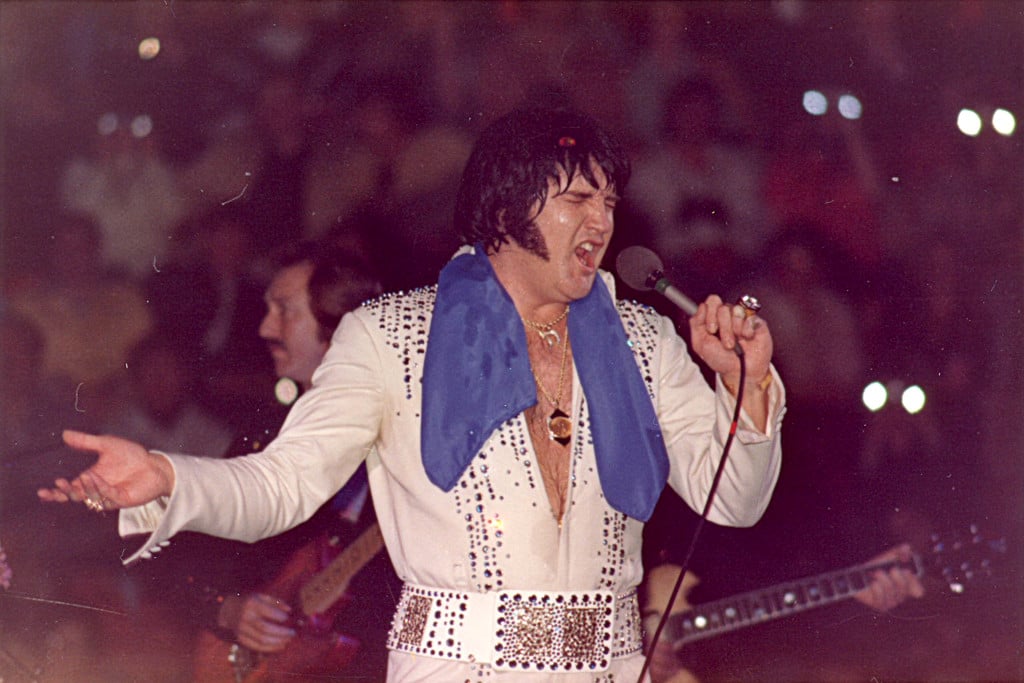
Father’s Day is coming up, and boy-oh-boy have we have found the perfect gift: A jockstrap that belonged to Elvis Presley is up for sale for almost £30,000. The rhinestone-studded posing pouch, bearing The King’s initials, was custom-made by one of Elvis’s fans

The seller called it:“Extravagant. Absurd. Sexually potent. This… is pure Elvis Presley.” He also noted that the King wore it until his death in 1977. Which, to me, is not exactly a selling point.
Try not to think about it…

The problem with thought experiments: “While thought experiments are as old as philosophy itself, the weight placed on them in recent philosophy is distinctive. Even when scenarios are highly unrealistic, judgments about them are thought to have wide-ranging implications for what should be done in the real world. The assumption is that, if you can show that a point of ethical principle holds in one artfully designed case, however bizarre, then this tells us something significant . . . Although philosophers don’t often talk about this, it would appear that they assume that the interpretation of thought experiments should be subject to a convention of authoritative authorial ethical framing. In other words, the experiments are about what the author intends them to be and nothing else, much like Lewis Carroll’s Humpty Dumpty, who used words to mean whatever he wanted them to mean.”

Somehow this reminds me of a line I heard not too long ago: “Imagine their were no hypothetical situations.”

Is it just me, or do you refuse to read anything called a “must-read”.

Hmmm….Was there ANYTHING this man did not write about ?

No photo description available.

Well, that’s it for this week, friends. Let’s end with this short video, which gets more interesting as it goes:

“How can I know the presence of God in my final season of life?” (or at any time?)

A Feather in Time. Photo by diane cordell at Flickr. Creative Commons License

“How can I know the presence of God in my final season of life?” (or at any time?)
An excerpt from Walking Home Together: Spiritual Guidance and Practical Advice For The End Of Life

When people ask about knowing the presence of God in the midst of their terminal illness or death, I sometimes think that extraordinary spiritual experiences or “miracles” are what they imagine. Honestly, I have heard about plenty of them. From seeing Jesus himself to seeing angels, saints, deceased loved ones, little children or other “heavenly representatives,” patients and families have reported to our hospice team a variety of visions, experiences, and impressions. Sometimes the impressions were audible: voices, music, bells, a certain moving of the wind. On other occasions patients and families have witnessed curious events that they have interpreted as “signs.” One patient loved birds, for example, and right before she died a bird perched outside her window and then flew away at the exact moment she passed.

These curious occurrences get our attention, seem to add a level of meaning to sad situations, and bring a measure of comfort. I have little doubt that God can grant such blessings, and I never discount that possibility when presented with someone’s experience. However, it must be said that I’ve never known anyone to have control over such things happening. If these experiences are from God, then it appears to be God’s choice and God’s alone as to when and where and for whom they take place.

Therefore, if someone asks me, “How can I know the presence of God in my final season of life?” I wouldn’t counsel that person to expect the extraordinary vision, impression, or sign. Instead, I would encourage him to seek God’s help through the more ordinary means of grace — prayer, scripture, spiritual reading, the sacraments of the church, other spiritual practices, and so on.

I do have one unequivocal piece of counsel. If a person wants to know the presence of God in the midst of his sufferings, I would urge that person person to look for God primarily in the love of those around him.

Beloved, if God so loved us, we also must love one another. No one has ever seen God. Yet, if we love one another, God remains in us and his love is brought to perfection in us. (1 John 4:11-12)

…Before his death, Jesus summarized what he had taught his disciples: “I have told you this so that you might have peace in me. In the world you will have trouble, but take courage, I have conquered the world” (John 16:33). How did Jesus overcome this evil world with all its troubles? By loving the people of the world and laying down his life for them. He overcame suffering and death by acts of sacrificial love.

Even so, we overcome through love.

If love is God’s answer to human suffering, then knowing God in our sufferings will involve immersing ourselves ever more deeply into loving relationships.

Walking Home Together, pp. 35-40

Four Reasons You Shouldn’t Exist

Four Reasons You Shouldn’t Exist

Here is a cheeky little article by Dave Goldberg who is a physics professor at Drexel University and author, most recently, of The Universe in the Rearview Mirror: How Hidden Symmetries Shape Reality entitled “Four Reasons You Shouldn’t Exist

It’s a nice little reminder of the wonderment that is this universe and our existence in it.  His main point is that we are “impurities in an otherwise beautifully simple universe”.  Think of your lineage back even just 5 generations, and how improbable the pairings of great-ancestors had to be to produce the unique DNA profile that is you.  What were the chances of those meetings that resulted in the marriage-couplings that gave rise to you.  As Goldberg says, “It was improbable that your parents met each other and conceived you at just the right instant, and their parents and their parents and so on back to time immemorial. This is science’s way of reminding you to be grateful for what you have.”

Of course, it goes much beyond that.  We’ve talked many times here of the fine tuning of the physical constants of the universe.  Goldberg says:

Your existence wasn’t just predicated on amorousness and luck of your ancestors, but on an almost absurdly finely tuned universe. Had the universe opted to turn up the strength of the electromagnetic force by even a small factor, poof! Suddenly stars wouldn’t be able to produce any heavy elements, much less the giant wet rock we’re standing on. Worse, if the universe were only minutely denser than the one we inhabit, it would have collapsed before it began.

I know that doesn’t impress some people – but it should.  The change in the electromagnetic force would only have to be 1 part in 1040.  How small is that?

Then Goldberg points out how symmetrical the universe and the laws of physics are.  Which is (or should be) a problem for us.

“Which sounds innocuous enough until you realize that if the entire universe were made symmetric, then all of the good features (e.g., you) are decidedly asymmetric lumps that ruin the otherwise perfect beauty of the cosmos… Everything is kinda the same? Every Friday night is like every other one? Sounds almost comforting. But it would be a mistake to be comforted by the symmetries of the universe. In truth, they are your worst enemies. Everything we know about those rational, predictable arrangements dictates that you shouldn’t be here at all.”

He then brings up Olbers’ Paradox the paradox that in the night sky any line of sight from Earth must end at the (very bright) surface of a star and hence the night sky should be completely illuminated and very bright. This contradicts the observed darkness and non-uniformity of the night.  Goldberg explains:

If you suppose that astronomers are just playing math games, go to the middle of a forest. Nearby trees will look big. More distant trees will look small, but there are so many of them that if you’re far enough into the woods, you won’t be able to see out in any direction. Now suppose that those trees were on fire and were as bright as the sun. In Darkness at Night: A Riddle of the Universe, the cosmologist Edward Harrison puts it rather poetically:  “In this inferno of intense heat, the Earth’s atmosphere would vanish in minutes, its oceans boil away in hours, and the Earth itself evaporate in a few years. And yet, when we survey the heavens, we find the universe plunged in darkness.”

The symmetry of the universe would bake us in no time at all, but an asymmetry rescues us. Kepler recognized that for the sky to be dark at all, the universe must be “enclosed and circumscribed by a wall or a vault.”

That asymmetry is the arrow of time.  Time only moves in one direction.  Although the physics of very small particles and very small events seem to run the same in any direction; the physics of large scale events have, nevertheless acquired the unidirectional arrow we call time.  Goldberg says:

Without an arrow of time, life certainly couldn’t exist as we know it. The chief—really the only—distinction between time and space is that in space you can go forward and backward, but time is one-way. Without a definite arrow of time—a broken symmetry—there’d be no future or past, no scientific discovery, no anticipation, and no memory. Is that really living?

The worst impediment to our existence, he says, is that “In the simplest of all possible universes, all fundamental particles should be massless, and some are, like the photon.”  For 50 years, physicists have postulated that some kind of field would have to exist that gave rise to mass.  In 2012, in the Large Hadron Collider, the Higgs boson was discovered .

In atoms, electrons allow for a flow of electricity, and by sharing electrons between atoms, allow for bonding, for chemistry itself. Just as a spaceship will escape the gravitational pull of the Earth, a massless electron (which, by definition, will travel at the speed of light) will easily break its molecular bonds.  Without electrons binding to protons, there would be no chemistry, no molecules, and nothing more complicated than a cloud of charged gas.

But, improbable as it seems, there is.  And therefore, we are.  Now you don’t have to be a Christian, or even a theist, to appreciate this wonderment.  But our viewpoint as Christians gives meaning and purpose to this wonder.  Psalm 19:1, “The heavens declare the glory of God; and the firmament sheweth his handywork.” John 1:3, “All things were made by him; and without him was not any thing made that was made.”  Colossians 1:16, “For by him were all things created, that are in heaven, and that are in earth, visible and invisible, whether they be thrones, or dominions, or principalities, or powers: all things were created by him, and for him.”

As improbable as it seems, we were created by him, and for him.  That is reason enough for us to exist.


Wednesday with Michael Spencer: “The exhausting effort to be a good Christian denies Christ.”

daughter of sisyphus. Photo by Andrew Wallace at Flickr. Creative Commons License

Wednesday with Michael Spencer
Excerpt from Mere Churchianity: Finding Your Way Back to Jesus-Shaped Spirituality

I discovered, while listening to a lecture on Luther’s breakthrough discovery of grace, that the victorious Christian life is a lie. It is a completely un-Jesus-shaped imposter. The Christian life isn’t a denial of the prodigal son parable, with the prodigal suddenly becoming a good boy and making his father proud. It is lived at the point where the empty-handed, thoroughly humbled son kneels before his father and has nothing to offer. The son can do nothing but be loved. He is empty and has only one recourse—receive the gift of all things and eternity.

The exhausting effort to be a good Christian denies Christ. If you insist on securing your own holiness and acceptability, you disqualify yourself from receiving anything from Jesus. He came to earth to save sinners, not good Christians.

This discovery, like most Jesus-shaped discoveries, doesn’t go over well in your usual religious environments. It plays well in AA meetings, counselors’ offices, bars, and prison chapels, but doesn’t fit the program in the success seminars and motivational sessions passing as mainstream North American evangelicalism. It falls far short of the glamorous lifestyles of wealth, beauty, and popularity that keep showing up in church promos. It is, however, very good news to the poor, the brokenhearted, and the destitute, who welcome the message that Jesus proclaimed and lived.

If you have left the church or are headed for the door, there is a strong possibility that you have to leave in order to hold on to your integrity. You realized you can no longer play the religion game. You may be playing other games—I’m not letting any of us off the hook. But you found you could no longer be party to the endless act that says you are living the victorious Christian life.

If that is the case, your leaving in order to find true humanity, real vulnerability, and surprising grace may be the greatest gift you could give to the church. Not because of your absence, but because you have become one more person who has chosen real life in place of the inauthenticity of pretending to have it all together.

Mere Churchianity (p. 135-136)

Being Merciful to Yourself (especially for caregivers)

Being Merciful to Yourself
An excerpt from Guide Them Safely Home, Lord: A Caregiver’s Companion

Mercy triumphs over judgment.

– James 2:13

* * *

I recently read an article by Marian Friedrichs in which she shared the following experience:

One Saturday, when I confessed yet again to judging other people harshly, the priest told me, “I want you to work on loving and accepting yourself. If you can’t have compassion for yourself, you can’t have compassion for anyone else.” He was right. If I constantly criticize myself, it’s tempting to look smugly at other people to make myself feel better. On the other hand, if I accept myself as I am, I don’t need to try to feel superior to others, so I can see them with loving eyes. Self-acceptance also helps me avoid the habit of critical thinking that inevitably clouds the way I see everyone, not just myself.

“Show Mercy to Yourself,” marian.org

Some of us are, by nature, hard on ourselves. We may be perfectionists. We find it hard to accept the fact that we will make mistakes or fail to accomplish every single goal we set out to achieve. Others are mistake-prone and find themselves feeling a constant sense of guilt and shame that they aren’t more quick-thinking, coordinated, or capable. And of course, at time we have all willfully lived with selfishness and disregard for God and other people.

There is not one of us who has lived perfectly. We humans are limited, imperfect, and subject to all kinds of influences and powers stronger that we are. Each of us sins. We all miss the mark. Every person must look in the mirror and figure out how to deal with failure, disappointment, and regret. The Book of Common Prayer encourages us to ask forgiveness, recognizing that “we have left undone those things which we ought to have done, and we have done those things which we ought not to have done….”

A person who faces the challenging job of caregiving each day will have an abundance of opportunities to fall short. There is no perfect caregiving. It is messy, perplexing work that can be maddening at times. You will get tired, angry, sad, or forgetful. You won’t always to things on time, in the right order, or with perfect skill. You may disappoint yourself and others.

Do your best, and leave room for mercy. You can be both hard and gentle on yourself. It is no sin to have high standards, but please accept that you are human, not superhuman. To some degree, you will fail. But you are not a failure. Receive and extend God’s mercy to yourself, even as you seek to be merciful and caring toward others.

The Consummate Cockburn Collection – Part Three

Welcome once again to our Consummate Cockburn Collection.  If you missed it, you might want to check out our list of Cockburn top ten albums in part one and part two.

But what about those songs that didn’t make the top ten albums?  Are there any gems in those other albums that you might want to listen to?  Well, as a matter of fact there is.

Once again I am joined by my good friend Peter Heath.

Peter: Even though I have always appreciated Bruce Cockburn’s work and count him as an influence in my own attempts at songwriting, to be honest it has been a while since I really dug into his catalogue. Working with Mike on these blog posts has challenged me to review his catalogue in depth – the parts that have always resonated with me as well as portions that I haven’t paid as much attention to. In particular, I have been digging into his 21st century albums with more intentionality than ever before. And so, lest we think of the man only as a historical figure, I would like to shine a light on some worthy songs from the last 30 years of his career (let’s pause and consider how mind blowing that statement is). But that said, I first want to visit three songs from the first 20 years.   

Dweller By A Dark Stream (Mummy Dust 1981)
Dweller is Cockburn’s clearest articulation of his faith in Christ, and for that reason it is one of my favourites. Musically it is pretty straightforward (not to be confused with being boring or poor quality) and fits well with the electric direction he embarked on in the early 80s. Lyrically, the first verse stakes out his theme with almost unusual clarity. 

It could have been me put the thorns in your crown
Rooted as I am in a violent ground
How many times have I turned your promise down
Still you pour out your love, pour out your love

Those lines wouldn’t be out of place in any contemporary Praise and Worship song, which is kind of surprising for Cockburn. But then the chorus pivots into a unique way of expressing our lostness without Christ and the gift we have: 

I was a dweller by a dark stream
A crying heart hooked on a dark dream
In my convict soul I saw your love gleam
And you showed me what you’ve done
Jesus, thank-you joyous Son

Love it. 

All The Diamonds (Salt, Sun and Time 1974 )
Diamonds is another clear articulation of faith, but this time Cockburn brings all the power of his poetic capabilities to the task. This song is full of metaphor and marine imagery describing a life left behind. So what changed? The “gull chased ship” has got to be symbolic, right? He then departs his nautical theme for a single couplet that drives home the point with as much clarity as this crafty songwriter wants to provide, if you want to follow:

Two thousand years and half a world away
Dying trees still grow greener when you pray 

What a fascinating way to describe the New Life. 

Musically, this may be the single most elegant, delicate (but not weak) and beautiful song in Cockburn’s entire catalogue. The guitar work alone could make you weep. 

Stolen Land (Waiting For A Miracle 1987)
The original was a funky number (what? Bruce Cockburn funky?) that bore the musical influence of Hugh Marsh, Cockburn friend and collaborator on multiple albums. (Check out the violin solo at the end of Loner, that is Marsh at his best.) And it was good and you could actually dance to it, but then Cockburn went on a solo tour in 1999 and figured out how to play this song with nothing but a bodhran (a Celtic drum) and a Bo Diddley beat. There is no way this should have worked, but it ended being better than the original. Lyrically, Cockburn tackles First Nations land claims and pulls no punches on what has happened and where we are now (“Stolen land — but it’s all we’ve got; Stolen land — and there’s no going back … So now we’ve all discovered the world wasn’t only made for whites, What step are you gonna take to try and set things right”). This issue is real and it is more complex than I thought it was 30 years ago. But that last question in the lyrics is still something to ask ourselves. 

Mike: Well before you continue on with the rest of your song list, let me jump in with a couple of observations.

Dweller by a Dark Stream and All the Diamonds were both at the top of my list of songs not on the top ten albums.  Both would also be on my top ten list of all Cockburn songs if I had one.  

Stolen Land didn’t grab me the way it grabbed you though I agree that the message is important.    The glacial pace of land claims settlements has been atrocious.  Some have dragged on for over 100 years.  (I am speaking of the Canadian experience here as that is what I am most familiar with.)   Let me tell you about a similarly themed song that did grab me.

Red Brother Red Sister (Circles in the Stream 1977)
This song resonated with me much more as to the plight of the First Nations in Canada for a couple of reasons:  Musically Cockburn was able to weave in a native chant into the song which really carries the song along.  The lyrics are quite biting and he doesn’t hide his disgust that Christianity, and the name of his Saviour was used to propagate injustice.

Went to a pow wow, red brother
Felt the people’s love/joy flow around
It left me crying just thinking about it
How they used my saviour’s name to keep you down

I had to think.  Does injustice bring me to tears?  If not, why not? What am I doing about it?  

I really appreciate how Steve Bell has taken up the torch in speaking up for indigenous people?

Before you move on to some of Bruce’s later works, I had a few other favourites of my own from his earlier days that I wanted to mention.

Thoughts on a Rainy Afternoon (Album: Bruce Cockburn 1970)
This is a song that has really resonated with me throughout the years.  Hard to believe that Bruce’s self titled first Album was launched 50 years ago.  The refrain is a prayer “Oh Jesus, don’t let Toronto/Tomorrow take my love away.”  It is a simple song that any young student of guitar could play, which is maybe what drew me to it in the first place.  I liked the classic descending bass line, perhaps the only time that Bruce used one is his vast discography.  And for a time, that prayer became my own.

Joy Will Find A Way (Album: Joy Will Find A Way 1975)
Along with Festival of Friends, this is another song I would like played at my funeral/memorial service. It is a short song about dying, but the refrain “joy will find a way, joy will find a way” is a reminder to me that we have a hope that extends beyond this mortal coil.  I know that I can be a downer at times as I “kick against the darkness”, but ultimately I would like to be known as a person of joy.  I am just not sure that I am quite there yet.

Coldest Night Of The Year (Album: Mummy Dust 1981)

Mummy Dust was his first compilation album, and Coldest Night of the Year was one of two new songs on the Album.  The Album is highly recommended if you want to get a sense of some of Bruce’s earlier works.  It didn’t make our Top Ten album list simply because we excluded compilation albums.  Coldest night of the year is another song that reflects back on his marriage breakup. 

I was up all night, socializing
Trying to keep the latent depression from crystalizing
Now the sun is lurking just behind the Scarborough horizon
And you’re not even here
On the coldest night of the year.

Scarborough was the municipality that the other parts of Toronto turned their noses up at, and nicknamed it Scarberia.  Using Scarborough in conjunction with “coldest night of the year”  conjures up an image of desolation.  But he isn’t talking about physical temperature here, he is talking about the coldness of a missing relationship.   Ironically, Scarborough contains one of the prettiest parts of the city.  Walking along the Scarborough bluffs overlooking Lake Ontario is a wonderful way to spend a summer afternoon.  If you were wondering about the significance of the picture accompanying this post, well, now you know.

Santiago Dawn (Album: World Of Wonders 1986)
Santiago Dawn was another song that I found absolutely mesmerizing, and I played it on repeat over and over.  Bruce sets aside his guitar in favour of a Charango, a small mandolin sized instrument traditionally made in South America from the shell of an Armadillo.  I find that Cockburn is at his best when he is telling a story, and this song is no exception.    Here he writes about the Chilean death squads that had been terrorizing the country since 1973 

Something moves in the still dark hours
Sunday in a shanty town
Eyelids open two by two
But not a single light goes on

Tension builds as the only sound
Is the quiet clash of metal and boots
And now and then an order barked
At the bullies in the drab green suits

Military thugs with their dogs and clubs
Spreading through the poblacion
Hunting whoever still has a voice
Sure that everyone will run…

The interplay of the higher pitched Chirango, representing the hopes and dreams of those living in the shanty town, with the thump of the bass drum, representing the oppressors, is extremely powerful.  Written at the same time as the Stealing Fire Album, this song is different in that it resolves with hope for an end to the tyranny.

I got a dream and I’m not alone
Darkness dead and gone
All the people marching home
Kissing the rush of dawn

I know that Santiago Dawn makes your list of top songs as well Peter.  I think you are a little more familiar than I am with his more recent albums, so why don’t you tell us what has stood out to you that hasn’t already been mentioned.

Closer to the Light (Dart To The Heart 1994)
Peter:  Thanks Mike.  A few years after I discovered Bruce Cockburn I bumped into Mark Heard, an American folk-rock singer-songwriter-engineer-producer. He was the only songwriter I know of that can match Cockburn’s poetic abilities; Heard was also amazing on acoustic guitar and mandolin. (Dig up his albums Eye of the Storm and Second Hand.) Tragically, Heard died of a heart attack in 1992 at the age of 40. A lot of people were shocked and saddened at his passing, including Cockburn who composed Closer To The Light as his tribute. So, it comes as no surprise that this song appears on my list, but it is also a fantastic song giving voice to deep mourning while desperately holding onto a Hope that evidently didn’t feel hopeful at the time (“another step deeper into darkness, closer to the light”). The music and lyrics fit so well together, communicating the melancholy of that moment with depth and beauty. By the way, this song was covered by Steve Bell on his album My Dinner With Bruce – three of my favourite songwriters tied together in one song. 

Last Night of the World  (Breakfast in New Orleans 1999) 
One of Cockburn’s gifts is taking a seemingly mundane moment in life, linking it with other moments that may or may not appear to be related and pulling out a thread of significance most of us would miss. Last Night Of The World is like that – a 3AM drink, a fruit fly, tires hitting potholes, bar-throb bass and laughter … a burden, a day when we’re pried loose … all building in a seemingly random way to the last verse:

I’ve seen the flame of hope among the hopeless
And that was truly the biggest heartbreak of all
That was the straw that broke me open

These lyrical considerations ride on top of an insistent, yet somehow playful acoustic guitar (note the thrumming on the low E string which is a common element in Cockburn’s playing)

The verses occupy a small range in Cockburn’s lower vocal range, then the chorus rises with both voice and guitar and the question, “If this were the last night of the world, what would I do, what would I do that was different?” The answer for Cockburn is a little surprising (make sure you check it out). But in many ways the question is enough. Isn’t that something we should all ask ourselves?  

Open (You’ve Never Seen Everything 2003) 
Most of my comments in these posts have focused on lyrics. And lyrics are a big deal, there are lots of popular songs (and popular people) that say many words without saying anything at all. Lyrics are most effective when they are carried well by the music, often focused on Cockburn’s guitar work (and rightly so). This song is a little different. The lyrics are great, offering a vision of openness of spirit in opposition to too much striving for balance. But I really enjoy the way the whole band builds the music together. The drums and bass advance and recede in perfect waves. Sarah Harmer’s backing vocals punctuate the message. Hugh Marsh’s violin sings in anticipation and continues in counterpoint that complements the melody superbly. A little triumph for teamwork here, especially for a “loner” like Cockburn. 

See You Tomorrow (Life Short Call Now 2006)
Longing and expectation crash into each other at high speed in the propulsive second song of Life Short Call Now. So naturally, Cockburn starts this song relating a bizarre interaction with a gun runner in the 60s! The point of that is how he “liked the thought of living that guilt-free” which then runs headlong into the real point of the song – how you can handle the pains and restrictions of life when you know something amazing is just up ahead. 

40 Years In The Wilderness (Bone On Bone 2017) 
Starting off with deliberate thoughtfulness, this song finds Cockburn at another moment of decision. He cleverly plays with some key Biblical images of different people hitting decision points – Israel chooses fear and gets 40 years in the wilderness, Jesus chooses fasting for 40 days and nights before starting his public ministry, Esau tragically chooses his stomach, Philip chooses a random direction from an angel and helps birth the African church. Cockburn’s own decision? Play it safe, stick with what you know, or launch into something new. You get the sense from the song that he will choose the new, even at age 70. The musical setting is relatively simple, which matches the title and theme very well. The backing vocals are provided by some of the singers from his church in San Francisco; they lift the song into a loveliness that Cockburn’s own earnest singing cannot often attain. 

Bardo Rush (Crowing Ignites 2019) 
Finally, the lead song from Cockburn’s latest album Crowing Ignites which was released just last year. That means Bruce is north of 70 now and can still compose and play inventive, driving instrumentals like this one with just his acoustic guitar. In other words … dude still got chops!  

Mike:  Thanks for joining us Peter.  It has been great to look back on all this music with you. I should mention that the thing that inspired this series was Peter nominating me in a Facebook post of his most influential albums.  I declined, but it got the wheels churning, and I proposed this idea back to Peter.   It has also certainly brought back memories of some of our own adventures together.  A veritable cornucopia of “the best stories come from bad decisions!”

We will leave that for another day.

As always your thoughts and comments are welcome!

Riffing on Richard Beck and Why God Matters

Rev. Bill Vanecko, a retired pastor, prays on Palm Sunday, April 5, during a live-streamed service in a nearly empty Saint Columbanus Catholic Church in Chicago.

Riffing on Richard Beck and Why God Matters

In a recent post at the always excellent Experimental Theology blog, Richard Beck opines that the most important question facing Christians and churches today in this pandemic is why God matters to us.

He gives two examples of Christian reactions to the Covid-19 crisis that he has observed. The first involves Christian people taking a stand for and promoting common sense health and safety measures. He welcomes this as a legitimate expression of wisdom, but far short of the kind of theological thinking that involves God in what we’re thinking about, praying about, and talking about. The second is the impulse to serve. Once more, this is a necessary and noble reflex for those who follow the One who came to serve, but again Beck suggests that doing benevolent work in our communities still doesn’t necessarily force us to face the God question.

Over the last two months, as we’ve wrestled with the world of COVID-19, I’ve been having a bunch of scattered thoughts about God and the church.

The big question I’ve been thinking about is this: How does God matter in our lives?

It seems to me that this is the most pressing question facing churches today. Two places where this thought has occurred to me.

First, when you look at progressive Christian Twitter the spiritual counsel being offered is, well, not all that impressive. It basically boils down to wash your hands, social distance, and practice self-care. All legitimate bits of advice, but you don’t really need God for any of this. Just follow the recommendations of the CDC and listen to your therapist. When this is the content of Christian speech during crises–#selfcare and #medicalprofessionals–God isn’t adding anything to our lives, or to our ability to cope with challenging times. During pandemics you don’t really need God. All you need is science and self-care.

Second, I was on a call with some pastors recently, invited to share some thoughts and encouragements during this difficult time. During the call, one of the pastors lamented how he wished his church had more and better ways to meet the needs of his community as we wrestle with the world of COVID-19. Specifically, there were so many good community organizations already in full swing and doing great work this pastor couldn’t see the niche for his church. And without that niche, he felt that the church was useless.

I totally empathized, and encouraged his church to find some place to serve or support the community, but I also offered a caution or, perhaps, a question.

Specifically, the church doesn’t primarily exist to do benevolence work in the community. The church should do this sort of work, and I’m even comfortable in saying the church must do this work. But the church can’t be reduced to this work.

So I shared with the pastor, you’re right, there’s lots of good work being done by community organizations. And they often do this work better than the church. But a pressing challenge for pastors is to boldly articulate for your congregation why God matters independently of social work.

My point in all this, again, is that Christians and churches need to articulate why God matters, beyond science, self-care, and social work.

This, I think, is the theological labor of our time.

The first thing I would say in response is that crises tend to limit our imaginations by necessity. Pressed to respond to the immediate situation, we tend to lock in on a few actions we deem appropriate and helpful. We may not have time for much in the way of reflection or theological discussion.

However, this pandemic has afforded a different kind of opportunity. We are not all fulfilling roles of health providers who work to exhaustion caring for Covid-19 patients in addition to carrying their normal load. In fact, for a lot of us, life has slowed down and given us ample opportunity to read, think, pray, and have conversations via various ways of connecting.

With regard to the two responses Richard Beck writes about, I would hope that we would not only practice common sense wisdom and works of helpfulness, but also go deeper in our theological reasoning as to why these things are important. Though he urges us to think of why God matters independently of these responses, I prefer to start there.

This virus gives us an optimal opportunity to think about the nature of God’s creation, the importance of our bodies, and the vocation God has given us as this good world’s stewards. God matters because “We believe in God the Father Almighty, Creator of heaven and earth.” That’s why my attention has gone back to the first pages of the Bible and I encourage us all to reflect upon why a good Creator God matters in the midst of a pandemic.

One complaint I’ve always had about evangelicalism is that I’ve seen a lot of shallow activism without a corresponding amount of devotion given to serious study, attention to history and tradition, and spiritual practices. But I would never criticize the impulse to serve. Nor does Richard Beck, though he notes correctly that our faith cannot be reduced to good works alone.

When our work pauses, there is ample time to let the experience of serving our neighbors (and being served by them) lead us into a deeper love for Jesus, the servant of all, and a more profound grasp on why he matters to us and to the world. Let’s not miss this chance to develop a more Jesus-shaped theology and spirituality.

Bonhoeffer: Who Am I?

This poem is from one of Bonhoeffer’s final prison letters, shortly before his execution. Though most of us are not facing certain death as he was, nevertheless I find the expressions in this poem relevant to what we may be experiencing and feeling in these uncertain days of pandemic and lockdowns.

• • •

Who Am I?
By Dietrich Bonhoeffer

Who am I? They often tell me
I step out from my cell
calm and cheerful and poised,
like a squire from his manor.

Who am I? They often tell me
I speak with my guards
freely, friendly and clear,
as though I were the one in charge.

Who am I? They also tell me
I bear days of calamity
serenely, smiling and proud,
like one accustomed to victory.

Am I really what others say of me?
Or am I only what I know of myself?
Restless, yearning, sick, like a caged bird,
struggling for life breath, as if I were being strangled,
starving for colors, for flowers, for birdsong,
thirsting for kind words, human closeness,
shaking with rage at power lust and pettiest insult,
tossed about, waiting for great things to happen,
helplessly fearing for friends so far away,
too tired and empty to pray, to think, to work,
weary and ready to take my leave of it all?

Who am I? This one or the other?
Am I this one today and tomorrow another?
Am I both at once? Before others a hypocrite
and in my own eyes a pitiful, whimpering weakling?
Or is what remains in me like a defeated army,
Fleeing in disarray from victory already won?

Who am I? They mock me, these lonely questions of mine.

Whoever I am, thou knowest me; O God, I am thine!

• Clifford J. Green, The Bonhoeffer Reader

The Liturgy of Creation (Introduction)

Chicago Botanical Gardens 1 (2018)

The Liturgy of Creation (Introduction)

As I said the other day, I am working through Michael Lefebvre’s revelatory book, The Liturgy of Creation: Understanding Calendars in Old Testament Context. RJS has also been blogging on this at Musings on Science and Theology.

Michael Lefebvre is the teaching elder/pastor at Christ Church Reformed Presbyterian in Brownsburg, Indiana. He grew up outside of Cleveland, Ohio, and moved to the Indianapolis area in the mid-1990s. Michael received his MDiv from the Reformed Presbyterian Theological Seminary in Pittsburgh, and his PhD from the University of Aberdeen in Scotland. One thing that I surmise about his study from knowing Lefebvre’s faith tradition is a strong respect for a sabbatarian perspective.

Today I will simply introduce the main thesis of the book with excerpts from the text itself.

I want to propose in this book that the Genesis 1:1–2:3 creation week is most fruitfully read as a “calendar narrative.” It is a special kind of historical narrative in which historical events are given the dates of a festival observance (sabbath observance in the case of the creation week), without regard for the timing of the original occurrence.

…I argue that the creation week narrative is, transparently, not a chronological account of the original creation event. Instead, it is a structured retelling of the creation around the pattern of a Model Farmer tending his fields and livestock each day of the week until the sabbath. This form was to serve as a practical guide for the lay Israelite in his or her weekly labors and sabbath worship, and it does not even attempt to answer the curiosities of modern science regarding the processes or timing of the original creation event.

…My desire is to promote the creation week as a rich and practical guide for the weekly labors and worship of God’s people, and I hope to urge Christians to “pull back” from its frequent misuse in scientific, anti-scientific, and pseudo-scientific polemics. I want to show in this book that the creation week was designed as a guide for faithful work and sabbath worship, and that we rob the text of its intended force when we instead deploy it in disputes about physics, cosmology, and natural history. This, I believe, is how the fourth commandment teaches us to uphold the creation week calendar.

The Liturgy of Creation (Kindle Locations 328-351)

The Death of Expertise

The Death of Expertise

“Snake oil is a euphemism for deceptive marketing and health care fraud. It refers to the petroleum-based mineral oil or “snake oil” that used to be sold as a cure-all elixir for many kinds of physiological problems. Many 19th-century United States and 18th-century European entrepreneurs advertised and sold mineral oil (often mixed with various active and inactive household herbs, spices, and compounds, but containing no snake-derived substances whatsoever) as “snake oil liniment”, making frivolous claims about its efficacy as a panacea.” https://en.wikipedia.org/wiki/Snake_oil

It seems to me that the “snake oil” phenomenon is still very much alive and well in 21st Century America.  Recently, a certain televangelist was warned by two state Attorney Generals to stop promoting “silver solution” as a cure for the coronavirus. Another news article tells of “Strange devices (that) have been cropping up on the lapels of political figures around the world. Sometimes known as Air Doctor and sometimes as Virus Shut Out, they look like normal ID badges. But according to their manufacturers, they use chemicals to wipe out airborne pathogens and protect wearers from disease.”

This article in the Federalist by Tom Nichols, a professor of national security affairs at the U.S. Naval War College and an adjunct professor in the Harvard Extension School, encapsulates my rant for today.  Tom says:

I fear we are witnessing the “death of expertise”: a Google-fueled, Wikipedia-based, blog-sodden collapse of any division between professionals and laymen, students and teachers, knowers and wonderers – in other words, between those of any achievement in an area and those with none at all.

Just so, and it bothers me greatly.  Of course, experts can make mistakes, they are, after all, human like the rest of us.  But when somebody spends years at schools and universities studying a subject, and then years laboring in that field of study gaining real world experience—why wouldn’t you listen to them?  Why wouldn’t you give more weight to their opinion on their subject than someone with no schooling or experience on that subject?  I am a scientist with expertise in certain areas of geology, but not in other areas.  Even though I have more experience and knowledge than a layman, I’m more than happy to yield my opinion when I recognize expertise in someone else.  I just don’t get the current attitude. Nichols says:

To reject the notion of expertise, and to replace it with a sanctimonious insistence that every person has a right to his or her own opinion, is silly… Worse, it’s dangerous. The death of expertise is a rejection not only of knowledge, but of the ways in which we gain knowledge and learn about things. Fundamentally, it’s a rejection of science and rationality…

Nichols uses the example of whooping cough, an often fatal scourge that was nearly eliminated last century.  But it is now resurging in this country because otherwise seemingly intelligent people aren’t vaccinating their children.  And they are following, not the advice of medical professionals or their own doctors, but this…this… this… ditz 

Who said, “The University of Google,” she said to Oprah, “is where I got my degree from.”

How did we, as a society, get to this point that we ignore competence and expertise and give ear to foolish and dangerous nonsense?  Nichols argues some of it is due to globalization and the rise of the internet.  There are no longer gatekeepers or editors that used to filter at least the most egregious idiocy.  Nichols says:

Now, anyone can bum rush the comments section of any major publication. Sometimes, that results in a free-for-all that spurs better thinking. Most of the time, however, it means that anyone can post anything they want, under any anonymous cover, and never have to defend their views or get called out for being wrong.

The universities bear some blame, as they no longer educate students but have become “boutiques, in which the professors are expected to be something like intellectual valets. This produces nothing but a delusion of intellectual adequacy in children who should be instructed, not catered to.”

The Dunning-Kruger effect in action

Of course, some of this is just human nature and was always so.  In psychology it is called the Dunning-Kruger effect  a lack of self-awareness where the person vastly overestimates their knowledge and expertise, when, in fact, they are a… well… dumbass!  A loud, in-your-face, supremely confident, obnoxious one at that!

What can be done?  Nichols has some ideas:

  1. We can all stipulate: the expert isn’t always right.
  2. But an expert is far more likely to be right than you are. On a question of factual interpretation or evaluation, it shouldn’t engender insecurity or anxiety to think that an expert’s view is likely to be better-informed than yours. (Because, likely, it is.)
  3. Experts come in many flavors. Education enables it, but practitioners in a field acquire expertise through experience; usually the combination of the two is the mark of a true expert in a field. But if you have neither education nor experience, you might want to consider exactly what it is you’re bringing to the argument.
  4. In any discussion, you have a positive obligation to learn at least enough to make the conversation possible. The University of Google doesn’t count. Remember: having a strong opinion about something isn’t the same as knowing something.
  5. And yes, your political opinions have value. Of course they do: you’re a member of a democracy and what you want is as important as what any other voter wants. As a layman, however, your political analysis, has far less value, and probably isn’t — indeed, almost certainly isn’t — as good as you think it is.

Well, I’m NOT giving up.  I’m going to keep insisting, in my circle of friends and family, that we heed the advice of the experts and ignore the conspiracy theorists.  That we not keep silent but speak up and rebuke nonsense with common sense. Maybe I’ll get shouted down sometimes… well so be it.  I’ll pay the price.  And I’m urging all who read this post to keep on keeping on.  Don’t grow weary in well-doing.  Don’t give up the fight.  Be the voice of reason when you are given the opportunity.  Rant over – Mike out- mic drop.