Please, just say it

There is no case that can be made biblically for a woman preacher. Period. Paragraph. End of discussion.

• John MacArthur

• • •

Last week, John MacArthur celebrated 50 years in the pastorate at a conference at his congregation Grace Community Church. During the event, MacArthur accused the Southern Baptist Convention of taking a “headlong plunge” toward allowing women preachers after women spoke at the SBC’s 2019 annual meeting.

That, he said, was a sign that the denomination no longer believed in biblical authority.

“When you literally overturn the teaching of Scripture to empower people who want power, you have given up biblical authority,” said MacArthur.

A moderator also asked MacArthur and his fellow panelists to offer their gut reactions to one- or two-word phrases.

When the moderator said “Beth Moore,” MacArthur replied, “Go home.”

John MacArthur Is No Stranger to Controversy, CT

John MacArthur put his best fundamentalist face forward again recently during the 50th anniversary celebration of his pastoral ministry. No one should be surprised. I’m certainly not.

What I am surprised about is the softball treatment given Johnny Mac by Christianity Today.

First, I read Jen Pollock Michel’s piece, “A Message to John MacArthur: The Bible Calls Both Men and Women to ‘Go Home.'”

Completely ignoring a direct take on his words, Pollock tries to counter MacArthur’s curt and craven command for women to “go home” with a convoluted argument that emphasizes the historical background of “home” being a place where both men and women fulfilled their respective vocations.

Her piece represents a typical form of evangelical avoidance with which I am well familiar, having been a pretty regular practitioner of it myself for years. Don’t directly take a stand, especially against another believer in public. Instead, go to the Scriptures and figure out some other interpretation that will give you the satisfaction of feeling like you made a solid “biblical” case that sidesteps the controversy but helps you make what you think is an important, related point.

My dear Ms. Pollock, John MacArthur is paying no attention. You didn’t even begin to touch what he’s all about.

Then there is the discussion between Jonathan Holmes, Morgan Lee, and Mark Galli, which contains the excerpted quote above. As you read the article (which is a summary of the podcast), you can see another evangelical trait: I call it “analytical insiderism” — the tendency to be “nice,” to give the benefit of the doubt, to use reason and analysis to try and understand the “worldview” behind the words of a preacher like MacArthur, who may have noticeable flaws, but after all he’s one of our own. Especially when you have a long history with said preacher, as CT does with JM.

The impression I get from the discussion is that John MacArthur has many, many admirable qualities, but he can be a bit quirky, opinionated, and outspoken. The bottom line (with which I agree) of why he is like this is that MacArthur claims to hold a “high” view of Scripture and everything he says is filtered through the inerrancy, authority, and sufficiency of Scripture. Holmes rightly notes that the downside of this can be “this sense of we’re the ones who have it right because we can always default back to ‘this is what the Bible says.’ Somebody might have an opposing interpretation that they’ve gleaned from scripture and it would be invalidated.”

Ya think? Forget “invalidated.” To JM, you’re screwed. There’s a place for you next to Servetus.

In the discussion, Mark Galli is not afraid to say that John MacArthur is a fundamentalist. Holmes says that JM sees himself as “a warrior for biblical truth,” who takes as his trademark vocation “contending for the truth once delivered” (Jude 3). And Morgan Lee raises the issue of JM’s “tone,” especially the offensive way he dissed Beth Moore and the SBC. The three then kind of dance around how people like JM think they are being “loving” when they speak truth, but may have a blindspot in the way they express it. There’s a general agreement that JM may at times be harsh and come across as insensitive, but a hesitancy to lay down direct and unequivocal criticism and disapproval.

Why can’t people just say John MacArthur the preacher is an unkind, pharisaic, contentious ass?

One doesn’t need to point to events like his recent remarks on Beth Moore, women preachers, and the SBC. This man has a 50-year history of making pronouncements and denouncing others in the guise of an unsustainable view of the Bible and a sense of certainty about his own interpretations that appears entirely cocksure and questionless.

It’s time to just say it.

Monday with Michael Spencer: What’s in a Name?

Temple of Apollo, Corinth

Monday with Michael Spencer
What’s in a Name? (2007)

Here in Kentucky, most of the Baptist Churches of a certain age have a particular approach to their names. Most choose to go the geographic route, so we have Three Forks of the Elkhorn, Muddy Gap, First Baptist Every-town-you-can-think-of, a couple of thousand “creeks” of various kinds and so on.

After that, Bible names come in second. Bethel. Emmanuel. Grace. Cana. Bethlehem. And finally, evangelical, emerging and missional names run last: The Journey. Friendship. Sojourners. Victory.

I’ve never put much stock in any theory that a church name has any actual influence on a church’s character. I’ve preached at Little Hope Baptist and everything seemed to be hopeful. We have a lot of “Memorial” churches- like my wife’s former church, which after a fire, renamed themselves Walnut Memorial- and everyone seems cheerfully engaged in the present rather than mourning over the past.

Occasionally, however, a name truly puzzles me. Why, I ask, would someone choose this name if they know anything about the actual meaning of the name? If it’s a Biblical name, I’m sometimes forced to conclude that someone hadn’t read very carefully.

For example, an extremely common name among Baptist churches in my area- and around the south apparently- is Corinth. I could drive you to several Corinth Baptist Churches within three hours. Wonderful churches all, but oh….that name! What were they thinking?

I’ve never seen a Philippi Baptist Church or a Thessalonica Baptist Church, but Corinth Baptist is remarkably popular. Inexplicably popular.

For those of you in the dark, there are two letters to the church at Corinth in the New Testament. It is true that one of these letters contains the famous “love” chapter, I Corinthians 13. But it is also true that the church at Corinth could best be described as a zoo of problems no church would want to be associated with.

Like what? Divisions galore. No visible functioning leadership. Sexual sin in the congregation is approved of to the point that Paul has to throw a bit of a fit to get them to deal with it. Once the offenders are excommunicated from the fellowship, Paul has to plead with them again to allow him to repent and return.

Paul himself is an issue, as the Corinthians have come to despise their founder in favor of something Paul calls “super-apostles.” Then there are divisions over food offered to idols. Lawsuits. Immaturity to the point that Paul calls the Corinthians infants and threatens to come after them “with a stick.” He thanks God that he baptized so few of them.

He has to haul out his entire spiritual experience resume to get their attention. They are enamored with philosophy and rhetoric. They’ve fallen under the influence of female spiritualists and their insistence that everyone speak in ecstatic tongues. He forbids women to speak, tells them to quit dressing like- and frequenting- prostitutes. They want less preaching and more “spiritual gifts.” They’ve turned the Lord’s Supper into a drunken embarrassment.

It’s a zoo, Why would anyone name their church after this bunch?

I have no good answer for that one, but I do know this.

Must of us are candidates for the Corinthian Church at one time or another. We’re immature, disobedient, shallow and rebellious. We would drive an apostle to make threats. We love our sin. We love our fan clubs. We love our personalities. We love our inconsistencies.

As churches, we are guilty of devaluing preaching, are fascinated by our own ideas of spirituality and see no big problem with hauling the world into our lives, homes and churches. We fight with one another and convince ourselves we’re quite spiritual. Church discipline is an alien word for most of us and the Lord’s Supper is actually vanishing for lack of entertainment value.

No word anywhere is more appropriate for us than the announcement that without love we’re just making noise. No one needs to hear the gospel more than those of us who act as if we’re far beyond it. In fact, our version of the Christian life would probably make us quite popular at Corinth.

Paul, amazingly, tells the Corinthians that Jesus died for their sins. He says you have the Holy Spirit. He says the righteousness of Christ is given to you even though you live such disappointing lives. The day of judgement will show that we had a good foundation and were given the riches of the gospel, but what we’ve done with that is another story.

We are still the people of God, like the rebellious and disobedient nation in the old covenant story. Like the Corinthians.

I Corinthians 12:27 Now you are the body of Christ and individually members of it. It’s still true, then and now.

Maybe Corinth Baptist Church is a very good name after all. There’s hope for the body of Christ. Jesus loves his people, and will present all the Corinths as a blameless, beautiful bride at the wedding banquet that’s coming.

NOTE: No offense to any Corinth Baptist Churches out there is intended in this post.

Reformation Sunday 2019: Can’t Buy Me Love

Luther and Zwingli debate at the Marburg Colloquy (1529)

REFORMATION SUNDAY 2019
Can’t Buy Me Love (Luke 18:9-14)

On this day, in our tradition, we commemorate Reformation Sunday. We recall the work of German reformer Martin Luther in the 16th century, who pointed out abuses, faulty teaching, and pastoral neglect in the churches of his day, and who sought to bring renewal and reform to the Christian faith.

At that time, of course, in Europe, there was only one primary church institution in the Western world, and that was the Roman Catholic Church. Luther’s intention was to reform the church, but in the end, what happened was that he, in conjunction with many other factors, unleashed a tidal wave that broke the one Church into a thousand different denominations and groups.

For example, on our recent trip to Switzerland, we visited the church where Ulrych Zwingli was the pastor back in Luther’s day. Zwingli was another reformer, but he and Luther had some severe disagreements, and, as a result, Switzerland became home to Reformed churches rather than Lutheran congregations.

We also visited places along Lake Geneva, in southwestern Switzerland, which is the French-speaking region of the country. In the city of Geneva, it was John Calvin who became the father of other groups of Reformed churches, many of which later represented the Presbyterian tradition.

Then one day we had the opportunity to try and track down some of my wife Gail’s Swiss heritage in the little town of Langnau, near Bern. There we visited the site of the first Mennonite congregation, a group that also goes back to the 1500s. Mennonites are heirs of the Anabaptist tradition, a group that Luther, Calvin, and Zwingli disagreed with.

Luther and the other reformers led movements that laid the foundations for the entire world of Protestant Christianity. Over the centuries Protestantism has been characterized by its propensity to divide and form various denominations and groups, each with their own distinctive teachings and practices.

However, something else must be said. A closer look at the Roman Catholic Church itself will reveal that it is not as monolithic and unchanging as many people think. Over the centuries, Catholicism has had many reformers who, unlike Luther, did not break away from Rome to form their own movements. Instead, they were able to reform the church from within and remain within Catholicism.

We saw this in Europe too. We visited a Benedictine Abbey in Tuscany that remains functioning today. This abbey was founded in the 1300s, two hundred years before Martin Luther, and it was based on the Rule of St. Benedict, written by Benedict in 516 AD, a thousand years before the Reformation! Benedict was one of those who brought renewal to the Catholic church by forming a movement within Catholicism.

We also went to Assisi, the home of St. Francis and St. Clare. Francis came along around the year 1200 and heard God calling him to repair the broken ruins of the church in his day. So Francis, who never became a priest, started an order of renewal that, to this day, retains its distinctive emphases, teachings and practices within the institution of the Catholic church.

When we say in the Nicene Creed, “We believe in one holy, catholic, and apostolic church,” we are not describing one institution. We are describing a many faceted movement, a diverse, worldwide family of people who, by God’s grace through faith, have come to trust and follow Christ.

For years and decades and centuries and millennia, Christianity has been criticized as a religion of division and conflict, and in all honesty that’s right. East and West. Catholic and Protestant. Thousands of different denominations and movements that separate themselves from each other. Reformation Day is a good day to acknowledge that, to confess our lack of love and partnership in Christ. It’s a good day to remind ourselves that Christianity always need reforming.

But it is also a good day to celebrate the bottom-line truth of what unites us, despite our many differences.

At the turn of the current century, the Roman Catholic Church and the Lutheran World Federation published a document called “The Joint Declaration on Justification.” After almost 500 years of fighting and disagreement, they put out a statement affirming that God has been at work, helping us to recognize our common commitment to the one thing that matters: the good news of Jesus Christ.

The Joint Declaration states:

Together we confess: By grace alone, in faith in Christ’s saving work and not because of any merit on our part, we are accepted by God and receive the Holy Spirit, who renews our hearts while equipping and calling us to good works.

In other words, God’s love, acceptance, salvation, forgiveness, and active presence in our lives are all gifts. Even faith itself is a gift, the statement goes on to say. They are all pure gifts. We don’t earn them. We can’t buy them. It’s not a matter of jumping through certain hoops or climbing any ladder. We don’t have to qualify or pass an entrance exam. We don’t have to meet certain criteria. There’s no transaction that has to be processed. “By grace alone, in faith in Christ’s saving work and not because of any merit on our part, we are accepted by God…”

It’s like life itself. What did you and I do to earn the privilege of being born and entering this life? The answer is obvious. We didn’t do a thing! Life is a gift we were given through someone else’s act of love. Even so, our spiritual life, the new life we have in Christ, the forgiven life, the resurrected life, the life of faith and good works, the life of fellowship in the family of God, the life of vocation in the world, the life that hopes for a new creation to come — this life that God has given us is just that: life that has been given to us by God who loved us and sent his Son for us.

In Jesus’ parable that I read this morning, we have a portrait of one person who understood this, and one who didn’t.

The Pharisee, one of the most moral and religious people you would have been likely to meet in Jesus’ day, nevertheless misunderstood his relationship with God and with others. He thought of life in transactional terms. He thought he had entered into a contract with God. His part of the bargain was to be religious — to fast, to pray, to go to temple, to tithe, to live a moral and ethical life, and to avoid the bad choices others made that led them down the wrong paths.

Nothing wrong with any of that, of course. If everyone lived like that, this would be a far better world. But the point is not how he lived, it’s that he thought by doing so he was earning his place with God. He paid his part of the agreement with God, so God must declare him a righteous person.

This also led the Pharisee to have less than stellar attitudes toward others. He’d done his best to get to the top of heap, and now all he could do was look down on others, like the tax collector he saw in the temple that day. C.S. Lewis once said that pride is the most deadly sin because as long as we’re looking down on others, we can never really look up to God. But that’s what a transactional approach to life gets you. You keep your part of the deal and it very naturally leads to an attitude of contempt toward those who haven’t.

The other person in this story, the tax collector, however, didn’t view his relationship with God as a transaction. He just came before God honestly, admitted his shortcomings, and asked for mercy. He wasn’t trying to make some sort of payment toward his salvation or forgiveness. He wasn’t playing “let’s make a deal” with God. He just knew he needed forgiveness and renewal, and he asked for it. He came to God personally, authentically, and without playing any games.

It’s like the Beatles sang: “Can’t buy me love.”

That’s the bottom line, folks. That’s the message Christian people everywhere, no matter what institution, denomination, or group they belong to, need to keep coming back to: the good news that God’s love and acceptance, God’s salvation and forgiveness is all a gift. That’s the good news of Jesus Christ. And that’s our common ground.

If we try to build our relationships with God and others on a transactional basis, we will always come up short. But if we live with honesty, with genuine humility, with gratitude for the gift of life and all the gifts of God that come with it, then we will truly experience life and find ways of sharing it with others.

And that’s what will always bring reformation to the church and to our lives.

Saturday Brunch, October 26 2019

Hello, friends, and welcome to the weekend. Ready for some brunch?

For American sport fans, this is the best week on the calendar. The NBA has started.  The NHL season began a few weeks ago. Football is going strong. AND the world series! This little window in late October (and early November) is the only time all four major sports are playing. Do you have a favorite? Are you watching the World Series?

By the way, since the World Series began in 1903 the United States and Canada have won ALL of them. ALL!! It’s like the other countries aren’t even trying.

Several sports will debut at next summer’s Tokyo Olympics, with the uniting theme of making the Games gnarlier. Skateboarding and surfing are the obvious headliners, but you should be aware of another extra-cool sport that’ll make its first appearance: speed climbing.

In speed climbing, unlike the two other disciplines of competitive climbing, the course is standardized and has been for years. Competitors memorize the exact sequence of moves they need to execute, and getting perfect runs is more about flowing than creativity or endurance the way it is for bouldering or lead climbing. This allows for the sort of standardized world records that are impossible in, say, bouldering, which depends on route setters. The men’s record is owned by Reza Alipour at 5.48 seconds; here’s a video of a different climb by him in under six.

Yeah, that’s crazy. It would take me at least 8 seconds to get up that wall.

The Great wall of Colorado. Donald Trump on Wednesday: “And we’re building a wall on the border of New Mexico and we’re building a wall in Colorado, we’re building a beautiful wall, a big one that really works that you can’t get over, you can’t get under and we’re building a wall in Texas. We’re not building a wall in Kansas but they get the benefit of the walls we just mentioned.”

Building a wall in Colorado….Building a wall in Colorado? Wait…I have questions. Sooo many questions. Are disgruntled Broncos fans trying to leave the state? Is Utah threatening to invade? Is New Mexico going to pay for it? Is Trump just basically saying he doesn’t want new Mexicans while he’s still trying to get rid of the old ones? Is he going to whip out a sharpie like he did for the hurricane path and just start changing our borders?

Oops, looks like that last question is already answered:Image result for trump colorado

Google claims a computing breakthrough. The company said today that it had achieved “quantum supremacy,” a milestone that would make current supercomputers look like toys.
At a research lab in California, a mathematical calculation that the largest supercomputers could not complete in under 10,000 years was done in 3 minutes 20 seconds, Google said in a paper in the science journal Nature. NYT reporter Dennis Overbye explains: “Ordinary computers store data and perform computations as a series of bits that are either 1 or 0. By contrast, a quantum computer uses qubits, which can be 1 and 0 at the same time, at least until they are measured.” So, basically a Schroeder’s cat computer. And somehow this means Google will be able to invade my privacy more thoroughly than before.

Rift in Canada: Election results showed that, as in other Western nations, an urban versus rural split and increasing regionalism have taken hold in a country known for social cohesion.

Uranus Opens And Closes Every Day To Let Out Hot Wind, According To Scientists. That’s the actual headline, and I just couldn’t resist sharing it with you. The post, from thescienceandspace.com, also includes this helpful image: 

What was Thomas Edison’s genius? “Thomas Edison was already well known by the time he perfected the long-burning incandescent light bulb, but he was photographed next to one of them so often that the public came to associate the bulbs with invention itself. That made sense, by a kind of transitive property of ingenuity: during his lifetime, Edison patented a record-setting one thousand and ninety-three different inventions. On a single day in 1888, he wrote down a hundred and twelve ideas; averaged across his adult life, he patented something roughly every eleven days. There was the light bulb and the phonograph, of course, but also the kinetoscope, the dictating machine, the alkaline battery, and the electric meter. Plus: a sap extractor, a talking doll, the world’s largest rock crusher, an electric pen, a fruit preserver, and a tornado-proof house. Not all these inventions worked or made money. Edison never got anywhere with his ink for the blind, whatever that was meant to be; his concrete furniture, though durable, was doomed; and his failed innovations in mining lost him several fortunes. But he founded more than a hundred companies and employed thousands of assistants, engineers, machinists, and researchers. At the time of his death, according to one estimate, about fifteen billion dollars of the national economy derived from his inventions alone. His was a household name, not least because his name was in every household—plastered on the appliances, devices, and products that defined modernity for so many families. Edison’s detractors insist that his greatest invention was his own fame, cultivated at the expense of collaborators and competitors alike. His defenders counter that his celebrity was commensurate with his brilliance.”

Brexit was in the news this week. Again….. Actually there may be a way around the impasse. All EU countries except UK should just leave the EU and start a new federation.  It would be way easier than Brexit. 

Pizza Hut–the largest pizza chain in the U.S.–announced that it is going to offer a plant-based Italian sausage at some stores to test reaction. The name of the meatless sausage: Incogmeato. I can’t decide if that name is stupid or genius.

What was the most intellectually influential book you read in college or graduate school? Mine was The Making of Modern German Christology by Alistar McGrath. I was scandalized by the price ($35!!!) but I still read it now and then. Amazing survey of how theology changed and grew after the enlightenment.

I say this because I want to recommend a book that McGrath just put out this month: A Theory of Everything (That Matters): A Brief Guide to Einstein, Relativity, and His Surprising Thoughts on God. McGrath is one of the few people I know (maybe the only one) that has earned doctorates in both a hard science and theology (both from Oxford), and is a superb thinker. He holds the Andreas Idreos Professorship in Science and Religion at the University of Oxford.

I may have to buy myself an early birthday present.

Related question: Which was the longest (but valuable) book or series of books you read in college or graduate school? The winner for me was God, Revelation and Authority, by Carl F.H. Henry. It was for a class taught by Henry, and we had to read all 3,000 pages (in six volumes) of small type and dense argumentation. I don’t think I could do it today.

Ran across this photo yesterday. It’s the wax figure of Mark Zuckerberg at Madame Tousades. Below that is a recent real picture of Zuckerberg. Umm…which one seems more lifelike to you?

Image result for mark zuckerberg madame

Pictures of Felicity Huffman in prison garb were posted on the internet last week. Martha Stewart gave Felicity some words of wisdom during this difficult time: “She should style her outfit a little bit more. She looked pretty schlumpy.” Stay classy, Martha.

Woke math? That’s what some are calling it. 

The Seattle school district is planning to infuse all K-12 math classes with ethnic-studies questions that encourage students to explore how math has been “appropriated” by Western culture and used in systems of power and oppression.

The district’s proposed framework outlines strands of discussion that teachers should incorporate into their classes. One leads students into exploring math’s roots “in the ancient histories of people and empires of color.” Another asks how math and science have been used to oppress and marginalize people of color, and who holds power in a math classroom.

Another theme focuses on resistance and liberation, encouraging students to recognize the mathematical practices and contributions of their own communities, and looking at how math has been used to free people from oppression.

Here are the questions addressed. You can see the guideline here.

Saw this; made me laugh: Final Exam

Backlash against the homeless in California. San Francisco residents installed boulders on a sidewalk to deter people from sleeping there. Homeowners in Los Angeles used prickly plants. Such measures represent a growing frustration with the homeless in a state with skyrocketing housing prices and a widening gap between rich and poor.

The details: San Jose counted 6,200 homeless people this year, up 42 percent from the last count two years ago. In Oakland, the figure climbed 47 percent.  “Some people who I’d put in the fed-up category, they’re not bad people,” said the chief executive of a social services agency in Los Angeles. “They would describe themselves as left of center, and sometimes very left of center, but at some point they reach the breaking point.”

 Cesar Schmitz had a problem. The 48-year-old truck driver, who lives in Enéas Marques, Brazil, was tired of roaches invading his garden. His wife was scared of them, and asked Cesar to “get rid of them once and for all”.

At first, Schmitz used a poisonous spray for killing beetles, but the product drove the cockroaches out of their burrow. Then he looked for another solution to get rid of the insects and he decided to light a match to set fire to the hole. He also threw in a cap full of gasoline for good measure. The home security video camera captured the results. which shows the explosion destroying his lawn, sending huge chunks of turf rocketing skywards, a garden

After the incident, Cesar revealed that he is still clearing up the mess and will need to replant his lawn, but added the roach infestation has now been solved.

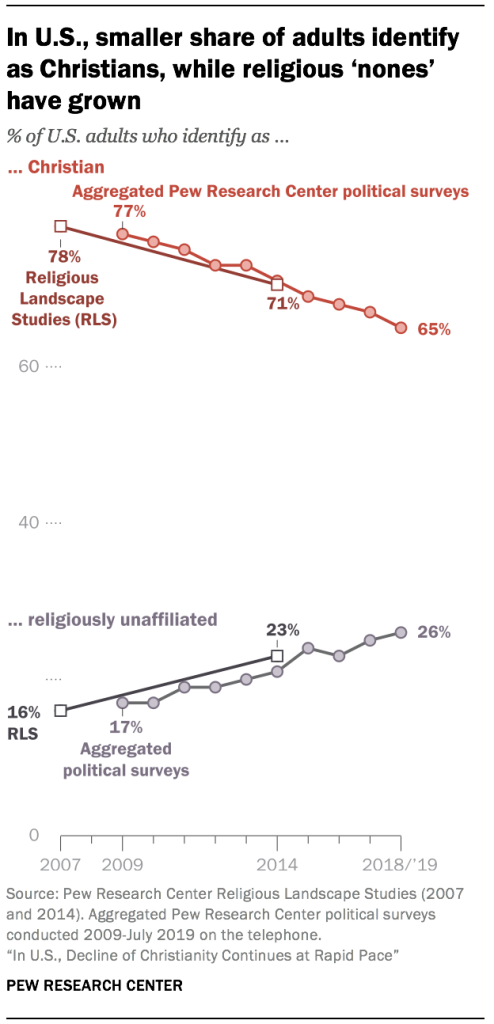
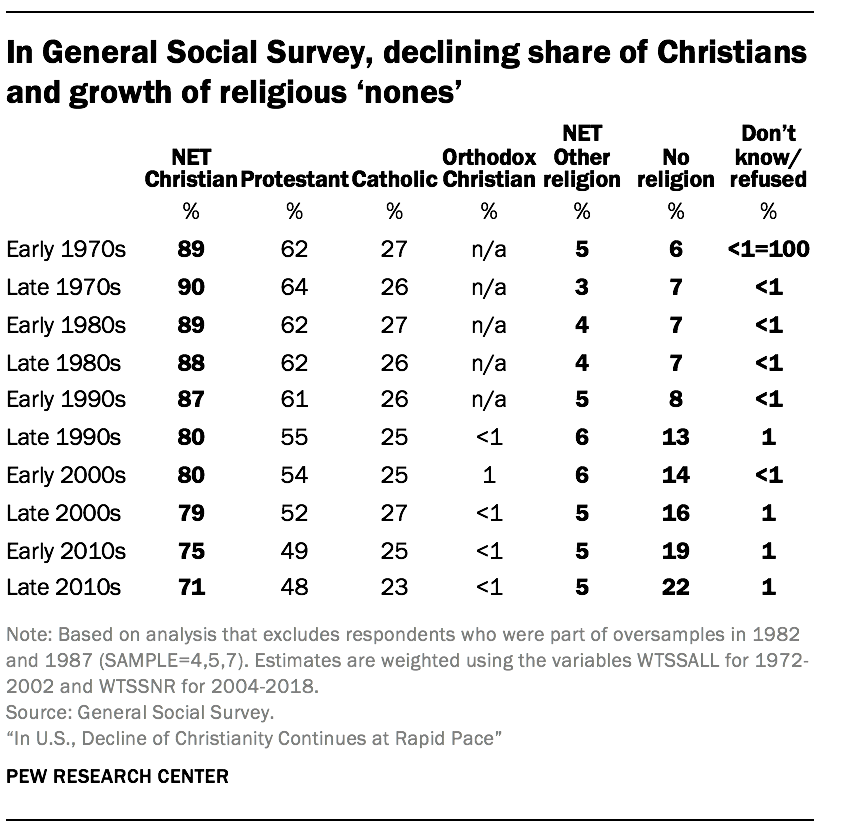
The religious landscape of the United States continues to change at a rapid clip. In Pew Research Center telephone surveys conducted in 2018 and 2019, 65% of American adults describe themselves as Christians when asked about their religion, down 12 percentage points over the past decade. Meanwhile, the religiously unaffiliated share of the population, consisting of people who describe their religious identity as atheist, agnostic or “nothing in particular,” now stands at 26%, up from 17% in 2009.

In U.S., smaller share of adults identify as Christians, while religious 'nones' have grown

In General Social Survey, declining share of Christians and growth of religious 'nones'

Needed:

Modern society

Well, that’s it for this week. Have a good Saturday.

Franciscan Friday: Sentimentalizing Francis

Legend of St. Francis – Renunciation of Worldly Goods. Attributed to Giotto

Franciscan Friday
Sentimentalizing Francis

I am reading Adrian House’s biography, Francis of Assisi: A Revolutionary Life, and thought today I would share some words from its introduction, written by Karen Armstrong.

Like Jesus himself, Francis is often sentimentalized. We like the image of the poetical saint, preaching to the birds and exulting in the beauties of the natural landscape. We look back with nostalgia to Francis’s time, when the natural world and the Bible seemed not to contradict but to complement one another. But we have no intention of imitating his total self-abandonment which, the masters of the spiritual life in all traditions insist, is essential if we wish to experience the Sacred. A great deal of religion is actually devoted to the propping up of the ego and the establishment of a secure identity. We do not wish to emulate Francis’s material poverty, a symbol of his transcendence of the self, and we prefer to keep clear of beggars and the like. Francis’s spiritual journey began when he laid aside his visceral disgust for the lepers of Assisi and kissed their hands. This act of compassionate love gave him an immediate intimation of the divine presence.

Religion cannot always be tasteful or confined within the polite restraints of institutional practice, because it aims at the infinite. Like Jesus, Francis showed the difficulty of incarnating a divine imperative in the flawed conditions of human existence. His stringent bodily and spiritual mortifications never degenerated into masochism or narcissism because they were always tempered by a kindness, compassion and gentleness to all creatures which, again, is often sadly missing from the churches that proclaim his sanctity.

Evolving Faith

Evolving Faith

Pete Enns had a recent post about the Evolving Faith Conference that he recently attended and spoke at.  The Evolving Faith Conference looks to me like a gathering of Progressive Christians.  See their website here and their speaker biographies here .  Now lately some of the more conservative Imonk commentators have tried to label Chaplain Mike and myself as progressives or even liberals.  It is simply not true, both CM and I have deep streaks of conservatism running through us.  We are creedal Christians who affirm the orthodox creeds and both of us have a deep and abiding respect and affection for the Scriptures. Up until a few years ago, I wouldn’t have paid the slightest attention to an Evolving Faith conference.

But thanks in large part to the writings of Michael Spencer, we have come to see the deep flaws in conservative evangelicalism as well as conservative politics.  We have realized that the “other side” has some valid points to make and some valid criticisms to level.  Does acknowledging the good points the other side makes now make you one of the others?  I don’t think so and I kind of resent the implication, or the outright accusation, that it does.

What resonated with me in Pete’s post was this:

I spoke at last year’s conference as well, and what has once again left a great impression on me is the raw pain that many, if not most, of the attendees live with.  That pain, to get right to the heart of it, was generated by their experiences in Evangelical and Fundamentalist spaces. I am not suggesting that Evangelical and Fundamentalist Christians do little else but make the lives of others a living nightmare—it’s not so much individuals as it is the ecclesiastical systems within which Evangelicals and Fundamentalists live out their faith.  These systems in particular offer the seductive promise of doctrinal certainty, impervious to critique from outside and within. Questions that threaten these systems must remain unasked, or the repercussions are swift. Anyone who has experienced the wrath of these systems doesn’t need me to elaborate.

Now I write at the intersection of faith and science, issues that are very important to me, as both a scientist and a Christian. I have a strong interest in helping Christians accept and appreciate science without feeling they have to give up their faith.  But for that to happen, as the Evolving Faith blurb says, one must be willing to accept some changes in their thought process.  There has to be a willingness to re-examine previous belief structures. In other words, by default, accept some Progressive Christian ideas.  Pete Enns notes:

As one speaker mentioned (I forgot who, I should have taken notes), Evolving Faith exposes the lie that so-called progressive Christians (I really don’t like the term but that’s another blog post) are only too eager to leave Scripture and theology behind so they can run naked through the streets. That simply is not true. They are calling out the failings of systems that have too long simply equated themselves with Christianity undefiled and used Scripture as a weapon to make their case.

Now I don’t want to undertake a full defense of Pete Enns in this post.  He is certainly capable of defending himself.  Just see this critique of How the Bible Actually Works with Pete’s response to that critique. But my point is that just as Enns is often accused of not respecting Scripture, so am I.  Because I try to give bible-believing Christians a way forward to remain bible-believing without rejecting the tenets and provisional conclusions of modern science, I’m accused of being a progressive while I am only in agreement with; “calling out the failings of systems that have too long simply equated themselves with Christianity undefiled and used Scripture as a weapon to make their case.”  In regards to modern science and literal interpretations of the bible, I’m in agreement with this particular progressive view.  Other aspects of the progressive view… not so much.  On those aspects I’m more in line with Richard Beck’s views as expressed in his series on being a post-progressive.

I know some people take the pathway from fundamentalist to evangelical to post-evangelical to progressive to agnostic to atheist.  I’m not on that pathway.  From time to time I examine my faith, or some horrifying crisis appears that prompts that re-examination.  But after reviewing the reasons and feelings that prompted me to leave atheism, I still find them valid and persuasive, and I remain committed to following Jesus.

I also want to encourage others to follow Jesus.  I want them to have a robust faith that accepts the inspiration and authority of the scriptures handed to us by the believing church to reveal Jesus, but not the type of biblio-centrism for which Evangelicalism is rightly criticized. In my opinion, too many Evangelicals tend to walk that thin line between respect for Scripture and idolizing it.  I want them to engage their minds and reason to love and embrace science as the “other book” that reveals God’s glory in his creation without having to look to phoney-baloney pseudo-science interpretations of scripture that, in essence, deny reality and saddle the scriptures with a burden the writers never intended for them to bear.

Recent polls show 38% of Americans and 68% of Christians still believe that God created the earth less than 10,000 years ago.  So if you’ll pardon me… I’ve got work to do.


Getting Ready for Reformation Sunday

Old Man in Sorrow (On the Threshold of Eternity). Van Gogh

Getting Ready for Reformation Sunday

Note from CM: Sorry for the delay, but I had a very busy day. I just cleaned a lot of spam out of the comment thread.

• • •

The Gospel reading for this week is Luke 18:9-14, Jesus’ parable about the Pharisee and the tax collector.

He also told this parable to some who trusted in themselves that they were righteous and regarded others with contempt: ‘Two men went up to the temple to pray, one a Pharisee and the other a tax-collector. The Pharisee, standing by himself, was praying thus, “God, I thank you that I am not like other people: thieves, rogues, adulterers, or even like this tax-collector. I fast twice a week; I give a tenth of all my income.” But the tax-collector, standing far off, would not even look up to heaven, but was beating his breast and saying, “God, be merciful to me, a sinner!” I tell you, this man went down to his home justified rather than the other; for all who exalt themselves will be humbled, but all who humble themselves will be exalted.’

Here are some of the good comments I’ve been reading as I prepare to preach on this text.

First, from Matt Skinner at Working Preacher:

One lesson of the Parable of the Tax Collector and the Pharisee in Luke 18:9-14 comes from its insinuation that religious folks like ourselves may have a tendency to get it all wrong. Even if we could hear the private prayers of our congregation, we will misunderstand the bigger picture. To be more precise: we may misunderstand how God hears those prayers and how God regards the individuals who are praying them.

The Pharisee in the parable isn’t wrong to be grateful that he isn’t a tax collector. He knew that that professional choice was available to him, if he wanted to take it. But he didn’t. Soaking the Galilean population as a Roman stooge might have given him an easier path toward a more comfortable life. But his faith, his privilege, or his values took him in a different direction. Thank God.

There’s no arrogance in his belief that he chose or inherited a better way. Where he falls short in the parable is in his unspoken assumption that the tax collector resides beyond the limits of divine mercy. Whether he actually hears the tax collector’s prayer or not, he wrongly assesses the tax collector and his dignity. What’s even more tragic: he misunderstands God.

If I heard your prayers, I’d misread your motives. Worse, I’d want to play God by deciding which prayers are worth considering. Like the Pharisee in the parable, I’d assume that your prayer for mercy (like the tax collector’s) wasn’t sincere enough to get God’s attention. Or, like many misled readers of the parable, I’d assume that your prayer of thanksgiving (like the Pharisee’s) wasn’t a real prayer but a self-gratifying expression of you own high regard for yourself.

Working Preachers, be careful about what you assume. Don’t make narrow the wideness in God’s mercy. We don’t know what God hears when God listens to the prayers of the world.

We do know this, however: that no one resides beyond the reach of God’s compassion and God’s desire to reconcile. We also know that the prayer God, be merciful to me, a sinner! is a perfectly good place for anyone to begin.

Here are some thoughts from Eric Smith at Lectio:

Pharisees are a favorite target of gospel-writers and modern Christians; we have made their name into a synonym for “hypocrite.” But it’s worth pointing out that this whole parable depends on the audience understanding that a Pharisee would have been utterly righteous. The whole setup is built on that; it’s like a joke about a nun and a criminal. The joke only works because everyone assumes that the nun is very holy. This parable assumes that Pharisees were unimpeachable, and it then plays on that stereotype (this particular Pharisee was kind of chauvinistic) for effect. The take-away is not that “all Pharisees are hypocrites,” but rather that “Pharisees were so righteous that when one wasn’t, it was noteworthy.”

Suzanne Guthrie, at At the Edge of the Enclosure, found help in grasping this passage through this quote from Thomas Merton:

Asceticism is utterly useless if it turns us into freaks. The cornerstone of all asceticism is humility, and Christian humility is first of all a matter of supernatural common sense. It teaches us to take ourselves as we are, instead of pretending (as pride would have us imagine) that we are something better than we are. If we really know ourselves we quietly take our proper place in the order designed by God. And so supernatural humility adds much to our human dignity by integrating us in the society of other men and placing us in our right relation to them and to God. Pride makes us artificial, and humility makes us real.

It is supreme humility to see that ordinary life, embraced with perfect faith, can be more saintly and more supernatural than a spectacular ascetical career. Such humility dares to be ordinary, and that is something beyond the reach of spiritual pride. Pride always longs to be unusual. Humility not so. Humility finds all its peace in hope, knowing that Christ must come again to elevate and transfigure ordinary things and fill them with His glory.

• Thomas Merton, No Man Is An Island

Don Clendenin, at Journey with Jesus, cites some ancient wisdom compatible with the lessons of this parable:

I’ve always loved the tender wisdom of St. Maximos the Confessor (seventh century): “The person who has come to know the weakness of human nature has gained experience of divine power. Such a person never belittles anyone… He knows that God is like a good and loving physician who heals with individual treatment each of those who are trying to make progress.”

Finally, we return to Working Preacher, and the words of David Lose:

All too often, it would seem, our moral geography is no less rigid than that of this Pharisee. Where, then, can we turn? But perhaps this is the point of the parable all along. If we take an honest look at the various venues of our everyday life, whether familial, religious, or civic, we realize that we have no where to turn, for even when we judge this Pharisee aright and chide him for his self-righteousness we have fallen prey to the same temptation: “Lord, I thank you that I am not like this Pharisee….” So perhaps Jesus tells this parable precisely so that we recognize that, like this tax collector, our only hope is the God who seeks out the lost, who rejoices at the repentance of the sinner, who justifies the ungodly, who causes light to shine from darkness, and who raises the dead to life.

If this is true, if we recognize that any status we claim comes from God alone, then perhaps we can look at our neighbor — even and especially those who disagree with us — with more generous eyes and recognize a fellow forgiven sinner for whom Christ died. Contempt has no place in our public life, in our religious life, in our personal life. And the only antidote for contempt is a compassion and solidarity born of our shared sense of need.

Another Look: The “Failed” Reformation

Failure. Photo by Tom Hart at Flickr.

Another Look: The “Failed” Reformation

Like all of us, Martin Luther didn’t always remember or apply his own theology in the face of life’s realities.

The following story by David Lose illustrates this.

This past summer I was visiting Wittenberg and heard a story about Martin Luther I hadn’t heard before that seems appropriate for those observing Reformation Sunday this week. I knew that Luther died in Eisleben, the place of his birth, bringing his work and life, in a sense, full circle. And I knew that he preached his last sermon there after successfully negotiating disputes between several local magistrates. What I didn’t know was that only five people showed up for the sermon. What I didn’t know was that he was pissed. He wrote a friend about the event, despairing over what he feared was a “failed” reformation.

I’ve been a pastor and I get Martin Luther’s sense of failure. We all long to be “successful” in our churches (however we might define that), and when the church appears weak and sickly, and people don’t seem interested in supporting or responding to her ministry, it’s the most natural thing in the world to imagine that our efforts have been for naught.

We can become angry, as Luther did. We can become fearful, disillusioned, and depressed like Elijah did in 1Kings 19, running from Jezebel after he had defeated the prophets of Baal. We can become sad of heart, like the disciples on the road to Emmaus, who kept saying, “But we thought he was the one . . .”

The brilliant answer to this sense of failure that Luther gave voice to in his writings is what we know as “the theology of the cross.” When it looks most like God has been defeated, he is winning. When God seems most absent, his presence is sustaining us. When all feels lost, we are, in fact, being saved.

I have long thought that this, above all Luther’s teachings, is needed in the Christian church today. We give so much attention to the appearance of success and strength that we fail to find God in much more prevalent circumstances of failure and weakness. We forget that our hope is in resurrection from hopeless death, not in being crowned after having built a glorious resumé.

The last word today goes back to David Lose:

While I can understand his dismay and disappointment, I nevertheless think that at that moment Luther forgot that much of our energy and effort will be given over to failed endeavors. He’d forgotten, that is, Paul’s reminder that we have all sinned and fallen short … and will keep sinning and falling short. Moreover, he’d forgotten that our ultimate hope rests not in our successes but in God’s great failure on the cross, the failure that redeems all failures and successes, binding them together in the promise of resurrection. He’d forgotten, that is, his own words at the close of the hymn many of us will sing this week, “Were they to take our house, goods, honor, child, or spouse, though life be wrenched away, they cannot win the day. God’s kingdom is ours forever.”

Monday with Michael Spencer: Letting Some Air Out of the Reformation Day Balloon

Contemporary caricature of Martin and Katie Luther

Note from CM: Should be an interesting week. We just got back from Italy and I’ve been immersing myself in Franciscan ways. This Sunday, Reformation Sunday, will be my first week back in the pulpit at my ELCA Lutheran congregation for the rest of the fall, winter, and spring until Easter. We have invited Catholic friends to join us. I may be a bit mixed up, but I’ll still say, “Happy Reformation week!”

Monday with Michael Spencer
Letting Some Air Out of the Reformation Day Balloon

It’s fairly obvious that, at least among some Christians, “Reformation Day” is a new holiday to be celebrated with all the enthusiasm we once reserved for actual holidays. (Lutherans: Party on. You’ve earned it.) I’m waiting for the photos of the “Dress Like a Reformer” party at a reformed church near you.

I’ll admit to having donned the Luther costume and done the Reformation Day lecture for the students at our school on a number of occasions, and I don’t regret having done so. Most of what I said was true. Well….some of it.

In the past year, I’ve read a lot about the reformation and even more about Luther. I’m currently finishing off McGrath’s Christianity’s Dangerous Idea – a popular history of Protestantism that’s right up to speed — and I’m almost done with Richard Marius’s Luther: The Christian Between God and Death, one of the most profitable biographies of Luther I’ve ever read and I read at least one every couple of years.

My reading on Luther and the Reformation has changed my mind about a lot of things. I don’t want to hurt anyone’s feelings, but here’s the short list.

  • I no longer believe the Reformation, as it’s commonly described by Protestants, is the distinct event we’ve made it out to be.
  • I no longer believe Luther ever intended to slay the Catholic Church and establish the wonder of contemporary Protestantism.
  • I am becoming increasingly sure that many things in the typical Reformation story are probably mythological, or most nearly so.
  • I’m especially convinced that a lot of the typical “Luther story” is probably historically inaccurate. Not necessarily untrue, but plenty of mythology in the mix.
  • I am very sure that the humanist and Catholic contribution to the reform of Christianity has been considerably obscured in the creation of a Protestant mythology.
  • I do not believe true Christianity was restored or rediscovered in the Reformation.
  • I’m convinced that it didn’t take long for Protestantism to accumulate enough problems of its own to justify another reformation or two.
  • I believe that a lot of Protestants say sola scriptura when they mean solo scriptura or nuda scriptura or something I don’t believe at all.
  • I now believe that tradition is a very good word.
  • I believe the Reformation was very secular, political and, eventually, quite violent. To act as if it was mostly a spiritual revival movement is naive.
  • I believe we ought to grieve the division of Christianity and the continuing division of Protestantism.
  • I no longer believe the theology of the Reformers was the pinnacle of evangelicalism or is the standard by which Biblical truth itself is judged.
  • I can see huge omissions from the work of the reformers, such as a theology of cross-cultural missions and much more.
  • I believe it is embarrassing to turn the Reformers into icons. Calvin on a t-shirt should win an award for irony.
  • I am a Protestant and I always will be, but I no longer take the kind of juvenile pride in Protestantism I did in the past. Much is good, and much has not been good. We have no right to stand superior to any other Christians.
  • I want to understand how Catholic and EO Christians understand Protestantism, and I want to do so with a sense of humility.
  • I don’t believe in ecumenism at any cost, but I can no longer imagine being a Christian without a commitment to ecumenism on some level.
  • There are many sins associated with Protestantism that I need to admit and repent of.

Part of my Reformation Day will be spent contemplating what it means to say “One Lord; One Faith; One Baptism; One Holy, Catholic, Apostolic Church.” Having a party celebrating the division of Christianity doesn’t really strike me as a something I want to do.

• • •

Here is a response to Michael’s at the time it was written, from Matthew Pancake.

Greatest Songs of My Lifetime: All Borders Vanish Here

A road to Pienza

Greatest Songs of My Lifetime: All Borders Vanish Here

Our recent travels brought to mind one of my favorite songs of all time, from one of the best singer-songwriters around.

Mary Chapin Carpenter’s 2012 album Ashes And Roses is a masterpiece I return to time and time again. She released this album after a time of great change, grief, and turmoil in her life, and every song reflects upon loss, what keeps us going, and journey we are all on together — whether we know it or not.

The first cut, Transcendental Reunion, tells of a gentle airport epiphany MCC had about the invisible bonds that connect us as we scurry about, pass each other unnoticed, wait in line together, pursue our affairs, and pray for traveling mercies. I’ve not found a better description of our common humanity than this verse:

We are travelers traveling
We are gypsies together
We’re philosophers gathering
We are business or pleasure
We are going or coming
We’re just finding our way
To the next destination
And from night into day

From twenty thousand feet high
I saw the lights below me
Twinkling just like Christmas
We descended slowly
And the curve of the world passed
With all of that flying
Above the mighty ocean
And now we all are arriving

Grab the carry-on baggage
Join the herd for the mad run
Take a place in the long line
Where does every one come from?
As we shuffle on forward
As we wait for inspection
Don’t be holding that line up
At the end lies redemption
Oh oh, hey hey, ah ah

Now I’m stamped and I’m waved through
I take up my position
At the mouth of the cannon
Saying prayers of contrition
Please deliver my suitcase
From all mischief and peril
Now the sight of it circling
Is a hymn to the faithful

Forgive me my staring
For my unconcealed envy
In the hall of arrivals
Where the great river empties
It’s handcarts and porters
All the people it carries
To be greeted with flowers
Grandfathers and babies
Oh oh, hey hey, ah ah

There is no one to meet me
Yet I’m all but surrounded
By the tears and embracing
By the joy unbounded
The friends and relations
Leaping over hemispheres
Transcendental reunion
All borders vanish here

We are travelers traveling
We are gypsies together
We’re philosophers gathering
We are business or pleasure
We are going or coming
We’re just finding our way
To the next destination
And from night into day
Oh oh, hey hey, ah ah,
Oh oh, hey hey, ah ah

In a giant bird’s belly
I flew over the ocean
From twenty thousand feet high
How those lights were glowing

Transcendental Reunion lyrics © Mary Chapin Carpenter Dba Why Walk Music