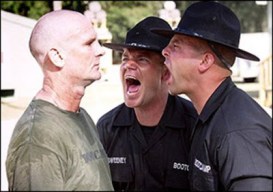
Boot Camp Blather

By Chaplain Mike

OK, I’ve had it. I feel a rant coming on.

I’ve been commenting at a couple of sites that are known for their strong opinions (to say the least). These sites have grown louder and more shrill in recent days, shouting alarmist warnings about the faith/science debate, particularly with regard to sites like BioLogos, evolution, the age of the earth, and the interpretation of Genesis. I thought I’d trying playing on their field for awhile.

I took the same approach as I did in our “Creation Week” series here at IM. I tried not to overstep my bounds. Didn’t talk about science. Didn’t bring up the subject of evolution. Said nary a word about an old earth. Expressed no interest in trying to reconcile the disciplines of Biblical interpretation and theology with any of the sciences.

All I did was set forth my understanding of Genesis in order to show folks there might be another way to look at the text. And that therefore maybe we shouldn’t get so dang fired up about beatin’ the other side loopy.

Silly me. In their ears, folks like me speak a foreign language. And besides, who’s got time for discussion with dullards like me? The war’s on. Course is set. Time to fire up the troops. You try to talk with them, but they want to play rough. Then they ultimately dismiss you if you disagree with them. You are of no use in the battle. You may be the enemy. Probably are.Continue reading “Boot Camp Blather”

The Good Land

Only recently did I discover that the monastic vows of Saint Benedict included the vow of stability:  poverty, chastity, obedience, and stability — staying in one place.

There is a virtue to staying where you are.  There is a virtue to being where you are.  Too many of us are never where we are.  We live with our windows closed, shades drawn, televisions on.  Our feet never feel the ground, and our skin never feels the air.  While our bodies occupy a vague, in-between world, our minds are editing the past or worrying about the future.

But “the heavens declare the glory of God; the skies proclaim the work of his hands” (Psalm 19:1) — to those who go outside and look.  God reveals himself through the place that he’s given us:  “a good land — a land with streams and pools of water, with springs flowing in the valleys and hills; a land with wheat and barley, vines and fig trees, pomegranates, olive oil, and honey; a land where bread will not be scarce and you will lack nothing; . . .When you have eaten and are satisfied, praise the Lord your God for the good land he has given you.” (Deuteronomy 8:6-10)

Continue reading “The Good Land”

Raspberry Wars, Part Two: Kindness

“I love mankind; it’s people I can’t stand.” – Charles Schultz

I stood at the gate of my raspberry garden admiring the beauty of the place. I’d been working diligently there for months and it showed. The plants were green and well watered, the ground uncluttered, the perimeters trim and the berries a deep magenta. From that distance, the picture was perfect, like an artist’s rendering. Then I stepped inside to begin my evening’s work.

On my knees, I saw details I didn’t notice from outside the gate. Small weeds had appeared that weren’t there yesterday. Japanese beetles clung in clumps to several of the leaves. Overripe fruit I’d missed the evening before dripped into a sticky mess and a few of my stubborn plants refused to be trained no matter how hard I tried. Instead they draped themselves over other plants and dragged them down. Suddenly, I felt frustrated.

What is true in the raspberry garden is true in the body of Christ. As terrible as it will prove me to be, I’ll let you in on a little secret. In my self-centeredness, I completely agree with Charles Schultz. Mankind, in general, seems noble and lovable. Individuals, up close and personal, can at times be … well, you know.

Continue reading “Raspberry Wars, Part Two: Kindness”

Seven, and It’s Summer

By Chaplain Mike

In the wake of last night’s baseball All-Star game, this simple reminiscence.

It was one of those perfect summer mornings. I was seven years old, a child in the great Midwest, looking forward to another fine day of riding my bike, playing ball, climbing the old weeping willow in our back yard, and doing a hundred other things seven year-old boys do with their pals on sunny summer days.

We were eating breakfast at the table, and I looked up from my bowl of Cheerios to check out the baseball standings in the morning paper. Being a Chicago Cubs fan, I naturally looked first at the bottom of the standings.

Continue reading “Seven, and It’s Summer”

Help! For Help?

Editor’s note: The following comment was recently posted to an essay we ran called Those Who Dance Are Considered To Be Insane By Those Who Cannot Hear The Music. Here is what Help? wrote:

I wish I knew God like you do….Could hear His voice. I feel like an Israelite, sitting in the camp, waiting for the truly spiritual to go up the mountain, meet with God, then come back and tell me about Him.

But I want to go…I want to hear Him speak to me. And I have no idea how. I’ve tried everything I know to do – pray, beg, memorize verses, read books….But nothing seems to change. It’s been several years of trying and I’m really tired, so I’ve stopped trying. Reading the Bible is so incredibly boring to me. It just seems fake. Like I’m following the “can’t miss” diet but still gaining weight. I feel like I’m wasting my time since I wake up every morning, read my Bible, yet never seem to really feel a connection with God.

And to make matters worse, anyone I tell seems to have nothing more than a trite reply like (true example), “Have you tried listening to Christian music?”. I hear that and I’m thinking, “Man….I just poured my heart out to you. I’m dying inside, desperate to know God, longing to hear His voice and know something more than religion….and you look back and tell me the answer is to start listening to Michael W Smith???”

Being born and raised in church, I know how to play the game. Honestly, anyone can look like their spiritual life is all together if they follow 5 simple rules (based on my religious background)….

1. Don’t smoke or drink
2. Come to church and Sunday school (or small group) each week
3. Don’t watch movies that are rated ‘R’, and make sure people notice your disapproval of such “immoral” films
4. Raise your hands when you sing. If everyone is sitting, you earn extra points for standing first when the song hits an emotional high point.
5. Memorize a few key verses you can recite at the appropriate moment (John 14:6, Rom 3:23, 2 Tim 3:16, etc). For even more impact, learn a few from the more obscure OT books like Amos or Nahum.

I’m lost.

Continue reading “Help! For Help?”

iMonk Classic: The Sanity Verses

Classic iMonk Post
by Michael Spencer
From July 16, 2005

Sometimes, I don’t need inspiration. What I need is just my sanity. I don’t need verses that tell me I’m about to see a miracle. I need something that says God wants me to make it to tomorrow, and I’ll still be useful. Sometimes I need to know that God doesn’t always want me to be a martyr, but that he wants me to stick around, survive and serve him again.

Sometimes, I don’t need to know how to succeed in ministry. I need to know that there is something on the other side of failure. I need to know that the cause of Christ matters, but that I matter, too.

I’ve collected some passages that fall into that category. I’m calling them “The Sanity Verses.” All of them contain something that we don’t hear enough about in descriptions of ministry—the comforting truth that, in the midst of all the important, spiritual stuff that matters and in the middle of rejection and failure in ministry…..I matter. I matter, too.Continue reading “iMonk Classic: The Sanity Verses”

Stanley and Screwtape

By Guest Blogger, Andy Zehner
Andy is Damaris Zehner’s (very talented) husband.

The notion that Socialism is the greatest threat facing Christianity was rightly shouted down on iMonk.(1) But why was that particular claim put forward in the first place? Why are Charles Stanley and the people who follow him especially concerned about a policy that hasn’t been espoused by anyone?(2)

One very good answer comes from C.S. Lewis, in the upside-down logic of the demon Screwtape:

“We direct the fashionable outcry of each generation against those vices of which it is least in danger and fix its approval on the virtue nearest to that vice which we are trying to make endemic. The game is to have them all running around with fire extinguishers whenever there is a flood, and all crowding to that side of the boat which is already nearly gunwale under.”

If, as usual, Lewis is a reliable guide, the current fuss about the imagined danger of Socialism alerts us that Stanley’s (and perhaps all Christianity’s) real problem is a lack of sociability. If the fashionable outcry is against Socialism, then perhaps the vice we are least in danger of is sending our spirit out too far and among too many diverse people. The word for the malady is Homophily. (It has nothing to do with sexual orientation. That is homophilia.) Homophily refers to love of people and things that are very much like oneself. Opposites, it turns out, don’t attract as often or as strongly as similarities do.(3)

Continue reading “Stanley and Screwtape”

IM Film Review: Into Great Silence

carthusians

It is a pity that the world has lost all sense of God.

• Carthusian Monk, “Into Great Silence”

Into Great Silence is not a film one watches, it is an experience into which one enters. It is an immersion in the contemplative life.

It is seasons passing, the sound of snow falling, the buzzing of flies. It is daily prayer, alone in one’s cell: sitting, kneeling, bowing, with books opened and closed, in complete silence or murmuring softly. It is eating alone, lifting homemade soup to one’s lips with a wooden spoon, breaking homemade bread with ones’ fingers. It is feeling the actual passing of time, like watching a slow moving train. It is the red glow of a single candle and the groans of creaking wood as hooded men kneel and rise and take their seats in the surrounding darkness. It is mesmerizing chant deep into the night.

It is also the rhythm of daily work. Measuring, sawing, and chopping of firewood. Chopping of celery, brilliant green against the bare stone kitchen counter and walls, scooped into a pot for soup. It is wheeling the food cart through the arched corridors, a key creaking open the access port of each cell, a silent messenger leaving bread and drink and salad before rumbling on. It is the buzz of the clippers in the barber shop, clumps of hair falling to the floor, a soft brush sweeping away stray leavings from the shorn monk’s head. Cats must be fed, seeds planted and gardens tended. Water lines checked out in the woods. Herds moved to new pastures, their cowbells mimicking the call to prayer. Most of this work is done by solitary workmen. Most is accomplished in complete silence.

Sundays are different. The community gathers and there is a meal together, during which the rules of the Carthusian Order are read and reinforced. Then, the monks take a long hike of approximately four hours known as “the spaciement” for refreshment and exercise amid the beauties of nature. Here they may talk and get to know one another. On one such walk in winter, the film portrays them giddily sliding in the snow down a magnificent Alpine mountainside. It is a rare moment of hilarity and laughter.

Throughout “Into Great Silence,” the filmmaker, Philip Gröning, composes portrait shots of the monks. Each stands still, looking directly into the camera. Some are more comfortable with this than others. We look into their eyes. We see the hints of smiles. We trace the lines on their faces. They are like us. But they are unlike us. We do not know their names. Their personal stories are a mystery. We know nothing of their motivations, their feelings, their opinions. There is no plot to their lives, it seems, no drama. Just the passing of days, the subtle balance of solitude and community, and most of all, the silence. The only monk who speaks tells how he came to accept blindness as God’s gift for the good of his soul.

With all this spareness, the film is remarkably sensuous. I doubt I have ever heard the snow fall as I did against the backdrop of silence. A thunderstorm never sounded more like a symphony. Footsteps rarely pique my interest as they did in this film. The Alpine setting is stunning enough; Gröning’s cinematography makes each detail live, from the ecstasy of spring crocuses to modern art impressions in puddles. Soup appeared a feast.

You will not find anything fashionable, not even a concern for being different.

• Carthusian Order website

La Grande Chartreuse is the mother house for the Carthusian Order of contemplative Catholic monks, the sons and daughters of St. Bruno (founded in 1084). They are known as the Catholic Church’s most ascetic religious order. Each monk (or nun in the women’s order) lives in a “hermitage,” or cell, and spends most of each day in solitary prayer or work. The community also meets three times a day for corporate prayer and worship: morning mass, late afternoon vespers, Matins and Lauds in the middle of the night. On Sundays, they partake of a meal together and then enjoy a hike in which they may talk freely. Monks are only allowed to see their families on two days of each year, and otherwise have little or no contact with the outside world.

In 1984, filmmaker Gröning contacted La Grande Chartreuse and requested permission to film at the monastery. He was told they were not ready and that he should wait perhaps 10-13 years. It was not until 16 years later that they told him the time was right. After five more years of filming and editing, “Into Great Silence” was released. During the making of the film, Gröning went into the monastery himself, and filmed with natural light, becoming part of the monks’ daily life and ritual.

The quote that appears repeatedly throughout the film is from Jeremiah 20:7 —“Oh Lord, you have seduced me, and I have been seduced.” “Into Great Silence” is a seductive experience, breaking down the viewer’s reluctance, creating a sense of longing in the spirit. As I watched, my mind kept raising objections. This is too hard. Who could do this for a lifetime? I would go crazy! And I’m sure I would.

One must have a specific calling to do this kind of work, for work it is. The Carthusians see themselves as the “heart” of the church and its mission in the world. As our hearts beat steadily, quietly, hidden deep within our chests, so these monks, hidden away in the French Alps, maintain a rhythmic pulse of solitude and community, prayer and work, day after day after day, pumping oxygenated (Spirit-filled) life invisibly throughout the world.

Who can tell what we owe them?

Thanks to Philip Gröning, we can at least begin to appreciate them and be comforted by their silent, lifegiving ministry.

More: You may watch the trailer for “Into Great Silence” here.
Those Who Dance Are Considered To Be Insane By Those Who Can’t Hear The Music

And the word of the Lord was rare in those days; there was no frequent vision. (1 Samuel 3:1, ESV)

For so many of my almost 37 years following the Lord, there has been no frequent vision, at least not for me. My “words from the Lord” have come through sermons and books I read. Even Scripture as I read it did not seem to be “alive” to me. My life was directed by what I saw others doing and what others “suggested” that I should be doing. You know, good Christian suggestions like, “You are going to go to a Christian college, aren’t you?” “Don’t date her—I don’t think she is Spirit-filled.” “All real Christians do ____/never do ____.” There always seemed to be someone within a stone’s throw willing to give me his personal advice on where I was failing to live up to the moniker of “good Christian.” With friends like this, who needed to hear God’s voice himself?

But three years ago this month God began to do something completely different in me.  I remember the day, the hour, the location when in July of 2007 God began messing in my heart in a new way. He let me taste of him and I saw that it was good. It was like I was given beef tenderloin after eating “meat” hot dogs all my life. I never wanted to go back to hearing God third-hand. I only wanted to experience him through him. But it was a skill I was sadly lacking.

Continue reading “Those Who Dance Are Considered To Be Insane By Those Who Can’t Hear The Music”

Sunday’s Gospel: Sometimes the Samaritans Shame Us

By Chaplain Mike

Seventh Sunday after Pentecost
Lectionary Readings
• Deuteronomy 30:9-14
• Psalm 25:1-10
• Colossians 1:1-14
• Luke 10:25-37

Today’s Gospel
We can get tripped up by the most familiar passages of Scripture. We just assume their meaning because they are more a part of atmosphere we breathe than texts we have carefully considered before God. Today’s Gospel reading is one of those passages.

This parable of Jesus is so familiar that it has changed our language over the years. When our Lord first spoke these words, a fellow Israelite would have cringed (or punched you out!) if you called him a “Samaritan.” If Jesus were speaking this parable today, he might talk about the “Good Palestinian,” and he would get the same negative reaction from the Jewish folks. But over the years, our understanding of the hostility that the word “Samaritan” once elicited has faded, and that word is no longer an epithet. Now, in fact, it is a designation of honor!

If I call you a “good Samaritan” today, it is a compliment. We have entire “Samaritan” societies founded to assist people in need. Our church used to have a “Good Samaritan Fund” to help the poor. Many hospitals bear the name as a way of saying they are there to heal the sick and injured. Good Samaritan laws have been drafted to protect bystanders who witness a person in distress and try to help. Any one of us would be proud to be called a “Samaritan.” It means we are sensitive to the needs around us and always willing to help.

‘Twasn’t so in Israel when Jesus gave this story.Continue reading “Sunday’s Gospel: Sometimes the Samaritans Shame Us”