Another Look: The Arithmetic of Grace

Another Look: The Arithmetic of Grace

The LORD did not set His love on you nor choose you because you were more in number than any of the peoples, for you were the fewest of all peoples, but because the LORD loved you and kept the oath which He swore to your forefathers, the LORD brought you out by a mighty hand and redeemed you from the house of slavery, from the hand of Pharaoh king of Egypt.

• Deuteronomy 7:7-8, NASB

• • •

Peter W. Marty once wrote, “In a memorable Dennis the Menace cartoon, Dennis and his friend Joey are leaving Mrs. Wilson’s house loaded up with a plate full of cookies. Joey turns to Dennis and says, ‘I wonder what we did to deserve this.’ Dennis is quick to reply, ‘Look Joey, Mrs. Wilson gives us cookies not because we’re nice, but because she’s nice.’ So goes the arithmetic of grace.” (The World of Grace)

Dennis’ sentiment captures what I have always loved about the sentence from Deuteronomy 7 cited above, though I have not meditated on it or internalized nearly enough. If you take out all the intervening clauses in the verse and boil down what God is saying to Israel, what you have is, “I love you…because I love you.” It’s as simple, and profound, as that.

It’s not because we’re nice. He loves us because he loves us. Period. It’s who God is that makes the difference in matters of love, grace, and choice.

And who is he? A remarkably indiscriminate lover! After all, he loves you and me.

The Biblical record is clear from beginning to end, and well-summarized in these NT words: “Listen, my beloved brethren: did not God choose the poor of this world to be rich in faith and heirs of the kingdom which He promised to those who love Him?” (James 2:5)

By “poor” he means not only those who have few material or monetary resources. All kinds of poverty are in view here — the intellectually poor, the morally poor, the relationally poor, the reputationally poor. In order to show that he does not discriminate against anyone, he has made a special effort to reach out to those who are, in our eyes, the most unlovely and undeserving.

God’s team roster is set forth in the Beatitudes (Matthew 5:1-12). In the world’s eyes at least, we are talent-poor (poor in spirit, mourners, meek, crushed by injustice) and we are power-poor — we try to engage the world with inadequate, futile strategies (through extending mercy, seeking purity of heart, acting as peacemakers). Ultimately, we are the “losers” (persecuted, insulted, accused). Nevertheless, by his love and grace, Jesus calls us “blessed.”

Similarly, the Hebrew people God spoke to in Deuteronomy 7 were poor. Their ancestors had been homeless wanderers. Their parents and grandparents had become slaves, the dregs of society, under foreign rulers in Egypt. After about four hundred years of that humiliation, God intervened and delivered them in spectacular fashion from their bondage by pure grace.

You might think that would have made them grateful, but instead they became a group of unruly complainers wandering through the desert. Moses tried to shape them up during a long camp-out at Mt. Sinai, but they proved so unmanageable he had to plead with God at one point not to wipe them out in divine frustration and wrath. When they left Sinai to go to the Promised Land of Canaan, all but a few of them rebelled so badly they ended up wasting forty years walking the desert in circles. Eventually, Israel wore even poor Moses down. One day he’d had enough of their bitching and moaning, and he blew up in angry, exasperated unbelief — an act that won him a grave in the wilderness.

And, these were the people to whom God said, “[I] wasn’t attracted to you and didn’t choose you because you were big and important—the fact is, there was almost nothing to you. [I] did it out of sheer love…” (The Message) Tens of thousands of dirty-faced Dennis the Menaces got full plates of cookies because of who God is, not because they were so nice.

And guess what? The new life we have received in Jesus came the same way. There we are one day, playing in the yard, fighting and hollering, breaking stuff, getting all dirty and tearing holes in our jeans, when Mrs. Wilson opens the door and hollers out,”Hey kids, would you like some cookies? I just made some. Come and get ’em!” And if we have any sense at all, we stop what we’re doing immediately and race to see who can get there first.

Oh, there’s nothing like the taste of fresh cookies, washed down with cold milk!

The problem is, we start thinking we must be pretty special to deserve such a treat. We strut our stuff around the neighborhood and brag on the gift we received. “Why the big smile?” the kid down the street asks. “Mrs. Wilson just gave us cookies!” we exclaim. “Man, were they good!” And for some reason, we get all caught up in that warm feeling in our belly and start to think we must be pretty good kids to deserve such a treat.

Then we look up, and see that Mrs. Wilson has come out of her house again, and this time she’s offering cookies to the neighbor children who live behind us. Those kids are a pain in the butt! In fact, they’re weird. They dress and talk differently and they don’t fit in to our games very well. We try to stay away from them, but sometimes we can’t and it seems like we always end up fighting and yelling. It really gripes us that they get cookies too.

We forget the “grace” part. Remember? Mrs. Wilson’s the nice one, not me.

Peter Marty quotes Barbara Brown Taylor, who once said, “I’m not so worried about God loving me less. It is the prospect of God loving that other person I can’t stand, just as much as God might love me.” He then comments,

The most outstanding feature of God’s grace is its indiscriminate character. I’m thoroughly convinced of this, even if I cannot always appreciate it. All of the factors that determine how God might show favor rest solely on God’s wishes. Our capacity to discriminate, establish devilish screening devices, and discern unpalatable idiosyncrasies in other people cannot hold back God’s grace. Jesus refused to respect the boundaries people set up between respectable and disreputable people, between right-thinking and wrong-thinking people. In the end, it was utterances like his “prostitutes and tax-collectors entering the kingdom before the rest of us” that — literally — hung him. (The Wideness of Love)

If receiving grace doesn’t make us both grateful and gracious, we really haven’t grasped grace.

If, in our lives, we don’t “cause [our] rain to fall on both the just and the unjust,” we are not following the One who does just that. Lavishly. Freely. Indiscriminately.

If we’re upset that Mrs. Wilson is sharing her cookies with kids we don’t like, we’ve probably developed the opinion that we deserve them more. And that some don’t deserve them at all.

Hey, if you’ve got a head full of rules about who deserves the cookies and who doesn’t, I don’t think you have much room in there for a guy like Jesus. He loves us because he loves us.

And that’s the whole story.

Sermon: Are We Ready for This? (Luke 14:25-33)

The Wedding Candles. Chagall

Sermon: Are We Ready for This?

Now large crowds were traveling with him; and he turned and said to them, ‘Whoever comes to me and does not hate father and mother, wife and children, brothers and sisters, yes, and even life itself, cannot be my disciple. Whoever does not carry the cross and follow me cannot be my disciple. For which of you, intending to build a tower, does not first sit down and estimate the cost, to see whether he has enough to complete it? Otherwise, when he has laid a foundation and is not able to finish, all who see it will begin to ridicule him, saying, “This fellow began to build and was not able to finish.” Or what king, going out to wage war against another king, will not sit down first and consider whether he is able with ten thousand to oppose the one who comes against him with twenty thousand? If he cannot, then, while the other is still far away, he sends a delegation and asks for the terms of peace. So therefore, none of you can become my disciple if you do not give up all your possessions. (Luke 14:25-33)

• • •

The Lord be with you.

Today we hear another one of Jesus’ “hard sayings” that poses a challenge to our understanding. Perhaps an illustration can help us grasp something of what Jesus is trying to say to us.

Two people stand in the front of a sanctuary at the altar in front of a minister. The minister asks them questions that have become familiar to us, so familiar that we don’t really grasp how radical and demanding they are.

Joe, will you have Mary to be your wife, to live together in the covenant of marriage? Will you love her, comfort her, honor and keep her, in sickness and in health, and, forsaking all others, be faithful to her as long as you both shall live? If so, please answer, “I will.”

Joe answers, “I will!!”

And in a few moments, Joe makes the following vows to his bride:

In the Name of God, I, Joe, take you, Mary, to be my wife, to have and to hold from this day forward, for better for worse, for richer for poorer, in sickness and in health, to love and to cherish, until we are parted by death. This is my solemn vow.

Through the exchanging of these lifelong promises, in that moment, two lives are completely changed. The past is past. They find themselves in a new reality. It’s as though they’ve walked through a door and entered a completely new country. A new family in this world has been created. The two people at the center of the ceremony are now in a whole new relationship, and because of that, all other relationships in their lives have changed.

They remain the children of their parents, but they are no longer their children in the same way. They are still friends with their friends, but it’s different now. And even between themselves, everything has changed. What once belonged to one of them alone now belongs to them both together. They have entered into a partnership, a oneness in which what was once “mine” now becomes “yours” as well. These are “our” possessions now. This is “our” life now.

With that brief exchange of promises, the old has passed away and all has become new. These two people, now one, begin to move along a new, yet unplanned path through life. This path may take them away from their families, away from the places they have called home. This path may lead them into new friendships that will become closer than the friendships they have before they were married. They may take up new interests, new work, new vocations together that lead them to set aside the activities and involvements they were previously engaged in. The old has passed away, all has become new, and who knows what the future will hold? Who knows what changes it will bring? Who knows where it will lead?

When you stop and think about it for a moment, for two people to make promises like this for a lifetime seems almost crazy. But what these two people are saying on their wedding day is this: We want to make a life together. Today it begins. From now on, there is no turning back. Our former experiences have brought us to this new adventure, and now it is time to embrace it fully. No matter where this path may lead us, we’re in it together for the long haul.

In today’s Gospel, Jesus uses strong, exaggerated language about what it means to follow him, but I wonder if this illustration might shed some light on what he is saying to the crowds, to his disciples, to each one of us.

  • If you are going to follow me, all of your other relationships, even your closest family connections, are going to change. Are you ready for that?
  • If you are going to follow me, it will no longer be just about you. Even your relationship with your own self, with your own ideas, your own plans, your own desires, is going to change. In a sense, you’ll have to die to all of that and rise into a new reality in which you will have to open yourself up to what I will say to you. Are you ready for that?
  • If you are going to follow me, your possessions will no longer be yours alone. They will be ours together, and I will have a say about how we will enjoy them and use them in our life together. Are you ready for that?

Right before he said these words to the crowds that day, Luke tells us that Jesus told a parable about a great dinner to which many people had been invited. When it came time for the festivities to begin, the host sent out his servants to let the invitees know. But those who had been invited gave excuse after excuse:

  • Sorry, I just bought some land and have to take care of it. I won’t be able to come.
  • Sorry, I just bought some new livestock and must care for them. I can’t attend.
  • Sorry, I was just recently married, and we have some things we must do at this time. We won’t be coming to the dinner.

They had accepted the invitation earlier, but in the end, their own lives, their possessions, and their relationships got in the way of them actually participating in the dinner. When the time came, they weren’t ready to set aside those things in order to respond to the great invitation.

And today’s Gospel is Jesus’ teaching about how those excuses just won’t cut it when it comes to taking the necessary, life-transforming step of becoming his disciple.

You see, Jesus’ invitation to us isn’t just about forgiveness, as wonderful as that is.

It is about entering a whole new life with him. A life that changes everything.

Are we ready for that?

May the word of Christ dwell in us richly in all wisdom. And whatever we do, in word or deed, may we do everything in the name of the Lord Jesus, giving thanks to God the Father through him.

Sunday with Walter Brueggemann: To Relish the Generosity of God

Harvest at La Crau, with Montmajour in the Background, Van Gogh

Sunday with Walter Brueggemann
To Relish the Generosity of God

[To] deny self is taken too often to mean you should have some self-hate, feel bad about yourself, ponder your failure and your guilt, and reject your worth. But that is surely not what Jesus is talking about.

Rather, he is talking about coming to see that God—the generous creator who gives good gifts—is the center of your life and that the self-taken-alone does not have the resources or capacity to make a good life. To deny self means to recognize that I cannot be a self-starter, cannot be self-sufficient, cannot be self-made or self-securing, and that to try to do so will end in isolation and fear and greed and brutality and finally in violence. It will not work because we are not made that way. It will not work even if all the consumer ads tell us to have life for ourselves. You cannot have the life you want that way.

The alternative to self-focus is to move one’s attention away from self to know that our life is safely and well held by God, who loves us more than we love ourselves, to relish the generosity of God and so to be free of the anxieties and needs and hungers of those who are driven by a mistaken, inadequate sense of self. The self who is denied is the self who is received from God and given back to God in obedience and praise.

A Way other than Our Own: Devotions for Lent, pp. 28-29

Saturday Brunch, September 7, 2019

Hello, friends, and welcome to the weekend.

Do you play golf? Here is a great, simple tutorial you need to watch. Actually, you need to watch it even if, like me, you consider golf the biggest waste of time since Freud.

The descendants of Kaiser Wilhelm II are suing the state to reclaim palaces and artworks: “The biggest prize up for grabs is the right of residence in Cecilienhof Palace near Berlin, site of the 1945 Potsdam Conference. The Tudor-style mansion, which boasts 176 rooms, six courtyards and 55 fireplaces, was the last Prussian palace built by the Hohenzollerns. It was there that the victorious Allied leaders, US president Harry Truman, British prime minister Winston Churchill and Soviet leader Joseph Stalin, decided the shape of a post-war world . . . Family representatives and cultural foundations have held secret negotiations on their compensation and restitution demands since 2013, sometimes in Angela Merkel’s chancellery building.” Who you pulling for in this?

Do you have concerns about your privacy in today’s world? If not, you haven’t been paying attention. But I’m not sure the following is the way to handle it. Polish designer Ewa Nowak has created a metal mask called Incognito. The mask affixes to the front of your face to make you unrecognizable to a facial recognition tech. Each shape is connected by a strand of wire that also secures the mask. The result? Well…you can judge for yourself?

Yes, way to stay under the radar. Very incognito.

By the way, from what I understand the above “jewelry” would be illegal in the U.K. where you get a fine if you obscure your face in a public area that gets surveillanced.

Deanna Grills asked her sister to be maid of honor, and told her, “You can wear anything”. Sis took her quite literally. Image may contain: 1 person, standing, wedding, outdoor and nature

What is the essence of modernism? Disenchantment?  Gabriel Josipovici thinks so. Scott Beauchamp reviews Josipovici’s latest book.

Pinpointing exactly when this disenchantment occurred is a complex, almost impossible task. Josipovici suggests that the Marburg debate between Luther and Zwingli over the substantial presence of Christ in the Sacrament might be a milestone of creeping secularization. Luther, despite being such a firebrand in certain matters, was a solid denizen of the old world, in which God worked directly upon reality turning the bread and wine of the Eucharist literally into the flesh and blood of Christ. Zwingli found the notion laughable. By Josipovici’s definition, Zwingli was a modernist, at least in spirit. Luther was not. In literature the earliest expressions of the modernist impulse come from Cervantes and Rabelais, whose awareness of the absence of cosmic authority force their writing into comical self-referentiality.”

Well, maybe. Or maybe disenchantment has always been with us, and there is no milestone.  Or maybe the essence of modernism has very little to do with disenchantment. Your thoughts? Read the rest of Scott Beauchamp’s review here.

Image may contain: text

Children are growing up with robots. Are we okay with that? Better question: how will growing up with toys and figures with artificial intelligence change the next generation? The Wall Street Journal has an interesting article, including this list of how to raise an AI-savvy child:

Use the pronoun “it” when referring to a robot.

Display a positive attitude toward the beneficial effects of AI.

Encourage your child to explore how robots are built.

Explain that humans are the source of AI-driven devices’ intelligence.

Guard against AI-propelled toys that presume too much, such as claiming to be your child’s best friend.

Invite children to consider the ethics of AI design, such as how a bot should behave after winning a game.

Encourage skepticism about information received from smart toys and devices.

Holding up our fish for a photo. What could go wrong?


Scholars discover unknown John Locke manuscript in St. John’s Greenfield Library: “It was a unique find; in the world of Locke scholarship, there is a fairly definitive online bibliography of more than 8,000 of the philosopher’s works, from books and treatises to notes and letters. The Reasons for tolerateing Papists manuscript was not among them. ‘It was amazing because it was obviously a Locke manuscript. There was no mistake about that. St. John’s was in possession of a very rare item even by the standards of major U.S. libraries . . . And the content was really, really interesting.’”

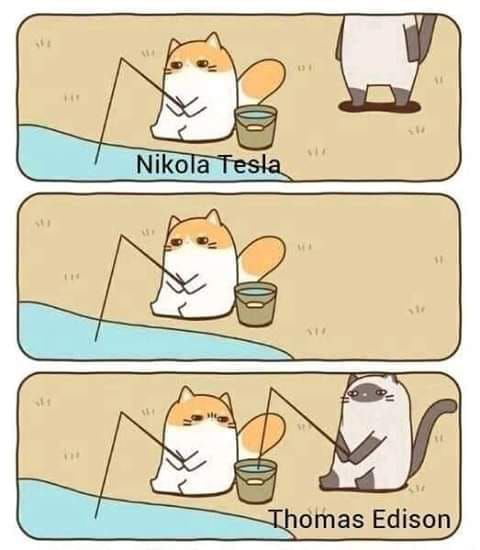
There's always going to be a Thomas Edison in our life, f**king shit up and then taking credit for the good stuff.

The Evangelical Free Church of America (EFCA) has changed its position on end times doctrine. The denomination recently voted to drop the word “premillennial” from its statement of faith.

…we “major on the majors and minor on the minors.” In light of this distinctive
EFCA value of uniting around the central doctrines of the gospel, our SOF is silent
on significant issues on which we have divergence of conviction and agree to
disagree, such as Calvinist/Reformed vs. Arminian/Wesleyan views of
conversion, cessationist vs. continualist views of the miraculous gifts, believer vs.
infant baptism and the young vs. old age of the earth.

In presenting this EFCA identity we believe there is a significant
inconsistency in continuing to include premillennialism as a required theological
position when it is clear that the nature of the millennium is one of those doctrines
over which theologians, equally knowledgeable, equally committed to the Bible,
and equally Evangelical, have disagreed through the history of the church. All,
however, have agreed that Christ’s return will be “glorious”

Are GMO’s bad? That’s the wrong question, Tess Doezema argues in her review of Mark Lynas’s Seeds of Science: Why We Got It So Wrong on GMOs: “The central problem that plagues Lynas’s argument is the same one that plagues the GMO debate in general: The conceit that the battle will be won by establishing a unitary scientific Truth about whether genetically modified organisms are good or bad. This view from nowhere is impossible to achieve for an issue bound up with so many questions of social and cultural meaning, from humanity’s relation to nature, to the significance of life, to the role of markets in creating, shaping, and producing it. What ought to be genetically engineered, when, and to what ends — these are questions far broader than biologists can answer. Lynas’s book reveals how damaging the effort to pretend otherwise has been.”

It works

Despite all the differences between languages, there is at least one similarity: People use them to transmit information at roughly the same rate. Rachel Gutman explains in The Atlantic:

“In the early 1960s, a doctoral student at Cornell University wanted to figure out whether there was any truth behind the ‘cultural stereotype’ that certain foreigners speak faster than Americans. He recorded 12 of his fellow students—six Japanese speakers and six American English speakers—monologuing about life on campus, analyzed one minute of each man’s speech, and found that the two groups produced sounds at roughly the same speed. He and a co-author concluded that ‘the hearer judges the speech rate of a foreign language in terms of his linguistic background,’ and that humans the world over were all likely to be more or less equally fast talkers.

“In the half century since then, more rigorous studies have shown that, prejudice aside, some languages—such as Japanese, Basque, and Italian—really are spoken more quickly than others. But as mathematical methods and computing power have improved, linguists have spent more time studying not just speech rate, but the effort a speaker has to exert to get a message across to a listener. By calculating how much information every syllable in a language conveys, it’s possible to compare the ‘efficiency’ of different languages. And a study published today in Science Advances found that more efficient languages tend to be spoken more slowly. In other words, no matter how quickly speakers chatter, the rate of information they’re transmitting is roughly the same across languages.”

Post image

Well, that’s it for this weekend, friends. Have a good one.

Teaching One Another: Luke 14:25-33

Teaching One Another
Luke 14:25-33

We haven’t done this for awhile, and Sunday to come presents a good opportunity for me to revive the “Teaching One Another” category.

I’ll be preaching in my congregation, and as we traditionally do in the Lutheran church, my focus will be upon the Gospel text. And what a text we have! It’s a doozy, so I thought I’d get some thoughts from the iMonk community to help me prepare, and then you will get to see the fruits of our labors together on Monday.

This text falls squarely into the category of one of Jesus’ “hard sayings.” In particular, the beginning of what Jesus says here and then his concluding statement are what make this passage daunting to understand and to preach.

So, give me a hand with this, ok? Let’s try to teach one another today about Jesus’ challenging words in this Sunday’s Gospel.

Jesus discourses with his disciples. Tissot

Now large crowds were traveling with him; and he turned and said to them, ‘Whoever comes to me and does not hate father and mother, wife and children, brothers and sisters, yes, and even life itself, cannot be my disciple. Whoever does not carry the cross and follow me cannot be my disciple. For which of you, intending to build a tower, does not first sit down and estimate the cost, to see whether he has enough to complete it? Otherwise, when he has laid a foundation and is not able to finish, all who see it will begin to ridicule him, saying, “This fellow began to build and was not able to finish.” Or what king, going out to wage war against another king, will not sit down first and consider whether he is able with ten thousand to oppose the one who comes against him with twenty thousand? If he cannot, then, while the other is still far away, he sends a delegation and asks for the terms of peace. So therefore, none of you can become my disciple if you do not give up all your possessions.

Luke 14:25-33

Bad Objections to Evolution

Bad Objections to Evolution

It’s back to school time, and this video from Genesis Apologetics has been making the rounds of… well… I don’t really know where it’s making the rounds.  Maybe Christian home schools?  Videos like these are pretty typically posted on Facebook by evangelical/fundamentalist parents so school kids can be warned in case high school science teachers try to “propagandize” about evolution.  Something I’m pretty skeptical of actually happening; at least according to my grandkids, and my daughter who is a school teacher (2nd grade).

According to this report there isn’t much danger of “evolution propaganda”:

A recent survey of 926 public high school biology teachers has revealed that nearly three out of four are not aggressively endorsing evolution.  According to the survey, only about 28 percent of biology teachers are strong advocates for evolution and “consistently implement the major recommendations and conclusions of the National Research Council.”  Thirteen percent are just the opposite, and explicitly advocate creationism or intelligent design.  Most teachers, called the “cautious 60 percent,” told interviewers that they are “neither strong advocates for evolutionary biology nor explicit endorsers of nonscientific alternatives.”

In fact, the problem may be that the science isn’t taught much at all. The report goes on to say:

Frustrated by these numbers, many biologists are opening up, says Louise Mead, education director for the BEACON Center for the Study of Evolution in Action, which is headquartered at Michigan State University.

“Evolutionary biologists used to just put a hand up whenever people brought up the evolution controversy,” she said. “But there’s been a realization that we have to address the misconceptions. There has been a renewed focus on how we teach evolution and renewed outreach.”

Jim Stump, Vice President at BioLogos, has a response you can read here.  I agree with Jim right down the line in this response.  The main problem with sweet Kayla’s rant is that it is total bullshit completely counterproductive to the aim of the video: to provide “answers” to counter evolution.  Because each of her points has been thoroughly debunked by actual science, the Christian student “armed” with those talking points will be quickly and utterly disillusioned when they reach college and come into contact with the rebuttals. That disillusionment can lead to an actual loss of faith when the student realizes they were “propagandized” instead of told the truth by their so-called faith leaders.  As Jim says in the BioLogos article:

Narratives like the one in this video are attractive because they pit the plucky, faithful underdog from our tribe against an external threat. We’re wired to respond positively to that. But unfortunately the video only perpetuates echochamber thinking. It reinforces a stereotype that true Christian faith is bundled with a rejection of evolutionary science. For too many kids today, once they get out of the echochamber and find the science actually holds up, they feel they have to abandon faith too.

So, quick recap of the bad arguments:

“Life cannot come from non-life…” 

This confuses origin of life research with the theory of evolution.  Evolution is an explanation for the diversification of life on Earth, not for the origin of life on Earth.  Despite what we know about the state of the Earth 3–4 billion years ago and the complexity of the building blocks of life—DNA, RNA, amino acids, sugars—no entirely plausible scientific explanation for the spontaneous origin of life has been found. How life came from non-life, or abiogenesis, is still largely a scientific mystery.  Nevertheless, as I noted in this post: A Review of “A World From Dust- How the Periodic Table Shaped Life” by Ben McFarland, there are tantalizing clues from chemistry and physics that the laws of physics constrain the universe so that stars would form, that elements would be created in those stars (like carbon), and that the end life of those stars would spread those elements throughout the universe. The laws of chemistry constrain the randomness of the evolutionary process so that life can form. As RJS, the PhD chemistry professor who blogs at Jesus Creed said, the evolutionary process is an efficient search algorithm optimizing for specific functions.

“Mutation only loses information…”

As one commentator to Jim’s article said, “There is abundant evidence that mutation can generate significant, functional information at a rate far higher than required by evolution. One form of evidence can be found in your own body. You possess DNA that codes for hundreds (at least) of antibodies, each precisely tuned to match a protein on a specific pathogen that you have encountered in your lifetime. You were not born with any of those antibodies or with the DNA that codes for them. The DNA – and the information needed to produce those specific antibodies – was generated from a simple template by a process of random mutation and selection; part of the process is known as ‘somatic hypermutation’.”

If evolution is true, then “we’d have millions of in-between creatures running around…”

Jim’s answer is a pretty good one:

Did the teacher in the video seriously not have an answer for this? It is just a misunderstanding of evolutionary theory. Evolution does not claim that currently existing creatures have evolved into other currently existing creatures. Kirk Cameron and Ray Comfort thought they debunked evolution by holding up a picture of a crocoduck and asking why we don’t find any of these half crocodile, half duck creatures. But evolution claims that for any two organisms today, you could go back in time and find common ancestors of them. For crocodiles and ducks, that’s about 245 million years ago, and those common ancestors were neither crocodiles nor ducks. The “in-between” creatures aren’t running around today, but they were back before the two lineages diverged (but probably didn’t look like Cameron and Comfort’s picture!).

“All of the in-between fossils could fit in the back of my Prius…”

Creationists love to quote-mine the late Stephen J. Gould, Harvard paleontologist, who said, “The extreme rarity of transitional forms in the fossil record persists as the trade secret of paleontology.” [Evolution’s Erratic Pace – “Natural History,” May, 1977]”

The problem for creationists is an enormous catalog of transitional forms have been found since the time 42 years ago when Gould wrote his book. Since Gould’s long, long ago retirement from the field, paleontologists have discovered:

  • the long series from Pakicetus to blue whales
  • intermediate forms such as Tiktaalik in the transition from fish to amphibians.
  • a long series of transitional forms from dinosaurs to birds
  • a long series of transitional forms from early hominids to humans.
Jim looking at skulls in the Hall of Human Origins at the Smithsonian Museum of Natural History Photo Credit: T. Stump

Finally, the student’s speech both begins and ends with the oft-repeated claim: “It takes a lot more faith to believe in evolution…”

Jim’s answer is OK here, but what really bothers me about the answer is the pitting of faith vs. faith.  You know, your faith is in fallible men, but my faith is in the infallible God.  The implication is the Christian’s faith is in the God of the universe, who cannot lie and would never mislead anyone, and the Bible, which is the very WORD of God, inerrant and infallible, and can never be misinterpreted… if the plain reading is taken.  But Biblicism is just the opposite side of the coin as scientism.  They are both ideologies, subject to the mirror-image problems of fundamentalist mindset.  Besides, the theory of evolution is a scientific theory, it doesn’t require any faith at all.  It is a provisional explanation of the biologic diversity we observe throughout the planet’s history. You, the scientism ideologue, says it explains away the need for God to have created the universe, and shows belief in God to be delusional.  Well, guess what, you just stopped doing science and are now in engaged in metaphysical speculation.  And you, the Biblicist ideologue, says that if evolution is true then the Bible can’t be true.  That’s like saying if embryology is true then it can’t be true that God “knit me together in my mother’s womb” (Psalm 139:13), or if meteorology is true then it can’t be true that the Father “sends rain on the righteous and the unrighteous” (Matthew 5:45).

As Christians, we can, and should, really do better by our kids.

“Getting the Great Big Kick”

Retirement. Photo by Rik Jones at Flickr. Creative Commons License

“This isn’t how most people think they’re going to finish out their work lives,” said Richard Johnson, an Urban Institute economist and veteran scholar of the older labor force who worked on the analysis. “For the majority of older Americans, working after 50 is considerably riskier and more turbulent than we previously thought.”

• quoted by Peter Gosselin

• • •

One of the issues that arises out of our capitalist economy that has become of increasing interest to me in this season of my life is the fate of the aging worker. At ProPublica, an author I heard interviewed recently, Peter Gosselin, has a piece called, “If You’re Over 50, Chances Are the Decision to Leave a Job Won’t be Yours.”

Gosselin was interviewed in response to a case that is heading to court on Wednesday, accusing IBM of age discrimination. Last year, it was reported that the company fired more than 20,000 workers over the age of 40, which amounted to around 60% of the job losses at IBM. His article addresses a pattern that IBM exemplifies.

ProPublica and the Urban Institute, a Washington think tank, analyzed data from the Health and Retirement Study, or HRS, the premier source of quantitative information about aging in America. Since 1992, the study has followed a nationally representative sample of about 20,000 people from the time they turn 50 through the rest of their lives.

Through 2016, our analysis found that between the time older workers enter the study and when they leave paid employment, 56 percent are laid off at least once or leave jobs under such financially damaging circumstances that it’s likely they were pushed out rather than choosing to go voluntarily.

Only one in 10 of these workers ever again earns as much as they did before their employment setbacks, our analysis showed. Even years afterward, the household incomes of over half of those who experience such work disruptions remain substantially below those of workers who don’t.

In the article, Gosselin quotes Gary Burtless, a labor economist, who says, “We’ve known that some workers get a nudge from their employers to exit the work force and some get a great big kick. What these results suggest is that a whole lot more are getting the great big kick.”

A numerical analysis of the study suggests that, of the 40 million American workers over age 50, 22 million will suffer a layoff, forced retirement or other involuntary job separation, with only about 2 million recovering from the loss.

When you add in those forced to leave their jobs for personal reasons such as poor health or family trouble, the share of Americans pushed out of regular work late in their careers rises to almost two-thirds. That’s a far cry from the voluntary glide path to retirement that most economists assume, and many Americans expect.

There is such a thing as age discrimination, and it’s illegal. However, in recent years, enforcement of the Age Discrimination in Employment Act (ADEA) has been much more relaxed, leaving many without its protections. Furthermore, most companies are no longer offering pensions, which may have given older workers incentive to retire early without undue worry. Laid-off workers in their 50s and beyond are more apt than those in their 30s or 40s to be unemployed for long periods and land poorer subsequent jobs, which can dramatically impact their quality of life in its final seasons.

“The expectation that American workers decide when they want to retire is no longer realistic for a significant number of older workers who are pushed out before they are ready to retire,” said Rutgers’ [Carl] Van Horn. This, despite the fact that, since 1986, mandatory retirement at any age has been outlawed by Congress. They subsequently added a requirement that people’s retirement decisions must be “knowing and voluntary.”

It’s not happening for many, perhaps a majority, of older workers.

Yesterday, when we talked generally about capitalism and its relationship with the teachings of Christ and the eschatological faith of the church, most of the discussion focused on how this economic system emphasizes private wealth and acquisition that have often left the poor damaged and on the margins. Peter Gosselin puts his finger on another aspect in capitalism’s development that affects people at a variety of income levels and status.

But unjust treatment is unjust treatment, and Peter Gosselin’s analysis helps us understand that few are immune from the grinding wheels turned by the bottom line.

David Bentley Hart on Capitalism

David Bentley Hart on Capitalism

Whatever else capitalism may be, it is first and foremost a system for producing as much private wealth as possible by squandering as much as possible of humanity’s common inheritance of the goods of creation. But Christ condemned not only an unhealthy preoccupation with riches, but the getting and keeping of riches as such.

What Lies Beyond Capitalism?

• • •

At Plough, David Bentley Hart writes as direct and scathing article as you’ll read about his conviction that capitalism is thoroughly incompatible with the way of Christ. I’m not saying I agree with everything he says, but I think we should take his strong words seriously and have a conversation.

Here, in sum, are the points he makes:

  • Definition: “Capitalism, as many historians define it, is the set of financial conventions that took shape in the age of industrialization and that gradually supplanted the mercantilism of the previous era. As Proudhon defined it in 1861, it is a system in which as a general rule those whose work creates profits neither own the means of production nor enjoy the fruits of their labor.
  • Development:
    • This form of commerce largely destroyed the contractual power of free skilled labor, killed off the artisanal guilds, and introduced instead a mass wage system that reduced labor to a negotiable commodity.
    • “All of this, moreover, necessarily entailed a shift in economic eminence from the merchant class  – purveyors of goods contracted from and produced by independent labor, subsidiary estates, or small local markets – to capitalist investors who both produce and sell their goods.”
    • And this, in the fullness of time, evolved into a fully realized corporate system…a purely financial market where wealth is created for and enjoyed by those who toil not, neither do they spin, but who instead engage in an incessant circulation of investment and divestment, as a kind of game of chance.”
    • “…capitalism might be said to have achieved its most perfect expression in the rise of the commercial corporation with limited liability, an institution that allows the game to be played in abstraction even from whether the businesses invested in ultimately succeed or fail. (One can profit just as much from the destruction of livelihoods as from their creation.)
  • Description:
    • The corporation is thus morally bound to amorality.”
    • “And this whole system, obviously, not only allows for, but positively depends upon, immense concentrations of private capital and dispositive discretion over its use as unencumbered by regulations as possible.”
    • “It also allows for the exploitation of material and human resources on an unprecedentedly massive scale.”
    • And, inevitably, it eventuates in a culture of consumerism, because it must cultivate a social habit of consumption extravagantly in excess of mere natural need or even (arguably) natural want. It is not enough to satisfy natural desires; a capitalist culture must ceaselessly seek to fabricate new desires, through appeals to what 1 John calls “the lust of the eyes.”

David Bentley Hart believes that capitalism in this form is unsustainable in the long run. Why? My conviction is based, rather, on a very simple calculus of the disproportion between infinite appetite and finite resources,” he writes. Its material advantages come at the expense of its own material basis. The only answer to its unfeasible appetites must come from beyond, and Bentley Hart finds it in the eschatological Christian hope brought by Christ. This hope is not only a beacon pointing to a new creation, but also a radical judgment on present world-systems.

Christians are…obliged to affirm that this eschatological judgment has indeed already appeared within history, and in a very particular material, social, and political form.

DBH finds confirmation for a radically different perspective on economics and social matters related to material possessions all throughout the Gospels, and I will not list the representative passages he cites. They are numerous and clear. In short, he finds that the early Christians, taking this seriously, were “communists” (not, of course, in the modern sense of state-mandated egalitarianism), but in the sense spoken of in Acts 4:32 — “Now the whole group of those who believed were of one heart and soul, and no one claimed private ownership of any possessions, but everything they owned was held in common.”

The history of the Christian Church with regard to these matters shows, at best, a spotty grasp of Jesus’ teachings, seeking to practice a different way of life primarily in isolated, monastic, or “purist” movements. DBH says this is all good and fine as far as it goes, but the critique such movements offer to the world around them is easily brushed off. These good people are seen as having a special vocation, a prophetic role, but they do not provide any kind of a template for “ordinary” people or societies to follow.

Therein lies the gravest danger, because the full koinonia of the Body of Christ is not an option to be set alongside other equally plausible alternatives. It is not a private ethos or an elective affinity. It is a call not to withdrawal, but to revolution. It truly enters history as a final judgment that has nevertheless already been passed; it is inseparable from the extra-ordinary claim that Jesus is Lord over all things, that in the form of life he bequeathed to his followers the light of the kingdom has truly broken in upon this world, not as something that emerges over the course of a long historical development, but as an invasion. The verdict has already been handed down. The final word has already been spoken. In Christ, the judgment has come. Christians are those, then, who are no longer at liberty to imagine or desire any social or political or economic order other than the koinonia of the early church, no other communal morality than the anarchy of Christian love.

That, of course, raises a host of pragmatic questions about how Christians are to actually live in the world and how they are to plant seeds that will bring about organic, systematic change in world systems that are by nature amoral and focused fully on the bottom line.

Before all else, we must pursue a vision of the common good (by whatever charitable means we can) that presumes that the basis of law and justice is not the inviolable right to private property, but rather the more original truth taught by men such as Basil the Great, Gregory of Nyssa, Ambrose of Milan, and John Chrysostom: that the goods of creation belong equally to all, and that immense private wealth is theft – bread stolen from the hungry, clothing stolen from the naked, money stolen from the destitute.

With this as the Christian, the eschatological bottom line, perhaps we can begin to develop more Jesus-shaped economic and material lives and communities.

Labor Day 2019 — Another Look: Adam and Eve – A Failure of Vocation

September Road (2018)

Labor Day 2019
Another Look: Adam and Eve – A Failure of Vocation

What the Bible offers is not a “works contract,” but a covenant of vocation. The vocation in question is that of being a genuine human being, with genuinely human tasks to perform as part of the Creator’s purpose for his world. The main task of this vocation is “image-bearing,” reflecting the Creator’s wise stewardship into the world and reflecting the praises of all creation back to its maker. Those who do so are the “royal priesthood,” the “kingdom of priests,” the people who are called to stand at the dangerous but exhilarating point where heaven and earth meet.

• N.T. Wright, The Day the Revolution Began

• • •

In the context of the biblical story, Adam is not so much the first sinner as he is the first failed savior.

What do I mean by that?

Here is my overview on how I have come to read the message about humans and God’s creation purposes for them in the book of Genesis.

  • Despite our common perception, the world we see in Genesis 1-2 is not a perfect world, devoid of sin and death.
  • God created adam to be his image in the world (that is, his priestly representative). This was (and is) the human vocation.
  • As his priestly representatives in the world, adam was to” “Be fruitful and multiply, and fill the earth and subdue it; and have dominion over the fish of the sea and over the birds of the air and over every living thing that moves upon the earth” (Gen. 1:28). Thus, the vocation involved not only taking care of creation as God’s stewards, but also actively engaging and overcoming evil.
  • To summarize: from the beginning God chose humans, those who carry his “image” in the world, to repair the world (something like the Jewish concept of tikkun olam). The original mandate for humans is that we should represent God in the world and to work with him to rule over an unruly world and overcome evil and its effects on the world.
  • Adam and Eve were not the first humans, but they were the first representative humans to be called into this covenant vocation, that they might bring eternal life to the world (through the Tree of Life).
  • The story of Adam and Eve in the Garden of Eden shows humankind’s failure to do that. They failed to exercise dominion over the creatures and subdue evil (as represented in the wiles and lies of the serpent).
  • They were thus exiled from Eden, thereby losing access to the Tree of Life for themselves and all their descendants, subjecting themselves and the world to the domination of sin, evil, and death.
  • This is, in microcosm, what the story of Israel and her leaders is about. Placed in God’s good land, and called to be a kingdom of priests and a light to the nations, Israel failed to keep God’s commandments and show the way of life to the world, and was ultimately cast into exile. Israel, like Adam, failed to live up to her vocation of giving the world access to the Tree of Life.
  • What Adam could not do, what Israel and all her patriarchs, prophets, priests, and kings could not do, Jesus did. Through his death, resurrection and ascension, he exercised dominion over the powers holding this world captive and subdued evil, restoring access to the Tree of Life for the whole world. “If, because of the one man’s trespass, death exercised dominion through that one, much more surely will those who receive the abundance of grace and the free gift of righteousness exercise dominion in life through the one man, Jesus Christ” (Romans 5:17).
  • Those who are “in Christ” now receive a foretaste of this: “But you are a chosen race, a royal priesthood, a holy nation, God’s own people, in order that you may proclaim the mighty acts of him who called you out of darkness into his marvelous light” (1 Peter 2:9). We read of the ultimate goal in John’s vision of the throne: you have made them to be a kingdom and priests serving our God, and they will reign on earth” (Revelation 5:10).

Behind all consideration of our “callings” as human beings to live in this world and care for it and each other by means of doing our work well and relating to others with love and regard, there is a “big picture” vocation from the story of creation that only Jesus the Messiah and Lord was able to accomplish and win back for us.

Like the first humans, we are called again to live in God’s blessing and life because Jesus exercised dominion over the powers of this world and subdued evil through his death and resurrection. Our “big picture” vocation has been restored. In Christ we once more enter into God’s creation mandate as we announce its restoration to the world. Jesus has made it possible for humans to live in this world as fully formed human beings and to repair the world. This is the life-giving good news we announce: Jesus’ victory and restoration of our vocation.

It will not be perfectly experienced until the restoration of all things, the new creation. But through Jesus-shaped lives, we begin to taste of the age to come.

Jesus’s followers themselves were to be given a new kind of task. The Great Jailer had been overpowered; now someone had to go and unlock the prison doors. Forgiveness of sins had been accomplished, robbing the idols of their power; someone had to go and announce the amnesty to “sinners” far and wide. And this had to be done by means of the new sort of power: the cross-resurrection-Spirit kind of power. The power of suffering love.

• N.T. Wright

Sunday with Walter Brueggemann: The counterexperience of creation in worship

Olive Trees with the Alpilles in the Background, Van Gogh

Sunday with Walter Brueggemann
The counterexperience of creation in worship

One other peculiar practice in Israel’s worship life bears on our theme. It is evident in Gen 1:1–2:4a that creation and its gift of blessing are understood to be accomplished through (a) utterance, (b) separation of day from night and the waters from the waters, and (c) in the culminating practice of Sabbath.

It is widely held that creation became a crucial claim of Israel’s faith in exile, when Gen 1:1–2:4a is commonly dated. This setting for creation faith suggests that affirmation of creation as an ordered, reliable arena of generosity is a treasured alternative to the disordered experience of chaos in exile. If this critical judgment is accepted, creation then is an “enactment,” done in worship, in order to resist the negation of the world of exile. As a consequence, creation is not to be understood as a theory or as an intellectual, speculative notion, but as a concrete life-or-death discipline and practice, whereby the peculiar claims of YHWH were mediated in and to Israel.

This assumption has led a series of scholars to notice that the Priestly construct of the tabernacle in Exodus 25–31 has an odd and seemingly intentional parallel to the creation liturgy of Gen 1:1–2:4a.15 The instructions for the making of the tabernacle, given by YHWH to Moses, consist in seven speeches, matching the seven days of creation, and culminating, like Gen 2:1–4a, in the provision for the Sabbath (Exod 31:12–17).16 Moreover, the assertion that the tabernacle is finally “finished” (Exod 39:32; 40:33) corresponds to the “finish” of creation in Gen 2:1–2.1.

This parallelism suggests that while creation may be an experience of the world, in a context where the world is experienced as not good, orderly, or generative, Israel has recourse to the counterexperience of creation in worship. Such an exercise, we may suspect, permitted Israelites who gave themselves fully over to the drama and claims of the creation liturgy to live responsible, caring, secure, generative, and (above all) sane lives, even in circumstances that severely discouraged such resolved living. Thus creation, in such a context, has concrete and immediate pastoral implication.

An Unsettling God: The Heart of the Hebrew Bible (pp. 142-143)