Daughters of the Church Today?

Have you read this book? It was a pretty significant piece of scholarship when it was released in 1987. And, as it covers nearly 2000 years of church history, I would call it a pretty significant book still today.

From the Amazon summary:

Rich in historical events and colorfully written, this fascinating account of women in the church spans nearly two thousand years of church history. It tells of events and aspirations, determination and disappointment, patience and achievement that mark the history of daughters of the church from the time of Jesus to the present. The authors have endeavored to present an objective story. The very fact that readers may find themselves surprised now and again by the prominent role of women in certain events and movements proves an inequality that historical narrative has often been guilty of. This is a book about women. It is a setting straight off the record — a restoring of balance to history that has repeatedly played down the significance of the contributions of women to the theology, the witness, the movements, and the growth of the church. An exegetical study of relevant Scripture passages offers stimulating thought for discussion and for serious reevaluation of historical givens. This volume is enriched by pictures, appendixes, bibliography, and indexes. Like many of the women whose stories it tells, this book has a subdued strength that should not be underestimated.

But 1987 was a long time ago, and a lot has changed since then, especially in regards to women in ministry. My question for you for today is: Do you have any particular women writers, teachers, or speakers that you like to read or listen to? If so, who are they, and why do you find them an important part of your reading/listening life?

I will be chiming in a bit later with some names that I find worth my while.

As usual, your thoughts and comments are welcome.

Reformation Sunday 2020: Zwingli’s Plague Hymn

Grossmünster, Zurich – 2019 (Zwingli’s church)

Swiss Reformer Ulrich Zwingli contracted the black death (bubonic plague) in Zurich while caring for the sick in 1519. Fearing for his life, he penned this hymn of lament and trust, completing its final four stanzas after his recovery.

On Reformation Sunday, we present this as our own prayer for ourselves and each other, five hundred years later, during a worldwide pandemic that has taken 1.1 million lives, with no end in sight. Lord, have mercy.

Help me, O Lord,
My strength and rock;
Lo, at the door
I hear death’s knock.

Uplift thine arm,
Once pierced for me,
That conquered death.
And set me free.

Yet, if thy voice,
In life’s midday.
Recalls my soul,
Then I obey.

In faith and hope
Earth I resign.
Secure of heaven.
For I am Thine.

My pains increase;
Haste to console;
For fear and woe
Seize body and soul.

Death is at hand.
My senses fail.
My tongue is dumb;
Now, Christ, prevail.

Lo! Satan strains
To snatch his prey;
I feel his grasp;
Must I give way?

He harms me not,
I fear no loss,
For here I lie
Beneath thy cross.

My God! My Lord!
Healed by thy hand.
Upon the earth
Once more I stand.

Let sin no more
Rule over me;
My mouth shall sing
Alone to thee.

Though now delayed,
My hour will come.
Involved, perchance.
In deeper gloom.

But, let it come;
With joy I’ll rise,
And bear my yoke
Straight to the skies.

Saturday Brunch, POLITICS-FREE EDITION, October 24, 2020

Hello friends, and welcome to the weekend. Ready for brunch?

Okay, I’ve had enough. I don’t want to hear ONE word about politics today, especially in the comments section. NOT today, boys and girls. We are gonna brunch-out on some beautiful pics, some science, news, and some  random human weirdness. And if anyone even mentions a certain resident of 1600 Pennsylvania Ave, I will triangulate your ip address, find your home, drive there (yes, even you Aussies and Brits) knock on your door and then…

Well, actually I’m not sure what happens next. Still working on that. But my imagination is fertile.

The City of Tallahassee Animal Service Center rescued a pig who was living in a fraternity house. It was still young, but Petunia the Pig will grow to about 100 pounds. The pig is up for adoption now because, as the Animal Service Center argues, “Pigs aren’t meant to live in frat houses”. Which begs the questions of whether the fine public servants at the ASC have ever been inside of a frat house.

The City of Tallahassee Animal Service Center says they have rescued a pig who was living in a fraternity house.
“I was the cleanest one there.”

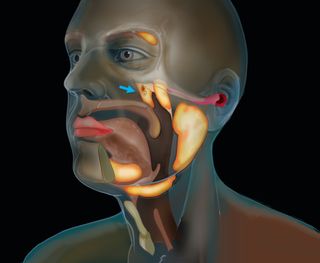
Surprise: You have a new organ in your head! Well, technically it’s been around as long as your head has, but scientists have just now discovered it. 

a new set of salivary glands has been found hiding behind the nose

Now, unfortunately, this is not a second brain or a biological radio transmitter. That would have been cool. It is actually a salivary gland. But still, it’s the first new human organ discovered for 300 years. So I guess that is cool enough.

Also in science: Betelgeuse is closer than we thought. And also smaller than we thought. More specifically the famous star is only 66 percent the size astronomers previously had it pegged at, and 25 percent closer to us. The upshot is that Betelgeuse isn’t in danger of going supernova anytime soon, as some astronomers had postulated it might.  They now calculate it could take 100,000 years before it gets to that stage. Just one more thing 2020 has taken from us…

At least Queen Elizabeth will likely get to see it.

Ever wonder what kind of damage a 1cm aluminum ball would do to a block of aluminum at 150,000 miles an hour? Of course you have.

If A Sphere Of Aluminum 1 Cm In Diameter Hits A Block Of Aluminum At ~15,000 Mph (Space Debris Impact Research Conducted By The ESA)
Space debris impact research by NASA; second ball added for scale, cuz the first ball is no more.

Hey, do you ever use a set of headphones? If so, you might want to examine the insides before you plop them on your noggin, at least if you live down under. Cuz this is what happened to Olly Hurst, after he put on his headphones and felt a “tickle” in one ear.

Yes, that is a rather large Huntsman Spider.

But how do you kill that thing without sticking your hand in to pull him out?

May I suggest playing some country music?

You ever hear of a rock band from Oklahoma called The Flaming Lips? Yeah, me neither. So why are we talking about them? Because they figured out a way to hold a full-house concert while still practicing safe-social. Hey, I think I just made up that phrase! Safe-social. Kinda like Safe-sex, but for Corona times.

Anyway, back to The Flaming Lips. How did they do it? Well, a picture is worth a thousand words.

The Flaming Lips Want to Take Its Space Bubbles on Tour - Variety

Yes, for the entire concert both the band members and the audience were in large plastic bubbles.

SOO many questions here:

  • How do you disinfect those things?
  • What happens if you have to tinkle?
  • I wonder if this would work at our church’s Christmas Eve Candlelight service?

So, what do you do when your country has sunk 5 billion into making a nuclear power plant, and then, just before it is set to open, Chernobyl happens? Well, if you’re Germany, you sell it to a Dutch investor Hennie van der Most. And his son, Hennie van der Least. Okay, I just made that part up. Sorry. And what does Mr. Most do with it? First, put up a hotel and then add a theme park. Because why not?

You can visit a theme park in Germany - built in a former nuclear power plant

The nuclear power plant never opened, and was instead bought and converted to a theme park


One of the rides is built into the cooling tower

It’s October. I think I heard some baseball is going on. Not sure.

Speaking of boring sports (sorry CM and Richard) I appreciate that some ice hockey teams are trying new things to spark interest, but it’s still a hard no from me:

Best YouTube comment on the above: “2020 on ice”.

Do you remember the Boaty McBoatFace story? You know the one where the British government thought it would be a good idea to let the internet vote on the name for their new 218 million research ship. And then reneged when “Boaty McBoatface” won in a landslide? You remember that, now?

Yeah, well IKEA didn’t.

They put out a FaceBook poll to name their new store in Valladolid, Spain [which, by the way, is the coolest name for a city ever] to name the street next to their store.  The winning entry?

      Calle Me Falta un Tornillo

Which translates to:

       I’m Missing a Screw Street. 

At least IKEA rolled with it.

España Bizarra — Calle Me Falta Un Tornillo (Arroyo de la...

Okay, I know I said no politics, but I’m going to have to make an exception for Kit.

And, hey, did you know you can find online pictures of taunting squirrels? Because of course you can.

I Can Has Cheezburger? - taunt - Funny Animals Online - Cheezburger

By the way, The Taunting Squirrels would be a great name for a rock band. Much better than The Flaming Lips.

Cell phones on the moon? NASA announced Wednesday that they will fund a project by Nokia to build a 4G cellular communication network on the moon with $14.1 million.

The space agency must quickly develop new technologies for living and working on the moon if it wants to realize its goal to have astronauts working at a lunar base by 2028, NASA Administrator Jim Bridenstine said in a live broadcast.

Man, their Instagram feed is going to be LIT.

Astronaut taking a selfie on Mars" Baby One-Piece by Whynot123 | Redbubble

Ran across this gravestone pic this week. I guess I can’t complain about my first name being Danny.

Did you know that Nikon has a “Small World” photography competition each year? Here are some of this year’s winners:

Human hair:

Human hair

Bogong moth

Bogong moth

Skeleton preparation of a short-tailed fruit bat embryo

Skeleton preparation of a short-tailed fruit bat embryo

Zebrafish

Zebrafish

Water Boatman

Water boatman

Tongue (radula) of a freshwater snail

Tongue (radula) of a freshwater snail

By the way, the winning shot was the zebrafish. You can find a LOT more (including videos) here. I actually found the 2019 entrees more fascinating.

So, finally, I suppose we should mention the Halloween season. I kinda hate to, though. Why does Halloween now get a season, complete with whole yard-fulls of skeletons and tombstones and orange spider webs, when thanksgiving, a much, much cooler holiday, only gets a day?

Besides…do we really need a Halloween season this year? Hasn’t 2020 been Halloween?

And trick-or-treating seems redundant. I’ve been wearing a mask and eating candy for six months.

Maybe I’ll dress up as the Corona Virus and scare anyone who’s read The Masque of the Red Death.

I was just joking about that, but then did a quick search, and viola:

Mixed reviews: Is the COVID-19 Halloween mask tacky or timely? | The Kansas City Star

Ok, fine. I’ll quit being whatever the Halloween version of Scrooge is. We will conclude our brunch by serving up a delightful montage of 50’s horror films (I think Chaplain Mike is an extra in a couple) set to, of course, The Monster Mash. Full-screen that baby (and yes I just made full-sreen a verb; deal with it)

One last thing. I have been thinking for the last couple months of re-starting a blog. Something with some humor and some ideas and a forum. I had insomnia last night and started working on it. Just a shell now, but more to come. And the forum works. You can see it here if you like, and suggestions are welcome.

Reconsider Jesus – The Forgiver of Sins (Mark 2:1-12)


Reconsider Jesus – A fresh look at Jesus from the Gospel of Mark
A devotional commentary by Michael Spencer
Compiled and Edited by: Michael Bell
Table of Contents

(Note: I wanted to take a moment to give a bit of an update on this project. Each post in this series usually takes me between three and six hours to put together. What you read however is not the final version. Dana, who we know from her very perceptive comments at Internet Monk, has become my de facto editor. She reads these posts and spends about an hour providing me with needed edits. Last post was the record so far: 36 recommended grammatical and wording changes! In contrast with Mark Chapter One, Chapter Two is going to consist of just four sections. After Chapter Two is complete, and Dana’s edits compiled back into Chapter One and Two, I will be seeking a publisher. Please send in your expressions of interest if you have not already done so, the more I have before approaching a publisher the better. )

The Forgiver of Sins

1 A few days later, when Jesus again entered Capernaum, the people heard that he had come home. 2 They gathered in such large numbers that there was no room left, not even outside the door, and he preached the word to them. 3 Some men came, bringing to him a paralyzed man, carried by four of them. 4 Since they could not get him to Jesus because of the crowd, they made an opening in the roof above Jesus by digging through it and then lowered the mat the man was lying on. 5 When Jesus saw their faith, he said to the paralyzed man, “Son, your sins are forgiven.”

6 Now some teachers of the law were sitting there, thinking to themselves,7 “Why does this fellow talk like that? He’s blaspheming! Who can forgive sins but God alone?”

8 Immediately Jesus knew in his spirit that this was what they were thinking in their hearts, and he said to them, “Why are you thinking these things?9 Which is easier: to say to this paralyzed man, ‘Your sins are forgiven,’ or to say, ‘Get up, take your mat and walk’? 10 But I want you to know that the Son of Man has authority on earth to forgive sins.” So he said to the man,11 “I tell you, get up, take your mat and go home.” 12 He got up, took his mat and walked out in full view of them all. This amazed everyone and they praised God, saying, “We have never seen anything like this!”

Mark 2:1-12 – NIV

Mark chapter two begins with another healing story, this time mentioning the enormous response Jesus was receiving in Capernaum. It is interesting that Mark says in verse one that Jesus had come “home”. Jesus was living in Capernaum, and it was the anchor for his early ministry.1 The passage, as written, is most naturally interpreted as happening in Jesus’ own house!2

The house-crowding response is in line with what all the Gospels show us about Jesus’ early ministry – the mobs were overwhelming, particularly when healing or feeding-miracles occurred. Like a modern-day celebrity who can’t even take a vacation without being hounded by paparazzi, mobs of people were following Jesus wherever he went. This is clearly the reason the religious and political leaders are interested in Jesus from the outset. His ability to draw a crowd was proven and potentially dangerous to the status quo. This is the first time we meet some of his religious opponents, in this case, “the teachers of the law”.

Growing up, I heard many sermons about the four men who brought the paralyzed friend to Jesus and lowered him through the roof. Generally these sermons missed the point because this part of the story is not the focal point of the passage. Rather it is the “memory device” used to isolate this story for recollection. Such details show that these stories were memorized and repeated long before they were written. The persistence of these men apparently reflects the persistence of the paralyzed man himself, who has insisted on seeing Jesus in order to be healed. His confidence in Jesus is so bold that no barrier – be it crowd or mud-and-thatch roof – will prevent him from getting to Jesus.

Throughout the gospels, Jesus is impressed with anyone who’s desperate enough to get to him: A woman who comes out and touches the hem of his garment;3 or a synagogue ruler who says, “Jesus, my daughter is dead.”4 Jesus recognizes the faith of the desperate.

Faith is often born of desperation: when we get to the place where we realize that “I have no other answer but God.” We shouldn’t despise this realization and we shouldn’t say, “I should have figured it out sooner.” Many, many people get to this place of desperation. This paralyzed man was no exception when he said, “I don’t care how, but get me to Jesus.” And his friends respond, “We’ll take you there.”

It is interesting that Jesus sees “their” faith. It is not only the paralyzed man’s faith, but the faith of his friends that is commended. Much of Western Christianity is hyper-individualized and resists the idea of a “community of faith.” But I think it is biblically impossible to speak of faith outside of a community of faith that believes before we do, nurtures us as we learn to believe, supports us as we believe and believes when we stumble in belief. God’s covenant with his “people” is a community covenant that does not downplay individual faith, but places God’s covenant with the community at the center of his dealings with human beings. All this underlines why it is vitally important for every Christian to be part of a believing community and not just a “lone ranger.”

In the Gospels, surprise is often found at the center of what is being communicated and Mark certainly surprises us when we read Jesus’ words to the paralyzed man: “Son, your sins are forgiven!” The forgiveness of sins seems to have nothing to do with this story. The paralyzed man came for the healing of his body. What does this mean?5 It’s no wonder that the teachers of the law are immediately awakened from their dozing by this little statement.

The crux of this story is the extension of Jesus’ Kingdom authority to that final and most profound area of human life – the forgiveness of sins. Sin is the basic human problem, the problem that occupies Genesis 1-11 and leads to the plan of God beginning with Abraham and continuing through the entire Bible. The Kingdom of God is an invasion of territory claimed by Satan but held by the power of sin. Salvation is the victory of God over sin and this victory is manifested first and foremost in forgiveness. The most basic of human needs is for the guilt we have before a holy God to be removed. Such an event is impossible in human power alone. We cannot forgive ourselves or do enough good to persuade God to forgive us. God forgives out of mercy and grace, prompted by the work of his Son in the incarnation, cross and resurrection. God may now forgive sinners because their penalty has been paid and his justice satisfied. The entire Old Testament pointed in this direction and Jesus now proclaims forgiveness as a free gift. This is the most important good news of the Gospel.

The scandal here, in this account, is for Jesus to proclaim forgiveness as the one doing the forgiving! If you’ve followed the story of the Gospel thus far, Jesus has expelled a demon,6 he’s healed a woman with a fever7 and he’s healed a leper.8 Many others have been healed as well. When they lower the paralyzed man everyone is expecting Jesus to say, “Your faith has made you whole. You’re healed.” However, Jesus says, “Your sins are forgiven.” I’m sure the room got very quiet.

The religious leaders were present and checking Jesus out, trying to understand what he was all about. They responded, “Wait one minute! Who is this guy, saying he can forgive sins?” But Jesus loves to answer questions with questions. So he replies, “Why are you thinking these things? Which of these things would be easier: to say, ‘Your sins are forgiven,’ or to tell the paralytic to stand up and walk’?”

These guys are asking the question in their mind and we’re told Jesus knew in his spirit what they were thinking in their hearts. This is unique and it is consistently testified in all four Gospels. This is not just reading moods or body language, but a manifestation of knowledge that only a divine person could have; the sort of searching knowledge of human thoughts and motives that allows God to know us as we are and to judge us with absolute integrity. It’s amazing the insight Jesus carries into each of us.

What Jesus did at this point was even more outrageous. To teach with authority was outrageous; to claim to forgive sins was taking it up a notch. The teachers of the law recognize this as blasphemy and they are exactly right. For Jesus to proclaim forgiveness, when he is only a man, would be blasphemy for “only God can forgive sins.” This probably seemed particularly scandalous when proclaimed to a man who was “cursed” with a disease and was not repenting in any visible way, but merely showing his confidence in Jesus to heal him. To these legalists, only proper sacrifice and acts of repentance held out any hope of forgiveness. To give forgiveness simply by a word was to act in the prerogative of God alone.

Jesus, if we properly understand him, is always leaving us no choice but to interpret his words and actions as either 1) insane, 2) calculatingly evil, 3) blasphemous or 4) consistent with the confession that Jesus is the Son of God. This is not something Christians have created and assigned to Jesus. It is essential to knowing how he understood and presented himself.9 From the very beginning, Jesus’ identity as divine was essential to everything the Christian message teaches and proclaims. Any version of Christianity that ignores this is a modern reworking.10

Not only that, but Jesus combines his authority to heal with his proclamation to forgive sins. These simple words of forgiveness are easy for anyone to utter, but who can demonstrate the integrity of such a claim by healing a paralyzed man on the spot? Jesus makes the religious leaders’ objection absurd because, with the same word that he heals, he also forgives sin. For Jesus, there is no limitation on his authority in any area of life. He can speak to sin, to disease, to demonic oppression, to guilt, to self-hatred – to anything that holds us in bondage – and set us free and make us whole. The meaning of salvation is always holistic in real Christianity. We look to Christ’s work to be applied in every area, according to God’s working through the Spirit and in history. Anyone who ministers in Jesus’ name is doing God’s work – no matter what area of human existence they are working in: social work, medical missions, evangelism, education, counseling. All include the authority of the Kingdom working out in human relationships and experience.

In this healing, as in others of Jesus, we observe something noteworthy: When Jesus healed, it was immediate, it was total. It wasn’t, “I was feeling a little pain in my back, and I’m feeling better today.” It wasn’t, “I’ve got a headache and it’s gone.” Rather we read of a person who is blind, and then can see; a person who he’s covered with leprosy and then the leprosy vanishes; and in this story, a man who is paralyzed for life and then gets up and walks. Jesus’ healings were breathtaking. Jesus leaves all amazed, flabbergasted, stupefied – “We have never seen anything like this!”

My prayer is that the churches you come in contact with might create a similar response in you: “That’s not like anything else we’ve seen. Their Jesus isn’t like any Jesus we’ve ever heard of!” Jesus Christ is like no other person. The authority with which he talked. The authority with which he healed. The authority by which he forgives sins. It’s all one and the same, it’s the authority of the Lord Jesus Christ. And I pray that if you’ve never acknowledged that authority, hold up the white flag and surrendered your life in faith, and say, “Lord I’m giving you everything, I’m giving up the war against you, and I’m going to put my life in your hands and live under your authority from now on.” If you’ve never done that, I hope that you do. I hope that you’ll do it today.

—————————————-

Footnotes:

[1] Matthew 4:13 confirms that Jesus lived in Capernaum.

[2] This simply shows how different the gospel portrayal of Jesus is when compared to the “approved” version, which has Jesus as continually itinerant. There are many items that are glossed over in the telling of Jesus’ story. For example, the fact that Jesus was primarily financially supported by several women (Luke 8:1-3) is rarely discussed in most church circles. It could be argued that this story happened in Peter’s home because of its mention in Mark 1:29-31. But if the story is an independent unit, which is far more likely, then Jesus’ own home in Capernaum is the more natural reference.

[3] Mark 5:25-34.

[4] Mark 1:35-43.

[5] Some could jump to the conclusion that this passage teaches that sin causes sickness. Such a claim needs a comment. In the Bible, all aspects of our fallen condition are the result of our separation from God and the curse that results from it. In this sense, sin is the cause of sickness.# But in any sense that a particular sin causes a particular sickness, we must be very, very cautious. While there are some instances where such a conclusion is drawn#, this sort of cause and effect thinking is generally discouraged.# I do not believe Jesus is drawing such a conclusion. It is the case, however, that Jesus’ message of the Kingdom does teach that the end of separation between God and man is manifested in every area of human existence, including physical healing.

[6] Mark 1:21-28.

[7] Mark 1:29-31.

[8] Mark 1:40-45

[9] Note here how Jesus refers to himself as “Son of Man”. This self-titling by Jesus has caused endless scholarly speculation. Ezekiel, the prophet, used this same title# and, so, Jesus may have been referring to himself as the humble prophet. But I doubt this is the source of the title. Rather its use by the prophet Daniel in Daniel 7:13, as a reference to the end-time Messiah, is simply too obvious to ignore. No one would use such a title thoughtlessly. To use this title to refer to yourself, while at the same time claiming to forgive sins and heal a paralyzed man, is Jesus making the claim that he is, in fact, the one Daniel saw and predicted.

[10] Some critics assert that the closer we get to the original sources of Christianity, the further we will be from any sense that Jesus is a divine figure. The Jesus of primitive Christianity, these commentators assume, was a teacher and political figure who would be completely surprised at discovering he is worshiped, invoked as divine or equated with God. These same folk often say that the Gospel of Mark is largely free from any evidence that Jesus saw himself in these terms. Instead, they claim that Mark’s gospel portrays Jesus as a servant and prophet within Judaism. However, this particular passage demonstrates how wrong this sort of assumption really is and how Mark’s presentation of Jesus goes beyond the known categories of prophet and preacher to something unique and powerful. For a representative example of the critics, see:
Erhman, Bart. How Jesus Became God: The Exaltation of a Jewish Preacher From Galilee. HarperOne, 2014.
In contrast, the following books detail how the deity of Christ was believed from the earliest days of Christianity:
Bowman, Robert M. Jr. and Komoszewski, J. Ed. Putting Jesus in His Place: The Case for the Deity of Christ. Kregel, 2007.
Bird, Michael F. (and four additional authors). How God Became Jesus: The Real Origins of Belief in Jesus’ Divine Nature—A Response to Bart Ehrman. Zondervan, 2014.
Bauckham, Richard. Jesus and the Eyewitnesses: The Gospels as Eyewitness Testimony. Wm. B. Eerdmans Publishing Co., 2008.
Wright, N.T. The Resurrection of the Son of God. Fortress Press, 2003.


Notes from Mike Bell:
Some questions for you:

1. What questions or thoughts come from your mind from what you have just read? What stood out to you?

2. Would you be interested in a paper or Kindle version of the book when it is available? Please email us at michaelspencersnewbook@gmail.com so that we can let you know when it is ready. This is an email to indicate interest only, I am not selling anything at this point, but I sure do appreciate the encouragement!

As usual, your thoughts and comments are welcome.

What is the plan for the Pandemic?

What is the plan for the Pandemic?

Are you tired of the Pandemic?  Are you through with the Pandemic?  Well the Pandemic is not “through” with you.  This latest report warns:

US Covid-19 cases will begin to rapidly accelerate in a week as the country topped 60,000 new infections Tuesday — triple what the daily average was back in June, when restrictions had begun to ease.

Here is the case for Indiana on October 21st

In April when cases were peaking at 700 per day, Governor Holcomb and the state of Indiana instituted work-from-home policies along with a general lockdown that included bars and restaurants.  Look at today — there are over 1,700 cases per day and still rising. And here in Indiana there is talk of ending work-from-home and bringing people back into the buildings.

What the hell is going on?  The virus is spreading faster than it did in the spring.  I spoke with my boss today and told him I was frankly worried.  I don’t want to catch this disease.  People my age and with my pre-existing conditions are suffering greatly even after recovering even if they don’t die outright. What if I’m required to go back to work?

President Trump has apparently learned nothing from his bout with the disease.  And he IS denigrating Anthony Fauci in the press because HE IS EFFING DOING HIS JOB!!!

What we need is a plan that incorporates reasonable precautions that does not result in economic ruin.  But who is going to formulate and put into practice such a plan?  Is such a plan possible?  Or are we just doomed to having the coronavirus burn through our population until mass herd immunity is reached, assuming that is even possible?  Maybe if Biden is elected he will let Fauci take the lead in the pandemic response.  One can hope- and hope seems hard to come by these days…

Affective Polarization

“I’m not just running against Biden — Sleepy Joe — I’m running against the corrupt media, the big tech giants, the Washington swamp. And the Democrat Party is a part of all of them — every single one of them. They flood your communities with criminal aliens, drugs and crime, while they live behind beautiful gated compounds….If you want depression, doom, and despair, vote for Sleepy Joe Biden.” (Donald Trump, 10/20/20)

I encourage you to read this good article by Richard Beck about “affective polarization” and how it has been increasing and leading to more political tribalism in our society. Affective polarization goes beyond having differences with others. It involves a spectrum of feelings about those with whom we disagree — from disagreement to distrust to dislike to demonization.

Beck and I agree about how this corrupts and breaks down the purpose and practice of politics.

Basically, politics should be a tool, a way to solve our social problems. But politics has become increasingly moralized, transforming itself into a holy war, a clash between Good and Evil. The pragmatic spirit is lost, and politics ceases to function as a tool to solve our problems. It’s all identity markers, wherever you look across the political landscape. No solutions, just the social signaling of Us versus Them.

Because of the technology available to him, there has been no greater practitioner of this in my lifetime in American politics than Donald Trump. Trump’s relentless provocation of affective polarization in our country, to me, is one of the most destructive elements of his presidency. As many have noted in the comments here at IM, partisan division has always been a feature of life in the U.S. However, there is no doubt that we owe the current high level of public affective polarization to Trump and his imitators, who have used the tools of this information age to carve deep divides among us in their pursuit of power.

My question is: Where is this going?

Pro-life and Anti-Trump?

I recently ran across a Facebook argument, in which two people I respect (I will call them Mrs. A and Mr. B) took very different positions on voting. Both are thoughtful, intelligent Christians, yet the issue that primarily divided them was on whether abortion was an absolute deal-breaker when it came to voting for the Democratic candidate. To put it in rather stark terms, the question was whether ANY prolife candidate should ALWAYS command the vote of prolife people, regardless of other factors.

Mr. B seemed to answer that question in the affirmative while Mrs. A thought otherwise.

I did not chime in, for I think Facebook fosters division instead of constructive dialogue. But perhaps this forum will be different.

I will make it a little more personal and direct. I am prolife. Does this mean I need to vote for Donald Trump? Can I be prolife without being pro-Trump?


Let’s first define our terms a bit. To be prolife means I agree with two propositions:

First, that a human fetus becomes a human life at some point before birth.

Second, that society has a legitimate interest in protecting human life, even through legislation when necessary.

I am not going to argue these points right now. I am simply stating what I mean when I use the term prolife.

What does it mean to be anti-Trump?  For my purposes it means to refuse to vote for him as a presidential candidate. This can mean either voting for the Democratic ticket, voting for a third party, voting for a write-in candidate, or pointedly refraining from voting for the presidential race at all.


At face value, the prolife position has received much help from the current president, especially in his judicial appointments. Though Trump has kept less than half of his campaign promises from 2016, in the area of court picks he has delivered.

This fact, from what I can tell, is what will lead many conservative Christians to vote for him, though they may disapprove, or even abhor, his personal life and his divisive and dishonest rhetoric.

But I can think at least three reasons for religious conservatives like myself to not make this bargain.

First, it is not at all clear that the prolife goal will be helped by legislative or judicial action.

What is the goal of the prolife movement? Surely it is to decrease the amount of abortions that occur in our society. Good news: This has actually been accomplished.

The abortion rate has gone down consistently for almost twenty years now. In 2013 it actually dipped lower than the abortion rate before the Roe v. Wade decision (in 1973), and has continued to decline since then.

Let’s ponder this point: The abortion rate today, in 2020, is lower than it was when abortion was not legal nationwide.  And this trend has continued for 20 years, through Democratic and Republican presidents, through Democratic and Republican congresses, and through various iterations of the supreme court.

Why has it gone down? Many factors are in play, not just one. More couples using birth control. The hard work of crisis pregnancy centers. Changes in societal views on abortion, influenced by the prolife movement and better fetal imaging. A declining pregnancy rate among teenagers. Morning after pills. Restricted abortion options in some local communities.

Of these factors, the last is the only one directly controlled by judicial or legislative action. And this factor is the least weighty of the ones I mention.

In other words, the goal of the prolife movement has occurred and is occurring: to reduce the abortion rate in our society. And this has happened regardless of who is in the White House or whom they pick for federal judgeships.

Second, the Supreme Court is unlikely to reverse Roe v Wade anyway, and it is unclear what other abortion-related decisions they would choose to accept to adjudicate, nor how they would decide those cases.

Roe v Wade now has almost 50 years of legal standing. Anyone who keeps an eye on the judicial philosophy of the current court (even if ACB is added) would deem it doubtful that the court would reverse that decision. After all, in the early 90’s eight of the nine justices were Republican appointees, but there was no movement regarding Roe at all.

It’s just not going to happen.

Even if they did reverse Roe v Wade that would not outlaw abortion. Abortion legality would be decided at the state level, as it was before Roe.

Third, it is my opinion that the election of  Donald Trump will actually be a net negative for the pro-life position in the long run, despite his judicial picks.

This is because the prolife movement is about so much more than simply making more laws restricting abortion. It is about helping to create a society that values life more, especially vulnerable human lives, including the unborn. You cannot legislate that. You can only help create it.

How do you do that? By arguing a coherent and consistent prolife viewpoint. By exemplifying the kind of care and compassion for the weak and vulnerable that you are advocating for. By thoughtfully and compassionately caring for the women that may be in difficult situations. By displaying a concern for the weak and vulnerable in other situations than the unborn. And by prayer.

At its best, the prolife movement has done some of these much better than our opponents want to give us credit for. I have seen, and participated in, crisis pregnancy centers ministering to women (and men) in diverse ways. And this is, I think, part of the reason the abortion rate has fallen.

But look at those five things now. To which of those has Donald Trump contributed? Would not a dispassionate observer sense that his effect has been the exact opposite on several of these?

My concern is not primarily about him. It is about the prolife movement and how he affects it.

How can we maintain any kind of moral consistency about biblical values, or even traditional family values, when so many of us vote for a man who has cheated on all three of his wives, and who said that sleeping around while avoiding STD’s was his “personal Vietnam”? And without that moral consistency, how can we have any ability to argue in the areas of personal morality, or help create the kind of worldview in our society that takes the morality of abortion seriously?

How can we pretend our concern for the unborn is part of a holistic concern for the dignity of all human life, when we vote for a man who mocks the disabled, and called reportedly soldiers who died for their country “suckers” and “losers”?

How can we say we care about the value of women, all women, and object to their objectification when we vote for a man who boasts about sexually assaulting women, and refers to 15 year old girls as “a piece of ass”? And who, by the way, does not repent of these things.

I could go on. But why? Let me just ask you to give an honest answer to this question: Do you sense the prolife movement has been more prayerful, more compassionate, more consistent, more morally persuasive…than it was four years ago?

And…perhaps more to the point…how would society at large answer that question?

Politics, including the politics of abortion, is downstream from culture. Any legislative victories the prolife movement does achieves in the next few years will be short-lived indeed if the culture does not become increasingly prolife as well.

So, to wrap up, the president’s judicial picks are not likely to significantly change how many women get abortions, both because the court will not overturn Roe, and because the abortion rate is already decreasing dramatically without judicial action. But a prolife movement without a moral compass is lost.

Does this mean we should all vote for Joe Biden? Of course not. There are many issues and many options. What it means, if I am right, is that we should vote for our president not solely on the grounds of his judicial picks. It is certainly possible to be prolife and not be pro-Trump.

Reconsider Jesus – The Healer (Mark 1:29-45)


Reconsider Jesus – A fresh look at Jesus from the Gospel of Mark
A devotional commentary by Michael Spencer
Compiled and Edited by: Michael Bell
Table of Contents
(Note: The previous post was renamed to “The Compassionate One”)

The Healer

29 And immediately he left the synagogue and entered the house of Simon and Andrew, with James and John. 30 Now Simon’s mother-in-law lay ill with a fever, and immediately they told him about her. 31 And he came and took her by the hand and lifted her up, and the fever left her, and she began to serve them.

32 That evening at sundown they brought to him all who were sick or oppressed by demons. 33 And the whole city was gathered together at the door. 34 And he healed many who were sick with various diseases, and cast out many demons. And he would not permit the demons to speak, because they knew him.

35 And rising very early in the morning, while it was still dark, he departed and went out to a desolate place, and there he prayed. 36 And Simon and those who were with him searched for him, 37 and they found him and said to him, “Everyone is looking for you.” 38 And he said to them, “Let us go on to the next towns, that I may preach there also, for that is why I came out.” 39 And he went throughout all Galilee, preaching in their synagogues and casting out demons.

40 And a leper came to him, imploring him, and kneeling said to him, “If you will, you can make me clean.” 41 Moved with pity, he stretched out his hand and touched him and said to him, “I will; be clean.” 42 And immediately the leprosy left him, and he was made clean. 43 And Jesus sternly charged him and sent him away at once, 44 and said to him, “See that you say nothing to anyone, but go, show yourself to the priest and offer for your cleansing what Moses commanded, for a proof to them.” 45 But he went out and began to talk freely about it, and to spread the news, so that Jesus could no longer openly enter a town, but was out in desolate places, and people were coming to him from every quarter.

Mark 1:29-45 – ESV

In our last chapter, we discussed how Jesus acted with compassion and is calling us to reach across barriers and get out of our comfort zones. I think it is beneficial to spend a little longer on this passage of scripture and understand the import of Jesus as Healer. We can then delve deeper into what that “does”, and “should”, look like in a church today.

The healing miracles in Mark exist as part of a message: the Kingdom of God has arrived in Jesus. Disease and physical deterioration were part of the consequences of sin that we read about in Genesis 3. In contrast, the miracles of Jesus demonstrate the power of the Kingdom of God to reverse these consequences and destroy the works of the devil.82 Those who witnessed the miracles of Jesus were being convinced that the Kingdom of heaven was real and present. At the very end of the Bible we read what this will ultimately look like: “There will be no more death or mourning or crying or pain, for the old order of things has passed away.” The healing miracles of Jesus then, were a natural outgrowth of the presence of the Kingdom. In the Gospel of Matthew,83 Jesus cites his miracles as evidence to John the Baptist that he is indeed who John said he was – the one who brings the Kingdom of God into the present.84

Furthermore, the miracles attest to the unique identity of Jesus himself. Those anointed of God’s Spirit were involved in healing in the Old Testament, but this was a rarity. Jesus is anointed by God’s Spirit in a unique way. Healings are not exceptional events, but seemingly daily events in his ministry. Mark and the other Gospel writers select certain healings not because they were all the healings that occurred but in order to use those healings to show more of Jesus’ identity, power and message. The healings build a clear case that Jesus is the Messiah, anointed with the Holy Spirit and constantly moving in Kingdom power. As with the exorcisms, Jesus was not the only person in his culture with a claim to heal, but the Gospel writers, and especially Mark, wanted us to see that Jesus’ healing and delivering power was unusually abundant. The reader of the Gospels comes away with the impression that Jesus was almost humanly overwhelmed with those who came to experience healing.

It would be appropriate at this point to point out that Jesus’ healings usually contained certain characteristics:

Jesus’ healings were immediate. The healing of the man with leprosy is typical of this and the healing happened on the spot. Even the exception to this, the healing of the blind man found in Mark 8, happens immediately in comparison to much of what we hear today.

Jesus’ healings were total. The result was complete restoration, not improvement or more tolerance to the situation. Blind persons saw perfectly. Lepers were cleansed totally. Absent tissue was replaced. Visible symptoms vanished.

Jesus’ healings were visible. The results could be seen and verified on the spot. Even Jesus’ enemies had to acknowledge that the healings happened!

So, what do we see in churches today, and what should we see? Most of the churches that I am familiar with have a practice that falls into one of two extremes.

Jesus’ miracles were immediate, total, and visible. I mention these three areas because most of what is put forward as healing today fails these scriptural tests. Those whom Jesus commissioned to go out and continue Jesus’ ministry also experienced healings along these same three criteria, though not in the same measure or frequency as Jesus. Christians should not blush from pointing this out, for the rest of the world certainly sees it! Those who claim to be imitating Jesus but show no immediate, total and visible healings are either misled or creating a deception. Scripture warns us, in fact, that many will claim to have performed healings like Jesus, yet not belong to him.85 Other passages tell us that the coming of the evil one is accompanied by false miracles.86 The failure of Christians to consider this matter has left the sheep open to the appetite of wolves and false prophets. Healing is an area where human hopes and hurts often go far beyond our desire to remain rational and scriptural. Beware of those who claim to do what Jesus did when they fail in every way! All the lights, music, singing, shouting, and praying in the world will not conjure up a miracle! God is able to do the miraculous immediately, visibly and totally.

At the other extreme, are those who say that miracles have no place in the church. Those preachers will exclusively preach these texts as allegory, or to support some other point they want to make on a particular Sunday. I am amused at how many preachers who will preach these texts discourage any kind of serious healing ministry in their church.

So what “should” churches do?

I would like to reemphasize what we discussed in the last chapter: That Jesus is compassionate and inclusive. These healing miracles show that Jesus brings something to the whole person. The Kingdom of God is good news for all aspects of our life. Many of the stories show the love of God for the most basic and personal details of our lives. In Mark 5:26 we will study the woman healed of the issue of blood. That God knows and cares about such a private aspect of a woman’s experience is a powerful testimony to the holistic shalom that comes in Jesus: He speaks peace to all that is life. For this reason alone, let us interpret these stories properly.

There is a case to be made for healing ministries to have a place in the church of today. It is an important and neglected ministry. The Apostle Paul lists “those with gifts of healing” as part of the body of Christ.87 This is plural, indicating many people and various kinds of giftedness, and even various kinds of healing. This does not describe a healer who arrives like a circus, but an ongoing ministry in the body of the Church. Also, James indicates that you should pray for yourself, and that both the church and its elders should pray for the sick.88 God will sometimes restore a sick person to health as an answer to prayer. Paul however, also makes it very clear that sometimes God’s answer to prayer is not healing, but grace to persevere.89 This is crucial, in my opinion, for building a theology of illness, for it faces reality; encourages prayer; sees an answer that may not be physical healing; and speaks of larger purposes of God in allowing sickness.

Those, at the first extreme, who say that God will give perfect health to all who pray in faith must have a real problem reconciling that understanding with Paul’s writings and with the fact that all of God’s children will eventually die.

Here then is my encouragement for churches today. The church should be involved in healing prayer as well as prayer for the miraculous. We should also realize that the church is not Jesus or the apostles. For whatever reasons he chooses, God does not heal everyone who asks for prayer in the way Jesus healed people. The reason for this is clear to me – the miracles of the New Testament are not normative for the Christian life or the life of the church. They had a greater function in establishing the Kingdom of God and identifying the King. Christians are to pray in Jesus’ name, with persistence, power and compassion. But they are also to leave all the results in God’s sovereign hand.

—————————————-

Footnotes:

[82] In a previous chapter we looked at how, in the pre-scientific understanding of disease, demonic forces were credited with more than we would credit them today. However, it still holds true that disease is a work of the evil one and a fruit of the fall.

[83] Matthew 11:1-5

[84] The serious student should pursue a study of how the miracles in the Gospel of John are used as “signs”, that is, events which give insight into spiritual reality and the truth/presence of the Kingdom. This is a major area of Gospel study that will be very helpful in understanding miracles in the Gospels.

[85] Mark 13:22; Matthew 7:22-23

[86] 2 Thessalonians 2:9

[87] 1 Corinthians 12:28

[88] James 5:13-16

[89] 2 Corinthians 12:7-10


Notes from Mike Bell:
Well, fifteen posts in, and we have finally come to the end of Mark Chapter 1. I can assure that that the next chapters will proceed at a little faster clip! Some questions for you:

1. What questions or thoughts come from your mind from what you have just read? What stood out to you?

2. Would you be interested in a paper or Kindle version of the book when it is available? Please email us at michaelspencersnewbook@gmail.com so that we can let you know when it is ready. This is an email to indicate interest only, I am not selling anything at this point, but I sure do appreciate the encouragement!

As usual, your thoughts and comments are welcome.

Sunday with Michael Spencer: Ink Blot Church

Ink Blot Church
from 2005

God is like a Rorschach test. You know, the ink blot test, where you look at an image that really presents nothing coherent, and you describe what you see. Kind of like looking at clouds and talking about what you see.

The Rorschach test is outdated and was always controversial, but it does yield one agreed upon result:

There are a limited number of common responses to each image, and they do demonstrate that we don’t just purely see the world, but we bring a complex grip of presuppositions and assumptions to what we see, and this influences how we interpret an image.

I’m wondering why certain kinds of people seem to identify with particular expressions of Christianity. I don’t have to do this exercise for you, do I? Charismatics. Calvinists. Warren-style Boomers. Traditional Southern Baptists. Emerging church twenty-somethings. Social justice liberals and Jerry Falwell fundamentalists….they really aren’t the same kinds of people. They are different. Though they read the same Bible, hear the same stories about Jesus and talk about the same God, they are different from one another, and similar to those with the same label.

Is this really because some are smarter than others? Some are better at hearing God’s voice? Is it all a matter of social and family context? Or is it — at least partially — a matter of psychological factors that we don’t really want to look at, because they take away the veneer of “being right” and confront us with the fact we’re not quite the free-choosers and serious disciples we think we are?

Was Arthur W. Pink unable to find a church where he could minister because of his study of the scriptures? Did his eventual withdrawal to write a magazine at home with his wife, living almost as a hermit, come from the God he came to know in Jesus? Perhaps Pink was a hermit and a loner for reasons that we don’t know, and he interpreted Christianity in a way that made his withdrawal from other people a necessary protest against the weak Christianity of the age.

Are Rick Warren’s members and disciples really taken by Warren’s preaching and writing? Or do his followers come from those who have a psychological need to be part of the “winning” team as a way of validating themselves?

Do liberal Christians like Bishops Spong and Robinison represent a more humane, rational approach to reading the Bible, or are they identifying with an approach to God that allows them to deconstruct the strictures and prejudices they have suffered under throughout life?

Is Michael Spencer writing what he learns in his study of the Bible and his reflection on his faith, or does he need to be a writer to make up for failures to succeed in his career? Does self-publishing allow him to pretend he has something worth saying and people who want to read it?

This could go on for days. Do we see Jesus as he is? God as he is? The Bible as it is? Are we at all what we seem in our discussions and ministries, or are we moving to music that is deep within our make-up; music we can’t admit hearing and responding to?

I know it is possible to upend a lot of our Christianity under a ruthless psychological examination. The need for God to exist, the need to be right about morality and the afterlife, and the need for our answers to work are presuppositions with many of us.

When we look at religion, and at Christianity in particular, we see what we need to see and what we deeply desire to see in order for life to work. The vehemence of much of what we say to one another in the name of “right theology” and “right doctrine” is bogus. Much of it is nothing more significant than the need to assure ourselves we are right.

Faith in God is a living reality that risks all on a God who is not a psychological puppet show. Jesus really calls us to follow him. The Spirit invites us to live in a trusting adventure. These realities come to us through, above and beyond the many ways we presuppose the “truth” about God.

It would be good for me to step back and remember that my voice isn’t reporting the unbiased, pure teaching of scripture. Whatever I say comes along with all my psychological needs and baggage. Whatever is said to me by those who are sure they have the truth comes to me with their presuppositions and unacknowledged motivations as well.

What we see in the faith, in the scriptures and in the Gospel is highly personal. The kind of Christian we are is not automatically a reflection of Jesus. Frequently it is far from Jesus, and very close to our own dark sides. Pastors know this when they preach, if they will be honest. But it is hard to be honest. It’s hard to live this truthful life Jesus expects. We need to pray and be open to the ways God can shape us to be simple Christians, obedient servants and loving children in his family. Those who speak the loudest often live the least like Christ.

That is certainly true in my case. It would be good if we could all acknowledge that much of what we offer others isn’t genuine at all, and we have fooled ourselves (and others) rather than admitting the truth about who we are and why we do and say what we do.

The IM Saturday Monks Brunch: October 17, 2020

The IM Saturday Monks Brunch: October 17, 2020

• • •

Cartoon of the week

Joe Heller Copyright 2020 Hellertoon.com

Wise word of the week…from Richard Rohr

Over centuries, we became very used to equating evil with individual “sins” and we lost a sense of its collective nature. The word “sin” often serves as a label applied to various cultural taboos and expectations, frequently having to do with purity codes. That seems very different from the real evils destroying the world! Of course, moral development and impulse control are important individual disciplines, but the conflation of personal sin with the source of evil is a terrible misunderstanding which has led to tragic consequences. Perhaps so many of us stopped using the word “sin” because we located it inside of our own small, cultural categories, with little awareness of the true subtlety, depth, and importance of the much more devious concept.

We are all guilty with one another’s sin and not just our own.

We are all good with one another’s goodness and not just our own.

Sighting of the week…

For the second time in six weeks — Look! It’s a bird! It’s a plane! — no, it’s a guy with a jet-pack flying near Los Angeles International Airport!

China Airlines reported the sighting last Wednesday seven miles northwest of the airport. The jet-packer was flying at about 6,000 feet. On August 30, another sighting saw a man with a jet-pack cruising at 3,000 feet. The FAA is, of course, concerned.

We here at Internet Monk have discovered the flyer’s identity, but shh! don’t tell anyone.

Really, really bad teaching of the week…from he who must not be named

I know I said I would not give a certain “pastor-teacher” from California any more space here, but recently he said something so blatant and utterly wrong in the name of Christian doctrine that it just has to be called out. Here’s an article that critiques what he said.

And here is a portion of what he actually — I wish I were kidding — put out there as accepted “biblical” teaching:

So I believe we are charged to treat responsibly all the wonderful resources God has given us. But that, in fact, has very little to do with the environmental movement. The environmental movement is consumed with trying to preserve the planet forever. But we know that isn’t in God’s plan.

The earth we inhabit is not a permanent planet. It is, frankly, a disposable planet–it is going to have a very short life. It’s been around six thousand years or so–that’s all–and it may last a few thousand more. And then the Lord is going to destroy it.

I’ve told environmentalists that if they think humanity is wrecking the planet, wait until they see what Jesus does to it. Peter says God is going to literally turn it in on itself in an atomic implosion so that the whole universe goes out of existence (2 Peter 3:7-13).

This earth was never ever intended to be a permanent planet–it is not eternal. We do not have to worry about it being around tens of thousands, or millions, of years from now because God is going to create a new heaven and a new earth. Understanding those things is important to holding in balance our freedom to use, and responsibility to maintain, the earth.

Recommended viewing of the week…from David Attenborough

Wash that horrid teaching you just read about out of your brain and fill it with something that is both profoundly alarming but also a message of hope — if we humans will listen.

Link of the week…live animal feeds

The Best Live Animal Feeds from Around the World

Photo of the week…

Sergey Gorshkov was awarded the Wildlife Photographer of the Year Adult Grand Title award for this incredible photo of a Siberian tiger deep in a Russian forest, rubbing against a tree and marking her territory.

The Embrace by Sergey Gorshkov

This week’s episode of…”Chaplain Mike: Would-be Handyman”

[Theme music plays with voice-over…] Welcome to this week’s edition of “Chaplain Mike: Would-Be Handyman,” the show where we talk about a project Chaplain Mike took on, and you get to vote on whether or not his sanctification survived it.

[Cue Host…] Hi. You know the story: Chaplain Mike is not handy. After all, he is…uh…a chaplain. Chaplains don’t even fix other people, much less inanimate objects. Today we’re going to look at a recent project he had to do and, after hearing it, we’ll ask you to weigh in on whether you think the good chaplain was able to keep his cool or if he lost his Christian testimony.

CM had a day off and chose to do a simple task: replace the blades and mower belt on his lawn tractor and grease the fittings on the deck. Here’s how it went. As you’ll see, this time it wasn’t his own lack of handiness that caused problems — thank God that didn’t come into play much, or this day would have really been a doozy.

  • Estimated time of job: 60-90 minutes
  • 11:00 am — CM removed mower deck and began to remove blades.
  • 11:30 — Realized he didn’t have the right tools to remove blades
  • 11:30-1:00 — Round-trip trek to home improvement store to purchase tools.
  • 1:00-1:30 — Back home – removed and replaced blades. Turned mower deck over, cleaned it, and removed pulleys in preparation for installing belt. Noticed a part that was broken on the deck. That’s right, time for another trip…
  • 1:30-2:00 — Went to local dealer (15 miles) to get part. Found out they did not have part in stock. Said another store had one, they could get it here by Friday. CM said he would drive to the other store and pick it up. Store 45 miles away.
  • 2:00-3:30 — Drove to other store. They brought the part out. It was the wrong part. Clerk looked up the right one. They didn’t have one in stock. But CM’s local dealer, where he had gone earlier, had four. They had looked up and sent the wrong part number. And, it’s back in the car…
  • 3:30-4:30 — Drove back to first dealer (45 miles, again). Picked up part.
  • 4:30-5:30 — Drove home, installed part and belt, greased and reinstalled deck.
  • Total time: 6.5 hours; Total miles: 150; Total extra cost: $150

[Cue host…] Well, there you have it folks. Another simple handyman job that became an all-day comedy of errors. How did Chaplain Mike handle it? What do you think? Was he able to keep that calm, gracious demeanor he tries to exhibit in his work? Or did frustration boil over, with ugly results?

We look forward to your comments. Chaplain Mike will reveal the answer later in the day. Until then, thanks for watching “Chaplain Mike: Would-be Handyman.” [Theme music plays, fades out]

Quote of the week…about Christians and QAnon

At CNN: “Right now QAnon is still on the fringes of evangelicalism,” said Ed Stetzer, an evangelical pastor and dean at Wheaton College in Illinois who wrote a recent column warning Christians about QAnon. “But we have a pretty big fringe.” (emphasis mine)

Oddest story of the week…from India, where Trump is worshiped

Photo by Noah Seelam/AFP

From NYT: In India, where throngs admire President Trump, one rural farmer worshiped him like a god, praying to a life-size statue of Mr. Trump in his backyard every morning.

His village’s headman said that the young farmer, Bussa Krishna, had been drawn to Mr. Trump’s “straightforward ways and blunt speech.”

When Mr. Trump announced he had tested positive for the coronavirus, it devastated Mr. Krishna. The farmer posted a tearful video on Facebook, in which he said: “I feel very sad that my god, Trump, has contracted the coronavirus. I ask everyone to pray for his speedy recovery.”

He stopped eating to show solidarity with his idol’s suffering from Covid-19, his family said. He fell into a deep depression. On Sunday, he died of cardiac arrest.

This week’s conversation over coffee with Jesus

Karma of the week…where’s all the faith healing?

A few weeks ago, we mentioned a story about Sean Feucht, the Christian musician who has been traveling around the country holding “worship” gatherings in direct defiance of Covid-19 warnings and regulations in various cities.

Now, we read this story about Bethel Church, where Feuch is a member, which is currently dealing with a Covid-19 outbreak.

They come to Redding from all over the world for instruction in faith healing and raising the dead. They often approach strangers in local parking lots, businesses and hospitals offering prayers.

Now, state and church officials are asking the student body of more than 1,600 people at the Bethel School of Supernatural Ministry in Shasta County to lock down at their homes and apartments after 137 students and staff members tested positive for COVID-19. The cases represent 10 percent of Shasta County’s total infections so far.

Bethel Church and local health officials say the Redding megachurch is taking steps to limit the outbreak from spreading. But health officials worry the dozens of new cases could set off a wave of infections in this conservative community where a group of activists has angrily pushed back against COVID-19 restrictions and the local health officer has received threats for enforcing state mask mandates and business closures.

You might think a school that specializes in “instruction in faith healing and raising the dead” might be able to avoid a simple little virus, don’tcha?

This week’s best response to conservative evangelicalism’s war on “wokeness”

Australian Bible scholar Michael Bird has written a pointed critique of evangelicals who have been decrying “wokeness” and its supposedly deleterious effect on churches and the faithful proclamation of the gospel.

Read “The Fundamentalist War on Wokeness Is a War on Christian Love.”

To start with, Bird reminds us that he lives “in Melbourne, comically known as Melbingrad, one of the wokest cities in the world, where the Government is so progressive it makes California look like Alabama.” By experience, he knows the kind of “wokeness” that is characterized by “progressive authoritarianism,” based in radical identity hierarchies and promoting divisive racial politics.

However, Bird takes conservative evangelicals to task for not discerning the difference between those who promote Marxist narratives and those who simply want to take scripture seriously. He suggest the critics of “evangelical wokeness” may have other agendas that even they themselves may not be aware of.

The whole anti-woke and anti-critical race theory trope strike me as not so much interested in opposing progressive authoritarianism and its divisive racial politics, as much as it serves to deny ethnic minorities have any grievances and white churches have any responsibility to do anything about it.

In my mind, acknowledging the reality of racism, discrimination, and injustice – whether historical, cultural, institutional – and determining to change it, does not require adherence to a Marxist narrative, or becoming Woke. Rather, it is the outworking of the liberal political tradition rooted in a Christian worldview where everyone should have the same rights, freedoms, and opportunities. Where, to quote George Washington quoting Scripture, “Everyone will sit under their own fig tree and no-one will make them afraid.”

…So don’t buy into the lie that acknowledging a history of racial injustice and prioritizing the pursuit of racial justice is wokeness. Don’t buy into the lie that all social justice is driven by Marxist ideology. It is not! It is what the prophets commanded, what Jesus expects of his followers, what the church has accepted as normal, and what constitutional democracies with a Christian heritage should aspire to, not in spite of, but precisely because of their Christian heritage.

Music of the week…from the incomparable Glenn Gould

Fugue in E Major from The Well Tempered Clavier Book 2 – BWV 878