Rowan Williams on the Bible (2)

Calvary Hill, Gethsemani (2011)

Rowan Williams on the Bible (2)

Today we continue our series of reflections on Rowan Williams’s book, Being Christian: Baptism, Bible, Eucharist, Prayer, returning to the second big theme of the practice of being Christian — hearing God speak through the Bible.

It is all very well to talk about finding yourself in God’s story, about reflecting and imagining; but, as we do all that, how can we decide what a good or bad interpretation of that story might be like? What criteria do we have for discerning truth from falsehood? The Christian answer is, unsurprisingly, in terms of Jesus Christ. (p. 34)

For Rowan Williams, reading the Bible must be, to use Michael Spencer’s term, Jesus-shaped. The person of Jesus is the center and focal point of the scriptures. This means that our lifetime assignment is to see how the various bits of the Bible move us relentlessly to him.

Those readers who know their business are doing just that: pondering and absorbing the Bible, hoping that something will come alive in relation to Jesus Christ in a new way. So reading the Bible is about listening to God in Jesus… (p. 36)

What a great summarizing sentence: “Reading the Bible is about listening to God in Jesus.”

As we read the various (and often strange) stories, laws, poems, prophecies, and other materials in the Bible, we place ourselves in the story, in the human drama, in the place of the people who are experiencing God, responding to God, questioning God. As we do, we relate ourselves to these people, we try to make sense of their words, attitudes, and actions as depicted in scripture. We see ourselves in them. And — and this is the key — we relate and evaluate what we see in the light of Jesus the Christ.

What we learn of him enables us to evaluate what is a faithful response and what is unfaithful. What he teaches helps us to grasp what is an incomplete understanding of God and how God works in the world and how it fits in the development of theological, moral, and ethical thought up until Jesus.

Williams gives an example of this development in the pages of the Tanakh itself. In the last part of 1 Kings and the early chapters of 2 Kings, the prophets Elijah and Elisha receive God’s commission to anoint Jehu king of Israel. Jehu’s major accomplishment will be to rid Israel of the legacy of King Ahab by murdering his family and supporters en masse. This is portrayed as, in Williams’s words, “a triumph of God’s righteousness.” However, just a few generations later, the prophet Hosea takes a much different view of Jehu’s atrocities at Jezreel:

Name him Jezreel; for in a little while I will punish the house of Jehu for the blood of Jezreel, and I will put an end to the kingdom of the house of Israel. (Hosea 1:4)

Rowan Williams comments:

[In] the book of the prophet Hosea (1.4) you will find, just a few generations later, a prophet of Israel looking back on that very story and saying that Jezreel is a name of shame in history, not of triumph, and that Jehu’s atrocities deserve to be punished. Something has happened to shift the perspective. And I imagine that if asked what he meant, Hosea would have said, ‘I’m sure my prophetic forebears were absolutely certain they were doing the will of God. And I’m sure the tyranny and idolatry of the royal house of Ahab was a scandal that needed to be ended. But, human beings being what they are, the clear word of God calling Israel to faithfulness and to resistance was so easily turned into an excuse for yet another turn of the screw in human atrocity and violence. And we’re right to shed tears for that memory.’ (pp. 37-38)

Here is one small step in the Story toward God’s Messiah (anointed King) teaching his followers to love their enemies and then exemplifying self-giving love by taking their violence upon himself at the cross.

“Reading the Bible is about listening to God in Jesus.”

Monday with Michael Spencer: Where’s Jesus?

Gethsemani Madonna (2017)

Monday with Michael Spencer
From Where’s Jesus?: Thoughts on a Localized Christ

Answering the question “Where can you get your Jesus?” is very important.

Many of the divisions among Christians are actually a commentary on the relationship of the person of Jesus to various means of “accessing” or “localizing” Jesus. In other words, the question “Where is Jesus?” is an extremely important question and the claim to have a certain answer to the question is a matter around which Christians legitimately unite or divide.

On several occasions, Jesus said “I will be with you.” For instance, in Matthew 28, Jesus says “..And behold, I am with you always, to the end of the age.” In Matthew 18, Jesus says “…For where two or three are gathered in my name, there am I among them.” In John 15, in proximity to passages that speak of Jesus going away and sending the Holy Spirit as the “Helper,” Jesus tells his disciples repeatedly to “abide in him” in order that they bear real “fruit.” To abide or remain in Christ implies that Jesus is present. Jesus also spoke of himself as present in those to whom we minister, particularly the poor and the suffering.

How is Jesus, who left the world, present with us in it now? Is this presence of Christ connected to some “means” of accessing the reality of Christ, or is Jesus accessible to all Christians? Is the promise of Jesus to be “with” us tied to a church, or to the eucharist or a person? How localized, incarnated and mediated is Jesus in a particular local and physical reality?

Clearly, the claim of many Christians to have a localized presence and/or experience of Jesus Christ is a claim that cannot be completely ignored. Responding with a counter-set of “localization” claims is natural, but is Biblically pointless.

Think for a minute of the various forms in which Christians hear this claim.

“Our church is the true church. We are the actual body of Christ and we can prove it. Other gatherings of Christians are defective.”

“God shows us at our church every week. Our pastor is anointed with the Spirit and Jesus touches people through him.”

“The worship music at our church is so good. it’s almost like you can reach out and touch Jesus.”

“The essence of what it means to know Christ is contained in our confessions.”

“Come down the aisle and pray at the altar. Jesus is waiting for you.”

“When the Bible speaks, God speaks, and it’s the calling of our pastors to preach the Word of God.”

“In the Eucharist, Jesus is really and truly present.”

“Jesus is available to all persons who believe. To those who have received him as Lord and God, by faith, he is completely and genuinely present at every moment and in all of life. We live “Coram Deo.”

“I reached rock bottom in my drug use, and there was Jesus waiting for me.”

“Jesus spoke to me as I was driving, and he told me that he was very fond of me.”

“When I am serving the meal at the homeless shelter, I know I am feeding Jesus, who meets me in the poor.”

“I believe that Jesus is here tonight, inviting you to walk forward and accept him as your personal savior.”

“When Ben prayed for Grandmother, it was like Jesus was in the hospital room with us.”

“I had a dream and Jesus spoke to me. He told me that I should be a missionary.”

“If you are loving others, Jesus is with you.”

“When I am with Mark, I feel like I’m with Jesus.”

“Are you having a daily quiet time? Jesus is waiting to meet you every morning in that time you spend in the Word and prayer.”

All of us have heard and many of us have used these kinds of expressions that Jesus was present and available. These statements represent different approaches to Christian experience and different theological traditions, some of which reject major aspects of the claims of other traditions.

…How many of us would confess that when we are among some Christians who affirm the presence of Jesus in ways we do not, we are uncomfortable? We have localized Jesus, and we are denying the great truths of the New Testament that Jesus is with us in many different ways. Without denigrating those ways of affirming his presence that Jesus himself instituted, we also should be clear that we have no right to say that Jesus does not manifest himself today in the many diverse ways we find in the language of the New Testament. Even with substantial differences in reading scripture, there is no way to deny the universal presence of Jesus in his church and in the universe that he rules over.

Presenting Christianity as a system of localized appearances of Jesus distorts many things that we want to continually affirm: Jesus as the one mediator, Jesus as the ascended Lord of the universe, Christ who is in the midst of his church and present with all of his people. Maintaining the Biblical balance between “Jesus on the table,” “Jesus in my experience” and “Jesus at the right hand of the Father” is a crucial task for worship leaders, pastors and teachers.

Lisa Gungor: I Found Unbelief through Pastoring A Megachurch

Lisa Gungor’s new book is called The Most Beautiful Thing I’ve Seen: Opening Your Eyes to Wonder. It is the story of her transformation from serving in a megachurch and singing in a Dove Award-winning Christian band to a painful and wondrous journey in the post-evangelical wilderness.

You can read more of the details over at Relevant, where Tyler Huckabee chronicles “The Evolving Faith of Lisa Gungor.”

For today, here is a video where Lisa describes some of that journey in her own words.

• • •

Saturday Brunch, September 22, 2018

Hello, friends, and welcome to the weekend? I’m filling in for good Chaplain Mike today. Ready for some brunch?

As usual, we’ve got some silly stuff, some serious stuff, some pop culture stuff. Skip what you want (it’s Brunch!), but let’s start with some lighter fare.

“At this time, we do not have information on the health implications or effects of ‘sedating’ lobsters with marijuana.” Not a sentence you read every week. It was uttered by  Emily Spencer, a spokeswoman for the Maine’s Department of Health and Human Services. Ms. Spencer was responding to the practice of Charlotte Gill, the owner of Charlotte’s Legendary Lobster Pound in Southwest Harbor, who has lately been getting lobsters high before they are dumped in a pot of boiling water. Ms. Gill says the weed takes the lobster’s stress and fear away. But the state is warning her to slow her roll. Ms. Spencer says serving lobster high would make them “adulterated and therefore illegal”. No word on how they get the lobsters to hold the joint with their claw.

Photo illustration of a lobster smoking a joint.
“Dude, it’s, like, easier than it looks”

Speaking of weed, Coca-Cola might be working on a drink that’s infused with marijuana. They promise they’re still going to put your name on the side of the can (cause it’s the only way you’ll remember it). Apparently the marketing department is already working on some graphics:

Christians in the U.S. and Europe are very different animals. While, on paper, The U.S. and Western Europe have similar religious attributes, in practice the divergence could scarcely be larger. Most people on both sides of the Atlantic say they are Christian, for example. At the same time, substantial shares in the U.S. and Europe say they are religiously unaffiliated: Roughly a quarter of the American adult population identify as “nones” (23%), similar to the shares in Germany (24%), the United Kingdom (23%) and other Western European countries. But when you look at what people actually do, the difference is startling:Compared with U.S. adults, relatively few Western European Christians and religiously unaffiliated people are religiously observantIn fact, by several measures of religious commitment, religiously unaffiliated people in the U.S. are as religious as – or in some cases even more religious than – Christians in Western European countries. For example, while 20% of U.S. “nones” pray daily, only 6% of Christians in the UK do so. And religiously unaffiliated Americans are about twice as likely as German Christians to believe in God with absolute certainty (27% vs. 12%).

Scientists have announced plans to build a genetic Noah’s Ark which will contain genetic information from 66,000 species, beating the previous record held by the sheets at Motel 6.

This is very interesting (and very under-reported): A study released this month showed that the more often a Trump voter attended church, the less white-identitarian they appeared, the more they expressed favorable views of racial minorities, and the less they agreed with populist arguments on trade and immigration. The survey was conducted by the Cato Institute’s Emily Ekins for the Voter Study Group, who analyzed the views of Trump voters based on their frequency of church attendance — from “never” to “weekly” or more often. Here are the key findings, and then some graphs they published:

  • Donald Trump voters who attend church regularly are more likely than nonreligious Trump voters to have warm feelings toward racial and religious minorities, be more supportive of immigration and trade, and be more concerned about poverty.
  • Statistical tests indicate that Trump voters who attend church regularly are significantly more likely than nonreligious Trump voters to have favorable attitudes toward black people, Hispanics, Asians, Jews, Muslims, and immigrants, even while holding other demographic factors, such as education, constant.
  • Statistical tests find no significant difference in effects between Protestant and Catholic church attendance among Trump voters.
  • Religious Trump voters have higher levels of social capital: They are far more likely to volunteer, to be satisfied with their family relationships and neighborhood, and to believe the world is just and that people can be trusted.

Other findings:

  • Trump voters who frequently attend religious services have a much more positive view of immigration than those who do not attend church.
  • Opposition to capital punishment rises with church attendance. Very frequent churchgoing Trump voters are about two and a half times as likely as secular Trump voters to oppose the death penalty.
  • Religious Trump voters are more concerned about poverty than are nonreligious Trump voters. Trump voters who attend church at least once a week are nearly twice as likely as secular Trump voters to say that poverty is a “very important” issue to them (42 percent vs. 23 percent).
  • Religious Trump voters are more likely than nonreligious Trump voters to do volunteer work. For instance, while 61 percent of very frequent churchgoers among Trump voters volunteered at least once in the past 12 months, only 20 percent of secular Trump voters did.

How, then, exactly, did Trump get elected? Two factors seem to be in play. First, many of the church goers did not base their vote on the beliefs they held on these issues. Second, most of Trump’s supporters are simply not frequent church attenders. From the same survey of Trump voters:

Only about a third of Trump’s 2016 voters are in church on a typical Sunday, and 60 percent attend church less than twice a year.

Looking at the data, the researchers speculate that private institutions like churches “may serve an important function in reducing polarization and racial tensions and helping people find common ground.” But that influence is waning as society secularizes.

Nancy Crampton-Brophy is the author of How to Murder your Husband. She was arrested last week. For murdering her husband.

Tired of your job and bored with America? There’s an English bookstore in Florence for sale. It’s located “on the ground floor of a beautiful, historic, well-maintained building in the very center of Florence—literally in the shadow of the Duomo.” Sounds delightful.

By the way, the bookstore, Paperback Exchange, is so iconic that it was featured in Dan Brown’s recent blockbuster, Inferno. Last year my daughter and I took a trip to Rome and Florence (her college graduation present), and I wanted an easy read for the plane ride. I picked up Inferno, as it is mostly set in Florence and I thought it would give me insight into some of its secrets. Mistake. Big Mistake. It was, without doubt, the absolute worst book I have ever read in my 56 years. The poor character development was matched by the ridiculous plot and vile message (yes, it was very much a book with an agenda).  I do believe an average High School Junior could have written a better book (especially with an editor). Which makes me wonder: How on earth do novels like this not only get published but become best-sellers?

Related question: What is the worst novel you have ever read?

Photo: The best photo from the 2017 total eclipse (and the story behind it)

Yuck: A recent poll shows when asked what their favorite Mexican restaurant is, Americans overwhelmingly said Taco Bell.  By the way, two things happened right after this announcement. First, Mexico offered to pay for the wall after all. Second,  Pepto-Bism0l stock jumped fourfold.

Have you heard of Mark Taylor? He’s the self-appointed firefighter prophet who claims God told him, way back in 2011, that Trump would win the White House. One problem: he said this about “this next election”, that is, in 2012. Whatever, Mark’s apparently still gets inside info about hidden truths and future events. Some of them, I’m sure, will fascinate and enlighten you:

Last week, Taylor declared that the late Sen. John McCain had not died of brain cancer but had actually been executed by a military tribunal. Oh. Also, McCain was the head of ISIS. Who knew? Taylor further claimed that the “deep state” opposes Brett Kavanaugh’s confirmation to the Supreme Court because they know that he will support President Trump’s use of military tribunals against the likes of Barack Obama and Hillary Clinton.

We both know that John McCain was executed under military tribunals. Which is another reason why Judge Kavanaugh, they’re screaming so loud. They’re trying to disguise it that it’s abortion that they’re worried about; that’s not what they’re worried about. They want a solid 5-4 vote for military tribunals … It’s the military tribunals [they’re worried about] because they know it’s going to cost them lives and they’re going to be executed.

When you watched John McCain’s funeral and you saw the entire cabal right there in one spot. These people weren’t smiling. [Hey, Mark: it was a funeral] They knew John McCain was a prophetic marker in time that we have moved from judgment to justice is now being served. Period. And they know it and they know that if they don’t do something to stop this, they’re next. John McCain was the number three guy—you’ve got Barack Obama being number one, Hillary Clinton being number two, and John McCain being number three. So if they can take down the head of ISIS, John McCain, the number three guy out of all of this, they know they’re next. That’s why they’re scared to death, that’s why they’re screaming.

Now why do I bring all this up? Because, you, dear reader, can actually watch a movie in a couple weeks about this fascinating prophet. The Trump Prophecy will come out October 2. Here’s the kicker: the movie glorifying this false-prophet is produced in part by…wait for it…Liberty University.

Image result for the trump prophecy

Republican leaders in suburban Houston have apologized for an advertisement likening the Hindu deity Ganesha to the GOP’s elephant symbol amid a congressional race featuring an Indian-American Democrat. The ad was published last week in a newspaper popular with area Indian-Americans. It wished Hindus a happy Ganesh Chaturthi, or festival celebrating the elephant-headed Ganesha’s birth, asking, “Would you worship a donkey or an elephant?” The Hindu American Foundation was kinder than I might have been: “While we appreciate the Fort Bend County GOP’s attempt to reach out to Hindus on an important Hindu festival, its ad — equating Hindus’ veneration of the Lord Ganesha with choosing a political party based on its animal symbol — is problematic and offensive.”

Hillsong Church is now leaving its denomination to form itself as its own global denomination.

A small town in Missouri recently launched a newspaper called The Examiner. Seems a legit name for a newspaper, no? But Mayor Luge Hardman thinks the name stinks. “I’m sorry, but the innuendo of that title puts my city up for public ridicule, and I will not be a part of it,” Hardman said. Wait, what’s the problem? Well, the village is called — I promise this is real — Uranus. So the newspaper that they launched is The Uranus Examiner. Mayor Luge feels this will make the area the butt of jokes, and create a stain on Uranus: “I think that the Pulaski County Examiner, for example, would have been a real hit.” Well, I can’t imagine any of us mature adults making fun of this. Not when the town is rightfully proud of so many other things:

Image result for The Uranus Examiner

What has happened to ecumenism? Michael Root gives his take in First Things:

Fifty years ago, ecumenism could make grown men cry. Now it is mundane.

Many reasons can be given for the dampening of the ecumenical excitement of two generations ago. The mainstream Protestantism that had been a driving force of the ecumenical movement has declined precipitously in recent decades. Traditional church-dividing issues—infant baptism, the presence of the body and blood of Christ in the Eucharist—can seem arcane not just to the laity, but even to a church leadership that is far less theologically attuned than it was in the recent past. Church unity can seem irrelevant to church life, and ecumenical texts are often written by committees—a recipe for boring prose.

The whole essay is a very interesting long read. You can find it here.

While touring hurricane damage in North Carolina this week, President Trump said, “This is a tough hurricane. One of the wettest we’ve ever seen from the standpoint of water.” I really shouldn’t have to tell you by now that I did not make that quote up.

Grace Cathedral, an Episcopal church  in San Francisco, recently garnered headlines for holding a Beyoncé-mass. Last week, as part of the multiday Global Climate Action Summit they held a worship service featuring individuals portraying giant tree people. Which is fine, I guess. But I wouldn’t be able to get past waiting for them to storm Isengard.

Image result for grace cathedral tree people
Still looking for the Ent-wives

Well, that’s it for this week.  Let’s conclude with some pictures of people practicing faith around the world (photos courtesy of Religion News Service).

An idol of the elephant-headed Hindu god Ganesha is wrapped in a red cloth as it is transported on a vehicle for the Ganesh Chaturthi festival in Ahmadabad, India, on Sept. 13, 2018. The 10-day-long festival celebrating the birth of Ganesha began Sept. 13. (AP Photo/Ajit Solanki
Ultra-orthodox Jewish men pray ahead of their new year, Rosh Hashanah, at the Western Wall, the holiest Jewish site in Jerusalem’s Old City, on Sept. 9, 2018. (AP Photo/Ariel Schalit)
People take pictures of the annual Virgin of Charity procession in Havana on Sept. 8, 2018. Cuba’s patron saint is also recognized as a powerful deity in the African-influenced religion of Santeria, which refers to her as “Ochun.” (AP Photo/Desmond Boylan)
Shiite Muslim women on their way to attend a Muharram procession in Peshawar, Pakistan, on Sept. 13, 2018. Muharram, the first month of the Islamic calendar, is a period of mourning in remembrance of the martyrdom of Imam Hussein, the grandson of Prophet Muhammad. (AP Photo/Muhammad Sajjad)
A woman kisses an icon as Orthodox Christian pilgrims pause in a children’s playground in Bucharest, Romania, on Sept. 13, 2018. Romanian Orthodox worshippers marched through the Romanian capital on the eve of the Feast of the Cross, a celebration of the cross used to crucify Jesus. (AP Photo/Vadim Ghirda)
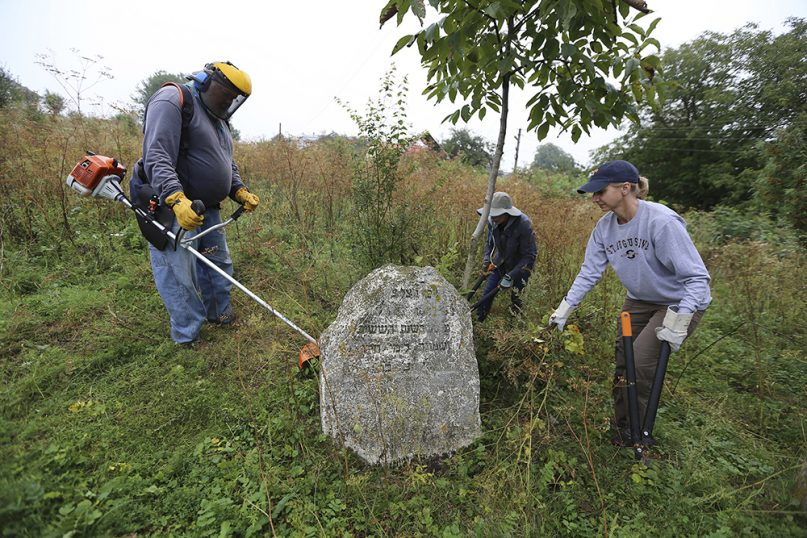
The Rev. Steven Reece, left, an ordained Southern Baptist minister who lives near Atlanta, cleans an old Jewish cemetery with other volunteers in Rohatyn, the site of a Jewish Heritage project, close to Lviv, Ukraine, on Aug. 29, 2018. For years now, Reece has been cleaning Jewish cemeteries and erecting memorial plaques at mass grave sites in Poland, and more recently Ukraine. (AP Photo/Yevheniy Kravs)
Indian Muslims shout slogans during a protest against the Chinese government, in Mumbai, India, on Sept. 14, 2018. Nearly 150 Indian Muslims held a street protest in India’s financial capital, demanding that China stop detaining thousands of minority Uighur Muslims in detention and political indoctrination centers in the Xinjiang region. (AP Photo/Rajanish Kakade)
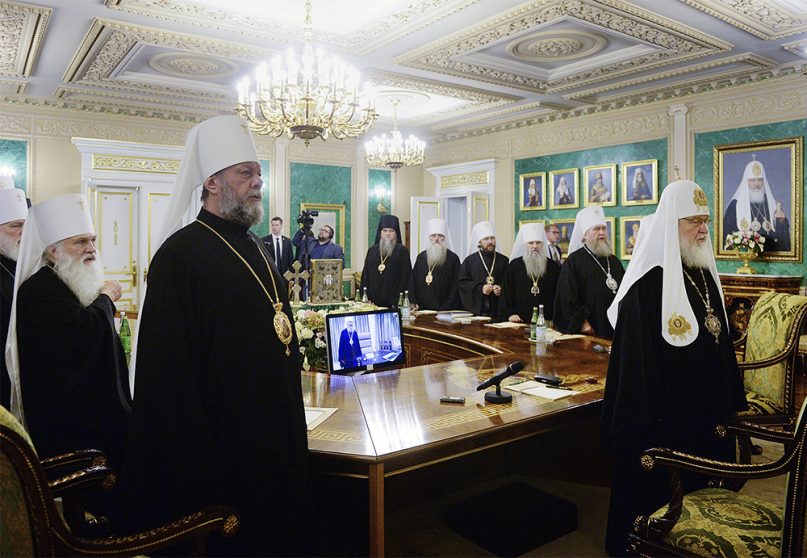
Russian Orthodox Church Patriarch Kirill, right, and other members of the Holy Synod of the Russian Orthodox Church pray before a meeting in Moscow on Sept. 14, 2018. The meeting of the Russian Orthodox Church’s top hierarchs mulled a response to a decision by Orthodox Christianity’s leading body to send two envoys to Ukraine. (Sergey Vlasov/Russian Orthodox Church Press Service via AP)
Devotees transport an idol of elephant-headed Hindu god Ganesha to a place of worship for the Ganesh Chaturthi festival in Hyderabad, India, on Sept. 13, 2018. The 10-day long Ganesh festival began Thursday and ends with the immersion of Ganesha idols in water bodies on the final day. (AP Photo/Mahesh Kumar A.)
Official seal notices are placed on the backdoor entrance of the Zion church after it was shut down by authorities in Beijing on Sept. 11, 2018. China is rolling out new rules on religious activity on the internet amid an ongoing crackdown on churches, mosques and other institutions by the officially atheist Communist Party. (AP Photo/Andy Wong)

Escaping the Wilderness: Part III – A square peg in a round hole

Suddenly alone, in an old familiar place.
As I look around, all I see are the new faces.
Scared of reaching out
Filled with fear and doubt
I was never good at making friends
Sometimes it’s like trying to mend
The edges of a frayed piece of cloth
I don’t think that I fit in.
Peter Heath – 1984

In my last post, I mentioned how three years ago I entered the wilderness once again.

I used the phrase “once again” because it seems like the wilderness is a place where I find myself more often than not.

Looking back over my fifty-five years of walking this earth (okay, 54, because I didn’t walk for my first year), I counted the number of years where I have felt at home in a church. The answer…

Five.

That’s it. Just five short years of feeling that I belonged.

Don’t get me wrong. For the past 30 years I have been very participatory, as an Elder, small group leader, Sunday School Teacher, Worship leader, Pastoral search committee member, or leading the college group. In most of those places though, I have felt like a square peg in a round hole.

There have been a number of reasons for this: Geography, Personalities, World Views, Theology, Philosophies.

As I have moved from church to church, there has always been some reason why this new one hasn’t been the right one. I think that is why at seminary so many of us were interested in Church planting. “If we started a church that did A, B, and C, wouldn’t it be wonderful!”

Last Friday, Burro pinned the tail on his proverbial half-sibling when he commented:

Particularly after the Reformation, the notion that correct doctrine would produce a correct Church gained increasing acceptance. Reformation, Counter-Reformation, Restoration, Oxford Movement, Latter Rain Move of God, the endless forays towards some new, imagined excellence, were the founding ideology of the various modern ecclesiologies.

This I think has been a large part of my problem: My desire to belong, to have people that I could relate to, talk to, dream with, has resulted in me chasing an ever elusive shadow, that seems just about visible beyond the next river bend.

Only it doesn’t exist at all.

I just finished watching Season One of “Alone” on the History Channel. Ten individuals get dropped off at ten different spots in the wilderness. Whoever lasts longest wins $500,000. Season one lasted 56 days. It is hard to thrive in the wilderness. But those who said “This is where I am, and I am going to make the best of it” were those who made it furthest. Spoiler alert – we could tell from about episode two who the finalists were going to be.

A large part of escaping the wilderness for me was realizing that what I was chasing was just a mirage. If you find a fresh source of water, put up a decent shelter, find a good source of food, and keep warm and dry, all of a sudden the wilderness doesn’t seem so much like wilderness anymore.

And that’s what I am trying to do with Church. It may not be perfect, but if I start making myself at home, then maybe it will start to feel like home.

As usual your thoughts and comments are welcome.

Quantum Physics and Theology: An Unexpected Kinship By John Polkinghorne (Part 2b) — Comparative Heuristics

Quantum Physics and Theology: An Unexpected Kinship

By John Polkinghorne (Part 2b) — Comparative Heuristics

We are reviewing the book, “Quantum Physics and Theology: An Unexpected Kinship” by John Polkinghorne.  Today we will look at the second part of Chapter 2- Comparative Heuristics.

As we said last time, John believes that similarities will emerge in the ways in which experience impacts upon thinking and the manner in which heuristic strategies, that is an approach to problem solving, learning, or discovery that employs a practical method not guaranteed to be optimal or perfect, but sufficient for the immediate goals, are developed to yield fuller comprehension.  He says four exemplary comparisons illustrate the point.  These four comparisons are:

  1. Techniques of discovery: Experience and understanding.
  2. Defining the problem: Critical questions.
  3. Expanding horizons: New regimes.
  4. Critical events of particular significance.

We looked at the first two the last time, today we will look at the next two comparisons.

(3) Expanding horizons: New regimes.  Progress requires allowing novel experience to enlarge the range of conceptual possibility.

(a) Phase transitions. One of the most assured results in physics was Ohm’s Law, discovered in 1827, which asserted that current in an electrical circuit was given by dividing the applied voltage by the circuits resistance: I = V/R.  This had been verified experimentally many times, but in 1911 Dutch physicist Heike Kamerlingh Onnes, discovered that if certain metals were cooled to very low temperatures, their resistance vanishes and a current can circulate without a sustaining electromotive force driving it.  Onnes had discovered superconductivity, for which he won a Nobel Prize in 1913.  At the time no one had the slightest understanding of why this strange behavior happened.  We now know that it was a quantum phenomenon, but it took another 50 years for a theoretical way of accounting the effect would be discovered.

Of course the laws of physics had not changed but the consequences of these laws altered drastically when one moved from the conducting regime to the superconducting regime; a phase transition had occurred.  The physicists had had the horizon of their understanding enlarged under the stubborn impact of the strange way metals had proved to have actually behaved.

(b) Miracles.  A rather similar approach is needed in theology in relation to the question of miracles.  John says:

It does not make theological sense to suppose God is a kind of show-off celestial conjurer, capriciously using divine power today to do something that God did not think of doing yesterday and won’t be bothered to do tomorrow.  There must be a deep underlying consistency in divine action, but that requirement does not condemn the deity never to do anything radically new and unexpected… when history enters the phase of a new regime, one might say—it is a coherent possibility that the new regime will be accompanied by novel providential phenomena… These two issues, resurrection and human/divine duality, are central to the theological agenda of this book.  They inextricably intertwine.  If Jesus is the Son of God, it is a coherent possibility that his life exhibited new and unprecedented phenomena, even to his being raised from the dead to an unending life of glory.

The attitude to miracles being taken here by Polkinghorne corresponds to the way in which John’s gospel speaks of them as “signs” (John 2:11), events that are windows opening up a more profound perspective into the divine reality that that which can be glimpsed in the course of everyday experience, just as superconductivity opened up a window into the behavior of electrons in metals, more revealing than the discoveries of Professor Ohm had been able to provide, or even conceive.

(4) Critical events of particular significance.  Specific phenomena, contrary in nature to previous expectation, can confirm radically new forms of understanding.

(a) Compton scattering.  Progress in scientific insight is often gradual and episodic, fought for step by step.  The idea of the isolated critical experiment that settles an issue out of hand is a notion beloved by the popular press writing on science issues.  Nevertheless, there are some occasions when an important matter does seem to receive definite settlement as the consequence of a particular experimental result.  Such a critical moment occurred in 1923 in an investigation by Arthur Compton into the scattering of X-rays by matter.

What Compton had discovered was the frequency of X-rays is changed by their being scattered by matter.  The scattering was induced by an interaction between the incident radiation and the electrons in the atoms that composed the matter.  According to a wave picture, these electrons would vibrate with the frequency of the incoming X-rays, and this excitation would cause them in turn to emit radiation of the same frequency.  Therefore, on the basis of an understanding framed in terms of classical wave theory, no change in frequency was to be expected.  Based on a particle picture, however, what would have been involved was a kind of “billiard ball” collision between photons and electrons.  In this collision, the incoming photon would lose some of its energy to the struck electron.  According to Planck’s rule, reduced energy corresponds to reduced frequency, with the result that the outgoing scattered radiation would have its rate of vibration diminished, just as Compton had discovered to be the case.  It was straightforward to calculate the effect, and the resulting formula agreed perfectly with the experimental measurements.  Compton’s work had clinched the case for particle-like behavior, fully dispelling any lingering doubts.

(b) The resurrection.  The critical question on which all turns in the case of Christology is the resurrection of Jesus.  No one disputes his remarkable public ministry; drawing crowds, healing the sick, proclaiming the Kingdom of God.  But then on that final visit to Jerusalem, it all seems to fall apart.  First, his entry into the city with being hailed by the politically dangerous cry, “Blessed is the coming kingdom of our father David!” (Mark 11:10).  Shades of Judas Maccabee, Pilate must have thought, here we go again!  Then the religiously and economically provocative act of the cleansing of the Temple (Mark 11:15-18).  The expected result occurred; Caiaphas and Pilate acted to regain control of a potentially dangerous situation.  Jesus was swiftly arrested, condemned, and led away to crucifixion.

This painful and shameful death, reserved by the Romans for slaves and rebels, was seen by devout Jews as a sign of God’s rejection, since Deuteronomy 21:23 proclaimed a divine curse on anyone hung on a tree.  Even Jesus himself seemed to agree because out of the darkness of the place of execution came the cry of dereliction, “My God, my God, why have you forsaken me?” (Matthew 27:46).  As far as the people and even the disciples were concerned, it was over, done, and had ended in utter failure.  As John says:

If that had been the end of his story, not only would it put into question any claim that he might have had to any special significance, but I believe that it would have made it likely that he, someone who left no personally written legacy, would have disappeared from active historical remembrance in the way that people do who are humiliated by being seen to have had pretensions above the sober reality of their status.  Yet we have all heard of Jesus, and down the subsequent centuries he has proved to be one of the most influential figures in the history of the world.  Any adequate account of him has to be able to explain this remarkable fact.  Something must have happened to continue the story of Jesus.   Whatever it was must have been of a magnitude adequate to explain the transformation that came on his followers, changing that bunch of frightened deserters who ran away when he was arrested, into those who would face the authorities in Jerusalem, only a few weeks later, with the confident proclamation that Jesus was God’s chosen Lord and Messiah (Acts 2:22-36).  I do not think that so great a transformation could have come about simply through calm recollection and a renewed determination to continue to affirm the teachings of Jesus.  All the writers of the New Testament believe that what had happened was the resurrection of Jesus from the dead on the third day after his execution.

John points out that Paul’s hymn/creed in 1Corinthians 15:3-8, written within 20-25 years of the crucifixion, can reasonably be traced to his reception of it shortly after his Damascus road conversion within 2-3 years of the crucifixion, too soon for legendary accretion.  The character of the resurrection stories in the New Testament are enigmatic rather than triumphalist; there is a recurrent inability to recognize at first who it is that is with them, and even then a persistent tendency to doubt their own eyes—see Matthew 28:17 (When they saw him, they worshiped him; but some doubted.)  That does not read like a collection of pious fictional tales made up to express their conviction that the message of Jesus could continue beyond his death.  Not to Polkinghorne, and not to me.

Then there are the accounts of the empty tomb.  The story, told in all four gospels, is essentially the same, again with the striking absence of a triumphalist tone.  In fact, the initial reaction to the emptiness of the tomb is fear rather than rejoicing.  The gospels certainly do not present the story as an instant, knock-down proof of the resurrection.  The first question to ask is whether there was an identifiable tomb.  The usual Roman custom was to cast executed felons into a common grave, though Polkinghorne says there is archeological evidence there were exceptions to this.  The case for believing that Jesus was one of these exceptions is strengthened by the part played by Joseph of Arimathea in the story.  He is an otherwise unknown figure of no obvious importance to the early Christian community, and there seems to be no reason to assign him this honorable role other than the fact he actually performed it.  In the controversies that developed between the growing Christian movement and contemporary Judaism, conflicts that can be traced back into the first century, it is always common ground between the parties that there was a tomb and that it was empty.

The strongest reason for taking the story of the empty tomb seriously is completely under-appreciated by the modern reader.  That is the women are assigned the principal role as the prime witnesses.  In that ancient world, their testimony would have been regarded as unreliable and not to be trusted in a court of law.  Any first century person making up so strange a story would have sought to bolster their credibility by making good reliable men the prime witnesses.  The women are credited with the discovery simply because they actually made it.  Perhaps they were given that privilege because, unlike those “reliable” men, they had not run away when the authorities closed in on Jesus.

Another consideration that also is under-appreciated today; the Christian establishment of Sunday as the Lord’s Day in place of the Jewish Sabbath, in commemoration of its being the day of his rising.   This was a change that would surely have required strong motivation in the first church whose members were pious Jews.  Finally, the continuing witness of the Church, from its very first conception, has been to speak of Jesus as its living Lord in the present, rather than as a revered founder figure in the past.

Polkinghorne certainly realizes that a unique event of this kind cannot be confirmed with the same degree of certainty that attaches to a repeatable experiment like Compton scattering.  Nevertheless, he thinks resurrection belief is a well-motivated belief he finds persuasive.  It surely deserves the label of a critical event of particular significance.

J. Michael Jones: Finding a Christian (metaphysical) View of Nature, Part I

Note from CM: Today we welcome yet another “Mike” to our group of iMonk authors. J. Michael Jones. Mike blogs at J. Michael Jones, where you can also find information about his books.

Here is a brief bio:

J. Michael Jones lives with his wife, Denise, in Anacortes, Washington. They have five grown children. For 35 years, Michael has had a career as a PA in neurology and medical care in the developing world. He has written over 30 articles in national and international medical journals and published four books including: Waters of Bimini, Butterflies in the Belfry, A Kernel in the Pod, and Why Your Head Aches.

You can quickly link to Amazon for two of Mike’s books on our right sidebar under “IMONK AUTHORS.”

• • •

Finding a Christian (metaphysical) View of Nature, Part I
by J. Michael Jones

The concept of nature and its adjectival derivative, natural, have been on my mind for several years. The origin of my personal interest is multifactorial. I have two main watersheds of my personal curiosity. The first one is moving from practicing medicine at Mayo Clinic (a very evidential environment) fifteen years ago, to the Pacific Northwest, where it seems like everyone wants only “natural treatments” for their ailments. The pinnacle of this interaction was when I had a patient who was refusing life-saving antihypertensive medication because he was, “very health-conscious and never puts chemicals in his body.” A moment later, not being of a judgement mind but pure astonishment I said, “Is that a pack of cigarettes in your shirt pocket?” To which he answered, “Yeah. They’re natural.” He pulled out the pack and right on the package cover it read, “Organic and Natural Cigarettes.”

The second, more substantive, experience was during a ten-year study of philosophy, when it became apparent to me that metaphysical notions of nature were often central topics of each system of thought. I came to realize, that likewise, the Christian’s view of nature isn’t just one trivial subject of many possible Christian perspectives, but it may be the essential substratum of them all. Even very practical things, such one’s political orientation, approach to sin and godliness, all can pivot on one’s subliminal view of nature.

Before I can even start the discussion, I must first spelunk deep into the caverns of semantics to find a definition of this subject matter that I, and the reader, can agree upon. There are few words more emotionally laden and with such diverse meanings than nature. I will first eliminate those topics of nature that I’m not talking about.

I suggested to my church once, that I do a Sunday School on the topic of, The Christian View of Nature. Like all my previous suggestions, it was quickly rejected. But during an afterthought, it dawned on me (from the questions I was being asked), that the Sunday School director was making assumptions about the meaning that I did not intend. She appearently assumed that it was the most superficial understanding of the Christian interaction with nature. Simply, that what I wanted to do was to show beautiful slides of nature scenes, such as our local North Cascades, and then have us meditate on its beauty. Maybe, if I was really creative, I would then add a verse, such as Isaiah 55:12, “You will go out in joy and be led forth in peace; the mountains and hills will burst into song before you, and all the trees of the field will clap their hands.” I would call this the aesthetical layer. It is like the outer-most doll of a set of Russian nesting (matryoshka) dolls.

The next layer or doll would be the moral consideration of nature. This is where we ask the ethical questions such as, is it a sin for the Christian not to recycle? Once again, a discussion at this level, while interesting, is not addressing the fundamentals.

The next, innermost doll would be the theological consideration of nature. While this is of greater intrigue and does touch on what I want to talk about, it still is not enough. We can ask theological questions about God’s intention with nature, how original sin influenced nature, the impact on our view of nature on eschatology, and the working out of redemption in the real, natural world. However, the Christian philosophical view of nature is the underpinning of all other Christian views. This is the monolithic baby at the center of the matryoshkas.

My evangelical friends would argue at this point that one must first build a foundation of correct theology before one can venture into philosophy. Some would even argue that to dabble in philosophy at all is a form of depravity. Those of such a view would quote Colossians 2:8 for support, “See to it that no one takes you captive through hollow and deceptive philosophy, which depends on human tradition and the elemental spiritual forces of this world rather than on Christ.” But one’s philosophical footing determines the bias of their exegesis, with which they extract theological positions from the written words of scripture. Yes, it can and should flow the other direction as well, where one’s philosophical perspective is shaped by their theology, which had been formed by their exegesis. However, if we were honest, we would see that it usually flows in the former direction. Our philosophical orientation is most often determined by the culture in which we are exposed, which in turn has been fashioned by tradition, which is built upon the writing and thinking of people of philosophy, some Christian, while many not.

“True Philosophy” is simply the love of knowledge. It is in the same spirit of Solomon, where he asked God for wisdom or knowledge, and God was honored by his request. That the whole idea of “being dumb for Jesus” might sound “special”… but is a grave mistake. Being “learned for Jesus,” is much better.

I will therefore establish that the core of the matter, the solid baby at the center of the matryoshka dolls, is the philosophical concept of nature. At this juncture I must shed the word nature completely in the same way that Mr. Rogers took off his outside jacket and put a cardigan. We do this as we come inside and enter the world of philosophical concepts. The philosophical word I will use is material, although true students of philosophy may cringe at my over-simplification.

Francis Schaeffer was able to use the word Nature, with a capital N. I considered using that word here too, yet there has been too much “natural” water under the bridge since the 1960s when Schaeffer did most of his writing.

Anytime you use the word nature, it becomes easily misunderstood, just like with our Sunday school director or the guy buying the natural cigarettes. I must therefore define my use of material.

I was tempted to say that the material is the seen, (vs the unseen). But much of the material universe is unseen. So, a better definition is that the material is that which can be measured by units of math. For example, anything with weight, height, depth, frequency, lumens, volts, mass, force, speed, or etc. would be considered material. Concepts, such as romantic love cannot be measured (although thousands of beautiful song writers and poets have attempted to). As a Christian, I personally feel very comfortable with the term creation, however, the connotation of that word is not in the philosophy lexicon and may mean different things for different people.

“Material,” as I will use it, falls under the philosophical subject of metaphysics, and specifically in the area known as Ontology, which deals with the questions of being or existence. I want to discuss six major possible viewpoints on the material and then next time discuss the very practical application of some of them.

Solipsism. I will use Solipsism as the philosophical theory to represent the first perspective. In this view, the material world is not real and that our measurement of it is just an illusion. At least, its existence is not provable. It could be just a mind projection as in something like the movie The Matrix. In this thinking, the only thing that we are sure exists, is our self. Even Plato and Pythagoras dabbled in this type of thinking at times. This is very different than Descartes’ statement, “Cogito, ergo sum,” which was an exercise as a starting point for logic. He certainly believed in an observable, real material universe.

Platonic Dualism. For the next position, I will pick Platonic Dualism, as the archetype. Other philosophical views are related. In this view, the material world is probably real (however, there is overlap with Solipsism), but like a vapor or mist. Plato uses the example of the material being like a two-dimensional shadow cast on the back part of a cave, where you cannot see directly out through the cave’s entrance. In this perspective, there is a more real world than the material, which is the world of ideals outside the cave. In this—more perfect—world, which Plato believed existed up in the ether, are things like mathematical concepts, beauty, love, spirituality, and the human soul.

Not only is this non-material world more real for Platonists, but superior in value and on a much higher plane that what we see with our eyes, smell with our noses, and touch with our hands (or measure with our math).

Unfortunately, this view was very popular in the Greek society by the first century. This Hellenistic culture was the canvas upon which the Church was painted. This view became the dominant perspective of the Church by the Middle Ages, and remnants of that thought continue today. This was the type of secular philosophy that Paul was warning the Colossians about… but it happened anyway.

Pantheism. This philosophical base of several religions would best represent the next perspective. In this view, God or gods are woven intimately with the material as well as the immaterial. God is neither above nor below the material, but one with it, all of it, both evil and good. To experience the material or the immaterial is to experience God. This philosophy has insidiously seeped into Christian thinking staring in the early twentieth century. The pantheistic Christian, so influenced, might say that all religions and philosophies are the same, leading to the same place. The pantheistic Christian might also say that they can find “God in nature.”

The Biblical-centric Christian (can’t think of a better term right now) on the other hand, would say they can learn a lot about God by studying the material or nature, but not find God in the material. As an example, they would also say they can find out a lot about an artist by studying his/her paintings; looking at the brush strokes, the style, and the subject matter. These things tell you about what was on the artist’s heart. However, the former position would say there is no artist, that the painting itself is also the artist and EVERYTHING you could ever know about the artist is within the painting.

Pantheism is so attractive because it offers a temporal peace and avoidance of conflict as well as the relativism of truth. The merging of many great cultures and religions within the Indus Valley (mostly of what is now Pakistan) became the incubator for pantheistic ideology over 4,000 years ago, because it allowed for the merging of opposing ideals as waves of invaders came across the Khyber Pass. This why it is so attractive in our ever shrinking, multicultural world.

The Biblical View. This brings me to the next school of thought and is what I will call the Biblical view. I don’t like that term at all and searched for another. It is so abused, often twisted to support whatever view you hold dear. But I use it only as it applies to the very fundamentals of this topic. If you try to divorce your mind from other secular philosophical contaminations, we could all agree that the Genesis account is quite simple. The God-head created the material, and most likely the immaterial (although only implied) outside of themselves, through their power and it was good. That original sin injured the material, leaving it still good but imperfect. We humans have been charged to bring God’s redemption to our kind and to all the material in general. Toward the end of scripture, in Revelation, chapter 21, it is implied that God is not finished with the material creation but is committed to fixing it and making it part of our eternal destiny.

One of the ways that the Christian has allowed philosophies “built on human traditions rather than Christ,” to seep in, is by mixing Platonic Dualism with the Biblical view of the material. In that case, it is assumed that the material was created inferior or dirty, and that only the “spiritual” has merit. The spiritual is transcendent of this material world. This material world, in all its nasty-evilness, will be destroyed in the end. While the Church fought against this idea through its great councils (addressing the Christology of it, stating clearly that Christ was material AND immaterial, and still perfect) it allowed (wrongly) the adoption of Platonic Dualism in other areas because it empowered the Church. If your job, chores, and daily activities of your miserable little life were part of your disgusting material existence, and the Church was the only doorway to the, far more important immaterial, then the Church would have complete domination over your life, your society and whole world.

Rousseauian Naturalism. Jean Jacques Rousseau (1712-1778) was the son of a Calvinist preacher. His father, like most Protestants of the time, had a blended Biblical and Platonic view of the material. I will start to slip and call the material in this case, nature, because that was Rousseau’s term.

Due to the Platonic influence, the Calvinists believed that the material was inferior even before original sin had entered it. That nature was wild, dirty, and dangerous. They believed the role of the Christian was to bring redemption, but that redemption was to not to restore nature to its original glorious form, but to subdue it, tame it, and exploit it. Rousseau rejected this popular Christian view and took the position that nature was originally pure but became contaminated by human touch. The less human influence the better nature could be. This idea has become the backbone of the modern view of nature in the West, including the man with the natural cigarettes. The word “natural” now just means less human touching.

The psychological basis of Rousseau’s view of nature was formed out of political necessity. It was during a time of total oppression and domination of the masses by the King (Louis XVI and his wife Marie Antoinette) and the Church of France, (read A Tale of Two Cities to feel that oppression) that he adopted this new view of nature. Rousseauians believes that it is the influence of humans, which contaminates the material world. This made Rousseau the philosophical architect of the French Revolution. Like I said earlier, the philosophical view of the material (or nature) is the center matryoshka doll, around which all other layers of thought are developed.

Therefore, you can conclude on the outer, political or social, layer, that if you rebel and destroy the established human institutions of oppression, the monarch and the Church, that it would be liberating, and human can return to its natural, good form in an anarchical society. This would make sense if the root of all evil was humans interfering with nature. However, as you can read in Victor Hugo’s Les Misérables, it did not work out so well.

The Impersonal Universe. What I mean by this is that the universe had no personal beginning, no God, gods or god force. It was a complete fluke, maybe where, for no reason, matter and antimatter suddenly parted, forming the Big Bang. From that point, incredible energy coalesced into spots of material, following laws of physics, written by no one. This spontaneous and undirected evolution of events ended with the universe as we now know it. In that model, there is only the material and there can be no meaning, morals or value. Of course, no one can live that way, so most atheists, illogically and artificially, inject meaning by using pantheistic terms (think of the Force in Star Wars) as having intent or personalities, which they exhibit in such silly statements as, “As nature intended.”

I will next return in Part II, to discuss the very practical manifestations of each of these views of the material on modern society, including the Christian societies.

Scott Lencke: Can Women Be Church Leaders? The NT Household Codes

Note from CM: Gender issues continue to provoke lively debate within the evangelical churches. Scott Lencke takes up the subject again for us today, reminding us in the process that how one approaches and reads the Bible plays a crucial role in understanding matters like this. Scott blogs at The Prodigal Thought.

After reading this, you might also want to refer to what we’ve written here on the NT Haustafeln.

• • •

Can Women Be Church Leaders? The NT Household Codes
by Scott Lencke

Can women be church leaders?

It’s a big question that causes a lot of debate. Not as much today as, say, a couple of decades ago. Thankfully. Nonetheless, this remains a fairly divisive issue in the church today.

I’ve spent plenty of time looking at the question of women leadership here at the blog. But, in this article, I want to address a couple of Scriptures known as the “household codes” in the New Testament. These are particularly found in Eph 5:22-6:9 and Col 3:18-4:1.

Obviously these passages don’t specifically speak about church leadership. However, many, if not most, see a connection between leadership in the home and leadership in the church, all going back to God’s “original creation design.” So, while these are distinct, they are related and these household codes are worth addressing in the larger context of the discussion concerning women’s roles.

In both of these New Testament passages, six specific groups of people are addressed:

  1. Wives (Eph 5:22-24; Col 3:18)
  2. Husbands (Eph 5:25-33; Col 3:19)
  3. Children (Eph 6:1-3; Col 3:20)
  4. Fathers (Eph 6:4; Col 3:21)
  5. Slaves (Eph 6:5-8; Col 3:22-25)
  6. Masters (Eph 6:9; Col 4:1)

These household passages include instructions not just for the family nucleus as we may think in our modern world today (husband/wife and children/parents), but they also have little snippets that speak to the relationship between household slaves (kind of like indentured servants) and masters.

When it comes to wives, for many, these passages clearly state that men are the ones given the final leadership authority in the home. Yes, we are reminded by complementarians that the man is charged to be over his wife in a servant manner, as Christ served the church. But the husband is still the head; still the de facto lead in the marriage relationship.

In all, men are the leaders in the home and they also carry the lead role within the church (1 Cor 14 and 1 Tim 2 are highlighted by complementarians).

This view is all the more emphasized as God’s design in creation because the male leadership in the marriage is rooted in Christ and his relationship to the church. We probably know these oft-read words at weddings:

Wives, submit yourselves to your own husbands as you do to the Lord. For the husband is the head of the wife as Christ is the head of the church, his body, of which he is the Savior. Now as the church submits to Christ, so also wives should submit to their husbands in everything. (Eph 5:22-24)

It is plain.

Husbands are the head; women are to submit.

This is the biblical view – right there, black ink on white paper (because no interpretation is needed for this plain view).

And it’s rooted in Christ himself!

Well, as you might imagine, I’d actually argue the opposite of the complementarian view.

Here’s why.

First off, we have to be very careful stamping a particular view as the “biblical” view. We can quote all types of Bible passages to support all types of actions that are definitely not of God. That’s been part of church history up to the present day, unfortunately. To advocate something as “biblical” doesn’t necessarily mean it’s what God is asking of us.

As I learned in seminary (yes, I learned something in seminary!), it takes wisdom to apply the wisdom of the Bible.

Furthermore, with the household instructions found in Eph 5-6 and Col 3-4, I believe we will do well to first engage these words knowing the ancient setting in which they were given. This is key!

Here’s what’s interesting. In those same exact passages, we actually find reason to perpetuate household slaves. Remember the plain reading? “Slaves, obey your earthly masters with respect and fear, and with sincerity of heart, just as you would obey Christ” (6:5).

Sounds fair enough to conclude we could continue the practice of household slaves. And it’s also spiritually connected to Christ, right?

“…just as you would obey Christ.”

As long as we ensure masters are right and fair (Col 4:1), ultimately honoring God in their mastering of the household slave, all is well and good. And let’s also remind these slaves to obey their masters respectfully, just as if it was Jesus they were serving.

So it’s ok to perpetuate the practice of keeping household slaves.

Do you remember what I stated above? We can quote all types of Bible verses to support all types of actions that are definitely not of God.

Guess what’s been done with slavery in church history, including American Church history?

It got stamped with Bible verses, including Eph 6 and Col 3-4.

No, way?!

Yes, way!

Maybe there is more to these passages than meets the eye.

Maybe, as we started to realize in America some one hundred and fifty years ago (in the 1850s and 1860s), then again a century after that (in the 1950s and 1960s), the enslavement of other human beings made in the image of God is a stench in the nostrils of God.

I don’t care how much we spin it, enslavement of others is wrong. It is not Christlike.

But we have instructions from Paul seemingly rooting this practice in Christ and our own relationship with him. Both for slavery and marriage.

What to do?

Here’s a thought.

Perhaps the instructions in places like Eph 5-6 and Col 3-4 are to be recognized within the framework they were given: the ancient household construct. Maybe these instructions are not given for all peoples of all time.

What I would offer is that Paul is giving instructions to the church of the first-century Mediterranean world on how to conduct themselves in their home life in the most honorable way possible for their setting. I’ve already contended that the directive about slaves and masters is not something for all people for all time, even as Paul charges slaves to obey their masters like they would obey Christ. This is not casting God’s word aside nor doubting what God has said. It’s simply using our wisdom as we read Scripture. I wish our American fathers had done the same.

And so, translating this in regards to the instructions for husbands and wives, think about it. These words are given within an ancient, patriarchal society. Guess what the general flow was? Men in charge; women not so much. Thus, Paul is giving a directive on how the entire Christian household should function – wives, husbands, children, fathers, slaves and masters. His words ring with clarity to the Christian church of the first century. But that isn’t so easily converted into every culture of every time.

Again, remember the slave.

Let me be very clear. I know this may feel scary to some. If we can re-apply the household passages, then we can re-apply just about any passage, it may be argued.

But I would say the goal here is not to disregard holy Scripture. The aim is not to spurn God’s word. The intent is not to re-apply each passage on a whim. Rather, there is the purpose of thoughtfully wrestling with God’s word – as each generation and culture has – in order to effectively apply it into our own context.

And thankfully we have church history to bounce things off of, as well as the church of our own day.

Is it perfect?

No.

It wasn’t then. It isn’t now. It never has been.

Theology is not an empirical science. Trust me on that one.

In the end, I don’t believe it’s a truly honest approach to run to Ephesians and Colossians and say, “Look, Paul said this about husbands and wives. It’s very clear the man is the leader and the wife is to be submitted with no mutual, shared leadership, just as it is with Christ and the church.” Otherwise, we need to also head into Ephesians and Colossians and remind ourselves, as some of our fathers and mothers did, “Look, Paul allows for household slaves, just as long as we treat them fairly. So we are ok to have household slaves.”

It doesn’t work that way.

For slaves.

Nor for understanding the leadership roles of women and men in the home.

I believe we should not use these two little letters to perpetuate a theological system that disallows women to lead as they are called by God, to work in tandem with humble men God has also called as leaders.

I also believe there is no set, determined household code that is the only way for all peoples of all cultures of all time. Again, it takes wisdom to apply the wisdom of Scripture.

I am grateful God calls women to lead the people of God. I am grateful that wives and husbands can lead their home together in mutual submission to one another.

Monday with Michael Spencer: Dumb up, brother!

September Country Evening (2018)

Monday with Michael Spencer
Dumb up, brother!

I live in a part of the county where ignorance of every sort is widespread. The dropout rate is almost 30%. Running any kind of school here is a battle. And most of the ministers and Christians in this area are untaught, or at the most, self-taught. Comparatively speaking, pastoral ignorance of various kinds is common.

My friend Walter is a local pastor. He’s never attended Bible school, much less college. He’s not much of a reader. He’s too busy in his bi-vocational ministry just trying to make ends meet and do what his job, family and church need of him to be a scholar. Some of Walter’s sermons are difficult for me to listen to. They are delivered in mountain style and they are, frankly, hard to understand. Mostly, Walter takes a well known character or story and applies some principle from the scripture to the day to day experiences of his congregation.

Mountain people face many difficulties. These include poverty, drugs in the community, unsafe living conditions, lack of economic opportunities, undependable medical care, crime and so on. A mountain pastor is always facing a congregation who, for the most part, are there because if God doesn’t come through, life is going to fall apart. Walter’s people believe that he can point them to God’s power and presence. They believe the encouragement of the Lord comes through the “man of God.” They are generally not there to experience a “Christian classroom” with pastor as professor.

Of course, those who are more educated in the doctrines of the Christian faith will tell me that there is much wrong with Walter’s ministry. He needs to know many, many things and preach them faithfully. His congregation will be strengthened by doctrinal soundness in way they won’t be through Biblical stories and their lessons. His ignorance ought to be repaired and his ministry improved. I’ll not argue with that, but I will tell you another Walter story.

One thing I didn’t tell you is that two years ago, I was in the hospital with my dying mom, and I needed a pastor. At the time, I didn’t have one. I guess I could have called any number of the ministers that I know. Actually, having been the minister in the hospital before, I was fairly certain of what would happen, and while I wouldn’t have been ungrateful, it wasn’t that important to me.

Walter happened to be in the hospital that day, visiting members of his congregation and the wider community, as was his habit. He found me, my wife and my dying mom in the ER.

Walter stayed with me all day. He found a doctor who would let my mother stay in our hospital and pass there, instead of flying her to Lexington. He helped me talk to the doctors about the course of treatment mom and I had agreed on. He prayed for me. He was a pastor to me. He was Christ to me.

Never once did Walter attempt a theological justification of the ways of God. He never got out the Bible. He was the Bible for me that day. He put flesh and blood on God and hung out with me. He thought for me when I couldn’t think clearly. He knew my heart and he helped me listen to my heart at a very confusing moment. He treated me with love and dignity that brought joy into one of the worst days of my life.

Walter showed me that day that if you are going to measure life by how it’s lived, and not by how people talk about what they believe, he knows a lot more about God than I do. He’s not read anywhere close to the books that I’ve read and he doesn’t have my vocabulary or degrees. He has the the book that matters, and its author, in him. Compared to Walter’s embodiment of Jesus, I’m stupid.

Those of you planning to write and tell me the other side of the coin can save your ink.

I know the other side of the coin. What I’m going to say to anyone listening is that I see little evidence that great learning or correct doctrine produces Christ-like people. It may, and it certainly has a part to play that can’t be eliminated. God has used books in my life to make me more like Him. But a lot of those books have been theologically ignorant and incorrect by the standards of the doctrinally correct and intelligent.

I’ve spent years listening to claims and counter claims about how various theologies, doctrines and denominations can get you the real Jesus if you’ll learn there bit or or join their team. Based on the resulting lives I’ve seen — starting with my own — I’d say we’re all full of “dung” on that one. Christ-possessed individuals exist across the spectrum of denominations, education and sophistication. In fact, I’m starting to suspect God puts his fingerprints all over more people from the wrong side of the tracks than on “our” side just to throw us off. He must enjoy hearing me say someone who does or doesn’t believe theology/doctrine “X” can’t manifest the deep imprint of the fingerprints of Jesus. (Heaven’s Comedy Channel must include hours of stupid things I’ve said.)

Jesus says that God loves to take a Walter and show me real spirituality. He loves for me to realize that I can make an “A” on a theology paper and be useless in a hospital or in the lives of real people. He loves for me to hearing the banging, clanking, crashing uselessness of much of what I’ve valued, and then discover the treasure in what I’ve called trash.

Walter has a life full of Jesus. How did Walter get so full of Jesus? By wanting him there and keeping the doors and windows open for Jesus. Not by learning the outline, the answers and the PowerPoint version and stopping there. My version of Jesus often looks a lot like an essay question I’d write. Walter’s Jesus — his rough, unpolished and ignorant version of Jesus — is the real deal, at least when it counts.

Remember that Jesus was a teacher, but he never dismissed class. Life was his classroom, because he refused to isolate truth into compartments. He had no intention of producing a disciple who was an expert in theology but useless in a hospital ER. He had no plan to allow the specializations we use to excuse ourselves from what it really means to be a Christian. “Carrying the Cross” and “Washing Feet” weren’t talks. They were life.

And if you’re smart enough to improve on that, you’re too smart.

Dumb up, brother.

Andrew Perriman: A Podcast about Hell — Why both sides in the debate miss the point

Fire! Photo by D4E

One of my favorite blogs on our links list is Andrew Perriman’s P.OST site. It is always thought-provoking and relentlessly focused on trying to understand the Bible in the context of its narrative history.

Now Andrew has begun a podcast, and here is the first episode, entitled “The debate about ‘hell’: why both sides are missing the point.”

Here is his description of the talk:

The popular debate about “hell” has been misconceived. Our narrow theologies of personal salvation have blinded us to the large-scale narratives that give meaning to the language of wrath and judgment in the teaching of Jesus and of those sent out to proclaim his name among the nations.

I’m not sure I’m on board with everything Andrew Perriman teaches, but he makes some very good points in this podcase. I present it to you today for your study and consideration.

• • •

Photo by D4E at Flickr. Creative Commons License.