Randy Thompson: A Reminiscence of Thanksgivings Past

Evans/Getty Images

A Reminiscence of Thanksgivings Past
by Randy Thompson

I think it’s sad that we, as a country, no longer honor the celebration of Thanksgiving as we once did. Now, it is little more than a kick-off for Christmas-related consumerism, with people showing up at Walmart Thanksgiving Day for “door buster” deals, provided they’re not at home watching whatever NFL games are on TV.

If you will, allow me, an old man, to reminisce a bit. . .

I remember when Thanksgiving stood on its own as a holiday. As a child, I loved the October Halloween decorations at the five-and-ten store near our home, and just as much enjoyed the Thanksgiving decorations of November. Christmas appeared only when Thanksgiving was over and done. I loved the decorative pumpkins, the shocks of wheat, and the cornucopias full of fruits and vegetables. I loved the cardboard, cut-out pilgrims and turkeys. I loved all of it. Yes, this was nothing more than sentimental nostalgia in suburban Southern California, but it harked back to simpler, agricultural times, when fall’s harvest was viewed as God’s blessing and the hope of nourishment over the long winter.

I’d like to suggest that such sentimental nostalgia is healthy and good. It’s good to remember when we really did live off the land, and that we lived and ate at the mercy of drought, storm, and frost. Thanksgiving, with all its imagery of pilgrims, Indians, harvests and cornucopias, was a time to remember that our food really didn’t come from the local supermarket, but from the farmers that grew it, and who first-hand knew that a harvest was a blessing of God, and not to be presumed. The cardboard cut-outs of wheat shocks and turkeys served to remind us that our food didn’t just come in cans and cellophane wrap and plastic trays, but that it came from real places and from real people who knew that every harvest was a grace from God.

Sadly, this time of farm and harvest nostalgia has given way to the commercialized behemoths of Halloween and Christmas, where November is no longer the time for Thanksgiving, but the time for taking down Halloween decorations and putting up the Christmas decorations. It’s a time for before-dawn shopping, football games, and Christmas-themed movies on the Hallmark Channel.

It is indeed still a family time, when people go to great lengths to go home “for the holidays,” of which Thanksgiving is the precursor. It is a time of Norman Rockwell expectations of a family around a dinner table, yet our families have become ever more broken and fragmented. The reality of family too often betrays our hope for warmth, acceptance, and intimacy. We go “home” for the holidays, and find that we can’t wait to get back to our real homes.

Most of all, we spiritually sleep-walk through Thanksgiving oblivious to the purpose of the holiday, which is thanks-giving. A feast to celebrate God’s blessing of a good harvest has become merely a dining extravaganza. The food is no longer a sign of God’s presence and blessing, but is merely food. A time out from shopping, working and going about our normal lives.

But, that wasn’t the only purpose of this holiday. President Abraham Lincoln, in his Proclamation of a Day of Thanksgiving, said

I do therefore invite my fellow citizens in every part of the United States . . . to set apart and observe the last Thursday of November next, as a day of Thanksgiving and Praise to our beneficent Father who dwelleth in the Heavens. And I recommend to them that while offering up the ascriptions justly due to Him for such singular deliverances and blessings, they do also, with humble penitence for our national perverseness and disobedience, commend to His tender care all those who have become widows, orphans, mourners or sufferers in the lamentable civil strife in which we are unavoidably engaged, and fervently implore the interposition of the Almighty Hand to heal the wounds of the nation and to restore it as soon as may be consistent with the Divine purposes to the full enjoyment of peace, harmony, tranquility and Union.

Thanksgiving was intended to be a special time. Not only were we to express our thanks for God’s “singular deliverances and blessings,” it was also a reflective time, a time to ask God to “heal the wounds of the nation and to restore it as soon as may be consistent with the Divine purposes.” Then, the wounds of the nation were those we inflicted on ourselves in a great civil war. Now, our wounds are just as deep, if not as bloody.

If we are called to thank God and praise God for his “deliverances and blessings,” we are also called to implore God’s healing of our nation’s woundedness.

So, this Thanksgiving, put away the Christmas advertising and turn down the football game, and share a special meal together with those you love, remembering that this meal is an expression of gratitude for blessings received, and a reminder of wounds that need to be healed. Let it be a joyful, grateful meal, but let it also be a reflective one, a reminder that we have fallen far short of the righteousness of a God who loves and blesses all the same.

Words about Thanksgiving 2019

November Horses at Dusk (2017)

Words about Thanksgiving 2019

Thomas Merton
To be grateful is to recognize the Love of God in everything He has given us – and He has given us everything. Every breath we draw is a gift of His love, every moment of existence is a grace, for it brings with it immense graces from Him.

Gratitude therefore takes nothing for granted, is never unresponsive, is constantly awakening to new wonder and to praise of the goodness of God. For the grateful person knows that God is good, not by hearsay but by experience. And that is what makes all the difference.

Annie Dillard
I think the dying pray at the last not “please,” but “thank you,” as a guest thanks his host at the door.

Ronald Rolheiser
Sanctity has to do with gratitude. To be a saint is to be fueled by gratitude, nothing more and nothing less.

Peter Leithart
Thanksgiving is thus the liturgy of Christian living. It is the continuous sacrifice that Christians offer. Gratitude to God is the continuous sanctification of the world.

N.T. Wright
A sense of astonished gratitude is very near the heart of authentic Christian experience.

Richard Rohr
Prayer is sitting in the silence until it silences us, choosing gratitude until we are grateful, and praising God until we ourselves are an act of praise.

G.K. Chesterton
Gratitude is happiness doubled by wonder.

Henri Nouwen
Gratitude goes beyond the “mine” and “thine” and claims the truth that all of life is a pure gift. In the past I always thought of gratitude as a spontaneous response to the awareness of gifts received, but now I realize that gratitude can also be lived as a discipline. The discipline of gratitude is the explicit effort to acknowledge that all I am and have is given to me as a gift of love, a gift to be celebrated with joy.

Richard Beck
Gratitude, holding life as a gift, is key to the ability to love, the ability to give freely and non-anxiously to others.

Dietrich Bonhoeffer
It is only with gratitude that life becomes rich!

Eugene Peterson
We wake up each morning to a world we did not make. How did it get here? How did we get here? We open our eyes and see that “old bowling ball the sun” careen over the horizon. We wiggle our toes. A mocking bird takes off and improvises on themes set down by robins, vireos, and wrens, and we marvel at the intricacies. The smell of frying bacon works its way into our nostrils and we begin anticipating buttered toast, scrambled eggs, and coffee freshly brewed from our favorite Javanese beans.

There is so much here — around, above, below, inside, outside. Even with the help of poets and scientists we can account for very little of it. We notice this, then that. We start exploring the neighborhood. We try this street, and then that one. We venture across the tracks. Before long we are looking out through telescopes and down into microscopes, curious, fascinated by this endless proliferation of sheer Is-ness — color and shape and texture and sound.

After awhile we get used to it and quit noticing. We get narrowed down into something small and constricting. Somewhere along the way this exponential expansion of awareness, this wide-eyed looking around, this sheer untaught delight in what is here, reverses itself: the world contracts; we are reduced to a life of routine through which we sleepwalk.

But not for long. Something always shows up to jar us awake: a child’s question, a fox’s sleek beauty, a sharp pain, a pastor’s sermon, a fresh metaphor, an artist’s vision, a slap in the face, scent from a crushed violet. We are again awake, alert, in wonder: how did this happen? And why this? Why anything at all? Why nothing at all?

Gratitude is our spontaneous response to all this: to life. Something wells up within us: Thank you! More often than not, the thank you is directed to God even by those who don’t believe in him. . . .

Wonder. Astonishment. Adoration. There can’t be very many of us for whom the sheer fact of existence hasn’t rocked us back on our heels. We take off our sandals before the burning bush. We catch our breath at the sight of a plummeting hawk. “Thank you, God.” We find ourselves in a lavish existence in which we feel a deep sense of kinship — we belong here; we say thanks with our lives to life. And not just “Thanks” or “Thank it,” but “Thank you.” Most of the people who have lived on this planet earth have identified this you with God or gods. This is not just a matter of learning our manners, the way children are taught to say thank you as a social grace. It is the cultivation of adequateness within ourselves to the nature of reality, developing the capacity to sustain an adequate response to the overwhelming giftedness and goodness of life.

Another Look: Let’s Go Marveling

Swiss Alps (2019)

Let’s go marveling.

“This felicitous phrase is taken from the great Methodist preacher Fred Craddock, who tells of the ancestral practice of taking walks every Sunday afternoon and finding things to marvel at and to share with others” (Wm. P. Brown).

A sense of wonder is essential to the attitude of thankfulness. It is when we go through life “marveling” that we find ourselves most filled with gratitude. “Gratitude” comes from the same root as the word “grace,” and being grateful involves recognizing that my very existence, life, and what I am and have is gift.

The introduction to William Brown’s book, Sacred Sense: Discovering the Wonder of God’s Word and World, is called, “Wonder’s Wonder.” It is a meditation on the concept and an encouragement to let ourselves be “lost in wonder, love, and praise,” as we sing in the old Wesleyan hymn. With approval he quotes this part of the Oxford English Dictionary’s definition:

The emotion excited by the perception of something novel and unexpected, or inexplicable; astonishment mingled with perplexity or bewildered curiosity.

I especially like that last phrase: “astonishment mingled with perplexity or bewildered curiosity.” Here is a sense I find mostly missing in the Christian world with which I am most familiar. I find enthusiasm, excitement, a sort of adolescent exhilaration that interprets relatively banal events with words like “awesome.” But genuine awe — jaw-dropping astonishment that feels as much like fear as joy — is rare.

Brown notes that wonder can spring from unsettling experiences of disorientation, overwhelming us, throwing our preconceived ideas into question, and leaving us breathless, wordless. When Jacobs says, “Surely the Lord is in this place and I did not know it!” (Gen. 28:16), he is undone, barely capable of arising. Brown calls this the “Wow!” response.

Wonder can also come from seeing what one called a “sense of perfection in the ordering of the world.” This is profoundly orienting rather than disorienting wonder. Seeing how things actually and elegantly fit together to create something wonder-full is the task of scientists, artists, musicians, story tellers and sages. William Brown calls this the “Yes!” response that complements the “Wow!” Something deep within us responds to beauty, symmetry, and the overwhelming rightness of something we encounter.

We shall continue our discussion of this in days to come, but I want to look ahead a bit and introduce a point that I find key to this whole matter. Here are William Brown’s own words:

In wonder the object of knowing never becomes conquered territory or something consumed. To know something in wonder is to participate rather than to appropriate; it is to be awakened and made vulnerable, transformed in an ongoing adventure of knowing. In wonder, mystery remains, but it remains ever alluring, drawing us into greater awareness. Wonder is prompted by something or someone quintessentially other, wholly outside of us yet striking a resonant chord deep within us. Wonder is being touched by otherness, and it requires becoming vulnerable to the source or object of wonder. Whether in beauty or in ugliness, the experience of wonder comes unbidden, as a disruption and, ultimately, as a gift.

Our cultural predilection would be to see cultivating wonder as yet another method for coming to know God, one way among others. But we do not control wonder. We do not consciously initiate encounters that take our breath away and bring us to our knees. As C.S. Lewis was surprised by joy, so wonder must ever be something we meet, not manufacture.

Randy Thompson: A Late November Meditation on Memory, Gratitude and Joy

November Morning (2018)

A Late November Meditation on Memory, Gratitude and Joy
by Randy Thompson

Distinctions can be made between joy and happiness, but generally speaking, making the distinction isn’t worth the effort. Let’s say, simply, that happiness tends to be fueled by specific events and circumstances, while joy is a contentment rooted deep in the heart. Like scotch, both are an acquired taste, and both, here, will be lumped together as “joy.”

Joy is a byproduct of gratitude and praise. When we experience something praiseworthy, something beautiful and excellent like a painting or a song or a sunset, it delights us and makes us happy, and we give voice to that delight and happiness. To be grateful is to treasure kindnesses, gifts, and encouragements we have received from others, all of which are reminders that we are loved and that we matter.

Yet, gratitude and praise themselves find their origins and nourishment in something deeper than themselves and that is common to all of us. Gratitude and praise are nourished and vitalized by remembering those things we praise and for which we are grateful. These are the things that we treasure above all. To make a point of remembering such things is to cultivate a disciplined, attentive memory, a memory that serves as the garden soil in which joy grows.

In and of itself, memory is a neutral human capacity. It can remember the painful and bad and ignore the good. The result is a heart infected with bitterness, resentment, and anger. This is a diseased memory giving rise to symptoms of great emotional and interpersonal pain.

Memory also can remember the good and ignore the bad. The result is sentimentality, where the past becomes an unreal fantasy that blinds one to the reality of present evils, especially to the recognition of our own evils of selfishness and hard-heartedness, so that our lives are marred by self-satisfied moral irresponsibility. This too is a diseased memory. But, because it results in self-satisfied contentment that generates no painful symptoms, it is even a deadlier spiritual disease than the former.

If joy is the byproduct of a disciplined, attentive memory, what does that mean? What is the discipline that can shape memory?

Memory, if it is to work properly, must attend to things outside of itself, things that have happened in reality. And, as noted, a disciplined memory has a focus that shapes and interprets all other objects of memory (or “memories”).

For me, as a Christian, this focus is the God who meets us on the cross of His Son. Not just “God,” not just “the Father,” and not just “the God of the prophets,” but God the Father of Jesus Christ crucified, who, “in Christ was reconciling the world to himself” (2 Corinthians 5:19). A human memory which has this crucified God at its center leaves little room for bitterness, resentment and anger on one hand, and sentimentality and irresponsible contentment on the other. A cruciform memory, finally, leaves no room at all for bitterness or sentimental contentment.

A memory set on the cross is set on a source of life and well-being that reminds us both of a God-given forgiveness and the human cost of that forgiveness. To see the cross is to see both great ugliness and great beauty. To see the beauty of the cross is to die to resentment, for one sees the beauty of forgiveness. To see the ugliness of the cross is to die to sentimentality, for one sees oneself in the light of the cross for who one is.

To remember the cross in its beauty and ugliness is to be able to embrace all of life—both the beautiful and the ugly—as an occasion for meeting the cruciform God.

Praises and thanksgivings to God based only on life’s good things are always vulnerable to life’s disasters when they happen. If God is only in the good, then, when the bad comes, God seems to disappear; there is no reason for praise or gratitude. Where’s God?

Praises and thanksgivings expressed from the depths of the pit, from the deep, dark times when everything is wrong, everything is ugly, are praises and thanksgivings expressed by those who know the God who meets us on the cross. Those who look at Friday crucifixion and call it “Good” Friday. To remember the cross is to be in heaven when we seem to be swallowed up in hell.

Those who have such a memory, for whom the cross is the center not just of one’s mental life but the center of all human life, are a window to heaven.

Some years ago I came across a recording of one of the most powerful expressions of praise and thanksgiving I have ever heard. It was John Tavener’s “Akathist of Thanksgiving.” An “Akathist” is an Orthodox hymn form, and the text for Tavener’s music came from a Soviet prison camp in 1940, written by a Russian priest named Gregory Petrov, who died, forgotten, not long afterward. His was a hymn—an Akathist—of thanksgiving. Thanksgiving! In a Siberian prison camp! Yet, the inspiration of this hymn goes back centuries before. His Akathist is a meditation on the dying words of the exiled St. John Chrysostom, “Glory to God for all things!”

Petrov’s “Akathist of Thanksgiving” is too long to quote here, but let this climactic hymn of praise suffice:

Glory to thee for calling me into being
Glory to Thee, showing me the beauty of the universe
Glory to Thee, spreading out before me heaven and earth
Like the pages in a book of eternal wisdom
Glory to Thee for Thine eternity in this fleeting world
Glory to Thee for Thy mercies, seen and unseen
Glory to Thee through every sign of my sorrow
Glory to Thee for every step of my life’s journey
For every moment of glory
Glory to Thee, O God, from age to ages

To have the cross of Christ deeply embedded in one’s memory, giving shape to all other memories, is either to be a saint, or on the way to becoming one.

I am not a saint. But I would like to know God like Fr. Petrov and St. John Crysostom did. I would like to follow them on the path they are on, even though I am miles and miles behind them. Yet, I am encouraged to continue on this path, my feeble, cross-shaped memory clinging to “Glory to God for all things!”

And that helps make me happy and grateful.

Sermon: Reign of Christ Sunday — What kind of King is this?

The Crucified King. Basilica dei Santi Cosma e Damiano, Rome

Sermon: Reign of Christ Sunday
What kind of King is this? (Luke 22:33-43)

The Lord be with you.

On the church calendar, it is the last Sunday of the year, the Sunday on which we celebrate the Reign of Christ — his Kingship, his rulership over all of our lives, over all the world, over all creation.

What kind of ruler is Jesus? What is his throne like? How does he exercise his rule and dominion over all things?

Luke’s Gospel for today shatters all the images that we normally have in our minds about kingship and rulers and thrones.

“…they crucified Jesus,” the Gospel says.

The story begins with the king dying. Not a promising start.

And the death he dies is no ordinary death. He is being put to death by others, by the Empire that claims to rule the world, the Empire that sees this man as a threat.

Crucifixion is reserved for convicted traitors. This type of death is a warning that no one should test the power of the current regime. It is horrific and violent. It is a public display of humiliation, designed to terrorize others into obedience. It is a frightening display of the power of the Empire to crush the life out of anyone who opposes it.

This king is dying the death of the damned.

What kind of king is this?

“…they crucified him between two criminals,” the Gospel says.

This is his throne.

You won’t find it in a palace. You won’t find it luxuriously appointed. You won’t find it surrounded and attended by the wealthy and influential people of the day. It’s a cross, and it is located right out in public, on a hill, in plain sight, at the place the Empire chose to make a public spectacle of those who dare to oppose them.

This place, this ruler’s throne, is out there, right in the midst of the criminals, the outcasts, the powerless, the condemned.

What kind of ruler, what kind of throne, is this?

Then Jesus said, “Father, forgive them; for they do not know what they are doing,” the Gospel says.

This ruler does not call for armies to rescue him, nor does he threaten revenge or retribution.

He prays.

He prays for his enemies. He prays for those who are doing this to him. He prays that God will forgive them. He even gives them the benefit of the doubt. He prays that God will overlook their inability to grasp what they are doing.

He prays this, and all the while the soldiers cruelly mock him. He prays this while they rob him of his few possessions.

He prays this while people watch and do nothing to help him. He prays this while, over and over again, heartless bullies insult him and ridicule him.

He keeps praying and praying. Forgive them. Forgive them.

What kind of king is this?

“…this man has done nothing wrong,” the Gospel says of this man, this ruler.

Not only is this king suffering this death, he is suffering as an innocent man. He did nothing wrong. He does not deserve this. He has been wrongly accused and convicted. He is now being wrongly executed.

His death is a perversion of justice. Nothing about this is right.

He knows it, and others around him know it. Yet he does not protest. He does not defend himself. He does not accuse his accusers. He refuses to return insult for insult.

What kind of ruler is this?

“Truly I tell you — today you will be with me in Paradise,” the Gospel says.

One person recognizes this king. One person, one guilty condemned person.

This one person knows what kind of king this man is. And he asks him for a place in his kingdom.

And the king says yes.

That is the kind of king he is. That is the kind of ruler we see here.

The kind who forgives. The kind that refuses to condemn. The kind that welcomes those who are justly condemned into his life and rule.

The kind who promises a paradise where the power of Empire that rules over others with an iron fist will be no longer.

Instead, the power of acceptance. Instead, the power of welcome. Instead, the power of forgiveness. The power to make all things new.

This is our king. This is his throne. This is the kingdom into which he invites us today.

May the word of Christ dwell in us richly in all wisdom. Amen.

Saturday Brunch, November 23, 2019

Hello, friends, and welcome to the weekend. Ready for some brunch?

A Mexican church claims it has “accidentally” erected the largest baby Jesus statue in the world. “There is a space of between 26 feet between the ceiling and the floor and I ordered a statue measuring 21 feet, but I never intended to make it the biggest baby Jesus statue in the world,” Father Rodriquez  said.

Upon its completion, the church began investigating the sizes of other baby Jesus statues around the world and found that the previous record-holder was just 16 feet tall and 661 pounds. Rodriguez says he’s contacted Guinness World Records to confirm their new, inadvertent record-beater.

No word yet on if it’s also an accident that the Baby Jesus looks uncannily like Phil Collins

Notice the priest on the left bottom

Speaking of dead ringers…did you know that there is a biopic about Harriet Tubman now out, that took 25 years to get approved and produced. And this nugget: The film’s screenwriter and producer, Gregory Allen Howard, says when he first started working on the movie in 1994 that one studio executive suggested Julia Roberts to portray the legendary slave turned abolitionist. Yes, that Julia Roberts.

Allen recalled how “the climate in Hollywood … was very different” some 25 years ago.

“I was told how one studio head said in a meeting, ‘This script is fantastic. Let’s get Julia Roberts to play Harriet Tubman,’” Allen explained. “When someone pointed out that Roberts couldn’t be Harriet, the executive responded, ‘It was so long ago. No one is going to know the difference.’”

In fairness, they could be twins:

Julia Roberts and Harriet Tubman aren't exactly twins.

Time to ditch Gauguin? The French painter who died in 1903, is still popular with curators, but he had sex with teenage girls and called the Polynesian people he painted “savages.” Now, some museums are reassessing his legacy. The national gallery in London features “Tehamana Has Many Parents” (1893). It pictures Gauguin’s teenage lover, holding a fan. The placard now reads: The artist “repeatedly entered into sexual relations with young girls, ‘marrying’ two of them and fathering children,” reads the wall text. “Gauguin undoubtedly exploited his position as a privileged Westerner to make the most of the sexual freedoms available to him.”

The girls were as young as 13 or 14.

“Exotic Eve” (1890)

Ashley Remer, a New Zealand-based American curator who in 2009 founded girlmuseum.org, an online museum focused on the representation of young girls in history and culture, insisted that in Gauguin’s case the man’s actions were so egregious that they overshadowed the work. “He was an arrogant, overrated, patronizing pedophile, to be very blunt,” she said. If his paintings were photographs, they would be “way more scandalous,” and “we wouldn’t have been accepting of the images,” she added.

But some worry that re-examining the past from a 21st-century perspective could lead to a boycott of great art. I worry that we are still considering Gauguin a great artist.

In other art news: Police raids across Europe have led to the retrieval of 10,000 stolen artworks and 23 arrests. Picasso’s electrician has been convicted (again) for possessing stolen goods. The former electrician and his wife claimed that the works by Picasso in their possession were gifts.

“Meth. We’re on it”: That’s South Dakota’s slogan for a new campaign against methamphetamine addiction. Critics have called it tone-deafImages from South Dakota's anti-methamphetamine campaign.

Rejected options included “Meth: Just Do It” “Meth: for Real Men” “Meth: Fun, Cheap, Wacky” “Meth: Bringing Families Together”

What is a “Jeopardy!” showdown? Three record-breaking players — James Holzhauer, Ken Jennings and Brad Rutter — will compete against each other in January.

Secularism in France: a 70-year old Catholic nun was informed she couldn’t live in a publicly funded retirement home unless she gave up her religious habit and veil. The retirement home’s managers told her that to honor the country’s laws around secularism, she could not display any signs of being part of a religious community.

“Religion is a private matter and must remain so,” the retirement home’s letter to the nun read, according to Agence France-Presse.

Alain Chrétien, the mayor of the eastern town of Vesoul, where the home is located, apologized for the situation on Tuesday and pledged to help the nun find a spot in a public retirement home.

Beijing criticized a New York Times investigation that exposed how China forced as many as a million ethnic Uighurs, Kazakhs and others into internment camps and prisons over the past three years. More than 400 pages of internal papers obtained by The Times reveal how top-level policy led to the creation of the camps in western China where inmates sometimes undergo years of indoctrination and interrogation.

Ladies, we’re just saying...“Semen seems to help female fruit flies remember things better.”

Late-night comedy: Stephen Colbert joked that Rudy Giuliani “seems more like a Molotov cocktail — used by Russians and full of alcohol.”

By the way, let’s talk about a man named Andrew, one of the longest-serving members of the Trump administration (since March 2017). Age: 31 Job: Coordinating professional athletes visiting Trump. Salary: $90,700 a year Qualification: He golfs….and his father is Rudy Giuliani.

Besides helping to arrange sports teams’ visits to the White House, Andrew often joins the president on some rounds of golf. Beyond that, well, it’s not quite clear what he else he works on “‘He doesn’t really try to be involved in anything,’ one former senior White House official said, speaking on the condition of anonymity in order to be candid. ‘He’s just having a nice time.’”

Image result for well that's precious meme

Did you watch the Democratic Presidential debate this week? Likely not; it had the lowest ratings of any of the debates so far. There might have been more candidates than viewers. Andrew Yang supporters are angry that their candidate didn’t get to talk very much and Joe Biden’s supporters are angry that theirs did. “We have to keep punching at it, and punching at it, and punching at it,” Biden said, “it” referring to domestic violence. Ouch.

Biden also caught heat for saying that he ‘came out of the black community, in terms of my support.’  He added that he had the endorsement of “the only bl– African-American woman that had ever been elected to the United States Senate.”

He was referring to former Sen. Carol Mosley Braun. Unfortunately, he made the comment with Sen. Kamala Harris, the second black African-American woman elected to the Senate, looking on.

Gotta say this about Biden: he’s never afraid to say the wrong thing.

Amy Klobuchar gave the best back-handed compliment of the night, to South Bend Mayor Pete Buttigieg : “I have all of the appreciation for your good work as a local official”.

Time may be a great healer, but it’s a lousy beautician.

Staying put: A smaller share of Americans are moving each year than at any time since the Census Bureau started keeping track in the 1940s, according to new data.

Tesla unveils electric pickup: The angular “Cybertruck,” which the company hopes will rival Ford’s best-selling F-150 line, has a stainless steel exterior and a triangular roof. Production begins in 2021. The design is….interesting Image

The flying wedge starts at 40k, but you will need to fork out 70k for a three-motor 4-wheel drive version. Spendy, but the truck is supposed to be “bullet-proof”, because, ya know,  Tesla owners always live in the rough parts of town. Unfortunately, the demo about the “unbreakable windows” didn’t go quite as planned:

Related note: A prototype of a Tesla mini-van was also leaked this week:

Exclusive : Tesla cyber bus

Edinburgh University decided to return a set of skulls to Sri Lanka. This has been criticised by historians who fear Britain’s museums risk being stripped of objects which are crucial in explaining to future generations this country’s place in the world.

Some of the country’s most respected museum curators and antiquarians have expressed their concern over the growing number of artifacts and works of art being returned to countries from which campaigners say they were “stolen”.

They fear that far from providing a just restitution of objects stolen from their countries of origin, returning works of art paradoxically risks denying Britain’s history as a former imperial power and coloniser.

After Chippewa Falls, Wisconsin, police pulled over a man for his 4th OWI, they noticed his license plates were not exactly …legal. In fact, they were home-made. Out of a beer box.Officer Scott Schoenwetter showing off beer plates

Guess what? It’s almost Thanksgiving. You know what that means: the war on Christmas is about to begin.

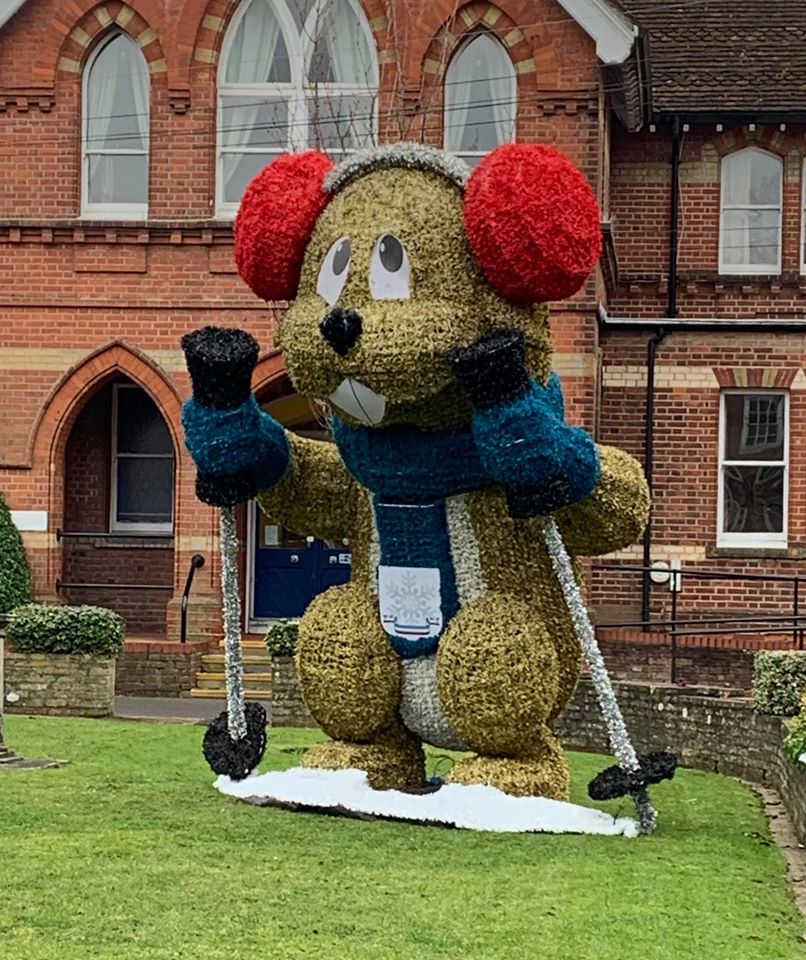
Speaking of Christmas, the Alton Town Council (in England) spent £20,000 on this 16 foot display:

Some people have questioned the display

Some residents are nonplussed about the giant skiing Marmot: “I just don’t understand! Whatever it is, it has no relevance to Christmas, it’s embarrassing and just plain ugly…. “So is this what we have paid for as a community? A fancy skiing giant rodent….”Did the three wise men ride these instead of camels? Or did the shepherds watch their marmot flock by night?”

An Utah woman could be forced to register as a sex offender after appearing topless in front of her step-children in her own home. Tilli Buchanan was charged with three counts of misdemeanour lewdness involving a child after appearing topless along with the children’s father in their home last year. Ms Buchanan’s lawyers are contesting the charge, arguing it is unfair to treat men and women differently for baring her chest.

She said she and her husband were working in their garage in late 2017 or early 2018 and removed their shirts to prevent them from getting dusty. She told the court that when the children, aged nine and 13, entered the garage she “explained she considers herself a feminist and wanted to make a point that everybody should be fine with walking around their house or elsewhere with skin showing”.

“It was in the privacy of my own home. My husband was right next to me in the same exact manner that I was, and he’s not being prosecuted,” she said after the court hearing.

Well, that’s it for this weekend, friends. What are your plans for Thanksgiving?

IM Recommended Reading: Late Migrations

I am reading a remarkable, luminous book by Margaret Renkl, called Late Migrations: A Natural History of Love and Loss. This book of meditations and and short essays reminds me of Annie Dillard’s writing, with its intermingling of nature observations and reflections on life. Maureen Corrigan said the following in her review: “Late Migrations is a vivid and original essay collection that’s a little hard to characterize because — to borrow from the title of a novel by Jeannette Haien, another one-of-a-kind writer — Renkl’s subject here is “the all of it.” By that I mean the cycle of life, out there in nature and inside our own families and our own bodies.”

Lee Smith’s recommendation at Margaret Renkl’s website captures the intricacies of Renkl’s narrative prose well: “Here is an extraordinary mind combined with a poet’s soul to register our own old world in a way we have not quite seen before. Late Migrations is the psychological and spiritual portrait of an entire family and place presented in quick takes―snapshots―a soul’s true memoir. The dire dreams and fears of childhood, the mother’s mysterious tears, the imperfect beloved family―all are part of a charged and vibrant natural world also filled with rivalry, conflict, the occasional resolution, loss, and delight. Late Migrations is a continual revelation.”

Here is a brief excerpt. I highly recommend this book as a generous gift of contemplation and wonder to us all.

In Mist

It came in the night on a cold wind that rattled the windows, and it lingered after the cold rains moved out this morning. It seems to mean that we will have no autumn at all this year. The long, desultory summer has finally given way, but it has not given way to fall. Winter is here now, and to signal its arrival we got just a single night of wind and rain, a single morning of mist beading in the air above the pond and blowing off with the wind.

It won’t last. In Tennessee we don’t get much of a winter anymore, and highs below freezing are random and uncommon. I like the idea of mist as much as I enjoy the lovely mist itself. Aren’t transitions always marked by tumult and confusion? How comforting it would be to say, as a matter of unremarkable fact, “I’m wandering in the mist just now. It will blow off in a bit.”

Late Migrations (p. 39)

Review of “Love and Quasars: An Astrophysicist Reconciles Faith and Science” by Paul Wallace, Part 4.

Review of “Love and Quasars: An Astrophysicist Reconciles Faith and Science” by Paul Wallace, Part 4.

Chapter 6 is entitled “A Larger, Stranger God: How Science Expands Your View of God.”  The chapter is basically a parable starring Tycho Brahe, the last great European astronomer to never use a telescope.  Tycho was a bit of an weirdo eccentric; here is a short video summary of his life.  He died from drinking too much beer and refusing to get up and go pee (sounds more like a geologist than an astronomer, but every good geologist knows you only rent beer, but I digress).

Tycho Brahe

Tycho never accepted Nicholas Copernicus’ idea that the Earth moves around the sun.  He had many reasons for rejecting it.  Contrary to popular belief, Copernicus had proved nothing, and Tycho knew it.  Anyone could see that the Earth stood solid underfoot.  Moreover a moving Earth violated the physics of his day.  No great wind blew as it would if the Earth were turning; objects thrown up in the air did not land to the west; and the stars failed to display annual parallax that would have confirmed its motion.

But Tycho’s greatest problems with Copernicus had nothing to do with science.  They concerned God: (1) humanity had seen itself as toiling near the lowest reaches of the cosmos while God serenely ruled from his throne far above the stars atop all things.  This cosmic model provided a fit setting for the human-divine drama of medieval Christianity.  So what could it mean for Earth, whose fixed place in the cosmic basement had for centuries made both scientific and religious sense, to be raised high above the sun and set in motion, no less?  It confused the relationship between God and humanity, with no hard scientific evidence to back it up.  (2) If the Earth moved around the sun the distances to the stars would have to be enormously greater than imagined, or else the stellar parallax could be observed.  If Copernicus were right, an incomprehensively vast ocean of nothingness would necessarily extend between the highest planet and the stars.  This radical expansion of scale is what bothered Tycho profoundly.  “Why would God have created so much empty space?” he asked, and in the end stated that, even if there had been no other absurdities to the Copernican theory, this alone would be sufficient to rule it out forever.

The two bright stars are (left) Alpha Centauri and (right) Beta Centauri, both binaries.

We think Tycho’s incredulity now quaint and naïve, but I think we do him an injustice.  Scientific measurements continued to expand the scale of the cosmos.  In 1833, a Scot named Thomas Henderson was named the director of the Royal Observatory in South Africa, where the bright triple star Alpha Centauri wheels high overhead all year round. Henderson began measuring the position of Alpha Centauri and discovered the stellar parallax that Tycho could never see.  It led him to calculate the star’s distance as 20 trillion miles (he was actually short by 6 trillion miles), six hundred times farther than Tycho’s worst nightmare of a distance. Let’s consider this distance in relation to the solar system.

If the sun were shrunk down to the size of a basketball and placed at the base of the Washington monument, Earth would be represented by a peppercorn 80 feet away.  A blueberry at a distance of about 1600 feet, at the edge of the Lincoln Memorial Reflecting Pool, would serve nicely as Uranus.  The entire solar system would fit within the limits of the National Mall, including Pluto and many comets that spend most of their time far beyond the orbit of Neptune.

On this scale, Henderson’s star would not reside inside the city limits of Washington DC, nor would it sit anywhere within the greater metropolitan area.  In fact, it would not be found in the states of Virginia or Maryland, nor anywhere in the continental United States.  On our sun-as-a-basketball scale, the two brightest stars of Alpha Centauri, our very closest neighbor star system, would be represented by a beach ball and a bowling ball lying about 1600 feet apart – the same as the distance between the basketball sun and blueberry Uranus – on a beach on the Big Island of Hawaii.  The third star, a red dwarf called Proxima Centauri, lies nearer to us than the others.  In our scale model, it would be represented by a golf-ball sized object floating about two hundred miles off the east coast of Hawaii.

In 1924, an unexpected discovery re-upped the cosmic distance scale many thousands of times.  Astronomer Edwin Hubble showed that our own Milky Way Galaxy, itself many thousands of times farther across than the distance between Earth and Alpha Centauri, floats among an uncountable number of other galaxies.  The human imagination fails utterly when faced with the distances between these galaxies.  Moreover, in 1929, Hubble demonstrated that distances to remote galaxies are growing daily. In 1999, it was discovered that this cosmic expansion, long assumed to be slowing down, is actually speeding up.  The universe is not only growing larger every day; it’s growing larger faster every day!

The biblical character of Job, like Tycho, thought he had a handle on who God was.  God, he supposed, was a lot like him: fair, reasonable, and concerned with the happiness of human beings.  If you prayed to him and worshipped him with the right sacrifices, your life would be blessed – until it wasn’t.  Job didn’t give up on God, but he wanted God to show up – until he did.  God answers Job out of the whirlwind and gives him a tour of the universe, which even from the perspective of time of the biblical writers, still shrank the human world and civilization to appear small and unimportant.  Unlike Tycho, Job gets the point.  The Job story beautifully balances the cosmic and the personal. Job’s vision of the universe forces him to expand his understanding of God and even to admit that he does not understand.  Wallace says this:

Christianity stands as one among many religions found on our humble planet.  Our local, particular faith seems mighty provincial in a cosmos such as ours.  Maybe a God that large, that strange, that invested in nonhuman worlds, that deep and mysterious, cannot be contained by our one local faith.  If this expanding and evolving and practically infinite cosmos is what is next to God, what must God be like?  And how in the world can we know?

He then concludes:

Let’s try to be less like Tycho and more like Job.  Let’s not let our idea of God keep up from knowing and loving what God has made, and let’s allow the cosmos to help us know God better.  Let’s not throw away science or faith because the universe is different from what we thought or might even prefer it to be.  Let’s allow the cosmos to guide us toward an unexpected and mysterious God.

I’m on board with Wallace here.  The larger and more mysterious the cosmos is revealed to be the more those facts deepen and make more mysterious the incarnation.  The incarnation is why I am, and remain, a Christian.  It is both deeply cosmic and deeply personal.  Anyone remember the Joan Osborne (written by Eric Bazilian) song; “What if God Was One of Us”?  It never got played on Christian radio stations, which is both ironic and sad.

(We didn’t write this song, but listen)

If God had a name, what would it be

And would we call it 2 His face

If we were faced with him and all his glory?

What would you ask if you had just one question?

Yeah, yeah, God is great

Yeah, yeah, God is good

Yeah, yeah, yeah, yeah, yeah!

[Chorus:]

What if God was one of us?

Just a slave like one of us?

Just a stranger on the bus

Trying to make his way home

If God had a face, what would it look like

And would you want to see it

If seeing meant that you would have to believe in things like heaven

And Jesus and the saints and all the prophets?

Yeah, yeah, God is great

Yeah, yeah, God is good

Yeah, yeah, yeah, yeah, yeah!

Yeah

Yeah, yeah, God is great

Yeah, yeah, God is good

Yeah, yeah, yeah, yeah, yeah!

What if God was one of us?

Just a slob (slave) like one of us?

Just a stranger on the bus

Trying to make his way home

Like a holy rolling stone

Back up to heaven all alone

Nobody calling on the phone

‘Except for the Pope maybe in Rome

But He ain’t home, he ain’t home, he ain’t home!

No, no, no, He ain’t home!

Oh yeah, oh!

(What if God was one us?)

BEYOND Traditional Marriage: A New Program

Song of Songs IV. Chagall

Another Look: BEYOND Traditional

Here is another look at a proposed program for strengthening marriages that we suggested a few years ago. We don’t just promote traditional marriage, we recommend going BEYOND traditional marriage and taking up these tried and true practices that are fully Biblical™ and forever enshrined for us in the pages of Holy Scripture.

Here are some sample lessons. I’m sure you’ll see how practical and helpful they will be in advancing the cause of Biblical™ marriage that goes BEYOND merely traditional:

Lesson One: Garden delights (Genesis 2-3)

Let’s start where the Bible does: with husband and wife frolicking about naked in a garden. If you want your marriage to be Biblical, outdoors nudity is essential. This lesson will give practical suggestions for creating your own private, outdoor retreat where the neighbors can’t spy on you, where you can play au natural to your hearts’ delight. Nothing will free you to express love, devotion, and commitment like walking, talking, eating fruit and gardening with each other in the altogether. Don’t be ashamed. Forsake those fig leaves that have kept your marriage from being all that it can be, and go BEYOND!

Lesson Two: But what if I married a Nephilim? (Genesis 6)

No marriage is perfect, but sometimes you wake up and wonder if the person lying next to you is actually some fallen angel with demonic intentions. The Bible affirms that this is indeed possible. Perhaps you think you missed God’s will. You never found your “Noah” even though you dreamed of a righteous and blameless life partner with whom you could weather the storms of life. So you settled for someone who called himself “a son of God,” but now you realize he was really an alien giant with a heart as dark as the depths of the sea. This lesson explores how you can manage those pesky human/alien incompatibility issues. It will also reveal how God wants to flood your life with blessings BEYOND what you think you can hope for, in spite of the bad match you made.


l

Boaz wakes up and sees Ruth at his feet. Chagall

Lesson Three: Creative ways to pass on your heritage (Genesis, Ruth)

God designed marriage to be his chosen method of producing a godly line of descendants. This can challenge a marriage, and sometimes, we have to work extra hard to make that happen. We want to encourage you to get creative, and go BEYOND!

We’ll study Lot, for example, and discuss the daughter-father connection. And then we will look at Tamar, who illustrates the more complex but explicitly commended Biblical principle of “my husband’s dead and my brother-in-law won’t sleep with me and I don’t have kids so I guess I’ll become a prostitute and seduce my father-in-law so I can become a mother.”

As a bonus, we’ll discover how we as parents can be like Naomi, and encourage our daughters to go lay naked at the feet of drunk wealthy landowners until they wake up, fear the worst, and agree to marry them. The possibilities are endless!

Lesson Four: Developing a way with words (Song of Solomon)

Ladies, ever wish your husband would speak more lovingly to you? That, for example, he would tell you your hair is like a flock of goats, your breasts like towers, your belly like a heap of wheat? Or at least that your feet look great in sandals? And men, wouldn’t you love to hear your wife compliment you for those ivory abs, those alabaster pillar legs you have? Wouldn’t you just love her to praise you as a gay gazelle, leaping over the mountains? Then you won’t want to miss this lesson. We’ll divide up into couples and challenge you to find creative ways of describing your partner’s body parts. Then we’ll come back together and share what we’ve come up with! It’s loads of fun and not embarrassing in the least. Then we’ll send you home so that you can practice naked in your garden.

Lesson Five: Marriage as Evangelism (Hosea, Esther)

God may sometimes call you to marry someone you would never naturally consider, just so that you can win them to the Lord and be an example to others. This was Hosea’s calling, and in this lesson we’ll help you men learn how to identify which broken, fallen women are just right for you. We’ll discuss strategies for the ladies too, taking our cues from Queen Esther. You’ll learn how to work up the perfect erotic dance moves so that you can capture the heart of the evil monster you’re eager to reach. Who knows whether some of us will be called to this kind of marriage in “such a time as this”? This is the time to go BEYOND!

• • •

Our crack staff will be hard at work developing other Biblical lessons too. We’ll suggest survival tips for concubines and demonstrate the best use of mandrakes to foil your sister-wife from sleeping with your husband tonight. We’ll show you how to keep a Levitical calendar and checklist to make sure your sex life doesn’t break God’s rules. For those of you forced to live with contentious spouses, we’ll show you how to make a corner of your attic into a proper place where you can hide, as Proverbs instructs. We’ll also study the prophets to see when it is appropriate to talk dirty and examine why Paul would rather stay single than go through all this hassle.

In every way possible, we want to encourage you to go BEYOND in your marriage! So watch for more lessons in this ground-breaking marriage program in days to come!

Take a stand for marriages that are BEYOND traditional — Be thoroughly BIBLICAL™!

Another Look: Are We More Gracious than God?

Morning Cross with Pilgrim (2014)

 Above all, maintain constant love for one another, for love covers a multitude of sins.

• 1 Peter 4:8, NRSV

Love…keeps no record of being wronged.

• 1 Corinthians 13:5, NLT

• • •

This is not meant as a formal theological analysis of the meaning of the atonement. It’s more like street-level questioning of the way people often talk about sin and grace and God, especially when we place too much or exclusive emphasis on the common evangelical metaphor of penal, substitutionary atonement.

Are we more gracious than God?

The following is what I often hear about God and his stance toward our sins. Some of these are direct quotes from sermons or theological writings or evangelistic articles. The sentiments are so common that I will not cite sources or name names. Just Google “sin must be punished,” and you’ll get lots and lots of statements like these.

There is a price tag on sin, and therefore sin must be paid for. God cannot allow sin to go unpunished.

Justice requires that sin be punished, because sin deserves punishment. The justice of God obliges him to punish sin.

God, in his holiness, is infinitely opposed to sin. He cannot overlook it but must act with righteous judgment, exacting vengeance against it.

Since God has given us his Law and commanded us to live by it, he must punish those who break his law. Not to do so would be unjust.

In Scripture, sin is spoken of not merely as a terrible evil; but, much more than this, as legal guilt, which the righteous Judge must punish; as something so abhorrent to his holy nature that he cannot allow himself to be approached by any one on whom that guilt still rests; that he cannot meet with anyone from whom that guilt has not been removed by sacrifice.

In order to avoid defying a part of His character, God must judge sin. God cannot ignore sin no matter how loving and kind He is for to do so would deny one of His attributes, i.e., His righteousness.

God is love, but He is also just and righteous. If so, he must punish wickedness in the same way that a judge in a court must punish for crimes.

God is love, but genuine love cannot mean leaving sin unpunished either. Rather, because he loves us, God took the punishment for our sins on himself in Jesus.

If God could just overlook sin, there would be no need for Christ to have taken our punishment on the cross.

Sin must be punished.  God provided a punishment for our sins – Jesus bore our punishment.  We can choose to accept the punishment that Jesus made on our behalf, or take the punishment ourselves.  Either way, sin must be punished.

I have heard and taught this for decades, and still agree with Scot McKnight, who wrote, “I don’t know how to read elements of (especially) Paul without explaining his soteriology as penal…” (A Community Called Atonement). The Bible’s portrait of God as a righteous judge who punishes evil as part of putting his fallen creation to rights is an undeniable part of the biblical witness.

But, as McKnight also reminds us, “Atonement language includes several evocative metaphors…Each is designed to carry us, like the pole, to the thing. But the metaphor is not the thing.” We need all the metaphors (such as sacrifice, reconciliation, redemption, and ransom) and, even then, must humbly confess that we understand only the the outlines of who God is, how he loves us, and what he has done for us in Jesus Christ.

As I was driving today, the verse heading this post came to my mind. It immediately struck me as yet another clue to the unfathomable love and grace of God toward you and me:

“…love covers a multitude of sins.”

These words were written to suffering followers of Jesus Christ, encouraging them to show deep love for one another. The author reminds them what love does — it covers sins. That is, it overlooks them, it regards them as of no account. Love is generous with others and releases them from expectations of sinless perfection. If you love me, you will not hold my sins against me. You will accept me in spite of my weaknesses, failures, and offenses.

As the complementary citation from 1 Corinthians 13 says, “Love…keeps no record of being wronged.” I don’t keep a running tally of your sins. In considering your actions or words, I assume your best intentions. I place the value of remaining on good terms with you above holding you accountable for any grievances I might have against you. Insofar as it depends on me, I try to be at peace with you.

So there are times we choose to ignore each other’s sins and shortcomings. We forget them. We overlook them. We don’t consider them worthy of damaging our relationship. We give each other grace, and space. Freedom to fail. The okay to be imperfect. We are committed to each other in a covenant of love. Sin cannot break that.

If this is what love is, and if God is love, why then can’t we factor in this same attitude in our thinking about how God views us and deals with us in our sins?

Are humans, who show this kind of love to each other, more gracious and loving than God?

I don’t think I’ve ever heard a Christian preacher or teacher say,

“God loves you, and he overlooks your sins.”

“God won’t let your sins stand between you and him.”

“God values you too much to hold your weaknesses and failures against you.”

“God loves you so much that not even sin can separate you from him.”

Perhaps he is like the father of the Prodigal Son, and not just like a righteous judge upholding the law.

Love covers a multitude of sins.

However, this is obviously not the whole story either.

This idea of “love covering sins” is simply one metaphor among many — a metaphor of relationship that grows out of the stuff of everyday life: family, friends, neighbors, fellow congregation members, coworkers, teammates, partners, fellow citizens. It grows out of living descriptions (not definitions) of love in action and the gracious forbearance, patience, and kindness human beings often show each other in commonplace daily interactions. It doesn’t indicate that we fail to take sin seriously. It just means we think other aspects of relating to each other are more important. It means putting sin in its place and not allowing it to win by pitting us against each other.

But there are times when other metaphors must take precedence. Sin can and does break relationships, and reconciliation is required. Sin, from one perspective, is a crime, and justice must be served through the payment of a penalty. Sin takes us captive, and we need to be set free (redemption) by some sort of payment (ransom) or atoning sacrifice.

All these metaphors become real in the person of Jesus Christ. We are perhaps most familiar and conversant with the concept of Jesus paying the just penalty for our sins by dying on the cross in our place.

But even on the cross, Jesus uttered the words, “Father, forgive them; for they do not know what they are doing.” (Luke 23:34). That is not the language of penal substitution. Those are words of generosity — Jesus is asking God to overlook the ignorance of his executioners.

Maybe sometimes Jesus just looks us in the eye, touches us, and says, “Go in peace.” Maybe sometimes he just runs down the road, throws his arms around us, and welcomes us home.

Maybe sometimes he just lets us off the hook.

His love covers a multitude of sins.