I like charts; they capture information in a way that allows clear comparison and contrast. Here is one I drew up regarding grace:
Three Kinds of Grace
Curious for your feedback on this. In particular, is libertine grace similar to what Bonhoeffer called cheap grace? When I wrote this I was not thinking of that, but on reading Bonhoeffer’s words again this week, it brought the question to mind.
Cheap grace is the deadly enemy of our Church. We are fighting today for costly grace. Cheap grace means grace sold on the market like cheapjacks’ wares. The sacraments, the forgiveness of sin, and the consolations of religion are thrown away at cut prices. Grace is represented as the Church’s inexhaustible treasury, from which she showers blessings with generous hands, without asking questions or fixing limits. Grace without price; grace without cost! The essence of grace, we suppose, is that the account has been paid in advance; and, because it has been paid, everything can be had for nothing….
Cheap grace means grace as a doctrine, a principle, a system. It means forgiveness of sins proclaimed as a general truth, the love of God taught as the Christian ‘conception’ of God. An intellectual assent to that idea is held to be of itself sufficient to secure remission of sins…. In such a Church the world finds a cheap covering for its sins; no contrition is required, still less any real desire to be delivered from sin. Cheap grace therefore amounts to a denial of the living Word of God, in fact, a denial of the Incarnation of the Word of God.
Cheap grace means the justification of sin without the justification of the sinner. Grace alone does everything they say, and so everything can remain as it was before. ‘All for sin could not atone.’ Well, then, let the Christian live like the rest of the world, let him model himself on the world’s standards in every sphere of life, and not presumptuously aspire to live a different life under grace from his old life under sin….
Cheap grace is the grace we bestow on ourselves. Cheap grace is the preaching of forgiveness without requiring repentance, baptism without church discipline, Communion without confession…. Cheap grace is grace without discipleship, grace without the cross, grace without Jesus Christ, living and incarnate.
Costly grace is the gospel which must be sought again and again and again, the gift which must be asked for, the door at which a man must knock. Such grace is costly because it calls us to follow, and it is grace because it calls us to follow Jesus Christ. It is costly because it costs a man his life, and it is grace because it gives a man the only true life. It is costly because it condemns sin, and grace because it justifies the sinner. Above all, it is costly because it cost God the life of his Son: “ye were bought at a price,” and what has cost God much cannot be cheap for us. Above all, it is grace because God did not reckon his Son too dear a price to pay for our life, but delivered him up for us. Costly grace is the Incarnation of God.
In today’s pluralist, spiritual-but-not-religious world, it’s worth asking: Why Christianity? A lot of people are asking that question these days, if not in words then in actions. You know the statistics: falling church membership, those who still attend not accepting the tenets of the historical faith, even growing atheism. More people are content with a personal spirituality or with no spirituality at all. Even Christian believers, if they are thoughtful, honest people, may ask themselves whether Christianity is objective truth or just what they happen to prefer.
If you’re even reading this, you have some thoughts about what purpose religion serves. Well, what is the purpose of religion, and is religion in general, and one religion in particular, the only way to achieve that purpose?
Being a good person
This is certainly what many would offer as the foundation of religion. All the world religions, and most of the philosophies, deal with what we have to do and how we have to live in order to be good people. We have to align ourselves with the mandate of heaven, or follow the Five Pillars or the Ten Commandments; we have to recognize the balance of dharma and do works of mercy to people as well as rituals for God or gods; we have to embrace suffering and develop impassivity, or we have to embrace pleasures and revel in creation. The stated goal of these religions and philosophies is to be better – to please God, sin less, be more in control of behavior, follow the rules more exactly, and (let’s be honest) look better in the eyes of neighbors.
But religion has hardly cornered the self-improvement market. Secular systems also offer options for improvement. Psychotherapy can make it easier for you to behave as you should in your society and in some cases is more effective at that than religion. Physical training can make you stronger, healthier, and more attractive. Wealth and success also promise improvements in both personality and circumstances. There are courses, books, retreats, and advice any where you look, and some of them actually work to some degree.
So if it’s self-help you need, Christianity is not your best option. In fact, if you look carefully, Christianity discourages its followers from simply trying to be good. It even assures adherents that they won’t succeed at it. And there are plenty of Christians illustrating the principle that their religion doesn’t make them good people, and plenty of people of other religions, or no religion at all, who are generous, humble, and wise.
Finding inner balance and outer peace
The message of Christianity here, as with being a good person, is disturbingly mixed. Jesus tells us he brings peace but also a sword. And Christianity’s track record in achieving world peace is – well, it doesn’t really have one, does it. It probably has a better claim to bringing about inner peace, but even in that case Christianity can point only to a minority of genuinely contented individuals. Most Christians are as frazzled and angry as the people around them.
If it’s inner peace you want, several religions focus more on that than Christianity does; so does psychotherapy. And for avoiding outright war, you might as well go to the United Nations or the Hague as to church. So why not embrace instead the meditating Buddha, the Zen path to enlightenment, or the Baha’i effort to erase racial and national differences?
Achieving insight into the universe
Although this is offered as a function of religion, I’m not sure how many people are even interested in unveiling the secrets of life, the universe, and everything. Most of my students, for example, just want to get a good job, provide for their family, and be comfortable – that’s enough. But those who are driven by a search for truth are less and less likely to look for it in religion. Science is the door to knowledge nowadays, according to many, and if science can’t explain something, they think, then it isn’t real. (This is the attitude of average non-scientists, anyway. I hear it a lot in the classroom and in other world at large.) Because Christianity’s claims about the nature of God and humankind can’t be tested in a laboratory, they lack credibility.
But science has its failings, too, and those who have lost their – well, faith, for lack of a better word – in science may go to the opposite extreme from the laboratory in their search for knowledge. They want the out-of-body, mystical, emotional experience that comes from, oh, gnostic initiations or hallucinogenic drugs. The quotidian duties of Christianity don’t satisfy them for long.
In fact, pretty much anything you might expect to get from Christianity you can get from somewhere else, in some cases much more easily and thoroughly.
So why Christianity?
Because Christianity is for losers.
Christianity is not for the successful but for the disillusioned and hopeless. Christianity begins where everything else ends. When you’ve tried the therapy and the rule-following and the exercise routine; when you’ve been to Mecca, meditated until you’re stuck in the lotus position, or spent your savings on plush retreats in the California hills, and you’re still the same sinner you ever were – that’s when Christianity has something to say to you. And what it says is that God understands that we are broken and we can’t fix ourselves. And that’s pretty much how things are going to be in this life.
It’s true that the Son of God worked some miracles, that he “fixed” a few people, but not many. Most people were and are left just as damaged as they were before meeting Jesus. So he didn’t come just to fix us here and now, even though that’s what we’d really prefer. He came to keep us company, to be God with Us.
Only Christianity shows us a God who is hungry and dirty, rejected, abused, and killed, all in solidarity with prostitutes, shake-down artists, adulterers, cheaters, and all the rest of us twisted by sin. Christianity shows us a God who joins us in our fallen world to weep over the dead, and to sweat in terror in the face of his own death. He is the sacrifice freely given in our stead, while we spit on him. He is also the father who runs to greet us after we’ve tried all those other routes to happiness and success that have ended in the pigsty. He is not far from us; he comes to us when we are still far off. He does not require perfection by our own efforts.
God’s humility offends the people who are still convinced that they can achieve some form of goodness by their own efforts, and that the universe is set up to reward those who try hardest. But those of us who have seen all earthly methods fail, and who know our own failure, can relax into the embrace of the shepherd, the loving mother, the longing father who knows our humanity and has blessed it by his presence. If all the other systems for human perfection are working for you, then the God of failures, killed as a thief in a dusty and obscure corner of the world, has nothing to offer you. But to me, he is hope and rest and peace.
Monday with Michael Spencer: October 7, 2019 Silence in Worship
Silence has been banished from most contemporary worship as if it were an outright evil, yet what modern worship consumer is not likely to come back from a monastic retreat saying “I loved the silence?”
The Protestant liturgy has no tradition of silence, but periods of silence have often been incorporated into Protestant worship.
For example, the pastoral prayer is sometimes preceded by silence. Sermons can be followed by silence. Some congregations have announcements well before the prelude, then call for relative silence during the prelude. The basic idea of the prelude and/or postlude may involve silence for some churches.
Silence presents some functional obstacles, especially where there are small children, but keep in mind that we are not trying to achieve some sort of state of absolute silence as a task, but to “be still and know that I am God.”
Perhaps more useful is simply the idea of ceasing conversations and being still and quiet before the Lord as a preparation for worship.
Many evangelicals have little idea how noisy their services are. Bring a visitor from the Catholic or Anglican church and see how they compare the “quiet” portions of your worship to theirs.
I grew up in a tradition where “meditation over music” was common in worship, Many traditional Baptist services continue this practice as part of prayer during worship. Exactly how silence and the sounds of an electronic organ or projected slides of nature accompanied by canned music relate to worship is still a mystery to me. I find such moments of meditation to be anything but meditative.
Silence taken to uncomfortable extremes can be distracting, and occasionally embarassing. Be judicious.
I have used a silent introduction to pastoral prayer for years, and will continue to do so until I actually fall asleep during the silence. Then we’ll have to review the idea.
Olivia Hussey and Leonard Whiting in Romeo and Juliet (1968). Banner in the Palazzo Piccolomini in Pienza, Italy.
Dispatch from Tuscany: October 6, 2019
To love is to suffer. To avoid suffering one must not love. But then one suffers from not loving. Therefore, to love is to suffer; not to love is to suffer; to suffer is to suffer. To be happy is to love. To be happy, then, is to suffer, but suffering makes one unhappy. Therefore, to be unhappy, one must love or love to suffer or suffer from too much happiness. I hope you’re getting this down.
• Sonia, in Woody Allen’s Love and Death
We have made our way to Italy, by means of less efficient trains and rental car (scary!). Our hosts here in Pienza, in the heart of Tuscany, are Andrea and Manuela at the sublime Fonte Bertusi agritourismo holiday house, where the themes are hospitality, art, and nature.
Yesterday we ventured into the city of Pienza, an ancient city that was rebuilt in the 1400s by Pope Pius II as an example of the ideal Renaissance city. We walked its labyrinthine cobblestone streets and viewed panoramic vistas from its city walls such as this:
Pienza is one of the locations where Franco Zefferelli shot his lush film Romeo and Juliet, which Robert Ebert called “the magical high point of his career.” Ebert notes how this movie, focusing on young love and its resistance to the traditional conflicts of the older generation, opened in 1968, one of the most tumultuous years in history with regard to those themes.
As for me, let me just say I fell head over heels in love with Olivia Hussey, the 16 year-old Argentine girl (not yet an actress) who played the 13 year-old Juliet, brilliant in the blush of first romance. I was 12 going on 13, and coming of age, and she represented the ideal of female delicacy and mystery that I was beginning to notice around me. The simple beauty of the score (“Love Theme from Romeo and Juliet,” by Henry Mancini) only enhanced the sense of love’s longing for that which it cannot hold forever.
And this is what it means to visit Tuscany. It is to fall in love again for the first time.
Hi, friends. Welcome to the weekend. Hungry for some brunch?
Non-crying section, please? Every traveler has their pet peeves, but crying babies make the list for almost every plane passenger. Now Japan Airlines has revealed a new tool that lets you dodge infants when you book your seat.”Passengers traveling with children between 8 days and 2 years old who select their seats on the JAL website will have a child icon displayed on their seats on the seat selection screen,” reads the airline’s website.
Well, that’s good, I suppsose. I recall once being on a long flight once next to two screaming, almost demonic children. The flight attendant refused to move me on the ridiculous grounds that I was their father.
Excessive exercise can tireout your brain to the point that you have trouble making decisions, a new study claims. Athletes who exerted themselves to the point of exhaustion showed reduced activity in an area of the brain important for making decisions. And they appeared more impulsive in tests that evaluated financial decision-making, going for immediate rewards instead of larger ones that would take more time to achieve, the researchers found. They are also more likely to cheat on their diet. So too much exercise leads to bad decisions? Man, I must be Solomon then.
The Titanic sails again. Well, at least an exact replica of it, set to launch in 2022.
Clive Palmer, chairman of Blue Star Line wrote in a statement: “The ship will follow the original journey…” Um, Clive….yeah, you might want to think through your wording on this
This may not be the time to mention that last week a giant iceberg, “larger than Los Angeles” broke off from Antarctica.
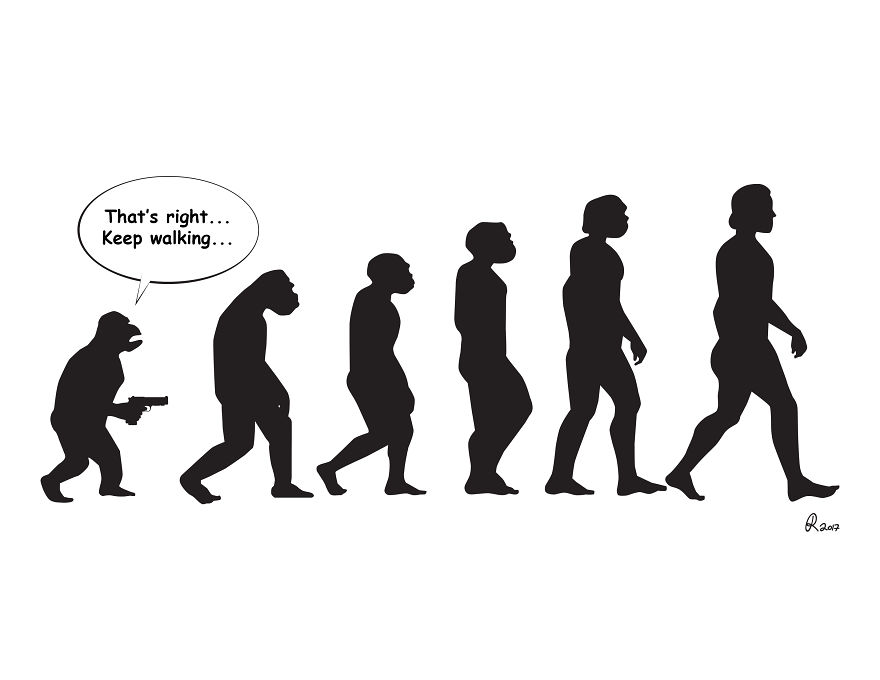
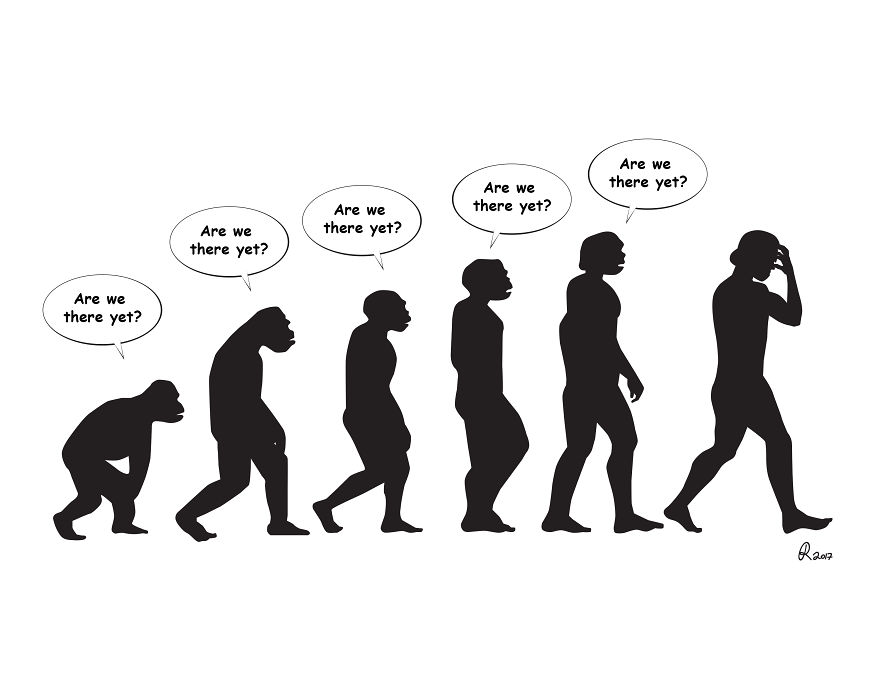
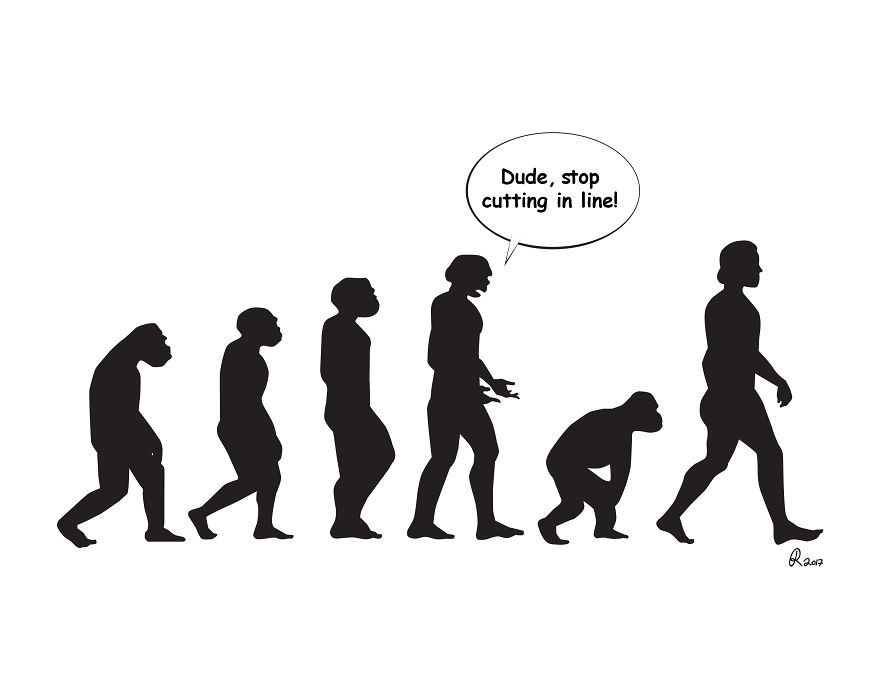
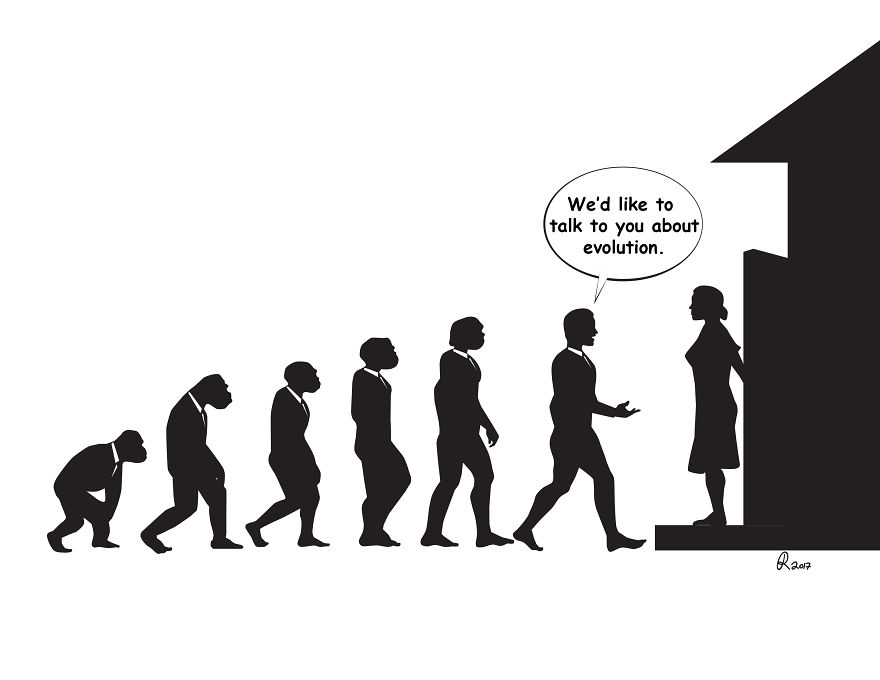
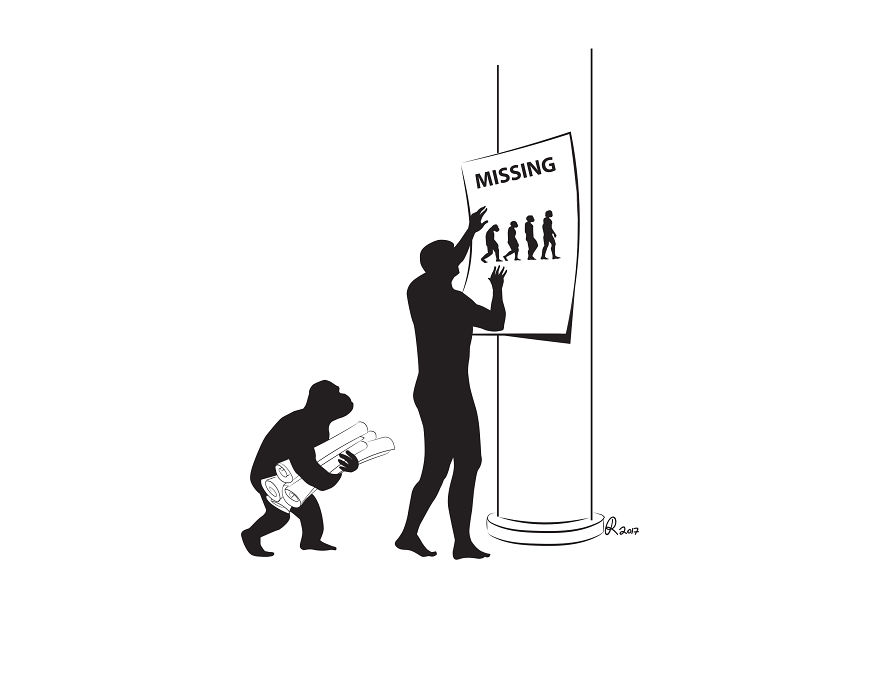
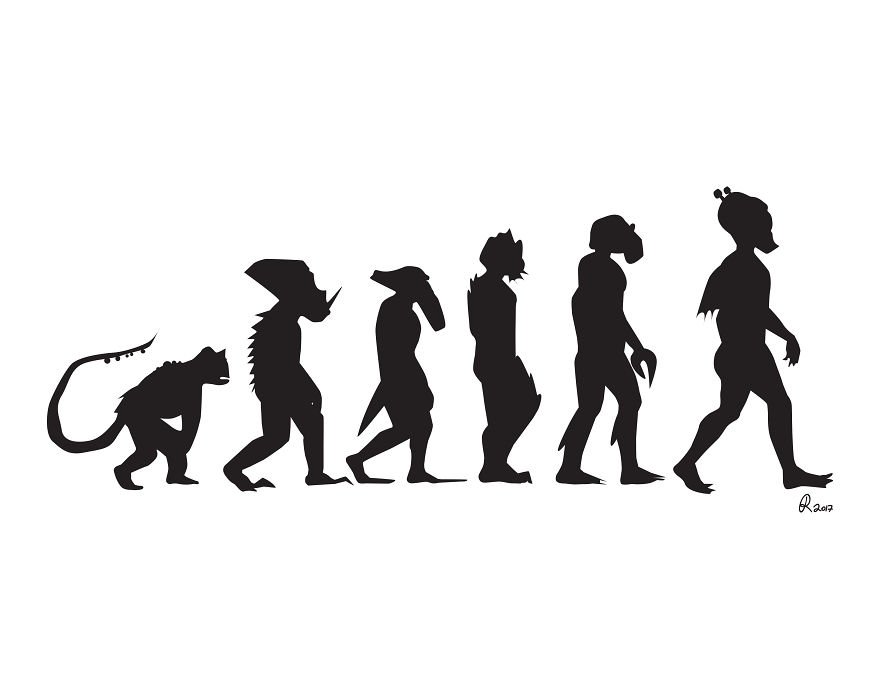
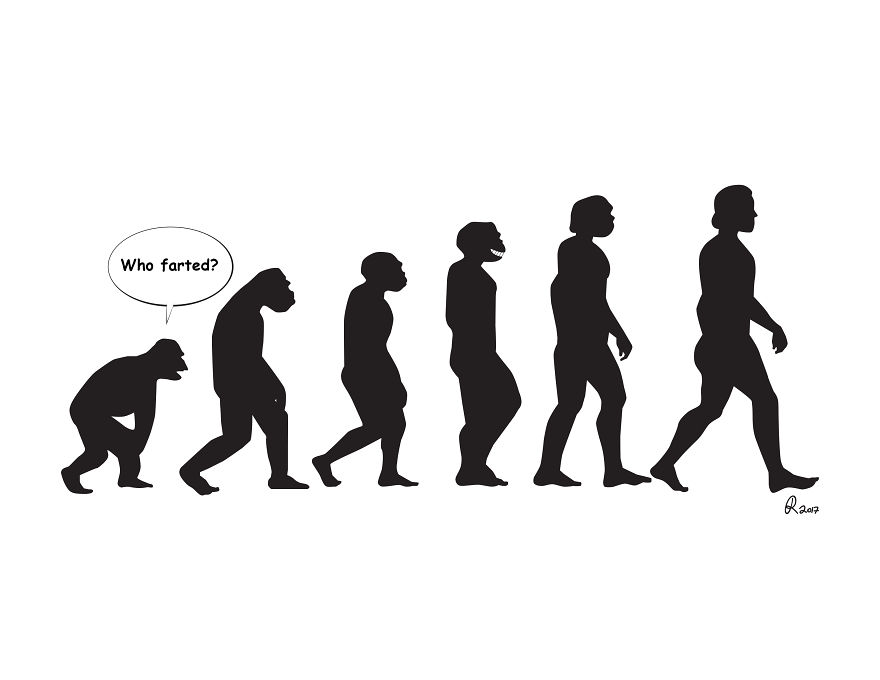
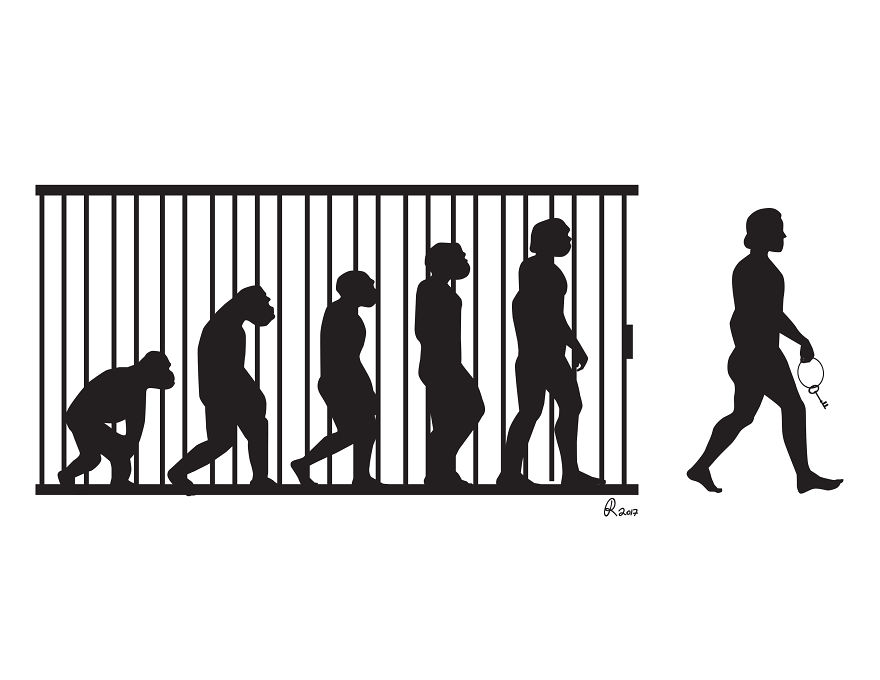
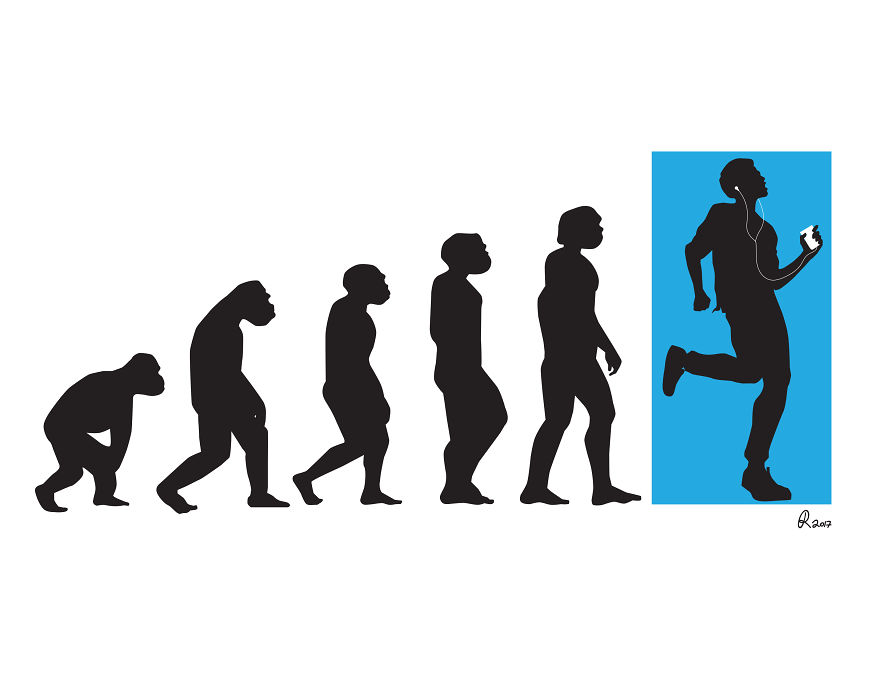
Rusty Yusonoff has a cool last name and an even cooler hobby. He pokes fun at modern culture by morphing the famous human evolution silhouette. Here are some of the better ones (the rest are here).
New York schools have banned unvaccinated children from enrolling.
More than 26,000 students in public and private schools and preschool programs in New York State had religious exemptions from required vaccines during the 2017–18 school year.
To lower the number of children susceptible to measles and other vaccine-preventable diseases, New York State lawmakers voted in June to end religious exemptions from immunizations required for school children.
I’m all for vacinations, but is this a good thing or government overreach?
Speaking of government overreach…Did you forget to walk your dog today? Do you live in Australia? If you answered the first question ‘yes’ you had better answer the second question ‘no’. A new law in Australia will fine owners who do not take their dogs for a walk every day. More specifically, you have two hours after you get home to walk Fido, or face a $4,000 fine! The penalty would not apply if a dog was kept in a backyard, where it could exercise, or if it had to be confined indoors for its welfare. I love dogs, but as a libertarian this really yanks my chain. Unenforceable laws degrade society, and enforcing this one would require Orwellian surveillance by the state.
An emergency room in Poland designed a new logo:
Yeah, that’s bad. Thankfully someone with photoshop “fixed” it:
Josh Gardner was just happily driving down the highway in South Carolina when this happened:
Yes, a flying turtle sailed into his windshield. It happened after another vehicle sent it into the air. “I still don’t understand how it happened”. said Gardner. I think I know:
So, last week was Banned Books Week, a hilariously ill-named promotion of the American Library. James Heaney is having none of it:
During this seven-day festival of self-righteousness, librarians across the country posture as opponents of censorship.
In reality, of course, they’re not fighting censorship at all. They can’t, because censorship doesn’t exist in this country. Any book can be published, any book can be sold. There are no “banned books.” The ALA is actually fighting parents, many of whom have the temerity to request changes to their school curricula or even, in the worst cases, ask their communities to make it slightly more difficult for children to access certain books that, in the parents’ opinion, could cause harm to those children. Access will not be denied, of course: again, censorship, the actual suppression of speech such that it cannot be heard, does not exist* in this country, and has been repeatedly ruled unconstitutional in a variety of contexts.
“Libraries Against Parenting”, however, lacks the same popular appeal as “Banned Books Week”, so America’s librarians construct an elaborate fantasy in which any attempt whatsoever to require or merely encourage a library to act in loco parentis (like any other responsible adult member of the community) is, through some arcane ritual of linguistic alchemy, a form of “censorship.”
Have you ever noticed that the Washington Monument looks ABSOLUTELY NOTHING LIKE George Washington? This really bugs me.
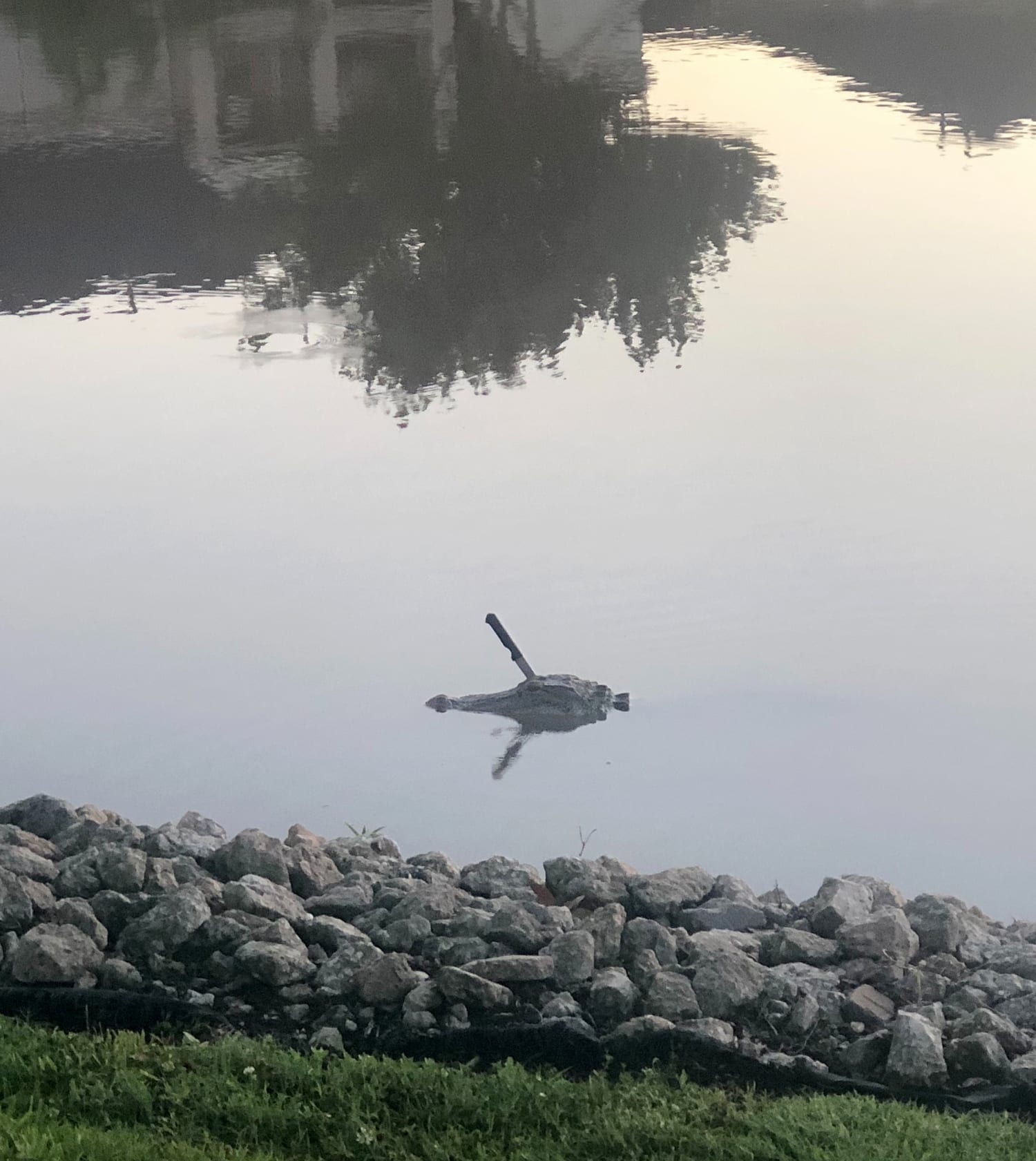
A Florida woman spotted something odd in the neighborhood pond. An alligator? Well, yes, but those are more common than dogs in Florida. This was an alligator with a knife sticking out of its head:
No one knows how he got it (my guess involves beer and rednecks) but its rumored whoever is able to pull it out becomes king of Florida.
Ever seen a sunset and a solar eclipse at the same time? Well, you have now:
Credits to the photographer- Dan McGlaun, who took this in Big Spring State Park, Texas. More here.
It’s not enough, Nicole Brewer argues at American Theatre, for directors to produced diverse works with a diverse slate of actors, they should focus exclusively on “anti-racist ideas” and “values”: “You’re not practicing ART [anti-racist theatre] properly unless change is felt, and you experience an intuitive understanding that the plurality of your humanity is welcome.” Hmmm…I’m not quite sure what the plural of my humanity is. Is this a crack about my weight? But in any case, art with an agenda is almost always bad art.
Have you ever written a thesis or dissertation? What was it about? I’m really interested. I wrote an M.A. thesis on the relationship between God and Time. I wish I would have seen the following list of phrases and their definitions before I wrote it:
“IT HAS LONG BEEN KNOWN”…
I didn’t look up the original reference.
“A DEFINITE TREND IS EVIDENT”…
These data are practically meaningless.
“WHILE IT HAS NOT BEEN POSSIBLE TO PROVIDE DEFINITE ANSWERS TO THE QUESTIONS”…
An unsuccessful experiment, but I still hope to get it published.
“THREE OF THE SAMPLES WERE CHOSEN FOR DETAILED STUDY”…
The other results didn’t make any sense.
“TYPICAL RESULTS ARE SHOWN”…
This is the prettiest graph.
“IN MY EXPERIENCE”…
Once
“IN CASE AFTER CASE”…
Twice
“IN A SERIES OF CASES”…
Thrice
“IT IS BELIEVED THAT”…
I think.
“IT IS GENERALLY BELIEVED THAT”…
A couple of others think so, too.
“CORRECT WITHIN AN ORDER OF MAGNITUDE”…
Wrong.
“ACCORDING TO STATISTICAL ANALYSIS”…
Rumor has it.
“A STATISTICALLY-ORIENTED PROJECTION OF THE SIGNIFICANCE OF THESE FINDINGS”…
A wild guess.
“A CAREFUL ANALYSIS OF OBTAINABLE DATA”…
Three pages of notes were obliterated when I knocked over a glass of soda.
“IT IS CLEAR THAT MUCH ADDITIONAL WORK WILL BE REQUIRED BEFORE A COMPLETE UNDERSTANDING OF THIS PHENOMENON OCCURS”…
I don’t understand it.
“AFTER ADDITIONAL STUDY BY MY COLLEAGUES”…
They don’t understand it either.
“THANKS ARE DUE TO JOE BLOTZ FOR ASSISTANCE WITH THE EXPERIMENT AND TO CINDY ADAMS FOR VALUABLE DISCUSSIONS”…
Mr. Blotz did the work and Ms. Adams explained to me what it meant.
“A HIGHLY SIGNIFICANT AREA FOR EXPLORATORY STUDY”…
A totally useless topic selected by my committee.
“IT IS HOPED THAT THIS STUDY WILL STIMULATE FURTHER INVESTIGATION IN THIS FIELD”…
I quit.
Biologos had a fascinating discussion with Aaron Niequist, who previously led worship at Mars Hill Bible Church in Grand Rapids and at Willow Creek Community Church.
“And so what I do is get up on a big stage with lights pointed at me and my face on a jumbotron and me holding the microphone. In that context, I’m saying ‘hey, don’t focus on me, me, me.’ It’s a very conflicting thing.”
In his years leading worship at Willow Creek, he felt like he had to “work against what the room was declaring really loudly — which is ‘focus on those people up on the stage in the lights.’”
Niequist hit a rocky point and had what he called “a real faith crisis” after college when he was around 22. The problem was, he was a professional worship leader at that point. “How do you lead these songs, how do you say ‘let’s worship this God that I don’t even know if I believe anymore,’” he remembered feeling.
What helped him through this? Supportive friends and family, one of whom recommended Dallas Willard’s book, The Divine Conspiracy.
“I remember where I was sitting, reading about the Kingdom of God, which I had never heard about. I had been a Christian for 22 years at that point and I had never heard a message on the primary message of Jesus which was the Kingdom of God. That was the born again again moment for me,” he said.
“I was like ‘wait, if this is the story — it’s not just you’re a sinner, say a prayer so you can go to Heaven someday but if it’s you get to join what God is doing to redeem and restore all things, I get to? You get to? We get to? I’m in. Let’s do this.’ That was as much a conversion moment as I’ve ever had in my life and it was about the Kingdom.”
Niequist’s perspective on everything changed and so did his goals. “It … reoriented the goal from getting people saved to getting us all into discipleship and Christ-likeness, transformation,” he said. Up until then, the only tools in his toolbox as a worship leader were “four pop songs and a hymn.”
He goes on to discover something called liturgy. You can hear about it here.
And now for a random reminder that, yes, we live in a time of political division, climate change, income inequality and various other maladies. But it could be worse:
This is interesting. How to visualize the speed of light? Here’s how:
A climate activist group called Extinction Rebellion somehow got a hold of a fire truck, filled it with 400 gallons of fake blood, and aimed it at the U.K. Treasury Building. What could go wrong?
Low methane sheep? Here is the headline: Scots scientists awarded £250,000 funding to breed sheep who fart less.
Well, that’s it for this week, friends. Have a great weekend!
Walking a labyrinth is a microcosm of life lived as a disciple of Jesus, a recapitulation of the Christian life as walked between hedges. It is an exercise in faith, trusting that the labyrinth’s designer has seen to it that the obscured pathway through the hedges will indeed arrive at the center, and an exercise of hope that this walk will somehow be meaningful. It is to be reminded that we now do indeed “see in a glass darkly” (1 Corinthians 13:12).
The path of the labyrinth to its center is sure but unseen. In a tangible way, it can be an experience of “the cloud of unknowing” when done prayerfully and attentively. As in the cloud of unknowing, one’s mind cannot know and one’s vision cannot see the way ahead. It is to “fly blind,” as when pilots are completely dependent on their instruments when flying in zero or near zero visibility.
The labyrinthine story of my getting from New Hampshire to Prince Edward Island (PEI) and walking a labyrinth was a story that began with a desire for rest, quiet and God’s love, random daydreams about revisiting PEI, a “chance” comment over dinner about a retreat for pastors on PEI, and ended with a trip to Canada. It was a story that moved unknowingly from random inner experiences to real life, with the Spirit of God weaving it all together. [See yesterday’s post for details.]
That there was a labyrinth at Healing Presence Christian Retreat seemed at first incidental, but, as my story unfolded, I came to realize that if God was the inspiration for this journey, then I needed to take a labyrinth at the journey’s end seriously. All the more so, as Healing Presence didn’t strike me as the kind of place that was into trendy spiritual practices.
The labyrinth consisted of two acres of waist high shrubs surrounded by English oak trees forming a Star of David. At the center was a large wooden cross surrounded by flowers in the shape of a heart, laid flat on the ground. It symbolized the heart of God the Father. The shape and construction of the labyrinth had special meaning for our hosts, Jim and Barbara. Of particular importance for me was the hope that to enter the labyrinth was to journey into the heart of the Father’s love.
Pausing to get a general sense of the whole, I entered the labyrinth. I was immediately struck by how quiet this place was, and that it was appropriate to walk slowly. Since you can’t clearly see where you’re going, it made sense to walk slowly and patiently. I was reminded of the words of Dallas Willard: “Hurry is the enemy of spiritual life.” If nothing else, walking a labyrinth is an exercise in slowing down, and in slowing down, I discovered, comes peace and the rest that accompanies peace.
Curiously, as I proceeded inward, I became aware of the many weeds sending out vines over the shrubbery—vetch. Being a compulsive weeder, I began to pull out handfuls of the stuff as I walked and tossed it outside the labyrinth. As I progressed, I realized that my progress didn’t seem like progress at all. I walked, seemingly getting ever closer to the center, but just as it seemed I would enter the center, the pathway took a turn, and I found myself getting further and further from it. I realized that this too was part of the spiritual journey. Drawing near to God often seemed to end not in some lasting, emotional embrace of Divine love, but in wandering away. Feeling God’s presence often led either back into the cloud of unknowing or into a dark night of the soul. Yet, this too is part of the pathway to the heart of God. A path that seems to take us away from intimacy toward absence is part of a greater journey where Divine absence serves a greater, future intimacy.
Slowly I made my way to the center, the path wandering away from it before returning to it. Once there, I didn’t know what to expect. Was I supposed to feel something? Was there some insight I was supposed to have? Nothing dramatic happened, and there was no voice from heaven and no grand inner enlightenment. I had arrived at the center, in the heart of God, and so all was well. I made my way out of the labyrinth, exiting by means of the shortcut, glad I had walked the labyrinth and having a clear sense that I needed to do it again.
I returned the next day, again pausing prayerfully before entering. Aware that vetch was everywhere, I began pulling its tendrils off the hedge by the handful and again threw them outside. It felt good to be doing something useful, or at least what seemed useful to me. Somehow, though, being useful didn’t seem to be an appropriate attitude for walking a labyrinth, so I began to see my weeding as a metaphor for dealing with my sins.
However, as I walked, I soon saw that my “sin weeding” was merely a justification for being distracted. This hit home, for distraction is a regular part of my prayer life. This isn’t a minor problem either, for I find myself often looking for distractions, even to the point of going outdoors and weeding the garden by our backdoor. This always feels good to me, as I feel like I’m doing something useful. After all, didn’t the Lord say that weeds were bad in the Parable of the Sower and the Seeds? That weeds choked the seedlings, rendering them fruitless? I tended to get lost in the metaphor and used it to justify my distractibility, and in so doing too often chose usefulness over God. My weeding had spiritual significance, as did my ripping out vetch from the labyrinth. Like the disciples on the Mount of Transfiguration, I was missing the point through my “usefulness.” God is present, but I am busy building booths. A distorted memory of weeds in a parable gave way to deeper memories of Mary and Martha, and that I was Martha, missing out on things deeper than mere usefulness.
The next day I returned to the labyrinth for the third and last time, and found that I was able to ignore whatever vetch I had failed to pull out previously. I walked slowly, my mind being drawn to the qualities of faith and hope, as it occurred to me that walking a labyrinth was, in a small way, an exercise of faith and hope that what I was doing was meaningfully assisting me to enter further into the love relationship that is the Trinity, a partaker of the Divine nature (2 Peter 1:4).
I again entered the center of the labyrinth, the heart of God in the shape of a large cross spread out across the ground. Unsure of what I should be doing or feeling, it suddenly seemed appropriate to lay myself down on the cross. A well-known verse came quickly to mind with greater depth than ever before: “I have been crucified with Christ. It is no longer I who live, but Christ who lives in me. And the life I now live in the flesh I live by faith in the Son of God, who loved me an gave himself for me” (Galatians 2:20, ESV).
I lay there quietly, spread out on the cross, waiting. But, for what? What else could I wait for? How much further into the love of God can I get than I am now? The labyrinth left me there, embracing a love that embraced me. Whatever other stories there may be for me, they all proceed from and return to this one.
The sun was warm and I was getting hot. It was time to leave. This time, I chose not to take the short cut back to the entrance. I walked the whole thing, weaving my way in and, finally, out, with the words “who loved me and gave himself for me” going through my mind.
Sooner or later, we must leave the labyrinth like we will leave this life. Our wandering will be over. We will know and see as we have been known and seen. We will see beyond the obscurity of the labyrinth and be at home in a place prepared for us from the beginning of time. We will remember our labyrinthine lives as training in faith and hope, empowered by a love that that draws us homeward.
To walk in a labyrinth is a catch a glimpse of a greater journey, ending not in a metaphorical center but in the real one. It’s a reminder that “now I know in part; but then shall I know even as I also am known” (1 Corinthians 13:12, KJV).
In her review of Rebecca McLaughlin’s new bookConfronting Christianity: 12 Hard Questions for the World’s Largest Religion, Jesus Creed regular contributor, RJS, discusses the question, “Hasn’t Science Disproved Christianity?” Of course, RJS’ answer is a hard no. She lays out her argument based on the fact that science has never, nor could, disprove anything essential to Christianity. RJS says:
First, what is the essence of Christianity? The Apostle’s Creed (see below) is a good starting point. There is absolutely nothing in the Creed that is disproved, or even addressed by science. Nothing here about the age of the earth or the shape creation took. The virgin birth and the resurrection are specific acts of God, and thus not anything that science can address. They are not ‘normal’ and repeatable, but both Christians and atheists agree here. Our future hope is for a new creation. Again not something addressed by science.
What I thought was interesting was, in her comments, frequent commentator, the atheist “Tim”, raised a good point. He said:
Well, anytime you have a belief that lays claim to noticeable effects in the real world, it can in principle be tested by science. So the question is whether Christianity entails such a belief? If Christianity, for instance, would put forward the expectation that sincere, devout Christians as they grow and develop in their discipleship will…overall on average (not every case of course)…manifest fruits of the spirit / light & salt in a way that would be noticeable to others (e.g., self-sacrificial love, mercy, forgiveness, meekness. discernment, etc.), then such a thing could be observed through the social sciences in some capacity. Now, if Christianity makes no such claims, or if any claims in this regard are so weak and sporadic as to be unnoticeable across a population of ostensibly devout and sincere Christians in comparison to the rest of the “world,” then the social sciences would be irrelevant to this question.
And that is what I’ve found. Anytime I discuss with others how we ought to expect Christianity to manifest in the real world in any noticeable positive way, the claims are hedged back so far as to the point that they might as well not be there. And so if you have a faith that doesn’t lay claim to any recognizable effects in the real world, then of course there’s nothing for science to look at is there? And this, it seems, is a very common apologetic approach in progressive Christianity.
Now Tim has a heck of a good point here, “a belief that lays claim to noticeable effects in the real world, it can in principle be tested by science”. I believe our own frequent commentator, Stephen, has raised this same issue before. There is a very nice back and forth with Tim and some other Christian commentators that is respectful and intelligent and worth reading. Kudos to those commentators. Then someone referenced a Roger Olson blog post that was covering a similar discussion. Roger was explaining why he deleted an aggressive comment recently and said:
Recently I just automatically deleted a brief comment from someone which claimed that theology has no explanatory power because there is no evidence for God. This was his response to my essay here describing the “integration model” of relating science to theology and vice versa. There I said that science has no explanatory power in matters of meaning and value and theology has no explanatory power in matters of nature and is ordinary workings. I also argued there that both have explanatory power within their own proper spheres and that sometimes those spheres overlap and in those areas where they overlap both can inform each other. They are somewhat interdependent. I was speaking to my audience: evangelical Christians.
Roger goes on to further buttress his argument with a riff on the classic C.S. Lewis “argument from evil.” Roger again:
An example is evil. Science alone, without drawing on any metaphysics or theology, cannot explain evil without reducing it to something other than evil. If evil is only decisions and actions resulting from chemical interactions in brains or only what individuals or society’s consider deleterious to some “common good,” then it is no longer really evil. The word, the concept evil, contains within itself something powerful, something that points beyond nature to something spiritual, something transcendent. It is what ought not to be but is. And it is what cannot be explained; it is an irreducible mystery…
This has become my stock response to anyone who claims that science alone has explanatory power: What about evil? Some will say science does explain it, but after they have described the alleged scientific explanation of evil it is no longer really evil. It is ignorance or it is a lack of evolutionary progress or it is what most people think is contrary to the common good or it is…. In every case of attempt to explain how science alone explains evil; evil becomes less than really evil.
The whole post is an example of the erudite reasoning that Roger Olson is famous for; go read the whole thing. Then, like icing on a cake, there is an excellent give and take in the comments (frequent Imonk commentators Iain Lovejoy, Dana Ames, and Christiane also partake). Good back and forth that really makes one think. At the end of the comments there is this exchange:
Brian K: “Only existential fallenness can really explain evil while keeping it evil.” If you define evil as necessarily some sort of existential force, then all your work is ahead of you. Demonstrate such a thing exists. Absent that, I’ll just continue to use the word in the colloquial sense.
Roger Olson: My point is exactly that “the colloquial sense” includes that “evil” is something more than just badness. Use it as you wish, but once you believe it can be explained without metaphysics you have emptied it of its power. Then you might as well discard it.
Brian K: I don’t see the dilemma. If it can’t be explained without appealing to things we have no reason to believe are real (or discoverable), then sure, discard it. Problem solved.
Roger Olson: The problem for your argument and prescription is that no one can really discard my meaning of evil when standing before the gates of Auschwitz.
Well, what do you think? I have always found Roger Olson’s argument persuasive. A version of that very reasoning is, in part, what turned me from my atheism. And although “Tim” raises a good point the problem with his argument is that the social sciences have really no way to set up the experiment. Because the issue isn’t measurable differences in different cohorts, it is measurable differences in each individual’s life through the progression of their life.
Dispatch from the Bernese-Oberland: October 2, 2019
I hadn’t anticipated crying. But when our small train pulled out and headed toward Mürren, the stupefying vista that opened up in front of us literally took my breath so that I could not speak. The tears welled up and I was rendered incapable of expression. We had reached the high Alps.
Awe is a precious commodity in our day. It’s a shame that one must climb to the top of the world to recapture what used to be the more common experience of human beings as they lived under the heavens, surrounded by enchanted nature, imagining gods that hurled lightning bolts and spoke in thunder. Or even felt something bigger than themselves in the light of stained glass windows.
Yet here we are. Privileged to be breathing this rare air.
• • •
Photo Gallery (Click on each pic for a larger image)
Until recently, labyrinths weren’t for me. From what I could make out, they were for people seeking that emotional warming oven known as “spirituality,” which may indeed warm but too often only leaves one half-baked. For the life of me, I couldn’t see the point of labyrinths and certainly couldn’t imagine myself ever walking through one.
Until a month ago.
Labyrinths, for those of you who don’t pay attention to such things, are meant to be “done.” That is, they’re a circular, maze-like pathway either painted on the ground or consisting of a a twisty-turny pathway through shrubbery leading to a center point. It looks like a maze, but, unlike a maze, it’s not designed to confuse you or get you lost. You can’t see where the labyrinth will take you, but, if you patiently follow the pathway, it will lead you in time to the center of it. You follow the twisty-turny pathway until it ends in the center, which, for me, is the love of God. But, I’m getting ahead of myself.
The path that led me to a labyrinth on Prince Edward Island was something of a labyrinth walk in and of itself.
It began late last spring. I found myself exhausted and not a little depressed. My wife and I operate a small retreat for pastors, missionaries and their spouses called Forest Haven. We live in a quiet, wooded part of New Hampshire, a beautifully perfect place to come away on a retreat. “Perfect,” that is, for everyone except my wife and I. The place of rest we offer to pastors requires a lot of work; we work here so pastors can rest here. So, what do you do and where do you go when you need to get away for rest?
Besides Forest Haven, I am also the part-time pastor of a warm, welcoming little church in Concord, about forty-five minutes away. My wife and I love the church to pieces, but the drive to get there gets longer and longer as we get older. And, as getting older might suggest, I am looking at my retirement from pastoral ministry in nine months or so, an event that is both a source of relief and depression.
Late last spring, I became increasingly aware that I needed rest and relaxation, but how? Where? This awareness was the beginning of the pathway into the labyrinth. Self-awareness gave rise to prayer, and as I prayed I found myself thinking a lot about Prince Edward Island (PEI), the smallest of Canada’s Provinces, which we had visited the year before. It is a quietly beautiful place of rolling hills of potato fields, reddish brown beaches and cliffs, and small fishing harbors; it has “peaceful and quiet” written all over it.
Of course, daydreaming about a return visit to PEI and paying for it are two different things. I was keenly aware of my desire to go back there, but equally aware that the little money we had available wasn’t going to get us there. At the time, I saw no correlation between what I was praying and my daydreams of PEI. After all, I daydream about visiting other places too, like China, France, Switzerland. Still, though, PEI daydreams seemed different, more real.
The weeks went by. Our Forest Haven guests came and went. The daydreams continued. Then, one evening over dinner, our guests casually mentioned that they had discovered a retreat like Forest Haven on PEI, but it was too far away from them to consider. Needless to say, their casual comment was not at all casual for me. Eagerly, I asked them if they had any contact information, and, perhaps a bit surprised at my interest, told me they did.
My need to get away and my love for PEI now moved from daydreams to a real possibility. I began to see my PEI daydreams in light of my prayers. “Healing Presence Christian Retreat” looked exactly like the kind of place we wanted—a simple place to stay at a spacious Christian retreat on the secluded shore of Murray River Basin. It was affordable, too. We contacted them, and, happily discovered that they had an opening for the time we wanted to get away in mid-August.
At this point, let’s pause a moment. Why am I telling a story that many would consider rather trite? Why am I going on and on about something as trivial as a retreat and a vacation? And what about the labyrinth for heaven’s sake?!
We’ll get to the labyrinth in a bit. Suffice it to say that Healing Presence Christian Retreat has a labyrinth, and an impressive one at that, consisting of hedges three or four feet tall. And, since our Pentecostal hosts, Jim and Barbara, had designed and grown the labyrinth themselves, I couldn’t write it off as some sort of hip, liberal Protestant trendiness. Since it seemed clear to me that God had led us there, I felt I needed to take their labyrinth seriously and do it.
Near Healing Presence Retreat
As promised, we’ll get to the actual labyrinth in the next section of this labyrinthine ramble. But, now, I’d like to pause and reflect on the fact that our return to PEI wasn’t just my desire for a vacation and a retreat; it was God’s doing.
God does indeed involve himself in our lives when momentous things are at stake, when we reach life’s crossroads where what we decide shapes the future. But, God also involves himself in the small, trivial things in our lives as well, such as a need for rest. Because of this, it is always worthwhile to pause and reflect on how God’s grace and our lives intersect, how at some moments we find ourselves unwittingly drawn into a thread within the grand tapestry of God’s will.
The road to PEI began with simple self-awareness, that I was physically and mentally tired and not a little depressed over my upcoming retirement. Nothing spiritual here, seemingly, but self-awareness became the fuel for prayer, as praying is to speak the truth about ourselves to God as best we can. Initially, I didn’t expect anything to come of this confession. The daydreams about PEI began after I started praying about in this way, but I didn’t make that connection at the time. As far as I was concerned, they were still merely daydreams. It wasn’t until our Forest Haven guests told us about a place like Forest Haven on PEI that I realized my daydreams had a source outside of myself.
I have found that prayer affects my decision-making and discernment by making me aware of things I might otherwise have missed or misunderstood. Praying for some time away also pre-disposed me to share parts of my life with our Canadian hosts that I would not have otherwise shared. And, I certainly would never have walked a labyrinth there, had I not, by this time, become convinced that God was in this whole journey—this labyrinth—even when early on I didn’t know that.
We follow Christ through life not always knowing what we’re doing or where he’s going. We know our ultimate resting place, the center of the labyrinth if you will, but can’t see the way there. “The Cloud of Unknowing” tells us, “God, the master of time, never gives the future. He gives only the present, moment by moment, for this is the law of the created order, and God will not contradict himself in his creation.”[1]
God only gives us the present moment in which His Spirit meets us to speak and guide. To enter into the presence of God and into God’s future is to enter a “Cloud of Unknowing” where we are known beyond our ability to know. These present moments take us step by step into God’s future, each step building on the previous one so that, in hindsight, we see an order and pattern in our life that we previously couldn’t see.
This is what it is to walk a labyrinth. It is to live forward with confidence into a way that is fundamentally safe though unseen, at least initially. Yet, although the way forward is shrouded in unknowing, at the center of it is a person who is The Way, who leads us home to the household of a Father who embraces his adoptee prodigals in welcome.
Part 2 on Friday: Walking an actual labyrinth as a way of experiencing and entering into the presence of the Father through the love of the Son who is the way, the truth, and the life.
[1] This was taken from “A Guide to Prayer for Ministers and Other Servants” (Nashville: The Upper Room). I do not know which translation of “The Cloud of Unknowing” was used here.
Monday with Michael Spencer: September 30, 2019 The Red Wheelbarrow Debate
so much depends upon
a red wheel barrow
glazed with rain water
beside the white chickens.
William Carlos Williams, “The Red Wheelbarrow”
And so once again, my AP English IV class begins its two-quarter study of poetry. I love this part of my course. Teaching poetry is easily my favorite part of being a teacher. Lecturing on poetry, reading it aloud and teaching my students to appreciate it are rare and sublime pleasures for me.
Each year, we visit many of the same poems, and I assign the same essays, questions and readings from “Perrine’s Literature: Structure, Sound and Sense.” Unlike Mr. Keating’s orders to tear out the “What is Poetry?” essay in his lit book, I have my students spend several days working through the characteristics of poetry and the nature of poetic language and art.
Which brings us to Mr. William Carlos Williams’ poem “The Red Wheelbarrow.” My students know it’s there. It’s always there in their literature books, waiting for them. It’s there in the English III study of American poetry. I assume it goes back earlier than that for some of them. So when we thumb through the collected poems in the back of the book on the first day of class, “The Red Wheelbarrow” appears, and the inevitable discussion begins.
Is it any good?
Thomas Aarp makes the point that the appreciation of poetry isn’t a skill we all possess by nature. We have to acquire the vocabulary and the knowledge of poetic elements. The average person would look at Shakespeare’s “Winter,” and say it’s an ugly, bad piece of writing. A person trained in literature sees Will’s genius in almost every line.
So a person with no art appreciation sees a Picasso and sees nothing but a quirky, unintelligible collection of lines and color. A person with artistic appreciation sees genius.
A person with no appreciation for art sees the Mona Lisa and sees a woman’s face. An artistic aesthete sees one of the high points of human creativity.
My students read “The Red Wheelbarrow,” and almost all of them see nothing. The authors of their textbooks, however, the literary critics, see William Carlos Williams as a great artist. They see a poem of utterly simplistic depth, and a poem of almost unparalleled significance in the art of poetry. The keepers of the poetic flame see a poem that will endlessly stimulate students to consider the truth that poetry is the most compressed and compact of literary forms.
I know what’s going to happen, and it only took two days. I am lecturing on the need to develop poetic appreciation in order to critically and aesthetically engage with the poems we are going to read. I’m making the case that education itself includes a commitment to go beyond the ordinary person’s appreciation of a particular area of knowledge or creativity, and to be able to perceive that subject in such a way that the good, the true and the beautiful can be actualized through your contribution.
I’m throwing this rock, however, into the ocean of relativism where my students live. They would probably never argue with me about moral relativism….but “The Red Wheelbarrow?” That’s too easy.
One of my most gifted students is a girl named Vicki. She raises her hand.
“Yes.”
“I’ll never believe “The Red Wheelbarrow” is any good.”
“I’m not surprised. Why do you say that?”
“Just because a professor somewhere says that there are all these great things about that poem doesn’t mean they are really there. He’s just educated himself so much he has to see things like that. It’s not that they are actually there. He simply needs to see them to feel smart.”
“You don’t think it’s possible that it’s a great poem, and you simply refuse to get to the place you can see it’s greatness by learning about poetry?”
She laughs at me. “It’s not a good poem.”
Of course, we’re both right on this one.
I could bring a brick into the classroom and most of my students would see nothing, but a historian of engineering would see the whole history of human advancement.
A glass of milk is the entirety of human dominance of the planet. A pencil is the triumph of technology. A button all of industry. And so on…
Did Williams see all of the human conquest of the world in that red wheelbarrow? Did he see our place in the world, and the world we have made? Or do readers and lovers of poetry stand in front of the wheelbarrow and say profound things so that there will always be books on poetry, and teachers teaching the mysteries of literature to the uninitiated?
What I want Vicki to see is that squirrels don’t think on such things. They see the red wheelbarrow as a thing. We see it as a piece of the puzzle of significance, and yes, there is something about human beings that wants to find the significance within the wheelbarrow and the button and the glass of milk.
Are we making up what is not there, or are we fulfilling our destiny and our created purpose by finding what is there, what should be there, and what can be there? Are the thoughts of literature teachers about poems describing red wheelbarrows so much dust in the wind, or are we exploring what it means to be made in the image of a God who made the world and made us in His image?
It will never be my favorite poem. Minimalism seems to tempt the trap door that Vicki is pointing at. Nonetheless, I see what Williams was doing in this and so many of his other poems. The evidences of our humanity are simple. They speak for themselves in their simplicity, and it is the calling of the poet to see, to listen, to stop, to speak.
And it is our duty to ask if anything- or everything has been said.
So in the beginning was the Word…..and the Word became flesh…and his own received him not.
God sent a Word, and we weren’t ready to hear the ultimate simplicity and clarity. There was, we say, nothing there.
Perhaps everything was there, if we were listening with the ears of poets.






 The Internet Monk Archives