We have been almost a week in Europe; a couple of days in Zurich and then down to Lausanne on Lake Geneva (Lac Lemon). Here are a few notes on churches we’ve seen and will attend.
As a Christian who practices in the Lutheran tradition, we look to 1517 as the key year in Reformation history, when Martin Luther challenged the theological community of his day to discuss his 95 Theses. But in Switzerland, the important date for the broader Reformation is 1523. That was the year Huldrych Zwingli published his 67 Artikel, which set forth reforms in Zurich.
Grossmünster Church, Zurich
We visited Grossmünster Church in Zurich, where Zwingli served as preaching pastor and advanced his own Reformation agenda throughout Switzerland. It is a primary landmark in the city of Zurich, its two majestic towers dominating the old city skyline.
We also walked across the bridge to Fraumünster Church, another Reformed Church. I was most keen to visit here, because this church has a remarkable set of stained glass windows by one of my favorite artists, Marc Chagall. No photography was allowed inside the building, so I can’t show you what we saw, but in days to come I plan to do a series on Sundays using these windows and the messages they convey, so we will look at them then. Here is a view of the Fraumünster Church, though.
Hello, friends, and welcome to the weekend. Hungry for some brunch?
As you likely know, Chaplain Mike is hobnobbing across Europe for a few weeks (i believe he is skinny-dipping in Lake Geneva today) and I volunteered to oversee the monastery for him. He promised that tomorrow he will post a few pics (hopefully not of the skinny-dipping). In the mean time, thanks for putting up with my writing this week.
By the way, here is a picture of my writing buddies this afternoon.
Have you heard of The Higher Committee of Human Fraternity? It’s a new ecumenical project, seeking to build “a culture of mutual respect and dialogue across all backgrounds, beliefs, and nationalities.” In February Pope Francis and the Grand Imam of al-Azhar, Sheikh Ahmed el-Tayeb, signed theDocument on Human Fraternity for World Peace and Living Together.
One of the first projects the Higher Committee will help guide is the Abrahamic Family House, to be located on Saadiyat Island in Abu Dhabi, the capital of the United Arab Emirates. A reflection of the Document on Human Fraternity, a church, mosque, and synagogue will share a collective space for the first time, serving as a community for inter-religious dialogue and exchange, and nurturing the values of peaceful co-existence and acceptance among different beliefs, nationalities and cultures.
The design of the Abrahamic Family House, by the award-winning and globally-renowned architect, Sir David Adjaye OBE, was unveiled at the New York event. Here is what it will look like:
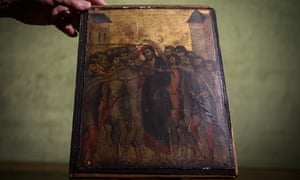
A Renaissance masterpiece is discovered in a kitchen in France. It was directly above a hotplate. Christ Mocked, by the 13th-century artist Cimabue, who taught Giotto, is estimated to be worth €4m-€6m (£3.5m-£5.3m). The work had for years gone unnoticed in the house of a woman in her 90s near the northern French town of Compiègne. It had been hanging between her open-plan kitchen and her living room, arousing little interest from the family, who assumed it was a standard religious icon. Although it was placed directly above a hotplate for cooking food, the picture was in good condition.
Has the word “evangelical” lost its meaning? Alan Jacobs argues it has in a review of Thomas Kidd’s new book, Who Is an Evangelical? The History of a Movement in Crisis.
While traversing frigid Arctic waters, a Russian Navy vessel met its match — a mighty mother walrus defending her calves. Battered by the tusked mammal’s attacks, the tugboat Altai sank into the sea, according to the Russian news outlet The Barents Observer. Luckily, the boat’s crew of Navy service members and researchers made it safely ashore on a smaller vessel.
Do we need semicolons?Yes, says Joseph Epstein. Do we need a whole book about semicolons? Apparently. Epstein reviews Cecelia Watson’s book Semicolon:
The short-story writer , Donald Barthel medescribed the semicolon as ‘ugly, ugly as a tick on a dog’s body.’ In the standard definition a semicolon is a stop of greater emphasis and duration than that of a comma but less than that of a period. A bit vague, hazy, this, is it not? “Do not use semicolons” was Kurt Vonnegut’s position on the matter. ‘They are transvestite hermaphrodites representing absolutely nothing. All they do is show you’ve been to college.’
Are UFOs real? In 2017, footage from Navy planes showing “unexplained aerial phenomena” were leaked online. Last week, the Navy confirmed that the footage was real and unedited. But no one seems to care: “If, like me, you claim unofficial membership in the League of Enthusiastic Americans with Slightly Overactive Imaginations, the past few weeks have brought both exciting and weird news. Here’s the exciting: The United States Navy has basically admitted that UFOs are real. Here’s the weird: Very few people seem to care.”
I’m sure KLM meant well. But two of the passengers in this scenario better hope for a smooth ride…
Megatrump supporter pastor Robert Jeffress displays his exegetical chops: “God said he created the environment to serve us, not for us to serve the environment. This Greta Thunberg, the 16 year-old, she was warning today about the mass extinction of humanity. Somebody needs to read poor Greta Genesis chapter 9 and tell her the next time she worries about global warming, just look at a rainbow; that’s God’s promise that the polar ice caps aren’t going to melt and flood the world again.”
If I ever become an atheist it’s because of pastors like this.
Or “prophets” like Mark Taylor. “God’s been showing me something,” Taylor said this week, claiming that an elevator in the Washington Monument getting stuck and an instance in which Pope Francis was trapped in an elevator earlier this month were both “prophetic signs.”
“We all know the Washington Monument is a phallic symbol to Baal built by the Freemasons,” he said. “We all know the Vatican is demonic.”
“What does an elevator actually mean? An elevator means a change in the anointing. Now this is a huge sign, guys, a huge prophetic sign that the Washington Monument—which represents Freemasonry, Illuminati, all these things that we are battling against right now—it stopped. It’s a change in the direction of that so-called power.”
“Now, let’s go back to the Vatican. The Pope’s on there. It stops. It’s losing power. It stopped because of a loss of power, guys. This is huge! This is a huge prophetic sign that says the Pope has lost power and so his so-called anointing from the dark side has now changed. This is a huge sign for everyone.”
Do you remember a study that came out in 2015, which showed that people who grew up in religious households were less generous than those who grew up in non-religious ones. The paper got a lot of attention, being covered by over 80 media outlets. Turns out it was wrong: “Another scholar, Azim Shariff, a leading expert on religion and pro-social behavior, was surprised by the results, as his own research and meta-analysis (combining evidence across studies from many authors) indicated that religious participation, in most settings, increased generosity. Shariff requested the data to try to understand more clearly what might explain the discrepancy.” The culprit? A coding error.
Though I’m sure that all 80 of those media outlets will report the mistake…
Why are we fascinated by twins? Helena de Bres, a twin herself, speculates:
In placing pressure on our usual understanding of where one self stops and another starts, such stories raise an interesting philosophical question. What determines how many people exist right now? We tend to assume a one-to-one relationship between persons and bodies. But approaching the question that way might result in under or overcounting, as the case of twins suggests. One possibility is that two (or more) people might share a single body. Conjoined twins are a real-life instance. In myth, we have Hercules, who intermittently took his mortal twin brother’s place after Iphicles’ death, sometimes appearing as a human, other times as a god. Another possibility is that a single person might be distributed across two (or more) bodies.
The fascination comes from another, opposite source as well. We may tell ourselves that proper human relationships retain a healthy degree of differentiation and separation. But many of us are also, despite ourselves, drawn to the contrary fantasy of the ideal relationship as a kind of merger: one soul, as Aristotle put it, spread over two bodies. We generally reserve this ideal for sexual relationships—“Nelly,” Cathy wails, “I am Heathcliff!”—yet surely part of what captivates us about twins is that they seem to embody it too. Arguably, they embody it more purely. Maybe one reason soul-mate twins have to die in literature is that they make singletons morbidly envious.
This seems like a good enough excuse to throw some funny twin pictures your way:
The three hardest things to say:
1. I’m sorry
2. I need help
3. Worcestershire Sauce
A transgender man from Kent who gave birth with the help of fertility treatment cannot be registered as his child’s father, the most senior family judge in England and Wales has ruled. Freddy McConnell, 32, who has lived as a man for several years but retained his female reproductive system and gave birth in 2018, went to court after a registrar insisted he was recorded as the baby’s mother on the birth certificate despite holding a gender recognition certificate that made it clear the law considered him male.
Sir Andrew McFarlane, the president of the high court’s family division, ruled on Wednesday that motherhood was about being pregnant and giving birth regardless of whether the person who does so was considered a man or a woman in law.
“Being a ‘mother’ or a ‘father’ with respect to the conception, pregnancy and birth of a child is not necessarily gender specific,”
“There is a material difference between a person’s gender and their status as a parent. Being a ‘mother’, whilst hitherto always associated with being female, is the status afforded to a person who undergoes the physical and biological process of carrying a pregnancy and giving birth.
“It is now medically and legally possible for an individual, whose gender is recognised in law as male, to become pregnant and give birth to their child. Whilst that person’s gender is ‘male’, their parental status, which derives from their biological role in giving birth, is that of ‘mother’.”
Conservative theologian David Bentley Hart recently published, That All Shall Be Saved: Heaven, Hell, and Universal Salvation. It makes the case for universalism. Douglas Farrow reviews it in First Things. It is a long article, and very informative. Well worth the time to read. I just want to bring out one relevant question for our discussion:
Hart harrows “hell” with panache. And do not fault him for falling carelessly into that “error about mercy” that Augustine rejects, an error “based on human sentiment” (Augustine’s words) that sets mercy against justice. Hart is indeed sentimental, viscerally sentimental, in embracing what Augustine rejects and rejecting what Augustine embraces, but there is nothing careless about it. He thinks it right and just to do so.
On the other hand, he does not address the vital question as to whether, and how far, fallen creatures can trust their visceral feelings and instincts to guide them.
Fair question. What are your thoughts?
So, this is a real thing…
Yes, that’s right, friends. Now you can enjoy the savory aroma of highly processed and gelatonized pork scraps mixed with pumpkin and cloves! Hormel even released an assortment of recipes for the Pumpkin Spice Spam. The recipes include a Pumpkin Spice Spam grilled cheese, Pumpkin Spice Spam waffles, and Pumpkin Spice Spam fall vegetable hash.
Well, that’s it for this Saturday. Let’s end with some photos of the week, courtesy of the Atlantic.
ANTALYA, TURKEY – SEPTEMBER 22: Scuba divers explore a model tank from 1960 after it submerged 20 meters underwater off the coast of the Mediterranean seaside resort of Kas in Turkey’s Antalya province, to serve diving tourism, on September 22, 2019. (Photo by Huseyin Yildiz/Anadolu Agency via Getty Images)Aerial photo taken on Sept. 15, 2019 shows eco-aged geese and blooming golden trees in sihong county, east China’s jiangsu province.- PHOTOGRAPH BY Costfoto / Barcroft Media (Photo credit should read Costfoto / Barcroft Media / Barcroft Media via Getty Images)University students take part in a protest outside the governor’s office in Padang, West Sumatra province, Indonesia, September 24, 2019 in this photo taken by Antara Foto. Antara Foto/Iggoy el Fitra/ via REUTERS ATTENTION EDITORS – THIS IMAGE WAS PROVIDED BY A THIRD PARTY. MANDATORY CREDIT. INDONESIA OUT. – RC11B64A4BE0Participants dressed in traditional attire pose for pictures during rehearsals for Garba, a folk dance, in preparations for the upcoming Navratri, a festival during which devotees worship the Hindu goddess Durga, in Ahmedabad, India, September 25, 2019. REUTERS/Amit Dave TPX IMAGES OF THE DAY – RC134467DD00A polka-dotted zebra foal stand close to its mother at the Masai Mara game reserve in Kenya on September 19, 2019. – Antony Tira, a Maasai guide who first spotted the foal, named him Tira. Tira has a condition called pseudomelanism, a rare genetic mutation in which animals display some sort of abnormality in their stripe pattern. (Photo by Yasuyoshi CHIBA / AFP) (Photo credit should read YASUYOSHI CHIBA/AFP/Getty Images)A newly-hatched baby sea turtle makes its way into the Mediterranean Sea for the first time, as part of the Israeli Sea Turtle Rescue Center’s conservation programme, at a beach near Mikhmoret north of Tel Aviv, Israel September 9, 2019. Picture taken September 9, 2019. REUTERS/Amir Cohen – RC1A40F65BB0HANGZHOU, CHINA – SEPTEMBER 22: Tourists, sitting in a chili-covered pool, participate in a chili pepper eating contest at Song Dynasty Town (Songcheng) on September 22, 2019 in Hangzhou, Zhejiang Province of China. (Photo by Lian Guoqing/VCG via Getty Images)Kids from Tembe indigenous tribe, who are facing a conflict with illegal loggers on their land, play at Gurupi River in Teko-haw indigenous village near Paragominas, Para state, Brazil September 10, 2019. Picture taken September 10, 2019. REUTERS/Ricardo Moraes – RC18452EC5A0BEAUMONT, TX – SEPTEMBER 20: An armadillo swims toward a boat as it struggles in the flooded waters on highway 124 on September 20, 2019 in Beaumont, Texas. Gov. Greg Abbott has declared much of Southeast Texas disaster areas after heavy rain and flooding from the remnants of Tropical Depression Imelda dumped more than two feet of water across some areas. (Photo by Thomas B. Shea/Getty Images)Birds sit in their cages during the annual bird-singing competition in Thailand’s southern province of Narathiwat on September 22, 2019. – Over 1,800 birds from Thailand, Malaysia and Singapore took part in the contest. (Photo by Madaree TOHLALA / AFP) (Photo credit should read MADAREE TOHLALA/AFP/Getty Images)A CZ-3B carrier rocket blasts off at the Xichang Satellite Launch Center in Xichang in southwest China’s Sichuan province early Monday, Sept. 23, 2019, to send the 47th and 48th Beidou navigation satellites into the orbit. (Photo credit should read ZHANG WENJUN / Barcroft Media via Getty Images)A frog is pictured on the leaf of a lotus after the rain at a pond in Lalitpur, Nepal September 26, 2019. REUTERS/Navesh Chitrakar – RC158F995760
In his book, Contact, Carl Sagan satirically asks why God doesn’t place a glowing cross in the sky at night to serve as irrefutable proof of Jesus’ resurrection. One could just as well ask why God doesn’t set up a website, or place billboards around. Why must we read and understand an ancient book to know God? Bertland Russell, the famous British atheist, once was asked what he would say, if, after his death, he came face to face with the God he had denied in life. Russell’s response: “Not enough evidence”.
This is not just a question for non-believers. As Christians, surely we all wonder why the evidence for God can be denied. Doesn’t God want us to all know Him? Then why doesn’t He make himself more obvious? Why doesn’t he shout from heaven? We certainly agree with Moses’ statement, “You are a God who hides himself”, but we usually have no clue why.
I think the answer to that is in understanding the difference between faith and knowledge, and why God desires faith.
Briefly, knowledge is the intellectual knowledge of what is (yes, I am aware of the different debates about knowledge, but am not going to get into them here, as they do not affect my main point). Faith is a little more difficult to define. I define it this way: Faith is choosing, for good but not unassailable reasons, to believe something is true, and then acting on that belief. This seems to me the definition most inline with the New Testament word (pistis in Greek) which is translated faith, belief, or trust. Notice a couple things about this definition:
First, it is a belief that has consequences. It is not a trivial thing, for this type of faith affects important choices (unlike, say, the belief that Van Gogh is better than Monet, or that the sun is around a million times the size of the earth).
Secondly, it is based on reason and evidence, but it is not compelled by them. That is, it is not against reason or evidence, but may sometimes go beyond them. I believe my spouse is faithful to me, not because I can prove it by evidence (I don’t have her video-taped 24/7) but because it is consistent with what I do know of her and our life together.
Third, to some degree, it is a choice. I have no real choice in believing that snow is cold, or that the chair I am sitting in is black. Unless I want to deny my sense experience, the belief is forced upon me. Nor can my belief that two plus two equals four be a faith decision; it is self-evident and irrefutable. But faith can only be cultivated in doubtful soil.
Now, if this is so, then we may begin to see why God makes faith our only acceptable response to Him: Since faith is a choice, it involves moral, and not just intellectual, implications. It is a whole-person decision. That is, to some degree, I will choose not just whether there is a God or not, but if I want there to be a God or not. This is not to imply faith has no intellectual content, but to affirm that is also has moral content. Reason can lead me to the water, but it can’t make me drink. I still must choose.
C. S. Lewis claimed hell is locked from the inside. The believer says to God, “I want you”, the unbeliever says, “I don’t want you”, and God says to them both, “Your will be done”. Or Blaise Pascal: “In faith there is enough light for those who want to believe and enough shadows to blind those who don’t…”. I hasten to clarify that I would not claim that everyone who does not believe in God does not want to; I’m not in their shoes. My main point is that faith in God must be a choice, not a deduction, else it is not really faith; and only the hiddeness of God allows that choice to be real.
Finally, we should also stop to ponder the question of what effect it would have on our faith if God was more obvious, and his ways shown with certainty to be true. For example, why doesn’t God automatically and visibly reward each act of faith and obedience? Every time I refuse some tempting sin, or every time I obey Him, why doesn’t He boom from Heaven, “Good job!”, and send down a twenty dollar bill (or solve whatever problem is bothering me)?
When put in terms like these, it is easy to see how this would distort our relationship with God. We would be treating Him as an object, something we manipulate for our own gain. Faith here would not only be stunted, but warped.
The example of Israel may be instructive here. If ever God was obvious, it was in His dealings with the Israelites, especially in the early years under the leadership of Moses. Just think: they saw the plagues on Egypt. They experienced the crossing of the Red Sea. They heard God thunder from the top of Mt. Sinai. In fact, the last verses of Exodus tell us that the visible sign of God’s presence was always with them:
In all the travels of the Israelites, whenever the cloud (representing God’s presence) lifted from above the tabernacle, they would set out; but if it did not life, they did not set out – until the day it lifted. So the cloud of the Lord was over the tabernacle by day, and fire was in the cloud by night, in the sight of all the house of Israel during all their travels. (Exodus 40: 36-38).
God certainly could not have been much clearer than that. Yet, the faith and obedience of the Israelites in the desert was anything but exemplary. Philip Yancey notes:
I also noticed a telling pattern in the Old Testament accounts: the very clarity of God’s will had a stunting effect on the Israelite’s faith. Why pursue God when He had already revealed Himself so clearly? Why step out in faith when God had already guaranteed the results? …In short, why should the Israelites act like adults when they could act like children? And act like children they did, grumbling against their leaders, cheating on the strict rules governing manna, whining about every food or water shortage. (Disappointment with God)
On the contrary, when God wanted to raise up David as His ideal King (thus representing His people) He did so by often seeming silent and even unfair (just check out the Psalms). In short, God knows what He is doing with us, and His silence and hiddeness have purpose.
Image: Artist’s representation of Venus with water.
Was Venus Habitable?
This article speculates that at some time in the past, Venus may have been somewhat temperate and could have had liquid water oceans. Currently, the thick atmosphere is almost entirely carbon dioxide, at a crushing pressure 93 times as at sea level on Earth. The average temperature is 460°C (860° F, hot enough to melt lead) planet-wide and even at night, because this heat is carried around the planet. There is no oxygen and no liquid water, and only the smallest trace of water vapor. Current Venus landers can only operate on the planet’s surface for a few hours due to the extreme atmospheric conditions. But it might not have always been that way, the article says:
The hellish planet Venus may have had a perfectly habitable environment for 2 to 3 billion years after the planet formed, suggesting life would have had ample time to emerge there, according to a new study. In 1978, NASA’s Pioneer Venus spacecraft found evidence that the planet may have once had shallow oceans on its surface. Since then, several missions have investigated the planet’s surface and atmosphere, revealing new details on how it transitioned from an “Earth-like” planet to the hot, hellish place it is today. It’s believed that Venus may have been a temperate planet hosting liquid water for 2 to 3 billion years before a massive resurfacing event about 700 million years ago triggered a runaway greenhouse effect, which caused the planet’s atmosphere to become incredibly dense and hot.
At NASA’s Goddard Institute researchers ran 5 different simulations based on various levels of ocean coverage. All of the simulations indicated that Venus may have been able to maintain stable temperatures ranging from 68° to 122° F for a period of 3 billion years. That would have enough for at least simple life to have formed.
Siberian Traps Basalt
The “resurfacing event”, they speculate, was massive volcanic outgassing of carbon dioxide. Something similar occurred on Earth at the end of the Permian period – 252 million years ago. That is known as the Permian Extinction where maybe 90% of life on the planet went extinct. The cause of the Permian Extinction is suspected to be volcanic activity related to the Siberian Traps, a caldera or series of calderas that erupted on a massive scale releasing huge amounts of carbon dioxide into the atmosphere and causing runaway greenhouse effect. There is some evidence that average global temperatures during the PE was as high as 140° F and ocean temperatures as high as 104° F.
In the September issue of National Geographic there was an article on the thawing of the arctic permafrost. The article says:
…researchers now suspect that for every one degree Celsius rise in Earth’s average temperature, permafrost may release the equivalent of four to six years’ worth of coal, oil, and natural gas emissions—double to triple what scientists thought a few years ago. Within a few decades, if we don’t curb fossil fuel use, permafrost could be as big a source of greenhouse gases as China, the world’s largest emitter, is today.
The question raised by all these articles is the Earth headed for similar runaway greenhouse effects that could bring a Venusian or Permian type catastrophe? I am still processing this information and have not come to any firm conclusions about what I believe or the level of alarm I should have. I have two questions that I would like to discuss today.
To what extent do you think the problem of climate change exists? Is it overblown, about the right amount of alarm, or worse than even now thought?
As people of faith, what should our response be?
I want to hear a range of opinions and the reasons you hold those opinions. Be civil – commence discussion…
Okay, I know you want to talk about this, and rightly so. And since I would rather not the other posts this week hijacked in the comments thread, I am putting out a second post today.
My opinion on this is no more informed than anyone else’s, so I am just going to copy some relevant links that the New York Times Daily Briefing sent me, and the rest is up to you. I would only ask that you seek to make your comments Jesus-shaped, as much as is possible on a political issue.
Speaker Nancy Pelosi accused President Trump on Tuesday of betraying the country as she announced that the Democratic-led House would begin a formal impeachment inquiry.
Ms. Pelosi had been reluctant to start the process because of the likely political consequences, but she said that revelations about Mr. Trump’s dealings with Ukraine and his administration’s stonewalling of Congress had left the House no choice.
Mr. Trump is accused of pressuring the Ukrainian president to open a corruption investigation into Joe Biden and his son during a phone call in July. Mr. Trump has said that the call, shortly after he froze nearly $400 million in aid to Ukraine, was “totally appropriate.” He promised to release a transcript today.
Related: The call is said to be part of a whistle-blower complaint by a member of the intelligence community. Officials were working on Tuesday to release a redacted version of the complaint and let congressional investigators speak to the whistle-blower.
Response: Mr. Trump said the impeachment battle would be “a positive” for his chances of winning a second term next year.
The details: Here’s where every House member stands on impeachment and how the process works. (Only two presidents, Andrew Johnson and Bill Clinton, have been impeached, and both were ultimately acquitted. Richard Nixon resigned in 1974 to avoid being impeached.)
What’s next: Ms. Pelosi is said to have told the six House committees that are investigating Mr. Trump to send their best cases on potentially impeachable offenses to the Judiciary Committee, although she has not provided a timeline.
News analysis: “In contrast to the murkiness of the special counsel’s report on Russian interference in the 2016 election and possible obstruction of justice by Mr. Trump, Democrats see the current allegations as damningly clear-cut,” our chief Washington correspondent writes.
Perspectives: Debatable, a newsletter from our Opinion section, has points of view from across the political spectrum on when it’s right to impeach.
“There are two kinds of people,” she once decreed to me emphatically. “One kind, you can tell just by looking at them at what point they congealed into their final selves. It might be a very nice self, but you know you can expect no more surprises from it. Whereas, the other kind keep moving, changing. With these people, you can never say, ‘X stops here,’ or, ‘Now I know all there is to know about Y.’ That doesn’t mean they’re unstable. Ah, no, far from it. They are fluid. They keep moving forward and making new trysts with life, and the motion of it keeps them young. In my opinion, they are the only people who are still alive. You must be constantly on your guard, Justin, against congealing. Don’t be lulled by your youth. Though middle age is the traditional danger point, I suspect that many a fourteen-year-old has congealed during the long history of this world. If you ever feel it coming, you must do something quickly. . . .”
Gail Goodwin, The Finishing School
I ran across this quote today from a commentary on 1 Samuel, of all places. Walter Bruegemann used it to warn against the danger of thinking our interpretation of a text is ever complete, so that it can no longer surprise us. But the quote hit me on a foundation level, about my own life.
“You must be constantly on your guard against congealing…If you ever feel it coming, you must do something quickly.”
Hmmm. This gives me a LOT to think about. Have I congealed? Am I no longer evolving or really changing? Do I even want to anymore? And what it the world would it mean to “do something quickly”?
Do you have the same questions?
I don’t have answers, only the willingness to open the door for discussion.
Few stories about Jesus are more misunderstood than his clearing of the temple.
On the one hand, many people see the act, and the cursing of the fig tree which accompanies it, as little more than a burst of anger, seemingly unworthy of a great teacher and model like Jesus. The noted atheist Bertland Russel accused Jesus of “vindictive fury” against the tree, and felt it tarnished his reputation.
On the other hand, many Christians interpret the clearing of the temple as Jesus’ assault on the financial corruption of the temple authorities, or as a warning not to commercialize holy ground.
Both these viewpoints are mistaken. Jesus did not act in a fit of rage, but with great foresight and meaning. And his point was not to warn against commercializing religion, but to judge “temple religion”. I will attempt to prove both these points by examining the context, the actions of Jesus, and the words of Jesus (especially his two Old Testament quotations) from Mark’s account (in Mark 11:1-12:12).
The Context
Chapter 11 begins a new division in the book of Mark; Jesus arrive in Jerusalem for the passion week, and the rest of the book is set in that city (and especially in the temple). Here is the flow of the narrative”
11:1-10 The Triumphal entry
11:11 Jesus examines the temple and its activities
11:12-14 The next morning Jesus curses the fig tree
11:15-19 Jesus clears the temple
11:20-21 The fig tree is seen and it has withered
11:20-26 Jesus teaches on prayer (and speaks of moving “this mountain”)
11:27-33 Jesus and the Jewish leaders argue Jesus’ authority to “do this”.
12:1-12 Jesus gives the parable of the vineyard and the tenants, denouncing the Jewish leaders.
It’s rather obvious that Jesus’ action at the temple is the central theme of this section; the way Mark sandwiches it between the two sections on the fig tree clearly links the two events together. Neither can be understood apart from the other.
The Clearing of the Temple
We will start, then, with the clearing, and work out from there. Mark 11:17 says:
On reaching Jerusalem, Jesus entered the temple area and began driving out those who were buying and selling there. He overturned the tables of the money changers and the benches of those selling doves, 16 and would not allow anyone to carry merchandise through the temple courts. 17 And as he taught them, he said, “Is it not written:
“ ‘My house will be called
a house of prayer for all nations’?
But you have made it ‘a den of robbers.
18 The chief priests and the teachers of the law heard this and began looking for a way to kill him, for they feared him, because the whole crowd was amazed at his teaching.
We should note the following things:
The passage says nothing about Jesus being in a rage. He used a corded whip to move the animals (who are notoriously bad at listening to reason) not to attack people (the Romans would have gotten involved if that had happened).
The emphasis is what on Jesus stopped: he stopped, for a day anyway, the buying and selling of animals which were used for the temple sacrifices and he stopped the conversion of money that was used for the temple offering. In other words, Jesus temporarily (and symbolically) ended the Temple operations.
The text emphasizes twice the teaching element of the scene; the temple authorities were not upset at some sort of violence on Jesus’ part, but the meaning of his action.
Jesus, in explaining his action, cites two texts from the prophets. The first (from Isaiah 56) describes what the temple was designed to be (a house of prayer for all nations, not just Jews) and what it had actually become (a den of thieves).
Jesus returns to the idea of prayer again in verses 22-25. Here we see that prayer can move “this mountain” (in context, the temple mount) into the sea. We also see that prayer is dependent, not on location (that is, at the temple) but on faith and forgiveness.
It becomes clear, then, that Jesus is taking action against the temple itself, and is not just upset that some people are buying in the temple courtyards. Why? The answer is explained in the two passages from the prophets that Jesus quotes to explain and justify his actions. The first is from Isaiah 56:
6And foreigners who bind themselves to the Lord
to serve him,
to love the name of the Lord,
and to worship him,
all who keep the Sabbath without desecrating it
and who hold fast to my covenant—
7these I will bring to my holy mountain
and give them joy in my house of prayer.
Their burnt offerings and sacrifices
will be accepted on my altar;
for my house will be called
a house of prayer for all nations.”
8The Sovereign Lord declares—
he who gathers the exiles of Israel:
“I will gather still others to them
besides those already gathered.”
Here the emphasis is clear: the temple is a place where God intends to draw “foreigners” and “all nations” to Himself. He will thereby gather other nations to Himself, besides those He has already gathered (Israel).
But this was not what was happening in the temple. In fact, a stone partition, a “dividing wall of hostility” (Ephesians 2:14-17) kept foreigners out of the main part of the temple, on pain of death. Instead of being a place where they could come and pray and worship Yahweh, it was now a painful reminder of their distance from Him.
The second quotation is even more damning. To understand what is meant by “den of thieves” we need to read the words in their context in Jeremiah 7:
This is the word that came to Jeremiah from the Lord: 2 “Stand at the gate of the Lord’s house and there proclaim this message:
“ ‘Hear the word of the Lord, all you people of Judah who come through these gates to worship the Lord. 3 This is what the Lord Almighty, the God of Israel, says: Reform your ways and your actions, and I will let you live in this place. 4 Do not trust in deceptive words and say, “This is the temple of the Lord, the temple of the Lord, the temple of the Lord!”5 If you really change your ways and your actions and deal with each other justly, 6 if you do not oppress the alien, the fatherless or the widow and do not shed innocent blood in this place, and if you do not follow other gods to your own harm, 7 then I will let you live in this place, in the land I gave your forefathers for ever and ever. 8 But look, you are trusting in deceptive words that are worthless.
9 “ ‘Will you steal and murder, commit adultery and perjury, burn incense to Baal and follow other gods you have not known, 10 and then come and stand before me in this house, which bears my Name, and say, “We are safe”—safe to do all these detestable things? 11 Has this house, which bears my Name, become a den of robbers to you? But I have been watching! declares the Lord.
12 “ ‘Go now to the place in Shiloh where I first made a dwelling for my Name, and see what I did to it because of the wickedness of my people Israel. 13 While you were doing all these things, declares the Lord, I spoke to you again and again, but you did not listen; I called you, but you did not answer. 14 Therefore, what I did to Shiloh I will now do to the house that bears my Name, the temple you trust in, the place I gave to you and your fathers. 15 I will thrust you from my presence, just as I did all your brothers, the people of Ephraim.’
This passage is a judgment against the people for misusing and perverting the temple. In particular, they were viewing it as some sort of talisman against God’s wrath, as if they could do whatever they wanted (steal, murder, commit adultery) and still be safe because they had “the temple of the Lord, the temple of the Lord, the temple of the Lord”. This gives background to the meaning of “den of robbers”. The point is that the den is where the robbers return after they have stolen, and find (they think) safety. The robbers are not robbing the den, but using the den as a safe house. So the condemnation of Jesus in the temple is not that the money changers were robbing the people, but that the religious authorities (and, no doubt, many of the common people) felt they could do whatever they wanted to do and yet they would be safe from God’s judgement because they had the temple. In that way, it had indeed become a “den of robbers”, a safe house for thieves.
Jesus then, quotes this passage from Jeremiah which announces that God will destroy the temple because of their perversion. If this seemed unthinkable, God reminds them that he let the tabernacle be destroyed in Shiloh. He is not bound by any building.
From the rest of the New Testament, we see that the temple is no longer needed because Jesus has fulfilled the symbolism of the temple, and, through His Spirit, has now reconnected his followers to God in a more profound way than the temple could ever afford; this is why he talks about our access to God in prayer in verses 22-25. Jesus stopped, temporarily and symbolically, that which He would soon stop completely.
The cleansing of the temple, then, is not a fit of rage, but “an acted parable” of the sort common to the prophets. We should view the cursing of the fig tree in the same light. It is also an acted parable, describing God’s anger at Israel’s unrighteousness. It also carries a warning to us.
The Cursing of the Fig Tree
As we have seen, the action about the fig tree sandwiches the temple clearing incident, and thus is closely related to it. Verses 12:-14 describe the first part:
12 The next day as they were leaving Bethany, Jesus was hungry. 13 Seeing in the distance a fig tree in leaf, he went to find out if it had any fruit. When he reached it, he found nothing but leaves, because it was not the season for figs. 14 Then he said to the tree, “May no one ever eat fruit from you again.” And his disciples heard him say it.
To explain the background, I will quote from the James Edwards in the Pillar New Testament Commentary (one of the best series, in my opinion):
After the fig harvest from mid-August to mid-October, the branches of fig trees sprout buds that remain undeveloped throughout the winter. These buds swell into small green knops known in Hebrew as paggim in March–April, followed shortly by the sprouting of leaf buds on the same branches, usually in April. The fig tree thus produces fig knops before it produces leaves. Once a fig tree is in leaf one therefore expects to find branches loaded with paggim in various stages of maturation. This is implied in 11:13, where Jesus, seeing a fig tree in full foliage, turns aside in hopes of finding something edible. In the spring of the year the paggim are of course not yet ripened into mature summer figs, but they can be eaten, and often are by natives (Hos 9:10; Cant 2:13). The tree in v. 13, however, turns out to be deceptive, for it is green in foliage, but when Jesus inspects it he finds no paggim; it is a tree with the signs of fruit but with no fruit.
The most puzzling part of the brief narrative of the cursing of the fig tree is the end of 11:13, “because it was not the season of figs.” This phrase is usually understood to exonerate the tree for not producing fruit since it was not yet the season. Understood as such, the phrase makes Jesus’ curse vindictive and irrational . . .But this is neither the only nor the best way to understand the phrase. It is better simply to distinguish between mature figs (Gk. sykē; Heb. te’enim) and early or unripe figs (Heb. paggim). The end of v. 13 might be paraphrased, “It was, of course, not the season for figs, but it was for paggim.”
In narrating the episode of Jesus and the fig tree Mark exploits its symbolic import, seeing in the curse of the tree the fate of Jerusalem and the temple. The prophets had often used the fig tree as a symbol of judgment (Isa 34:4; Jer 29:17; Hos 2:12; 9:10; Joel 1:7; Mic 7:1). In a scathing denunciation of Judah, Jeremiah says, “There will be no figs on the tree, and their leaves will wither” (8:13). Jesus, according to Luke (13:6–9), had in fact told a parable with the same image and point. Like the prophets who had on occasion dramatized a particularly trenchant message by action (Isa 20:1–6; Jer 13:1–11; 19:1–13; Ezek 4:1–13), Jesus dramatizes the end of the temple by an enacted parable. The leafy fig tree, with all its promise of fruit, is as deceptive as the temple, which, despite its religious commerce and activity, is really an outlaws’ hideout (v. 17). The curse of the fig tree is a symbol of God’s judgment of the temple.3
I think this is exactly right, and in line with the most ancient interpretation of the passage. The earliest commentary on the Gospel of Mark isby Victor of Antioch in the fifth century. Victor understood the event as an enacted parable, in which the cursing of the fig tree symbolized the judgment to befall Jerusalem.
This theme of judgment because of the lack of expected fruit is amplified in the section which ends this division of Mark, the parable of the vineyard:
He then began to speak to them in parables: “A man planted a vineyard. He put a wall around it, dug a pit for the winepress and built a watchtower. Then he rented the vineyard to some farmers and went away on a journey. 2 At harvest time he sent a servant to the tenants to collect from them some of the fruit of the vineyard. 3 But they seized him, beat him and sent him away empty-handed. 4 Then he sent another servant to them; they struck this man on the head and treated him shamefully. 5 He sent still another, and that one they killed. He sent many others; some of them they beat, others they killed.
6 “He had one left to send, a son, whom he loved. He sent him last of all, saying, ‘They will respect my son.’
7 “But the tenants said to one another, ‘This is the heir. Come, let’s kill him, and the inheritance will be ours.’ 8 So they took him and killed him, and threw him out of the vineyard.
9 “What then will the owner of the vineyard do? He will come and kill those tenants and give the vineyard to others. 10 Haven’t you read this scripture:
“ ‘The stone the builders rejected
has become the capstone;
11the Lord has done this,
and it is marvelous in our eyes’?”
12 Then they looked for a way to arrest him because they knew he had spoken the parable against them. But they were afraid of the crowd; so they left him and went away.
We must be thick indeed not to get the meaning of this parable after all the above. It fits in exactly the context preceding. After two enacted parables (the fig tree and the temple) Jesus finally gives an oral parable, with the same message of judgment on God’s people (especially the leaders) because they have not produced righteous fruit.
A Conclusion and a Warning
The conclusion is this: Jesus did not “lose it” in a fit of rage when he cursed the fig tree and cleared the temple. He, like the prophets before Him, enacted parables of judgment and warning. He did this, moreover, at the beginning of the passion week, where he had come “to give his life as a ransom for many” (10:45). The followers of Jesus, like blind Bartimaeus (10:46-52) are given new vision by trusting in Jesus. They no longer need the temple and its regulations; they now have access to God by Jesus, and exercise that access by faith in prayer (11:22-25).
But implicit in all this is a warning: God expects His people to grow in righteousness, not use their religion to cover up their sins. Not that we would ever do that today…
By the way, here is N.T. Wright on the meaning of the temple clearing:
Monday with Michael Spencer: September 23, 2019 Mom’s Money
My parents were always poor. They came from poor people. They lived through the Depression. The first house I remember was small, run down and drafty. Dad never was able to stay with a good job for very long, then his health broke down and he was disabled. He worked nickle and dime jobs, but never made any money.
Mom always worked for the family. She baby sat, took in laundry, and eventually took on a part time job in a warehouse where she worked for more than twenty years. We survived because of mom’s hard work and my parent’s depression era thriftiness.
I never thought much about this as a kid. I knew that other kids had more — lots more — but I always had a bike and the toys I wanted. When I was into Daniel Boone, my parents got me the appropriate toys to pretend I was a frontiersman. They weren’t as expensive or as authentic as my friends’, but they were adequate. I always had a suit for Sunday, and my shoes were shined. My folks were “poor but proud.”
When I was twelve, my parents moved to another house. It wasn’t as run down or in the obvious category of an almost-shack. It was very, very small. Dad put my room in the basement, which was kind of creepy, but at least gave me a room of my own. It never occurred to me that I really didn’t have a room (the basement wasn’t finished.) I would go to sleep at night with the radio on to keep me company, and if it got too loud, dad would stomp on the floor and tell me to turn it down.
This tiny house was near the hospital, and I realized at some point that dad had bought the house with the hope that the hospital would want the property. He was right.
When I was 15, the hospital started buying up our block. Dad held out longer than almost anyone, and sold the house for a very good profit. It was the one and only time in our life that we had money.
I never saw the money, but I knew it was there. My parents were excited. Their ship had come in. They bought a house in the south end of town; a nice ranch style suburban house. Still pretty small, but considering where we started out, it was palatial. It was a nice neighborhood. We had a real yard that we could enjoy. I had a room that I could bring friends to. The front room had a big window looking out to the street. My parents loved that house, and lived there the rest of their married lives.
Denise and I married, and for years we would visit that house. We had a hide-a-bed in the den. Our kids were born, and slept out there with us. We loved the house, too. It was special because our family never really deserved it.
Dad died in 1993, and mom decided immediately to sell the house and move into a senior adult high rise. The sale didn’t take long, and the profit was, of course, very good. Mom now had some money in the bank, and she took good care of it for the rest of her life.
My mother never spent money — except on her favorite restaurants. She “shopped” at garage sales and thrift stores. The values she grew up with in stark poverty and through the depression were the values she lived out when she didn’t have to any more. She didn’t ever buy a new dress. She never took a cruise or a vacation. She put her money away.
Well…she tithed to her church, and she never let me leave her presence without giving me $20. In fact, when we were driving her to the hospital with the bleeding stroke that took her life, she kept trying to get into her purse and give me money in case I needed it at the hospital.
What did mom do with the money? She put it in CDs. She split it up, and put aside a good bit for each of my kids (her only two grandchildren.) When each graduated, they received the CD and interest. The rest of the money from the house went into a money market account, and there it stayed.
Mom always wanted to know where that money was. Was it OK? Would it be there if she had to go in a nursing home? Could I get to it if I needed to?
Mom passed away in July of this year. One of the last things I did after the funeral was go to the attorney’s office and start the process of making mom’s money — the house money she’d kept all those years — and making it my money.
The process took several weeks, but finally all was in place. I wrote the insurance companies first. Mom had all of $4000 in insurance. If she had taken those premiums and invested them, she’d have been rich, but she trusted the Prudential. Oh well.
Then I wrote Transamerica, and within a few days, the money market fund with all of mom’s money was in my hand. I looked at it. And I thought about what I was holding.
My parents dreamed, worked and sacrificed for this moment. A year before he died, my dad had given me a generous lump sum that he had saved $100 at a time to pass on to me. It was in $100 bills, wrapped in aluminum foil in a tackle box. Dad didn’t trust banks. I remember once when he buried a wad of cash in a coffee can under a rock in the back yard.
Now here was the rest of my parent’s money. Here was mom’s money that she never spent; the money she saved for her son; her one and only boy that had almost killed her coming into the world. I held in my hand all the money my mom had in the world.
I took it to the bank and put it in my account. It was mine now. I never worked for it. I never sacrificed for it. I never did without to have it. I never earned a dollar of it. It was a gift. My mom’s money, given to me because she had passed on, was now mine to do with as I pleased.
I’ve got the number of two good mutual funds.
Why am I telling you this story? To extol the values of my parent’s generation? To be nostalgic about what kind of people God gave me as family? To shame those of us who can’t save a dollar and are 14k in credit card debt and sinking? (That last one isn’t a bad idea.)
No, I am writing this to share the Gospel with you. The Good News of Jesus and his salvation.
II Corinthians 8:9 For you know the grace of our Lord Jesus Christ, that though he was rich, yet for your sake he became poor, so that you by his poverty might become rich.
Ephesians 1:7 In him we have redemption through his blood, the forgiveness of our trespasses, according to the riches of his grace, 8a which he lavished upon us…
Ephesians 2:4 But God, being rich in mercy, because of the great love with which he loved us, 5 even when we were dead in our trespasses, made us alive together with Christ, by grace you have been saved, 6 and raised us up with him and seated us with him in the heavenly places in Christ Jesus, 7 so that in the coming ages he might show the immeasurable riches of his grace in kindness toward us in Christ Jesus. 8 For by grace you have been saved through faith. And this is not your own doing; it is the gift of God, 9 not a result of works, so that no one may boast.
God does not give us a plan for earning salvation. He has one and only one plan: grace. Jesus Christ has the riches of his father. The riches of God’s love, acceptance and salvation. The riches of adoption. The riches of forgiveness. The riches of eternal security. The riches of heaven.
God will not be an employer. He is glorified and takes pleasure in giving his riches to us. He gives some of them to every person in common grace, but to those who have faith in Jesus, his son, God gives all of his riches.
Jesus has inherited all the riches of his Father, and now, at the Father’s command, and to fulfill the Father’s purpose, pleasure and desire, Jesus will give all those riches into the account of bankrupt, undeserving, rebels who have spent their lives living as if God and his Son were worthless.
God gives his riches in grace to those who believe, but he can only give them when his Son dies, and passes on, in the New “Testament/Covenant,” those riches to the family. We are the brothers, sisters and family of Jesus. His inheritance is now ours. Undeserved, but ours none the less.
Just as I deposited my mom’s money into my account, and that money became mine, so the salvation, the righteousness and the riches of Jesus Christ are credited to your account when you let go of the worthless treasures of this world, and declare your bankruptcy apart from God’s free gift of the greatest treasure of all: his Son.
An auditor would know that mom’s money was not generated or earned by me. That auditor would know that I came into possession of that money by grace. But the money is in my account. It is mine. It can pay my debts. It can do what money is meant to do, and it will do it for me. I am not just the recipient of kindness; I am the recipient of the gift of righteousness.
And he (Abram) believed the Lord, and he counted it to him as righteousness. Genesis 15:6.
Jerry Bridges says the Christian life is a life of perpetual bankruptcy. I prefer to say we live in a state of perpetual inheritance. Never are we anything in and of ourselves, but only by the gracious gift of God, I have on my account the wealth of heaven itself, given to me as a gift.
This little analogy isn’t perfect. Theologians will pick it apart on the specifics. As an analogy, it’s far from perfect. That’s ok. It communicates to me the great gift of God. My parents showed me what God is like through their generosity. I have the opportunity to live the same way. It is not just receiving grace, but living grace, that makes us followers of Jesus. We are, as John Piper says, always standing under the fountain of God’s gracious giving to his children. From that, we should become gracious people who treat others with the love and generosity of God.
What can I do with mom’s money? Whatever I want. How does this gift from my mother change what I want to do with it? Don’t look for any new sport’s cars or cruises. No…I want to be, as much as possible, as good a husband and father as my folks were, so this money is a gift, but also a test and an opportunity.
So the grace of God in salvation is a gift, but also a demand, and an opportunity for God to be glorified even more as grace has more and more affect in the world.
I’ll never think of the money in my account as mine, even though it is counted as mine. I’ll always know it was mom’s, and came to me by her love for me. I also hope I’ll always think of these worldly things as an illustration of the greatest treasure of all: the Gospel.
Sunday with Walter Brueggemann On Changing the Subject
The test and norm is the reality of Jesus. Look at Jesus, because Jesus confronts all the throne talk of the world. You want to know about joy, and well-being, and truth, and goodness. Look at Jesus. Not being served, but serving. I have no doubt that the world depends on Jesus. I have no doubt that on a day-to-day basis, the world depends on the Jesus people who give their lives. What else would you do but give your life? Would you keep and save your life and let it grow sour? No, give it as a ransom. Think this day about being in another conversation, another community, another cup, another baptism. We are at a crucial moment in our society. In this moment, we are given a glimpse of a more excellent way. Local churches, local conversations, local servanthood, local giving, local cups to drink, local baptisms to live, local ways of being faithful and joyous, local ways of power for life. The story in Mark 10:35–45 begins with greedy thrones. By the end of the story, the subject is changed. Now the subject is servanthood and healing and ransom. What a way to be first and great! Come and have your subject changed.
Hello, friends, and welcome to the weekend. Ready for brunch?
You know what’s funny? The pictures from Comedy Wildlife Photography Awards. You know what’s funnier? Those same pictures mashed with Shakespeare quotes.
The awards are now in their fifth year. Last week we showed some of the 40 finalists for 2019. This week I would like to intersperse some of the pictures from that site, along with captions taken from the Bard. Because…why not? let’s start with these two:
This is cool: scholars believe they have found John Milton’s annotated copy of Shakespeare’s First Folio: “The astonishing find, which academics say could be one of the most important literary discoveries of modern times, was made by Cambridge University fellow Jason Scott-Warren when he was reading an article about the anonymous annotator by Pennsylvania State University English professor Claire Bourne. Bourne’s study of this copy, which has been housed in the Free Library of Philadelphia since 1944, dated the annotator to the mid-17th century, finding them alive to ‘the sense, accuracy, and interpretative possibility of the dialogue’. She also provided many images of the handwritten notes, which struck Scott-Warren as looking oddly similar to Milton’s hand.”
That reminds me of a joke I heard some years ago:
Jimmy had decided to take a year off before starting college and to hitchhike around Europe with a friend. After several weeks he called his dad to get him to send them more money .
“It’s been more expensive than I thought over here Dad”, Jimmy told his dad. “We got to Germany and we were dead broke.”
“Well, do you have any money to eat until I can get more money to you?” Dad asks.
“Yeah”, Jimmy replies. “We made a little money cleaning all the junk out of an old house for a guy. Man there were a lot of old papers and books and stuff in there. The guy said we could have anything of value we found, but it was all just junk.”
“Oh?” Dad says. “You didn’t find anything you could sell for a few Euros ?”
“Well, I almost kept this old bible that was in pretty good shape. It was really old. Published by some Gutenberg guy.” Jimmy says .
“Gutenberg! Son, that bible was worth hundreds of millions of dollars if it was in good shape!” Dad exclaims.
“Wow! Well, this one probably wasn’t worth that much” , Jimmy replies. “Some clown named Martin Luther had scribbled his notes all over the margins.”
Speaking of Paradise Lost, an undergraduate student has discovered a secret message in Milton’s epic poem. The hidden message is an acrostic, and spells out “FFAALL” and “FALL” — an appropriate triple-use of the word “fall,” as the poem’s subject is the Biblical story of the decline of Satan, as well as the banishment of Adam and Eve from the Garden of Eden.
*From his surmise prov’d false, find peace within,
*Favor from Heav’n, our witness from th’event.
*And what is Faith, Love, Virtue unassay’d
*Alone, without exterior help sustain’d?
*Let us not then suspect our happy State
*Left so imperfect by the Maker wise
*As not secure to single or combin’d.
*Frail is our happiness, if this be so
The asterisks mark the hidden message: Reading from top to bottom, Milton spelled out “FFAALL,” likely representing the double fall of humanity represented by Adam and Eve. Reading from bottom to top, the poet spelled out “FALL,” possibly a reference to Satan’s descent from Heaven.
The new acrostic was found by Miranda Phaal, a Tufts University senior. In August, Phaal published an article about her discovery in the journal Milton Quarterly.
“This acrostic entwines the double fall of man (FFAALL) with the fall of Satan (a single FALL, read from bottom to top), perhaps commenting on their shared inciter—Satan—or their shared root—pride, …Milton uses the acrostic to foreshadow what will happen to Adam and Even. Ultimately, the acrostic distills the entire poem down to its essence: three contingent falls, two paradises lost.”
Merriam-Webster has added a “non-binary” definition of “they,” and the Oxford Dictionaries are reviewing its definitions after receiving a petition demanding it eliminate all entries that “patronize” women. The dictionary is also being asked to “enlarge the dictionary’s entry for ‘woman’.” You see, the word “man” has 25 different usages, whereas “woman” only has five, and the petitioners are asking Oxford to increase the number of usages for “woman.” I’m not sure that’s how dictionaries work…
Want to burn 6,000 calories a day while barely moving? Play chess.
Robert Sapolsky, who studies stress in primates at Stanford University, says a chess player can burn up to 6,000 calories a day while playing in a tournament, three times what an average person consumes in a day. Based on breathing rates (which triple during competition), blood pressure (which elevates) and muscle contractions before, during and after major tournaments, Sapolsky suggests that grandmasters’ stress responses to chess are on par with what elite athletes experience.
“Grandmasters sustain elevated blood pressure for hours in the range found in competitive marathon runners,” Sapolsky says.
It all combines to produce an average weight loss of 2 pounds a day, or about 10-12 pounds over the course of a 10-day tournament in which each grandmaster might play five or six times.
Union Seminary in NYC is perhaps the best-known progressive, mainline seminary in the country, hosting such distinguished faculty as Dietrich Bonhoeffer in the past. Things got a little…unusual last week:
Today in chapel, we confessed to plants. Together, we held our grief, joy, regret, hope, guilt and sorrow in prayer; offering them to the beings who sustain us but whose gift we too often fail to honor.
Union took a little heat for this. The school responded with a long twitter defense, saying it was “a beautiful ceremony”, and concluding:
No one would have blinked if our chapel featured students apologizing to each other. What’s different (and the source of so much derision) is that we’re treating plants as fully created beings, divine Creation in its own right—not just something to be consumed. Because plants aren’t capable of verbal response, does that mean we shouldn’t engage with them? So, if you’re poking fun, we’d ask only that you also spend a couple moments asking: Do I treat plants and animals as divinely created beings?”
A few thoughts ran through my mind as I researched this one. Did the organizer of this chapel take Veggie Tales way too seriously? Could they not take the students outside, instead of snatching a few faculty office plants and throwing them in a pile of dirt? Coincidence there is no TULIP? And just what did they have for lunch after the chapel?
By the way, Bonhoeffer was not impressed with the students at Union during his time there. He wrote they “are completely clueless with respect to what dogmatics [theology] is really about. They are not familiar with even the most basic questions. They become intoxicated with liberal and humanistic phrases, are amused at the fundamentalists, and yet basically are not even up to their level.” Ouch. Wonder what he would have said about praying to plants…
The Far Sidereturns . . . online: “A new era of The Far Side, the newspaper strip by Gary Larson, is coming. Fans noticed over the weekend that the strip’s official website had been updated with a new cartoon and a message: ‘Uncommon, unreal, and (soon-to-be) unfrozen. A new online era of The Far Side is coming!’”
You may have noticed I don’t mention our current president too often in our brunches. You get enough of that other places, don’t you? But the Babylon Bee had an almost perfect satire article this week about a Trump stained glass window at Liberty University.
LYNCHBURG, VA—Liberty University has come under withering criticism after unveiling a Donald Trump stained glass window in the school’s newly renovated Worley Prayer Chapel.
The window is featured prominently in the chapel, allowing students and faculty to pray to their lord and savior Donald Trump as they escape the pressures and worries of campus life for a few minutes.
“We wanted the renovated prayer chapel to really help students think about what’s important: President Trump and His anointed agenda to make America great again,” said school president Jerry Falwell, Jr. “It’s important to remain focused and anchored. Now our students can take some time to reorient their hearts and spirits around Trump whenever they want.”
Falwell encouraged those attending Liberty University to turn their eyes upon Trump, “and the things of earth will grow strangely dim in the light of His glorious policies.”
One small window in the chapel is always open in the direction of Washington, D.C., so students can pray facing Trump.
While Trump’s stained glass window occupies the place of honor in the prayer chapel, the spot right in the center where the cross used to be, several other stained glass windows were installed along the walls of the chapel. These windows honor lesser icons of the Christian faith, such as the Republican elephant, the NRA, the wars in Iraq and Afghanistan, and Mike Pence. One particularly powerful piece beautifully depicts Trump’s Playboy magazine cover in exquisite colors.
Critics have questioned whether the move was appropriate.
“It seems like they may have gone a little too far here,” said one political pundit. “I mean, I get maybe having a small Trump statue or plaque in your place of worship, but a big stained glass window? It seems like that should be reserved for an American flag or something.”
Canadian Prime Minister Justin Trudeau was in the news, which is not unusual. But it was bad news: a photo emerged showing him wearing brownface at a party 18 years ago when he was a private school teacher.
Trudeau admitted to wearing the racist costume when he attended an ‘Arabian Nights’ themed gala at West Point Grey Academy – the private school in Vancouver where he was teaching at the time. He also admitted to wearing black makeup in high school to perform a version of African-American singer Harry Belafonte’s song ‘Banana Boat Song (Day-O)’ during a talent show.
Trudeau acknowledged that he had ‘always been more enthusiastic about costumes than is sometimes appropriate’. Which leads to jokes like this:
What are your thoughts on this, friends? On a scale of one to David Duke, how racist was this, and should it keep him from being re-elected? Should there be a “political statue-of-limitations”?
Well, that’s it for this week. Let’s end with a few more pics of animals quoting Shakespeare.




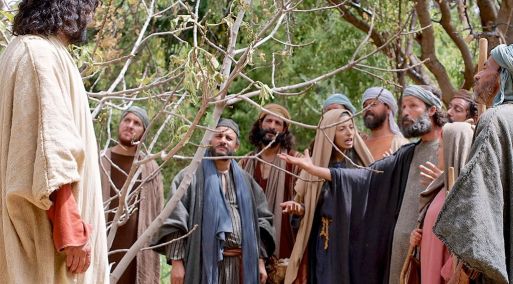


 The test and norm is the reality of Jesus. Look at Jesus, because Jesus confronts all the throne talk of the world. You want to know about joy, and well-being, and truth, and goodness. Look at Jesus. Not being served, but serving. I have no doubt that the world depends on Jesus. I have no doubt that on a day-to-day basis, the world depends on the Jesus people who give their lives. What else would you do but give your life? Would you keep and save your life and let it grow sour? No, give it as a ransom. Think this day about being in another conversation, another community, another cup, another baptism. We are at a crucial moment in our society. In this moment, we are given a glimpse of a more excellent way. Local churches, local conversations, local servanthood, local giving, local cups to drink, local baptisms to live, local ways of being faithful and joyous, local ways of power for life. The story in Mark 10:35–45 begins with greedy thrones. By the end of the story, the subject is changed. Now the subject is servanthood and healing and ransom. What a way to be first and great! Come and have your subject changed.



 The Internet Monk Archives