CM: An open invitation to evangelical supporters of President Trump…

Today, I extend an open invitation to all conservative evangelical Christians out there who support our current president.

From your perspective as an evangelical, talk to us about President Trump’s behavior and words at the National Prayer Breakfast last week.

In order to help you feel like this is a safe and open place for you to contribute your thoughts —

The only comments allowed today are those that come from SUPPORTERS of President Trump. And there will be no follow-up posts critiquing the comments that come today.

In case anyone missed it, Donald J. Trump, in a spirit of triumph over his “enemies,” waved his acquittal headline as he walked in the National Prayer Breakfast and called his political opponents “very dishonest and corrupt people.” He claimed that they had “put themselves ahead of our great country” in ways that hurt many people, including himself and his family.

Furthermore, he attacked them in terms of their religion. In a not-so-veiled reference to House Speaker Nancy Pelosi, who was sitting right near him, he said he does not like people who say they pray for you when they really don’t. Pelosi had said in December that she prays regularly for the president. Later, after the breakfast, in the East Room, the president said, “I doubt she prays at all.”

Referring to Mitt Romney, the only Republican who voted to convict him at his impeachment trial, the president said, “I don’t like people who use their faith as justification for doing what they know is wrong.” Romney had said his faith led him to make a decision of conscience.

All of this is ironic, given that the Prayer Breakfast has always been a bipartisan affair, specifically designed to bring people together despite their differences.

Further adding to the irony, the theme of this year’s Breakfast was “Love Your Enemies.” Conservative author Arthur Brookes, who gave one of the addresses, warned that our nation faces a “crisis of contempt and polarization.” He reminded those attending that Jesus called us to love and not just tolerate our enemies. He challenged the leaders present to “show people what leadership is all about” by answering hatred with love.

President Trump’s remarks, which followed, began with these words: “Arthur, I don’t know if I agree with you.” Then he launched into his speech against his opponents and in defense of religious liberty and his record in supporting religious causes.

My evangelical, President Trump-supporting friends, how do you respond to this?

Here’s what Pastor Robert Jeffress had to say, in support of the president:

Jeffress told ABC that Trump “was completely right in what he said.”

“This president, he absolutely hates phoniness; he can smell it a mile away,” Jeffress said in a separate appearance on Fox News’s “Fox & Friends” on Friday. “The president thinks there’s something inherently phony about saying you’re praying for him when you’re working to destroy him.”

He added that “the Bible supports his skepticism,” citing James 3:10, which reads, according to the New International Version, “Out of the same mouth come praise and cursing. My brothers and sisters, this should not be.”

Pelosi, who also attended the breakfast, defended her prayers for Trump.

“He really needs our prayers,” she said after the event. “So he can say whatever he wants, but I do pray for him and I do so sincerely and without anguish, gently, that’s the way I pray for everybody else.”

Jeffress also supported Trump’s comments about not loving his enemies, saying he told Trump this week: “Mr. President, to love your enemies means to want God’s best for them, but it doesn’t mean you’re going to be unified with them. Truth divides people.”

Jeffress also criticized Sen. Mitt Romney‘s (R-Utah) vote for Trump’s impeachment. Romney, before becoming the only Republican to vote to convict Trump on Wednesday, said “God demanded it of me.”

Jeffress told ABC that Romney’s vote “seems more based on self-promotion than religious beliefs.”

Another evangelical thought differently. Michael Gerson, who has been a consistent critic of the president and his evangelical supporters, wrote: “…the president again displayed a remarkable ability to corrupt, distort and discredit every institution he touches. The prayer breakfast was intended to foster personal connections across party differences. Trump turned it into a performative platform to express his rage and pride — the negation of a Christian ethic.”

I’m wondering what you think about all of this.

You may or may not know that I myself am a “never-Trump” person. I have been flabbergasted, not only that he got elected, but that he has garnered so much support from people of evangelical faith. In fact, that has been more of a concern for me than the president himself. As a post-evangelical, it has only confirmed and reinforced my decision to say good-bye to American evangelicalism. This behavior at the National Prayer Breakfast, it seems to me, would be a red line for those who trust and follow Jesus, and who take his words seriously.

But that’s me. And that’s all I’m going to say today.

I want to hear ONLY from supporters of President Trump in this semi-Open Forum.

Maybe you will defend his remarks and his stance, or maybe you will find them indefensible. Perhaps they do represent a “red line” for you that forces you to reconsider your support. Or maybe you think there are other, more important factors to consider.

At any rate, I will moderate closely today to make sure that you have complete freedom to express your views without any arguments from those who do not support President Trump.

I urge commenters who do not support the President to exercise restraint and just pay attention to what others are saying, no matter how strongly you may disagree.

And that includes me. My stance today is to be a listener only.

Now it’s your turn. Go.

Sermon: Epiphany V — Three ways of walking in Christ

Stations of the Cross, Gethsemani Abbey (2017)

Sermon: Epiphany V — What is involved in walking in Christ?

The Lord be with you.

Health experts tell us there are many benefits to walking. Walking is one of the easiest and most accessible forms of exercise. It can be done almost anywhere and at any time. It is safer than other forms of exercise, creating less stress and strain on your body. Walking is available to anyone who can do it –you don’t need a lot of equipment beyond a comfortable pair of shoes, and you don’t need to join a gym or find a facility or follow some complicated regimen.

Walking can also provide a means of engaging other people. When you walk side by side with a friend or a group of companions, it gives you a chance to talk and share with each other. But walking alone can be beneficial too. Taking walks in solitude creates a rhythm by which a person can think, and pray, and dream. Walking also slows down so that we can pay attention to the beauty in even the most common scenes around us.

Many pilgrims have sought God while walking. Some paths, such as the famous Camino de Santiago, is a pilgrimage that people have taken for over a thousand years. Some churches have built labyrinths, circular paths designed to help people practice contemplation. Some Christians walk the Stations of the Cross to meditate on Christ’s sufferings. My wife is part of a walking Bible study where the group discusses the scriptures while strolling together.

Walking is one of the simplest, most healthful practices we can do to keep our minds clear, refresh our bodies, and lift our spirits. When we walk with others, we enhance our relationships. And walking can help us cultivate a conversational relationship with God through meditating on his words and speaking to him in prayer.

Today, in Ephesians 5, verses 15-21, Paul encourages to pursue three ways of walking in Christ.

First, walking in Christ involves pursuing wisdom. “Be careful then how you live [walk], not as unwise people but as wise, making the most of the time, because the days are evil. So do not be foolish, but understand what the will of the Lord is.” Paul urges us here to walk carefully, to walk wisely, to walk in such a way that we make good use of the time we have and not waste it.

Why is it important to walk with Christ in wisdom? Because, the Apostle says, the days are evil. Now, remember, he wrote those words about 2000 years ago. The fact is, life in this world has never been easy. It has always been filled with complicated questions, temptations that are hard to avoid, and obstacles that will always try and prevent us from following the way of Christ. It always will be.

So, we need wisdom. We need to understand what the will of the Lord is, as Paul says. When I was in church youth group as a teenager, our youth leader had us memorize passages from Proverbs, one of the Bible books that teaches wisdom. He had me begin with Proverbs 2:

“My son, if thou wilt receive my words and hide my commandments with thee; So that thou incline thine ear unto wisdom, and apply thine heart to understanding; Yea, if thou criest after knowledge, and liftest up thy voice for understanding; If thou seekest her as silver, and searchest for her as for hid treasures; Then shalt thou understand the fear of the Lord, and find the knowledge of God. For the Lord giveth wisdom: out of his mouth cometh knowledge and understanding.”

Our youth leader knew what we needed most. As young people in Christ, he tried to create in us a hunger for wisdom, knowledge, and understanding. We needed to grow up, to pursue a more mature perspective on what it takes to walk in God’s peace and serve the Lord. And the process hasn’t stopped. I find I need to keep seeking God’s wisdom more and more the older I get. How about you?

Second, walking in Christ involves pursuing a life of worship. Paul writes, “Do not get drunk with wine, for that is debauchery; but be filled with the Spirit, as you sing psalms and hymns and spiritual songs among yourselves, singing and making melody to the Lord in your hearts, giving thanks to God the Father at all times and for everything in the name of our Lord Jesus Christ.”

Let me paraphrase this — “Learn to party like Christians, not like people who waste their lives getting high and seeking cheap thrills.”

Paul is not saying that Christians should never drink alcohol or have a good time, he is saying that there’s a whole population of people out there who don’t know how to find joy in much else. If we’re followers of Jesus however, Paul says, we have the Spirit within us and the Spirit gives us an appreciation for activities that are more profound and meaningful: being together as a church family, singing songs of praise and thanksgiving, and worshiping God together.

There are lots of ways to find thrills and happy experiences in life, and I don’t think Paul is denigrating them. But he is commending a wiser approach to these things, and encouraging us to put our emphasis on things that really matter. It’s not just about going to church either. It’s about walking with Jesus, cultivating a lifestyle in which weightier things take priority and we find joy, meaning, and fulfillment in the relationships and practices which help us live well together, with joy and thankfulness.

And that leads to the third aspect of walking in Christ: Walking in Christ involves pursuing a life of serving others. Paul’s next exhortation is, “Be subject to one another out of reverence for Christ.” If we are going to walk in Christ, if we are going to walk with Christ, then we will find ourselves walking in the places where he walked and relating to others as he did. And that means we are going to walk in love.

Love means that, like Jesus, I’ll want to spend time with others. Love means I will try and be a good listener. Love means I will look for ways to be helpful. Love means I won’t insist on my opinion or my own rights all the time, but will defer and learn to respect others’ perspectives, even if I disagree.

Love means I will watch for ways I can benefit others’ lives — at times that could mean performing some action to help them, at other times it might mean leaving them alone, or sometimes it may mean letting them help or serve me in some way. Love also means recognizing that we are going to fail each other often and that we will need to practice patience, forbearance, and forgiveness regularly. Being subject to one another means that my faith in Christ will work itself out in a life of love and service to others, in these and other ways.

What does it mean to walk in Christ? According to the Apostle Paul, it means pursuing a life of wisdom, pursuing a life of worship, and pursuing a life of loving service to others. Christ has raised us from sin and death to walk in this kind of new life.

The practice of walking is healthy for our bodies and minds. But walking with Christ as Paul encourages us here is not only healthy for ourselves and our own spiritual formation, but it also, through us, can help restore God’s life and shalom to the world around us.

May the word of Christ dwell in us richly in all wisdom. Amen.

CM – Sermon: Epiphany V — Three ways of walking in Christ

Stations of the Cross, Gethsemani Abbey (2017)

Sermon: Epiphany V — What is involved in walking in Christ?

The Lord be with you.

Health experts tell us there are many benefits to walking. Walking is one of the easiest and most accessible forms of exercise. It can be done almost anywhere and at any time. It is safer than other forms of exercise, creating less stress and strain on your body. Walking is available to anyone who can do it –you don’t need a lot of equipment beyond a comfortable pair of shoes, and you don’t need to join a gym or find a facility or follow some complicated regimen.

Walking can also provide a means of engaging other people. When you walk side by side with a friend or a group of companions, it gives you a chance to talk and share with each other. But walking alone can be beneficial too. Taking walks in solitude creates a rhythm by which a person can think, and pray, and dream. Walking also slows down so that we can pay attention to the beauty in even the most common scenes around us.

Many pilgrims have sought God while walking. Some paths, such as the famous Camino de Santiago, is a pilgrimage that people have taken for over a thousand years. Some churches have built labyrinths, circular paths designed to help people practice contemplation. Some Christians walk the Stations of the Cross to meditate on Christ’s sufferings. My wife is part of a walking Bible study where the group discusses the scriptures while strolling together.

Walking is one of the simplest, most healthful practices we can do to keep our minds clear, refresh our bodies, and lift our spirits. When we walk with others, we enhance our relationships. And walking can help us cultivate a conversational relationship with God through meditating on his words and speaking to him in prayer.

Today, in Ephesians 5, verses 15-21, Paul encourages to pursue three ways of walking in Christ.

First, walking in Christ involves pursuing wisdom. “Be careful then how you live [walk], not as unwise people but as wise, making the most of the time, because the days are evil. So do not be foolish, but understand what the will of the Lord is.” Paul urges us here to walk carefully, to walk wisely, to walk in such a way that we make good use of the time we have and not waste it.

Why is it important to walk with Christ in wisdom? Because, the Apostle says, the days are evil. Now, remember, he wrote those words about 2000 years ago. The fact is, life in this world has never been easy. It has always been filled with complicated questions, temptations that are hard to avoid, and obstacles that will always try and prevent us from following the way of Christ. It always will be.

So, we need wisdom. We need to understand what the will of the Lord is, as Paul says. When I was in church youth group as a teenager, our youth leader had us memorize passages from Proverbs, one of the Bible books that teaches wisdom. He had me begin with Proverbs 2:

“My son, if thou wilt receive my words and hide my commandments with thee; So that thou incline thine ear unto wisdom, and apply thine heart to understanding; Yea, if thou criest after knowledge, and liftest up thy voice for understanding; If thou seekest her as silver, and searchest for her as for hid treasures; Then shalt thou understand the fear of the Lord, and find the knowledge of God. For the Lord giveth wisdom: out of his mouth cometh knowledge and understanding.”

Our youth leader knew what we needed most. As young people in Christ, he tried to create in us a hunger for wisdom, knowledge, and understanding. We needed to grow up, to pursue a more mature perspective on what it takes to walk in God’s peace and serve the Lord. And the process hasn’t stopped. I find I need to keep seeking God’s wisdom more and more the older I get. How about you?

Second, walking in Christ involves pursuing a life of worship. Paul writes, “Do not get drunk with wine, for that is debauchery; but be filled with the Spirit, as you sing psalms and hymns and spiritual songs among yourselves, singing and making melody to the Lord in your hearts, giving thanks to God the Father at all times and for everything in the name of our Lord Jesus Christ.”

Let me paraphrase this — “Learn to party like Christians, not like people who waste their lives getting high and seeking cheap thrills.”

Paul is not saying that Christians should never drink alcohol or have a good time, he is saying that there’s a whole population of people out there who don’t know how to find joy in much else. If we’re followers of Jesus however, Paul says, we have the Spirit within us and the Spirit gives us an appreciation for activities that are more profound and meaningful: being together as a church family, singing songs of praise and thanksgiving, and worshiping God together.

There are lots of ways to find thrills and happy experiences in life, and I don’t think Paul is denigrating them. But he is commending a wiser approach to these things, and encouraging us to put our emphasis on things that really matter. It’s not just about going to church either. It’s about walking with Jesus, cultivating a lifestyle in which weightier things take priority and we find joy, meaning, and fulfillment in the relationships and practices which help us live well together, with joy and thankfulness.

And that leads to the third aspect of walking in Christ: Walking in Christ involves pursuing a life of serving others. Paul’s next exhortation is, “Be subject to one another out of reverence for Christ.” If we are going to walk in Christ, if we are going to walk with Christ, then we will find ourselves walking in the places where he walked and relating to others as he did. And that means we are going to walk in love.

Love means that, like Jesus, I’ll want to spend time with others. Love means I will try and be a good listener. Love means I will look for ways to be helpful. Love means I won’t insist on my opinion or my own rights all the time, but will defer and learn to respect others’ perspectives, even if I disagree.

Love means I will watch for ways I can benefit others’ lives — at times that could mean performing some action to help them, at other times it might mean leaving them alone, or sometimes it may mean letting them help or serve me in some way. Love also means recognizing that we are going to fail each other often and that we will need to practice patience, forbearance, and forgiveness regularly. Being subject to one another means that my faith in Christ will work itself out in a life of love and service to others, in these and other ways.

What does it mean to walk in Christ? According to the Apostle Paul, it means pursuing a life of wisdom, pursuing a life of worship, and pursuing a life of loving service to others. Christ has raised us from sin and death to walk in this kind of new life.

The practice of walking is healthy for our bodies and minds. But walking with Christ as Paul encourages us here is not only healthy for ourselves and our own spiritual formation, but it also, through us, can help restore God’s life and shalom to the world around us.

May the word of Christ dwell in us richly in all wisdom. Amen.

The IM Saturday Monks Brunch: February 8, 2020


The IM Saturday Monks Brunch: February 8, 2020

Hello, friends, and welcome to the weekend. Ready for some brunch?

You know what? On January 25th Internet Monk hit 300,000 comments, on roughly 6500 posts since January 2004. Pretty cool.

The Kansas City Chiefs scored three touchdowns in the fourth quarter to come from behind and beat the San Francisco 49ers, 31-20, in Super Bowl LIV on Sunday. It was the Chiefs’ first championship since the 1969 season. Kansas City’s 24-year-old quarterback, Patrick Mahomes, became the youngest player to be named the Super Bowl’s most valuable player.

Of course, the superbowl is the time when many companies introduce their new commercials, spending over 4 million for the privilege. Here are two of my favorites. The first is a throwback to one of my favorite movies:

The second almost had me in tears (hard to do when you’ve got a living room of teen boys from church watching with you). My step-mother is suffering from dementia and memory loss, and I am working on arraigning her care. So this struck close to home:


You likely didn’t hear, but Jennifer Lopez and Shakira led a hip-shaking, controversial half-time show.  I had to turn it off (remember my living room was full of teen boys). Lopez promised the show would be “family friendly”. Um…J-Lo, I’m not sure what kind of “family” you’re used to:

Yes, I know…I’m a prude. Jesus loves prudes too.

But at least I’m not as bad as vlogger Dave Daubenmire, who wants to sue the NFL for putting him in danger of hellfire:

“I think we ought to sue.

“I think we ought to go sit down in a courtroom and present this as evidence of how whoever [put on the halftime show] is keeping me from getting into the kingdom of Heaven. Could I go into a courtroom and say, ‘Viewing what you put on that screen put me in danger of hellfire’? Could the court say, ‘That doesn’t apply here because the right to [produce] porn overrides your right to [not] watch it’? Yeah, well, you didn’t tell me I was gonna watch it! You just brought it into my living room. You didn’t tell me there were gonna be crotch shots!”

Daubenmire declared that the halftime performance was a blatant example of anti-Christian discrimination because he should be able to watch the Super Bowl without having to see things that conflict with his values.

“That’s discriminatory against the value I have in my house. You can’t just do that,” he argued. “I wanna sue them for about $867 trillion.”

Daubenmire appears to be quite serious, as he posted a follow-up video on Facebook saying that he is looking for a lawyer who will file a class action lawsuit against Pepsi, the NFL, and his local cable company on his behalf.

If you really, really want to watch it…knock yourself out. But I’m not responsible for the loss of any brain cells, so don’t sue me.

Like I said, I didn’t watch it; but how can ANYONE get turned on by this? What am I missing?


Better-than-average puns of the week:

~ Without geometry, life is pointless.

~ When you dream in color, it’s a pigment of your imagination.

~ In democracy it’s your vote that counts.  In feudalism it’s your count that votes.

~ A plateau is a high form of flattery.

Heading to Indonesia by chance? Want to do a good deed, and get a reward in the process? All you have to do is pick up and dispose of one measly motorcycle tire, and provincial authorities will give you some cash (amount undisclosed). How hard could it be?

Oh…

It’s not every day that you come across not one but two interesting pieces on Bigfoot. Tom Jokinen writes about searching for unseen things in The Literary Review of Canada: “On all three coasts of Canada, and places in between, there are sites of mystery, where things live but are not seen, where things exist as rumour. This just adds to their power: the fairies of Newfoundland, the Manipogo of Lake Manitoba, the sasquatch of the West Coast. In Toronto, the only comparable myth is the 29 Dufferin bus, whispered about but never seen. Mostly, though, the tales of cryptids belong to the deep wilds and waters, and they are persistent. Sasquatch has been a star since 1967, when the famous Patterson-Gimlin film purportedly captured what came to be known as Bigfoot, in Northern California. The creature looks at the camera. Is it real? Or a man in an ape suit? The grainy footage is a moving Rorschach test: the figure is what you want it to be.”

In The New Atlantis, Clare Coffey reviews Linda Godfrey’s I Know What I Saw: Modern-Day Encounters With Monsters of New Urban Legend and Ancient Lore. The book is “something between a bestiary, a campfire tale collection, and a cryptozoology field report. It is a haphazard survey of extant American monster legends in the tradition of William T. Cox’s 1910 book Fearsome Creatures of the Lumberwoods. But where Fearsome Creatures is a work of imaginative extravagance and linguistic invention (the Tote-Road Shagamaw is my personal favorite), I Know What I Saw grounds an investigative bent in first-person accounts. Most of the loosely organized sections deal with a broad monster genus — werewolves, mystery cats, Bigfoot, little people — or a more specific local apparition, like the goat-man of Roswell, New Mexico.”

60 years of independence:  Above, the newly crowned Miss Independence, Rosemary Anieze, in Lagos, Nigeria, in 1960. Seventeen countries in Africa declared their independence that year; You can revisit this with the help of The Times’s photo archive and others.

Shower thoughts of the week:

  • All numbers are closer to 0 then they are to infinity.
  • The truest example of Pavlovian conditioning is that every time you hear ‘Pavlov’ you automatically think of a dog.
  • The Moon is the most amount of land most humans will ever see at once.
  • If the telephone had been invented after email, we would have thought it was a vast improvement in communication.
  • It must be hard for dragons to blow out candles.
  • If life is a game, gravestones are participation trophies
  • UFO’s may actually be tourist carrying cruise ships from future.

What’s the worst place in the world you’ve driven? Mumbai would be on my list, I think, if it weren’t for the fact I’ve never been to India. Mumbai was recently ranked as the fourth most congested city in the world, according to the TomTom traffic index, with 65% congestion and drivers spending an average of eight days and 17 hours in traffic each year. Worse, it is also “the honking capitol of the world”. Police are testing out an interesting solution:

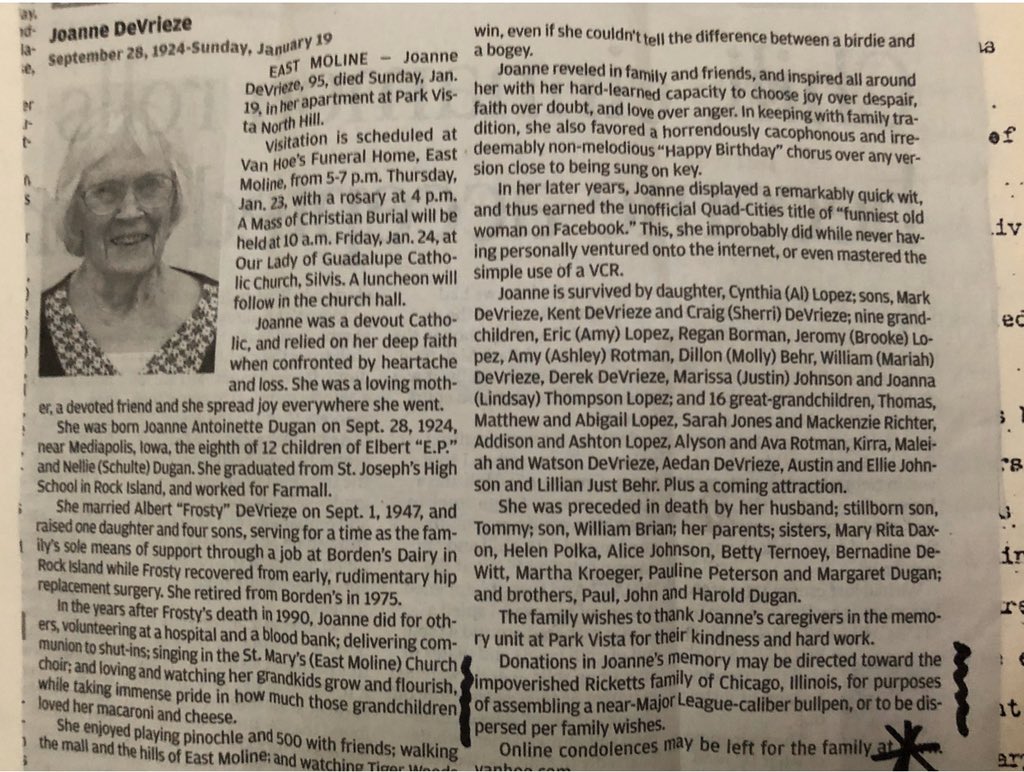
You may have to squint to  check out the obituary of this life-long Cubs fan, but the last paragraph is worth it:Image

A man has been found guilty of trying to steal a copy of Magna Carta from Salisbury Cathedral. Mark Royden, 47, from Kent, used a hammer to try to smash through the protective case around the 805-year-old document but failed to take it. Royden was arrested after being chased and detained by “good-spirited” members of the public as he attempted to leave. Royden apparently thought he was auditioning for National Treasure 3: Brexit.

A rare olm salamander reportedly stayed in the same spot in its cave in Europe for seven years, researchers say in a new study. Such intertia apparently isn’t uncommon for the species, as divers documenting the movements of olms in Herzegovinian caves found that over a decade, many of the animals tended to move less than 33 feet in total, according to the Independent.

An olm, an ancient underwater predator that can live up to 100 years and only breeds once in a decade is seen in a Postojna, Slovenia, cave in April 2016.

The blind, cave-dwelling animals are forced to move to mate, which they do about every 12 years, according to the study, which was published in the Journal of Zoology. The olms “are not highly gregarious, have no predators, are highly resistant to starvation – able to go without food for several years – and live in complete darkness underground and underwater,” the Independent said. And they can reportedly live as long as 100 years.

“They are hanging around, doing almost nothing,” Gergely Balázs at Eötvös Loránd University in Budapest, Hungary, told New Scientist.

I think the Road Workers Union of American has finally found its mascot.

That’s it for this week, friends. Let’s end with a Brit making fun of us Yankees.


The 2019-nCoV Corona Virus – An Internet Monk Primer


There has been much talk and much misinformation being spread about the Corona Virus that is currently hitting China hard. As a statistician, I thought I would help to shed some light on the topic in terms that most of us can understand.

My data that I am using here is taken primarily from two sources:

1. The real time interactive map that John Hopkins University is using to present the current status and trend of the virus.

2. A Lancet Medical Journal article published a week ago and updated/corrected February 4th.

The first image is part of a map of China. The data was updated as of 7:43 p.m. EST on Thursday. It is changing rapidly! The largest red circles that you see represent the provinces that have at least 1000 cases. When I started writing this post earlier this evening, there was only one large red circle, it contained 22,000 of the approximate 31,000 cases. By 8:30 when I saved this map there were two large circles. By 9:00 p.m. there were three. Within the next day or two there will be several more. This by the way is only confirmed cases. There is likely a multiplier effect of those who had such mild symptoms, that they did not even register as cases.

So what do we know?

The virus originated in a market in Wuhan through animal human interaction.
Wuhan is a major transportation hub, and the start of the virus corresponded with the Chinese Lunar New Year, when many were travelling.

The virus is spreading at an exponential rate. The Lancet Journal article estimated a doubling of the number of cases every 6.4 days. From recent data, cumulative deaths are doubling about every four days.
In my graph below I show the cumulative number of deaths. I calculated a best fit line that shows the number of cumulative deaths equal to approximately 1.8 times the square of the number of days since January 20th. To simplify and illustrate: 5 days after January 20th the approximate number of deaths was 5 squared * 1.8 = 45. 10 days after January 20th, it would have been 10 squared * 1.8 = 180. Yesterday, 17 days after the baseline date our calculation is 17 squared * 1.8 = 520, slightly under the actual number of 637. By Sunday night the number of deaths will have climbed to 20 squared * 1.8 = 720. A week from then the number of deaths will in excess of 1300. A month from now, 5600. Two months from now, 16,500. I hope these numbers are inflated, but I don’t believe they are. By contrast, SARS killed around 800 people total.

It is spreading quickly because each person has been infecting approximately 2.6 other people.

Currently the virus is killing 2 to 3% of those known to be infected. This number is still very hard to judge as the number of true infections is unknown. Contrast this to SARS which killed 10% of those infected. 2019-nCoV is much less lethal than SARS, but much more contagious.

What does the future hold?

The authors of the Lancet study suggest that the virus will peak in Wuhan sometime in April or May. What the number of dead will be by then is anyone’s guess. The disease seems to be fairly unstoppable in China right now. Regions outside of Wuhan as experiencing the same exponential growth as Wuhan, but a week or two delayed. As they too become epidemic centers, the disease will continue to spread outwards.

So far, the rest of the World has been fairly fortunate. The virus has not been able to get much of a foothold outside of China. There are some countries as risk however, and places like Vietnam, Thailand, and Japan will bear close watching over the next two weeks. The greatest fear is that it might somehow make its way to a continent like Africa, where it is very hard to control the movement of people.

There is a possibility (the jury is still out on this) that people may be infecting others before they start to show symptoms. If so it will be very difficult to contain. Lancet warns that “Independent self-sustaining outbreaks in major cities globally could become inevitable because of substantial exportation of presymptomatic cases and in the absence of large-scale public health interventions.”

The authors of the Lancet study conclude:

Our findings suggest that independent self-sustaining human-to-human spread is already present in multiple major Chinese cities, many of which are global transport hubs with huge numbers of both inbound and outbound passengers (eg, Beijing, Shanghai, Guangzhou, and Shenzhen)…
On the present trajectory, 2019-nCoV could be about to become a global epidemic in the absence of mitigation. Nevertheless, it might still be possible to secure containment of the spread of infection such that initial imported seeding cases or even early local transmission does not lead to a large epidemic in locations outside Wuhan. To possibly succeed, substantial, even draconian measures that limit population mobility should be seriously and immediately considered in affected areas, as should strategies to drastically reduce within-population contact rates through cancellation of mass gatherings, school closures, and instituting work-from-home arrangements, for example. Precisely what and how much should be done is highly contextually specific and there is no one-size-fits-all set of prescriptive interventions that would be appropriate across all settings.

My final thoughts.

Xenophobia (a prejudice against those from other countries) is on the rise in North America, especially against those who look Chinese. My city has a large prep school made up primarily of Chinese students. Many of them must be living fear of what is going on back home. They need our support and our prayers.

God, we pray for China.
We pray for those outside China, who have a real fear of this virus spreading to their countries. I think especially of places like Vietnam, Singapore, Thailand, Japan, and the continent of Africa.
We pray for the health workers and their families who risk their lives in treating this every day.
We pray for wise decisions from our political leaders.
We pray that effective vaccines might be developed quickly.
We pray for hope, where there seems to be not much.
Amen.

I leave you with a picture of Dr. Li Wenliang. He was one of the whistle blowers who warned the world of the dangers of this virus. He passed away this morning after contracting the virus himself. He was 34.

I will be resuming regular Friday writing at Internet Monk. More on that to come next week.

A Theory of Everything (That Matters): A Brief Guide to Einstein, Relativity, and His Surprising Thoughts on God by Alister McGrath- Part 2 Introduction and Chapter 1- Approaching Einstein: The Wonder of Nature

A Theory of Everything (That Matters): A Brief Guide to Einstein, Relativity, and His Surprising Thoughts on God by Alister McGrath- Part 2 Introduction and Chapter 1- Approaching Einstein: The Wonder of Nature

We are reviewing Alister McGrath’s new book, “A Theory of Everything (That Matters): A Brief Guide to Einstein, Relativity, and His Surprising Thoughts on God”.  McGrath says, “Albert Einstein remains the world’s favorite genius.  He has appeared on the cover of Time magazine no fewer than six times and was lionized as its Person of the Century in 1999. Einstein’s equation E = mc2―along with his trademark hairstyle―has found its way onto T-shirts and billboards.”

Einstein was a favorite of photographers.  One of the most iconic of his photos is Arthur Sasse’s shot of him sticking out his tongue.  It was taken right at the end of his birthday party in 1951 at Princeton.  A weary Einstein entered his chauffeured automobile to be driven home.  Sasse, who had been covering the event, ran up to the open door and asked Einstein for one final shot.  Einstein turned toward him and stuck out his tongue just as Sasse’s flashbulb went off.  Einstein liked the resulting photo so much that he used it for greeting cards he sent to his friends.

McGrath points out that most of us rely on his theory of relativity when using a Global Positioning System (GPS) without realizing it.  The light and warmth of the sun are the direct result of the conversion of mass to energy, first recognized by him in 1905, and expressed in the iconic equation E = mc2.  The same principle lies behind nuclear power – and atomic bombs.  McGrath credits Einstein’s letter to Franklin D. Roosevelt in 1939, warning of Nazi Germany progress in its development, for America’s race to build the bomb first.  Imagine the destruction that would have been wrought on England, not to say the world, had Germany built the A-bomb first.  It could have changed the course of history for the worse. McGrath delves more into this later in the book.

Nobody thinks a scientific genius is infallible.  Still Einstein’s status makes him worth listening to.  McGrath says he had a fascination with “big picture” questions and wove together science, ethics, and religious faith to yield a richer account of reality – as McGrath says, a theory of everything that matters. McGrath cautions that many sayings attributed to Einstein have no connection with him whatsoever, McGrath rigorously tries to sort those out.  For example, one attributed to him is: “Not everything that can be counted counts, and not everything that counts can be counted.”  It’s pithy, sure, and maybe even a great idea – but it’s not Einstein’s.

McGrath notes an authentic quote that sets up the agenda for this book: “Science can only ascertain what is, but not what should be” (Einstein, Ideas and Opinions, page 45).  Although the book explores Einstein’s scientific ideals, its real focus is how he attempted to develop a coherent view of the world – a grand theory of everything – that embraces both our understanding of how the world functions and the deeper question of what it means.

Chapter 1 is entitled, “Approaching Einstein: The Wonder of Nature.”  McGrath notes the year 1919 followed the end of “the Great War” as well as the social revolutions in China (1911) and Russia (1917).  There was a sense of an old order being swept away.  On November 7th of that year, the London Times printed a headline, “Revolution in Science, New Theory of the Universe, Newtonian Ideas Overthrown.”  Newton, the scion of British scientists had been discredited and dethroned.  And who dethroned him?  An obscure German physicist, hitherto unknown to the readers of the Times – Albert Einstein.  The Time headline propelled Einstein to international celebrity, so much so that in the early 1920s he had become a cult figure, an international icon of genius.  It didn’t hurt that he won the Nobel Prize in Physics in 1921.  In 1930, security staff at New York’s American Museum of Natural History had to deal with a near riot when 4000 people tried to see a film offering to “demystify” Einstein’s ideas.

Einstein’s influence continues to this day.  In 2016, a team of scientists reported they had recorded two black holes colliding.  They had heard and recorded the sound of two black holes colliding a billion light-years away, a “fleeting chirp” that fulfilled the last prediction of Einstein’s general theory of relativity.  McGrath says:

But beyond his scientific discoveries, what I have come to find really interesting is Einstein’s spiritual significance.  I write this book as someone who both encountered Einstein’s ideas and discovered the intellectual and spiritual riches of the Christian faith at Oxford University.  Although I will be aiming to give as reliable and accessible an account of Einstein’s views on science as possible, I will also explore his ideas on religion and how he weaves these together.  Yet perhaps more importantly, from my own personal perspective, I will also consider how his approach can be used by someone who, like me, wants to hold science and faith together, respecting their distinct identities yet finding a way of allowing them to enrich each other.  My views are not the same as Einstein’s, yet he has been an important influence in helping me navigate my way towards what I consider a workable and meaningful account of how this strange universe works and what it – and we – might mean.  Einstein opens the way to trying to develop a theory of everything that matters.

McGrath recounts how as a 13-year old he tried to understand the theory of relativity and a teacher gave him a book to read that went substantially over his head.  He still never lost his fascination with Einstein’s theories as he went to Oxford in 1971, where he took up chemistry and specialized in quantum theory.  Yet although he was thrilled at science’s capacity to explain how things worked, he could not shake the feeling it did not seem to be able to address deeper human longings and questions about meaning and purpose.  And Einstein himself made clear the sciences have their limits.  They are not equipped to answer questions of value or meaning, and they are not meant to.  McGrath says:

As a teenager, I assumed that my love for science required me to be an atheist.  After all, science and religion were meant to be at war with each other – at least according to the popular atheist tracts I had read. Yet is soon became clear to me that my teenage atheism was not adequately grounded in the evidence.  It was mere opinion on my part, which I had mistakenly assumed was a necessary outcome of reason and science.  There were other options available. If I might borrow some words from the novelist Salman Rushdie, I discovered that the “idea of God” is both “a repository for our awestruck wonderment at life and an answer to the great questions of existence”.

McGrath found himself drawn to the approach of Charles A. Coulson, Oxford University’s first professor of theoretical chemistry, who saw science and religious faith as offering complementary perspectives on our world.  At the same time he proposed a greater vision that allowed engagement with questions that were raised by science yet which lay beyond its capacity to answer.  McGrath was interested to note that Coulson regularly cited Einstein in his exploration of the relation of science and faith.

McGrath notes that Einstein was a complex and nuanced thinker, which made him vulnerable to ideologues who wanted to shoehorn his ideas into their own ways of thinking.  He says perhaps the most ridiculous of these distortions is the suggestion that Einstein’s theory of relativity provides scientific justification for rejecting moral absolutes and adopting relativism.  As a matter of fact, Einstein’s theory of relativity does not endorse relativism but affirms a regular universe governed by laws.  McGrath quotes Einstein from conversation with William Hermanns, Einstein and the Poet, page 132: “My God created laws… His universe is not ruled by wishful thinking but by immutable laws”.  In a letter of 1921 (Letter to Eberhard Zschimmer, dated September 30, 1921), noting the cultural misunderstandings of the scientific term relativity, Einstein suggested his approach was better described as a “Theory of Invariance” rather than a “Theory of Relativity”.  McGrath will expand on this point later in the book.

McGrath also says that Einstein has been conscripted by some propagandists as a mascot for their scientific atheism.  He says that Richard Dawkins, in the God Delusion (2006), presents Einstein as a closet atheist who was “repeatedly indignant at the suggestion he was a theist”.  Dawkins does not substantiate this incorrect assertion, offering instead a rather selective reading of some quotes from Einstein drawn from a secondary source.  McGrath says:

What really annoyed Einstein, according to his own writings – which merit reading in their totality, rather than in selective snippets – was the repeated suggestion that he was an atheist, or being quoted by certain kinds of atheist writers as if he shared their views, particularly those he termed “fanatical atheists” with a “grudge against traditional religion” (Letter dated August 7, 1941, Einstein Archive, Reel 54-927. For comment see Jammer, Einstein and Religion, page 97).

It is easy, however, to see how a superficial reading of Einstein could lead to the conclusion he was an atheist.  He did make it clear he did not believe in a “personal God”.  But as Max Jammer, a personal friend of Einstein, and professor of physics at Bar-Ilan University in Israel, points out in his book, Einstein and Religion, page 150, Einstein “never considered his denial of a personal God as a denial of God”, and was puzzled why anyone would even make the suggestion.

McGrath cautions that Einstein’s ideas about God and religion don’t’ fit our regular categories, and we need to listen to what he himself had to say about them, rather than forcing him into predetermined categories through selective quotation.

Since Einstein is often said to have “overthrown the views of Isaac Newton”, McGrath, in the next chapter, begins his assessment of Einstein’s significance by considering Newton’s approach – often, though not entirely accurately – described as a “mechanical universe”.


another look: midwinter

On a Winter’s Day. Photo by Carol McCray at Flickr

midwinter

in long and deep midwinter
dreams of spring arise
of fulsome brooks and fragile buds
of warmer winds and skies
that, moaning, pour the anguished tears
of childbirth on the land
and ‘midst the muddy, messy muck
transform the slender strands
weaving a carpet ‘neath the trees
which don their own green gowns
and fill the space below the blue
like dancers all around
who hear the call of lively song
— they bend, they reach, they sway —
and welcome all the newborn life
now coming out to play.

a wish-dream only!
cold and lonely
here i pass the day.

in frozen climes
i’ll wrangle rhymes
‘til winter pass away.

CM – another look: midwinter

On a Winter’s Day. Photo by Carol McCray at Flickr

midwinter

in long and deep midwinter
dreams of spring arise
of fulsome brooks and fragile buds
of warmer winds and skies
that, moaning, pour the anguished tears
of childbirth on the land
and ‘midst the muddy, messy muck
transform the slender strands
weaving a carpet ‘neath the trees
which don their own green gowns
and fill the space below the blue
like dancers all around
who hear the call of lively song
— they bend, they reach, they sway —
and welcome all the newborn life
now coming out to play.

a wish-dream only!
cold and lonely
here i pass the day.

in frozen climes
i’ll wrangle rhymes
‘til winter pass away.

each time love comes

Abraham welcoming the three angels. Boruch Nachson

oak shade, midday
three men appear at our tent
something striking
i wonder about their intent

rising, moving
i run to greet them and bow
please don’t pass by
stay and refresh yourselves now

serve them, watch them
what is it in them i see?
all so curious
something portentous for me?

shocking words come
my eyes grow wide at the news
somewhere laughter
utterly stunned and bemused

each time love comes
calling my soul to receive
gifts from strangers
i find it hard to believe

head shake, snicker
i dismiss right from the start
love’s potential
to find a place in my heart

hiding, doubting
i dash my hopes to the ground
all too wonderful
can true laughter be found?

CM: each time love comes

Abraham welcoming the three angels. Boruch Nachson

oak shade, midday
three men appear at our tent
something striking
i wonder about their intent

rising, moving
i run to greet them and bow
please don’t pass by
stay and refresh yourselves now

serve them, watch them
what is it in them i see?
all so curious
something portentous for me?

shocking words come
my eyes grow wide at the news
somewhere laughter
utterly stunned and bemused

each time love comes
calling my soul to receive
gifts from strangers
i find it hard to believe

head shake, snicker
i dismiss right from the start
love’s potential
to find a place in my heart

hiding, doubting
i dash my hopes to the ground
all too wonderful
can true laughter be found?