Today is celebrated as Ascension Sunday in many churches, when we remember that Jesus took his throne on the right hand of God the Father. He told his disciples that they should wait in Jerusalem after the ascension for the promised Holy Spirit. In Acts we read that they gathered in an upper room and devoted themselves to prayer during that waiting period.
As I preach today I will encourage the church to make this a week of waiting in prayer in preparation for Pentecost as well. And I prepared prayers for them, with associated scriptures, to use Monday through Friday. Perhaps these can be useful for you too, as we devote this week to asking God for the gift of his Spirit (Luke 11:13)
• • •
MONDAY Promise: And so I tell you, keep on asking, and you will receive what you ask for. Keep on seeking, and you will find. Keep on knocking, and the door will be opened to you. For everyone who asks, receives. Everyone who seeks, finds. And to everyone who knocks, the door will be opened. You fathers—if your children ask for a fish, do you give them a snake instead? Or if they ask for an egg, do you give them a scorpion? Of course not! So if you sinful people know how to give good gifts to your children, how much more will your heavenly Father give the Holy Spirit to those who ask him.” (Luke 11:9-13)
Prayer: Heavenly Father, you are good and give good gifts to your children. The best gift of all is your presence, love, and power in my life. Come, Holy Spirit, and fill me!
•
TUESDAY Promise: One day when the crowds were being baptized, Jesus himself was baptized. As he was praying, the heavens opened, and the Holy Spirit, in bodily form, descended on him like a dove. And a voice from heaven said, “You are my dearly loved Son, and you bring me great joy.” (Luke 3:21-22)
Prayer: Father, as Jesus was praying at his baptism, you poured out your Spirit upon him and claimed him as your own beloved child. As I remember and thank you for my baptism into Christ today, reassure me of your love and presence with me. Come, Holy Spirit!
•
WEDNESDAY Promise: And now I will send the Holy Spirit, just as my Father promised. But stay here in the city until the Holy Spirit comes and fills you with power from heaven. Then Jesus led them to Bethany, and lifting his hands to heaven, he blessed them. While he was blessing them, he left them and was taken up to heaven. So they worshiped him and then returned to Jerusalem filled with great joy. (Luke 24:49-52)
Prayer: Lord Jesus, you instructed your disciples to wait for the Spirit, to watch and pray. Teach me the patience of praying and waiting. Fill my life as you filled theirs, and bless your church with power from on high. Come, Holy Spirit!
•
THURSDAY Promise: God raised Jesus from the dead, and we are all witnesses of this. Now he is exalted to the place of highest honor in heaven, at God’s right hand. And the Father, as he had promised, gave him the Holy Spirit to pour out upon us, just as you see and hear today. (Acts 2:32-33)
Prayer: Jesus, you are King of all, seated at God’s right hand. As you poured out your Spirit upon those gathered on the Day of Pentecost, fill me today, that I too may be a good ambassador for our King. Come, Holy Spirit!
•
FRIDAY Promise: Be filled with the Holy Spirit, singing psalms and hymns and spiritual songs among yourselves, and making music to the Lord in your hearts. And give thanks for everything to God the Father in the name of our Lord Jesus Christ. And further, submit to one another out of reverence for Christ. (Ephesians 5:18-21)
Prayer: Loving God, revive me. Revive your church. Fill us with your Spirit. Write new songs in our hearts. Fill us with gratitude, contentment, and joy. Teach us to love and serve you, one another, and our neighbors. Come Holy Spirit, blow fresh winds of renewal through our lives!
Hello, friends, and welcome to the weekend. You know what we haven’t had for a while? BRUNCH! Let’s get right to it.
Remember when the Salvator Mundi, the supposed lost work of Leonardo da Vinci, sold a couple years ago for a record $450 million? Well, the speculation now is that it was a tad overpriced. How much is a tad? In this case, $448 million. What gives? Well, it seems more and more experts are doubting that Leonardo actually painted it. It was due to be lent to the Louvre in Paris this year for its big Leonardo show marking the 500th anniversary of his death. But the piece has now been rejected because because curators at the Louvre do not believe it can be attributed solely to the artist, it has been claimed. Ben Lewis, an art historian and writer who charted the story of the piece’s recent discovery, notes:
“My inside sources at the Louvre, various sources, tell me that not many curators think this picture is an autograph Leonardo da Vinci.
“If they did exhibit it … they would want to exhibit it as ‘workshop’.
“If that’s the case, it will be very unlikely that it will be shown, because the owner can’t possibly lend it … the value will go down to somewhere north of $1.5m (£1.2m).”
By the way, how do you think the person who spent nearly half a billion on a fake Da Vinci feels right now?
“Work hard, become successful, then you’ll be happy. At least, that’s what many of us were taught by our parents, teachers and peers. The idea that we must pursue success in order to experience happiness is enshrined in the United States’ most treasured institutions (the Declaration of Independence), beliefs (the American dream), and stories (Rocky and Cinderella). Most people want to be happy, so we chase success like a proverbial carrot on a stick – thinking that contentment lurks just the other side of getting into college, landing a dream job, being promoted or making six figures. But for many chasers, both success and happiness remain perpetually out of reach. The problem is that the equation might be backwards. Our hypothesis is that happiness precedes and leads to career success – not the other way around. In psychological science, ‘happiness’ relates to ‘subjective wellbeing’ and ‘positive emotions’ (we use the terms interchangeably). Those with greater wellbeing tend to be more satisfied with their lives, and also to experience more positive emotions and fewer negative ones. Research suggests that it’s these positive emotions – such as excitement, joy, and serenity – that promote success in the workplace.
You know what we need for this brunch? Panda pictures. Nothing is cuter than a panda. Let’s start with this rarity:
These are the first-ever documented images of an albino giant panda. China’s Sichuan Wolong National Nature Reserve Administration shared photos of the all-white panda on May 25. The color does not affect the animal’s activity or reproduction but it could make it sensitive to direct sunlight, the nature reserve writes.
Just for fun, we’re going to add a few more, with captions.
Ever wished for a “point of contact” with God? I mean, a point of contact besides Jesus and the Holy Spirit. Obviously. Ever wished you could get one for the low, low price of $45? Well, now you can! That’s right folks: for the price of a half dozen cappuccinos from Starbucks you can know own a genuine point of contact with God!!!
But wait, it gets better. This point of contact comes in the form of a coin featuring two famously godly men: Cyrus the Great, and Donald Trump.
The coin is being sold by Lance Wallnau. He claimed God told him to share the coin so people could pray for Trump. “When I asked the Lord, ‘Why the coin?’ he said ‘Because when you take the coin, it’s a point of contact,’” Wallnau is heard saying on the Jim Bakker show. “So your faith is being released with a million other believers to pray protection and peace and wisdom and counsel over the president of the United States and over his family….It’s our point of contact every day. When you see it remember God put something in your hand that you have a role in.”
I wonder how many of these coins it would take to melt down and create an image more appropriate to this kind of religious attitude? Something like this, maybe?
Did you get your 10,000 steps in yesterday? They say that’s the goal, you know, along with drinking eight glasses of water a day and eating 2,000 calories. But who are “they”? Turns out, at least for the first of these, the “they” is marketers, not scientists:
I-Min Lee, a professor of epidemiology at the Harvard University T. H. Chan School of Public Health and the lead author of a new study published this week in the Journal of the American Medical Association, began looking into the step rule because she was curious about where it came from. “It turns out the original basis for this 10,000-step guideline was really a marketing strategy,” she explains. “In 1965, a Japanese company was selling pedometers, and they gave it a name that, in Japanese, means ‘the 10,000-step meter.’”
Based on conversations she’s had with Japanese researchers, Lee believes that name was chosen for the product because the character for “10,000” looks sort of like a man walking. As far as she knows, the actual health merits of that number have never been validated by research.
So how many steps should be our goal? Lee designed a test by observing the step totals and mortality rates of more than 16,000 elderly American women. “The basic finding was that at 4,400 steps per day, these women had significantly lower mortality rates compared to the least active women,” Lee explains. If they did more, their mortality rates continued to drop, until they reached about 7,500 steps, at which point the rates leveled out.” So there you go.
Taco Bell announced plans this month to open a hotel. No, I’m not kidding. Taco Bell’s Chief Brand Officer Marisa Thalberg said that the idea for a Taco Bell-themed hotel is meant to be playful and fun, but the brand sincerely intends for it to be an “unparalleled experience.” She added, “I have often quipped that Taco Bell is the fast fashion of food. We have our everyday classics, but then we’re always introducing these cool limited-edition experiences to do something new and different.” Yes, Taco Bell foods often do something new and different to my digestive system.
Hopefully each hotel room will have double bathrooms.
I recently ran across a website of a guy who makes balloon creations. He notes, “I create animals, plant life and insects using only balloons. The works that has been published on this page are made from all balloon only. (Adhesive, marker pen, seal, etc. are not used at all) “. Hmmm. Well how good can they really be?
Yeah, so not very good at all. I could do far better.
An op-ed in the New York Times discussing a study of married couples acknowledges that the happiest wives by far in America are those in politically conservative, religious marriages. The study, conducted by a professor of sociology at the University of Virginia, a professor of marriage and family studies at Brigham Young University, and an adjunct lecturer in the sociology department at Georgetown University, found that 73% of wives “who hold conservative gender values and attend religious services regularly with their husbands have high-quality marriages.” Also: “Women in highly religious relationships are about 50% more likely to report that they are strongly satisfied with their sexual relationship than their secular and less religious counterparts.”
That figure dwarfs the numbers in less religious and conservative marriages. The authors write that only a little more than half (55%) of secular progressive wives in the United States, who are not religious and champion egalitarian family values, say they have high-quality marriages. The oped notes, “fewer than 46 percent of wives in the religious middle — who attend only infrequently or don’t share regular religious attendance with their husbands — and only 33 percent of secular conservative wives — who think men should take the lead on bread-winning and women on child-rearing but don’t attend church — have such marriages.”
Oh, and how did the Times title this item? “Religious dads can be devoted, too”. Yeah. I’m surprised they didn’t decide to add a few exclamation points.
“‘Holy Spirit’ saves German driver from speeding fine”. I didn’t expect to come across that headline on the BBC website. Charisma, sure, but not the BBC. Anyway, it seems the driver was caught on speed cameras – but his identity was hidden by the bird’s wings spread in flight.
A light-hearted police statement suggested that perhaps “it was no coincidence the Holy Spirit” intervened -We have understood the sign and leave the speeder in peace this time.”
Speaking of odd headlines, here are some recent ones. And, yes, these all came from real news sources (except for the one from Fox):
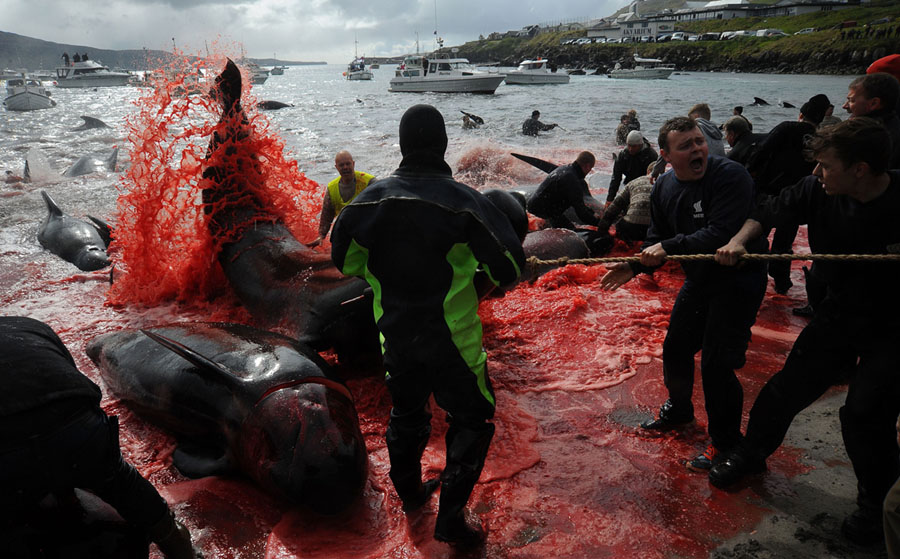
West Point cadets toss their caps into the air at the end of graduation ceremonies at the United States Military Academy in West Point, New York, on May 25, 2019.A security guard with unusual body armor, featuring curved spikes, four head-mounted flashlights, two pairs of sunglasses, and a ready gas mask, keeps watch during the swearing-in ceremony of Malawian President-elect Arthur Peter Mutharika at Kamuzu Stadium in Blantyre, Malawi, on May 28, 2019, after a contentious election marred by allegations of fraud and vote-riggingColette Giezentanner, 12, reacts to spelling a word right in the finals of the 92nd Scripps National Spelling Bee in National Harbor, Maryland, on May 30, 2019.A Muslim boy arrives at a mosque during Ramadan, the holiest month on the Islamic calendar, in Shah Alam, Malaysia, on May 30, 2019Corgis race during a heat of the Southern California Corgi Nationals championship at Santa Anita Park in Arcadia, California, on May 26 2019The eventual winner, Max McDougall (front left), chases the cheese during the first race of the annual spring bank-holiday cheese-rolling event at Cooper’s Hill, near Gloucester, England, on May 27, 2019. Traditionally held for villagers of Brockworth, today the event attracts people from around the worldA masked Kashmiri protester jumps on the hood of an armored Indian police vehicle as he throws stones at it during a protest in Srinagar, Indian-controlled Kashmir, on May 31, 2019A boy pours water on himself as he tries to cool off amid rising temperatures in New Delhi, India, on May 29, 2019Floodwater from the Mississippi River cuts off the roadway from Missouri to Illinois at the states’ border in St. Mary, Missouri, on May 30, 2019Fishermen and volunteers pull ashore pilot whales that they killed during a hunt, as blood turns the sea red, in Tórshavn, the Faroe Islands, on May 29, 2019. As local fishermen spot pods of pilot whales passing the shores of the Danish territory of the Faroe Islands during their migration, a convoy of boats drives the whales toward authorized fjords to harvest the catch.A plume of ash is released as the Mount Agung volcano erupts, seen from the Kubu subdistrict in Karangasem Regency on Indonesia’s resort island of Bali on May 31, 2019Two boys ride in the back of a horse-drawn buggy stopped at a traffic light in Lancaster County, near Gap, Pennsylvania, on May 29, 2019
Chapter 6- Death, Pain, Suffering, and the God of Love
We are reviewing the book: Is There Purpose in Biology?The Cost of Existence and the God of Love. By Denis Alexander.Today is:Chapter 6- Death, Pain, Suffering, and the God of Love.Alexander is going to try and tackle the theodicy question raised by evolution, to wit:
If we believe in a God of love who is immanent in upholding and sustaining the created order, then how come evolution works the way it does, entailing competition, food-chains, and lives which can end abruptly in the animal’s first few days of life in the mouth of some hungry predator?
Clearly, these are not “evils” in the way we normally use the word since no moral decision-making is entailed.We don’t seek punishment for animals that eat each other, and when a dangerous dog kills a child it is the owner who is held responsible.But I think theologically we are justified in calling certain aspects of the biological world “evil” in the rather specialized sense that they do not belong to the ultimate fulfilled kingdom of God in which God’s reign will be finally vindicated.When Jesus came teaching and preaching the kingdom of God, he clearly saw sickness as an evil to be confronted on the grounds that it had no place in God’s fulfilled kingdom, as we will consider further below.So “natural evil” is ultimately “unnatural evil” because it does not belong in the age which is to come, even though it is very much part of our experience now in the present evil age.And even if we do not wish to attach the word “evil” to such characteristics of the created order at all, we can at least all agree they represent facets of creation that we would rather do without.
Denis points out that if, you read the voluminous literature on the topic, you soon find there is a spectrum of opinion from the “hands-off” God who basically lets the world run itself to the “total control” God who determines everythingthat happens at the other extreme.
On the left end we find philosophers like Hans Jonas who suggests, in Mortality and Morality (Jonas 1996), that God self-empties himself of mind and power in giving creation its existence and then allows the interplay of chance and natural law to take its course.A little further to the right are the process theologians, like James Keller (Keller, J.A., 2013, Process Theism and Theodicies for Problems of Evil) who basically think denying God’s omnipotence a better response to the problems of evil than traditional theism. More toward the middle of the spectrum are the “kenosis”-types like Jack Haught, Keith Ward, and John Polkinghorne (who we reviewed here).Elizabeth Johnson, in her book, Ask the Beasts: Darwin and the God of Love, says that just as God bestows free will upon humans, so he also bestows “free-process” upon the natural world.Evolutionary biology is therefore an “unscripted adventure” in which the “natural world” freely participates in its own creation.
Alexander notes three particular problem with the so-called middle ground.
The material world is not “free” to do anything.Matter does what matter does, it’s not even free in the metaphorical sense intended by these commentators.Heisenberg’s Uncertainty Principle might make the behavior of matter indeterminate from a human perspective, but it does not thereby become free.
The second problem comes with the word kenosis.It has a defined theological meaning based on its use in Philippians Chapter 2, but it is not the way God’s actions in creation are described. There is no “self-emptying” on God’s part, rather the opposite, there is no “effort” at all as far as Scripture is concerned.God speaks, it’s done, end of story.
The third problem is that a hands-off God is just as responsible for the unintended consequences of his creation as the totally hands-on God is who determined the created order down to the smallest detail.As Denis says, “If I take my hands off the steering-wheel as my car goes down a hill and it then proceeds to crash into the pavement killing a child, I am just as culpable as if I had killed the childwith my hands still firmly on the steering-wheel.”
Denis’s sympathies lie more on the right end of the spectrum.He says:
In the views on the right of the spectrum, there is no room for kenosis in the context of God’s created work, because God is in no sense denying his own nature or emptying himself in the creative process.At the same time, God is not the puppet-master, micromanaging the created order, but the God who operates via secondary causes that have their own causal efficacy.This is a robust Trinitarian theism which takes the problem of natural evil right on the chin, fair and square.There is no ducking the issue.God really is responsible for God’s created order.How could it be otherwise?
One objection to this idea that the created order is contingent upon God’s continuous creative activity is based on the assumption that the creation is there to tell us something about God’s character.But Denis doesn’t agree with that assumption.Based on his reading of the Bible, the passages of scripture only provide a minimalist list; the fact that God exists, and that he’s powerful and full of glory – not other aspects of God’s character.It is the William Paley – Watchmaker God – Natural Theology reading of scripture that leads to, for example, to Darwin’s revulsion to parasites:
The Ichneumonidae are a parasitoid wasp family within the order Hymenoptera. They use their ovipositors to lay eggs on or in the body of their prey, and the eggs hatch into carnivorous larvae that eat and kill the host.
But I own that I cannot see, as plainly as other do, and as I should wish to do, evidence of design and beneficence on all sides of us. There seems to me too much misery in the world. I cannot persuade myself that a beneficent and omnipotent God would have designedly created the Ichneumonidae with the express intention of their feeding within the living bodies of caterpillars, or that a cat should play with mice. (From Darwin’s letter to Asa Gray, September 5, 1857)
Denis points out that:
. There is nothing in the biblical view of creation that suggests God “designs” particular organisms to do nasty things to other organisms.
. The Bible does not portray God as a “heavenly designer engineer” who goes about designing things.
. There is no evidence we are to infer God’s character from the behavior of parasites.
The created order is not there to teach about God’s character; we learn that through revelation.
So what is the overriding good that is generated by a world with these particular properties in which death, pain, and predation are part and parcel?Denis suggests that it is coherent existence itself which is the overriding good, including the existence of living things, and especially the existence of creatures like ourselves with the capacity to respond freely to God’s love.He says the physics and chemistry of carbon-based life are dependent on the physics and chemistry of carbon-based death – it is a package deal.Carbon-based life and carbon-based death are written into the anthropic script of God’s created order right from the beginning.The cost of existence is huge, and we all bear that cost.And by “we”, Denis means every living creature that has ever lived.
If the created order that we observe and investigate all around us is precisely the one God intended to bring into existence, how come Jesus in his incarnation made a central part of his ministry the healing of diseases for which he, within the Trinitarian Godhead, was ultimately responsible?It’s a cop-out to say it’s all a result of human sin, and besides that is not what Jesus taught –
“…who sinned, this man or his parents that he was born blind?”
“Neither this man nor his parents sinned,” said Jesus, “but this happened so that the works of God might be displayed in him. (John 9:2-3)
With the healing ministry of Jesus, the future fulfilled kingdom begins to break in to the present evil age.The door to the future is pushed open and a beautiful healing breeze blows through, giving us a taste of what is still to come.
Carbon-based existence is also wrapped up in the cost of the incarnation.Denis quotes Ernan McMullin from Notre Dame Universtiy:
When Christ took on human nature, the DNA that made him the son of Mary may have linked him to a more ancient heritage stretching far beyond Adam to the shallows of unimaginably ancient seas.And so, in the Incarnation, it would not have been just human nature that was joined to the Divine, but in a less direct but no less real sense all those myriad organisms that had unknowingly over the eons shaped the way for the coming of the human.
Without the physical properties of the universe there would be no life, no evolution, so no free will, no moral responsibility, therefore no sin, no incarnation, and no redemptive work of Christ upon the cross.The path God has chosen for us is a tough one, a boot camp, if you will.But the obvious question is; was it really necessary?Do we have to go through Phase 1 to get to Phase 2?
Denis ends this chapter with a personal story.He gave the Herrmann lecture on which this chapter is based on November 7, 2014, just 11 days after being diagnosed with colorectal cancer.Later in December he underwent surgery followed up with chemotherapy.All that to say his speculation about life and death, healing and disease, biology and purpose, was no mere academic discussion.He lived it.As he says:
What’s the point of telling you all that?Only, that for the Christian who sees God’s Purposes being worked out in all the nitty-gritty of a long history of biological evolution, it is all part and parcel of the same theology to know that God is working out his purposes in the history of our own individual lives.
I think it is appropriate to end this discussion with my favorite Dorothy Sayers quote:
“For whatever reason God chose to make man as he is— limited and suffering and subject to sorrows and death—He had the honesty and the courage to take His own medicine. Whatever game He is playing with His creation, He has kept His own rules and played fair. He can exact nothing from man that He has not exacted from Himself. He has Himself gone through the whole of human experience, from the trivial irritations of family life and the cramping restrictions of hard work and lack of money to the worst horrors of pain and humiliation, defeat, despair and death. When He was a man, He played the man. He was born in poverty and died in disgrace and thought it well worthwhile.”
Little children, I’m writing to you because your sins have been forgiven through Jesus’ name. Parents, I’m writing to you because you have known the one who has existed from the beginning. Young people, I’m writing to you because you have conquered the evil one. Little children, I write to you because you know the Father. Parents, I write to you because you have known the one who has existed from the beginning. Young people, I write to you because you are strong, the word of God remains in you, and you have conquered the evil one.
• 1John 2:12-14 CEB
• • •
One fact I did not understand when I was younger is that life is made up of different seasons and circumstances that can virtually define any given time in life, or even the entirety of your life. I could hardly grasp that I would be called to adapt and change and learn and respond differently — sometimes for extended periods of time — regarding aspects of life over which I would have little control. I still find it hard to deal with change and disruption of my plans and expectations. And if this is true of me, one who has lived a relatively trouble-free life, what of others who have faced monumental challenges and tragic life-altering situations?
A lot of “discipleship” does not take this into account either, but comes across as generic and all-purpose, a program for all audiences — read your Bible, pray, get involved in church, find places to serve.
What they never tell you is that you and life, God, work, relationships and the way you think about all these things and what you need to flourish in life and love is different at age 22 than it is at 35 — very different at 50 or 65. Discipleship programs rarely, if ever, let you in on the secret that you may have to trudge through vast swaths of wilderness in your life, hungry and thirsty, exhausted and threatened by heat stroke. Nor do they talk about the challenges of good times and the temptations of prosperity and the successful seasons of life and the fact that they may or may not contribute to one’s personal growth.
They also don’t take into account that each person has his or her own inner landscape, climate, and weather — that life with its seasons and circumstances looks and feels somewhat different to each individual.
There is a conformist tendency in institutional religion which suggests that because we’re all in this together, we must learn to deal with life in basically the same manner. This effectively disregards the apprenticeship approach Jesus took with his disciples and the apostles’ insistence that we live in the freedom of the Spirit.
This presents a great challenge for ministers and congregations who want to encourage spiritual formation in their churches. Taking each person’s unique situation into account and responding with grace and edifying love can be daunting.
Brothers and sisters, we ask you to respect those who are working with you, leading you, and instructing you. Think of them highly with love because of their work. Live in peace with each other. Brothers and sisters, we urge you to warn those who are disorderly. Comfort the discouraged. Help the weak. Be patient with everyone. Make sure no one repays a wrong with a wrong, but always pursue the good for each other and everyone else.
• 1Thess 5:12-15 CEB
There are many aspects of church life in which we are called to be formed in Christ together — worship through Word and Sacrament and catechesis, to name two — nevertheless all of us must also learn to walk in newness of life as individuals who have died and been raised up in Christ.
As a parent, one of the most surprising things I had to face was how different each of my children would be. I had to learn how to balance giving attention to their individual stories with composing our larger family story. This is the same challenge the church faces. There is no one-size-fits-all discipleship “program.” Run as fast as you can from any church that gives you the impression they think there is.
Another false notion about the seasons and circumstances of spiritual formation is that they lead to perceptible progress in the believer’s life. As though there is a definable pattern of personal development. Over the years, the spiritual life has been likened to a journey. That suggests a road with recognizable landmarks and destinations. It has also been envisioned in terms of climbing a ladder. And though Protestants have usually been suspicious of the ladder as advocating a system of meritorious works, even they find it hard to leave behind as some leftover relic from medieval theology. Mission statements of many contemporary churches are quite explicit that they expect certain measurable evidences of “growth” to become apparent in the lives of their members.
The movements of the Spirit, Nouwen observed within himself and in others, tend to come in cycles throughout our lives, with only a broad and hardly predictable progressive order. Instead of stepping up to higher and higher stages, as if achieving one stage leads to the next level and the next, we tend to vacillate back and forth between the poles that we seek to resolve. We move “from fear to love” and then back “from love to fear,” for example in a dynamic process that is never complete. Rather than resolving the tensions once and for all, the movements continue to call us to conversion and transformation.
As I’ve said before, this leads me to be reticent about promoting the idea of “growth” or “transformation” as though this is something that can be clearly observed or that “progress” can be marked as an unambiguous fact. As Nouwen himself writes:
After many years of seeking to live a spiritual life, I still ask myself, “Where am I as a Christian?” — “How far have I advanced?” — “Do I love God more now than earlier in my life?” — “Have I matured in faith since I started on the spiritual path?” Honestly, I don’t know the answers to these questions. There are just as many reasons for pessimism as for optimism. Many of the real struggles of twenty or forty years ago are still very much with me. I am still searching for inner peace, for creative relationships with others, and for a deeper experience of God. And I have no way of knowing if the small psychological and spiritual changes during the past decades have made me more or less a spiritual person.
…it is of great importance that we leave the world of measurements behind when we speak about the life of the Spirit.
Seasons come and seasons go. We travel onward in our journey with Christ. Where we are on the road at any given point in time is debatable from our point of view. What we can know, and what we must cling to, is that Christ has called and enabled us to be with him on the road, that he is with us, that he will not forsake us, and that he picks us up every time we fall.
The Lord directs the steps of the godly. He delights in every detail of their lives. Though they stumble, they will never fall, for the Lord holds them by the hand.
Kate Rusby, from Barnsley in Yorkshire, England, has been singing since she was a child. Born into a family of musicians, she took up the guitar, piano, and violin, and sang in local folk festivals, eventually becoming the lead vocalist in the groundbreaking female Celtic band, the Poozies. She’s gone on to record seventeen albums, including her latest, Philosophers, Poets and Kings. She has won numerous awards for her music, and is known in the UK as “Queen of the Folkies.”
I’m an unabashed fan of Celtic folk music, and one of Rusby great strengths is her ability to fuse both traditional and original songs. Her voice is angelic, the arrangements poignant, the songs firmly based in the narratives of family and clan, stories passed down in home and pub. Kate’s music is, in fact, so rooted in family, that it has become the Rusby cottage business, with parents and siblings managing her tours and their label Pure Records from their home in South Yorkshire.
You can watch a wonderful documentary on YouTube about Kate Rusby, her music, and their family music business. It reveals a refreshingly normal, ordinary person and the good folks around her who have found a way to incorporate splendid music into their life together while remaining grounded in community and relationships.
Her new album has won early rave reviews, and I highly recommend it. One reviewer wrote:
Like all of Rusby’s albums, “Philosophers, Poets & Kings” moves seamlessly across the emotional spectrum, from jaunty, comic tunes like “Jenny” and “The Squire and the Parson” to “Halt the Wagons,” one of the album’s most moving tracks. Rusby wrote “Halt the Wagons” in commemoration of the Huskar Pit Disaster, when, in 1838, 26 children lost their lives in a South Yorkshire mine, leading to legislature that prevented children under the age of 10 from working underground. The song is gorgeous in its simple, subdued, yet affective brass instrument arrangement, featuring the harmonizing chorus of flugle horn, French horn, cornet, and tuba. In order to give voice to the children who lost their lives, Rusby sings with the Barnsley Youth Choir. Another deeply moving song on the album, “The Wanderer,” is an original ballad honoring a man in Rusby’s village who suffers from Alzheimer’s.
Here are two tunes from the record, which explore both ends of that emotional spectrum.
For Memorial Day 2019: The Glory of the Nations – How Common Grace Redeems Nationalism by Michael Spencer
My friend Mark is a soldier. A Sergeant in the United States Marine Corps. He just returned from a tour of duty in Afghanistan, where he, in his own words, was “proud to be a Marine at a time my country needed my service.” I am proud of him, too. Not just because of his military service helping to keep my children safe from the terrorists who hate all Americans. I am proud of him because he is a Christian, one who is serious about following Jesus and gives real evidence of Christian commitment and character. I don’t hesitate to wish that my children would grow up and imitate Mark.
Recently, however, I was reminded that not everyone agrees with my assessment of my friend, Mark. There are some Christians who would say that Mark cannot love his country enough to go to Afghanistan and dispatch Bin Laden and company, while at the same time claiming that Jesus is King. This is idolatry, they say. A sinful and impossible compromise, choosing country over Christ and ignoring the Bible’s teaching that Jesus alone is King. These critics point to Jesus’ words of non-resistance and non-violence in the Sermon on the Mount and say that Mark is willfully disobeying Jesus at the instigation of nationalism.
Some of these critics make an articulate case that the evangelical church has adopted a blindly nationalistic, patriotic idolatry in the last two decades, as Christians have become flag-waving supporters of the Gulf War and the War on Terrorism. They point out America’s many sins, such as abortion, its shallow and unbiblical understanding of God, and its headlong pursuit of money and materialism. How can a Christian follow Christ and promote and defend these errors?
The Kingdom of God, these critics charge, is our true country and Christ is our only King. All other nations are under His judgment. Notions such as freedom, liberty and justice are perverted by the nations of the earth, and only Christ can be the source of such blessings. We are to live as aliens and strangers, giving no allegiance to nation or political party that ultimately belongs to God.
It’s the ultimate WWJD question. Would Jesus do what Mark did? Could Jesus have been a Sergeant in the Marine Corps, go to Afghanistan to fight terrorists and still have been our savior and example? Could Jesus give His service to America, and not sin in choosing to do so? Or would Jesus have refused military service? Would “Render unto Caesar” include or exclude fighting to defend His family if invaders attacked Nazareth, or if the nation of Israel asked for His service in defending itself? Tony Campolo used to ask if anyone could picture Jesus dropping bombs on North Vietnamese civilians.
These are serious questions that must be answered. As a Christian I believe I must answer them from the Bible, and that I must submit to what the Bible teaches and not to my own emotions and preferences. I freely admit that I am a patriot, and that the phrase “For God and country” is not nonsense to me. I have listened to the arguments of those who take the position outlined above, and I agree with substantial parts of their observations. But, in the end, I believe they have ignored and over-simplified the Biblical material to bolster their own choices.
To begin with, I will not outline my considerable agreement with those who accuse evangelicals of idolatry. There is a plague of patriotic idolatry in American Christianity. Our ultimate loyalty is to Christ. We are citizens of His Kingdom, and we must obey the law and example of our King. I am a great admirer of Dr. Martin Luther King, Jr. and I fully agree with the Biblical foundations for his critique of America and the movement he inspired. I don’t believe America is always right or that every conflict we have entered was right, and I certainly agree that America is fallen, pagan, materialistic and likely to become increasingly hostile to Christians in her midst.
My disagreement — and it is a substantial one — is that this picture is too simple. It discounts the Bible as a whole in favor of one stream of Biblical material. This is a common problem among people who build Biblical cases without an overall Biblical theology, and I have noted this with everyone I have debated concerning these issues. There is a real annoyance at bringing up anything other than the words of Jesus. Where Jesus endorsed all of scripture as a testimony of truth, these critics quickly reject or ignore scripture that is not on the level with the Sermon on the Mount or the words of Jesus. Of course, one must ignore the words of Jesus Himself that send us into the rest of the Bible to understand Jesus if we are going to maintain that position.
I also find it interesting that the position of the critics does not match up with what we find in scripture where Jesus or the disciples interact with people. I was surprised to discover that some advocates of pacifism teach that the centurion and the Roman officer Cornelius left the military after becoming Christians. The text, of course, says nothing of the sort, and, in fact, the New Testament seems to have a positive or at least neutral view of the career of soldier. Such assertions come perilously close to the kind of statements Roman Catholics make about the career of Mary. I am not denying that we may sometimes make logical inferences beyond scripture, but there is a limit to what sort of confident factual assertions we can make.
What is the missing factor in the argument that my friend Mark cannot serve God and country? Common grace, an element of theology that is more and more frequently abandoned by Christians who do not know the whole Biblical story. It is God’s common grace that redeems nationalism sufficiently that my friend Mark can defend my family against terrorists in the service of our military with a good conscience.
Common grace is an answer to the question, “To what extent did God abandon the world when it fell into sin?” Now the reason so few understand common grace is that their answer would be, “God abandoned the world totally and completely, because He can have nothing to do with sin, sinners, or anything they create.” And of course, there are lots of scripture verses to prop up that claim. The problem is, however, that while God’s holiness does dictate that His eyes are too pure to behold evil and so on, God’s mercy, kindness and continued involvement with sinners has been consistently demonstrated through all of redemptive history.
God should have exterminated Adam and Eve. Instead, He showed them mercy, forgave them, clothed them, allowed them to enjoy the blessing of marriage, family and creation. God was merciful to Cain. He blessed whole generations and nations of sinners. Even in the flood, when it appeared God had run out of grace, He was gracious to a whole family of sinners, and continued to be so after the flood when they demonstrated they were still quite sinful and fallen. The story of God’s surprising common grace is the story of the entire Bible. The Apostle Paul appeals to this often, as he does in Acts 17.
I won’t write a treatise. Common grace is the history of God’s dealings with every person and every nation in the Bible. When He should have utterly abandoned them, He did not. When He should have left them to themselves to rot in their own depravity, He showed a more patient, kinder face. He blessed them with gifts large and small. The goodness of His image remained with them, though marred and broken. He restrained judgment and extended mercy repeatedly. God did this as a witness to His mercy. As Paul said, the kindness of God is meant to bring us to repentance. Common grace is a pointer to saving grace. Many Christians may think it wasted, but God apparently disagrees, because He lavishes the stuff on the just and the unjust alike with every breath.
If you have come this far, please understand the importance of this last point. God has not utterly turned His back on humanity or human institutions, work, creations, and concerns. God is up to more in history than just the redemption of a people for eternal glory. He is invested in every aspect of human experience to do us good, even those of us who despise Him and always will. While the sinfulness, depravity and judgment-worthiness of humanity and its works are beyond dispute, that has not compelled God to abandon us. In the worst of people, the worst of human activities and the worst of human institutions, there is still the remaining purpose of God and His on-going common grace.
Now the premise of this essay is that common grace sufficiently redeems nationalism that my friend Mark may serve his country with a clear conscience and still give ultimate allegiance to Jesus Christ. Two passages of scripture catch my attention in this regard, one in Genesis and one in Revelation.
The first is the origin of human government itself, the story of the Tower of Babel (Genesis 11:1-11) I would like you to observe that what God is doing at Babel is a restraining act of mercy. It is God’s opinion that human nations will be less evil if separated into nations than if they are one nation, one culture. (One world government fans, have at it.) In other words, nations are, to a certain extent, a manifestation of God’s common grace, and this is, I believe, Paul’s entire point in the crucial text of Romans 13:1-13. The state is a minister of God to do you good. That is common grace in the form of a nation.
Now what is the purpose for God’s invention of a world of nations at Babel? If the purpose of the individual government is to bear the sword and punish the evildoer, then I do not think it a leap at all to say the entire Babel project had as one of its purposes the preservation of good and the restraining of evil in the community of nations. All nations are fallen, and all are under God’s judgment, but in the sovereignty of God, some nations will preserve genuine good more so than others. And the stage of Biblical history demonstrates that this is exactly the way God used nations: preserving truth and good, while bringing temporal, restraining judgments on individuals and other nations. (Read Habakkuk, where the prophet learns from God himself how God will use one nation as judgment and preservative.)
It is at this point that I want to say there is a good bit of unbiblical multi-culturalism underlying some of the criticisms I am answering, and I think it is important to point this out bluntly. A nation that treats women like animals is inferior to a nation that gives them equal rights. A nation that says kill innocents is worse than one that says protect innocents. (A true contradiction in America, as we protect some children and abort others.) A nation that protects religious freedom is better than one who denies it. A culture that allows people to choose their own government is better than a dictatorship. A nation that freed its slaves is better than one that enslaves its own people. A nation that gives generously is better than those who take ruthlessly.
I know both are fallen, depraved, wicked and under the judgment of God. But one, in the common grace of God, is better than the other on the scale of true virtues. It is grade school stuff. (At this point I will spare you the bizarre statements made by some critics that America is the moral equal of Nazi Germany or Communist North Vietnam. It is sad to see what multi-culturalism has done to the ability to recognize simple human decency. Some of our Christian colleges are churning out this remarkably barbaric point of view, and it is tragic.)
Now this alone, in my mind, justifies my friend Mark’s choices in life. He is fortunate to live in a country that, under the kindness of God, cares about values that are superior to and more compassionate than most other nations that have ever existed. Our country is flawed and its history is flawed, but no one need be ashamed to protect women, children and their fellow human beings. Mark is doing the Lord’s work, according to Romans 13.
Is it right for Mark to take the life of a terrorist? Don’t the words of Jesus absolutely preclude that option for a Christian? This is another essay, but I’ll say this: Where is the moral law of God eliminated as a result of the words or works of Jesus? If the Ten Commandments say “Do not murder,” and the next two chapters are filled with example after example of capital punishment, where does the New Testament say this moral law is abrogated? In John 8, is Jesus’ act of mercy premised on an elimination of the moral law? I hear Jesus’ words to Christians saying they cannot employ violence in any way towards those who persecute them, but where does the New Testament say I cannot protect my family?
Right here? Matthew 5:43-44: “You have heard that it was said, `Love your neighbor and hate your enemy.’ But I tell you: Love your enemies and pray for those who persecute you.” Are these words intended to stop Christian policeman from enforcing the law? Do they mean the state, if it submits to Christ’s words, will empty death row and all prisons? Does it mean I am obligated to only pray for the terrorist who is murdering my children, rather than stopping him — even with lethal force — if I can? I respect those who say that is the case, but I must respectfully disagree.
Romans 13 makes it quite clear that Paul assumed his readers understood the rightness of the execution of justice. A Christian choosing to not resist persecution is one thing. A Christian choosing to not do the just and right thing is another. God says He is a protector of the innocent. God says He is a warrior for the cause of right. God says we should imitate the good soldier. Jesus said that Pilate’s power to execute was from God. I believe that Cornelius went back to work after becoming a Christian, and if a threat to the safety of his fellow citizens came his way, he would be absolutely acting in accordance with right principles to deter the evildoer in any way, including the use of lethal force.
Should Cornelius obey Rome if it said, “We are going to invade Britain, pillage and rape the population?” In my opinion, no. The principles of justice can obviously be violated to the point that a Christian cannot serve, but my point (and St. Augustine’s) is simple: when a nation is defending what is good and just, a Christian may serve with a clear conscience.
And so my last passage is from Revelation 21:24 ,26: 24 The nations will walk by its light, and the kings of the earth will bring their splendor into it. 26 The glory and honor of the nations will be brought into it. This is, of course, the picture of the New Jerusalem, and it is explicitly said that the glory and honor of the nations, and their kings, will be brought into it.
The picture is one of triumph, the victory of God attended by the arrival of conquered nations, bringing their treasure to lay before their conqueror, the Lord Jesus Christ. Like all of Revelation, this is picture language, using the known to communicate the unspeakable. But it is striking, in a book that so consistently speaks of the nations of the world negatively, to hear of the “glory” and “honor” of the nations being part of the New Jerusalem.
I find this the perfect compliment to the idea of common grace given to every nation. To every nation and every culture, there is given the gracious gifts of God. These treasures of truth, justice, liberty and compassion are then soiled and broken in the hands of fallen, sinful men. But they are God’s gifts nonetheless. There is a glory and honor to every nation and culture, to every people group, and yes, apparently to every government. A glory and honor that we may be able to see or not. A glory and honor that we sometimes handle with respect or treat with contempt. A glory and honor that leads us to Christ, or which we distort and destroy to dishonor Christ.
In the kingdom, such glories will be redeemed. The gracious purpose and blessing of God will be recognized, and we will have a further reason to admire God’s kindness, mercy and salvation.
There is a divine glory to America. There is a godly honor given to this nation. Yes, it has been betrayed in the idolatries of human ambition, and soiled in the ignorance and evil of human greed. But those gifts have not been completely forgotten, and they are worth living for, and even dying for. Martin Luther King, Jr. saw this and spoke of it often. I believe my friend Mark sees that honor and is right to be proud of his service to a country that still upholds, imperfectly and inconsistently, values and truths that reflect God.
The critics I have responded to believe that America is rotten to the core because it is not, nor can it ever be, a Christian nation. They criticize those who say America is such a country, and point out the flaws of our founders, our dreams and our ambitions. In many ways they are right. But there is another way to look at America. In this fallen world, this is one nation where the churches of the Lord Jesus have flourished. This is a nation that has sent more missionaries and ministers to serve than any other in history. It is a nation given incredible blessing by God, and though these have been misused and made into idols, it is a nation that regularly thanks God for those blessings. It is a nation where millions of people beg that God for mercy and revival.
America is, among all the nations of the world, in many ways the best and the worst. The best in the grace that God has shown us. The worst in how little we have done to respond to that God. But where a young man named Mark lives for Christ, and serves the best values of this great country that God has established for His honor and glory, then I think we have no reason to be ashamed.
The owner of the life-size replica of Noah’s Ark in Northern Kentucky has sued its insurers for refusing to cover, of all things … rain damage.
Ark Encounter, which unveiled the 510-foot-long model in 2016, says that heavy rains in 2017 and 2018 caused a landslide on its access road, and its five insurance carriers refused to cover nearly $1 million in damages.
In a 77-page lawsuit filed in U.S. District Court, Ark Encounter asks for compensatory and punitive damages.
The ark itself was not damaged and the road has been rebuilt, according to the suit.
The park is open, said Melany Ethridge, a spokeswoman at the attraction’s Dallas-based public relations firm, who only laughed when informed that Ark Encounter had sued over flood damage.
“You got to get to the boat to be on the boat,” she said.
• • •
Read Chaplain Mike’s classic essay, “The Disney-ization of Faith,” which was written when the Ark project was being announced and promoted.
The number-one thing Jesus talked about is the kingdom of God. It’s everywhere in the Gospels and impossible to miss. But if the theme of the kingdom is so significant, then we need to make sure we know what it means. A good starting place is to have a solid working definition.
Here’s one: The kingdom is God’s reign through God’s people over God’s place.
I think that’s not bad. Let’s see how Treat develops it.
First, he emphasizes that the kingdom is about God’s reign. He critiques much “kingdom” talk these days as imagining utopian human dreams of “making the world a better place.” This is a kingdom “with a vacant throne,” Treat says, and cannot be identified with the kingdom scripture envisages.
God is king, and he reigns over his creation. But in a world marred by sin, God’s kingship is resisted, and the peace of his kingdom has been shattered. After Adam and Eve’s rebellion, God’s reign is revealed as redemptive. He’s the king who is reclaiming his creation. His kingdom is not the culmination of human potential and effort, but the intervention of his royal grace into a sinful and broken world.
Second, this kingdom is about God’s reign through his people. Treat begins with a statement I heartily endorse, one which I think captures the creational vocation of humanity as portrayed in Genesis 1 quite well: “Adam and Eve were commissioned as royal representatives of the king, called to steward his creation and spread the blessings of his reign throughout the earth.”
One thing that Treat misses, however, which has led a lot of Christian theology astray, is that the human vocation included the call to overcome the chaos and evil that was already present in the world.
God blessed them, and God said to them, ‘Be fruitful and multiply, and fill the earth and subdue it; and have dominion over the fish of the sea and over the birds of the air and over every living thing that moves upon the earth.’ (Gen. 1:28)
Treat, however, in good Reformed form, blames the “fall” of creation completely on human rebellion in the persons of Adam and Eve, “which shattered the goodness of his creation.” As a result, he takes the next logical leap, and posits complete discontinuity between the original creation design and the story that follows.
Ever since sin entered the world, God’s kingdom project has at its heart a rescue mission for rebellious sinners, drawing them into his renewing work.
This theology neglects the vast majority of the Bible, particularly the story of Israel. If this is the way the early chapters of Genesis work, then we might as well just jump to the New Testament, the cross, the tomb, and the resurrection. If this is the story of the Bible, if the message of the Kingdom is as Treat says it is — Creation, Fall, Redemption, New Creation — then we could just as well skip over the rest of the Hebrew Bible, understanding it all as mere preparation and prophecy for something to happen in a couple thousand years. Can that possibly be?
But perhaps the early chapters of Genesis are not just the beginning of the common Christian metanarrative. If instead they primarily introduce the story of Israel, then the “creation-fall” theme comes out looking quite different. Adam and Eve’s failure becomes not a singular event that changed everything, but the first account in a long chronicle of blessing-failure-redemption stories that characterize the history of the people whom God called to represent God in the world.
God, throughout the entire story, expects people (all people!) to fulfill his original creation mandate of living in his blessing, flourishing throughout the earth, overcoming evil, and exercising stewardship over creation. And time and time again, God intervenes with redemptive activity when humans fail in their calling. However, Jeremy Treat’s emphasis on a divine “kingdom project” that is solely focused on “redeeming sinners” through Christ basically throws out all human vocation, responsibility, ability, achievement, and progress over the course of history except for that which a few “redeemed” souls are able to accomplish.
Jeremy Treat gets some elements of “Kingdom” theology right, and in the third part of his post, he correctly identifies the location of God’s reign as the new creation, not some “heaven” that we leave this world for. But I think he seriously misunderstands and downplays the part humans — all humans and not only the ones he calls the “redeemed” — play in preparing for this new creation.
The whole purpose of Jesus’ incarnation and passion was to create a redeemed, Spirit-filled people — in continuity with the people of Israel but then extending throughout the whole world — who will actively participate in planting seeds that will bring about a great harvest in the new creation. Fulfilling the original creation mandate. Those who trust and follow Jesus are to lead the way, but also to work alongside all humanity (God’s representatives too!) in moving this world in that direction.
This is no mere utopian dream, dependent on human effort and leaving out God. This is taking seriously what God called us to do in partnership with him. It also takes seriously the responsibility and contributions of all humanity in fulfilling the creation calling of God.
Back in 2014 I wrote a Wilderness Update post called, “Square Peg Syndrome,” which resonated with many people. I wrote this as a follow-up to that piece. I’ve updated it for today.
Benjamin Corey, at his blog, Formerly Fundie, wrote a similar article called, “A Few Things I’ve Learned as a Christian Outsider.” He wrote it for those who, like him, “feel like outsiders– out of place everywhere, at home nowhere. . . . exhausted, and on the margins of faith.”
Here are a few of the lessons Corey said he has learned as a Christian outsider:
I’ve learned to get my identity from Jesus, not the tribe.
I’ve learned that the key to happiness is contentment.
I’ve learned who my friends are.
I’ve learned to forgive– not out of desire, but necessity.
I’ve learned that sometimes theology becomes more important than people, and that I don’t want to ever be on the wrong side of this equation again.
He concludes with these words:
Sometimes I think that those of us who feel like outsiders focus a little too heavily on the negative, so these are some positive things that I’m learning– things that are helping me feel like I’m slowly finding life again.
What things have you learned from life as a Christian outsider?
Good lessons. Good insight. Good question for us. If I were to answer, what would I say? How about you?
Let me share three simple lessons, then it will be your turn to respond.
1. I’ve learned that “church” (as we generally do it) means different things to me in different seasons of my life.
In our culture, church as we have organized it is primarily a young person’s place and an activity center for families. Especially in more suburban settings. Especially in larger churches. Keeping a lively program going for families, children, and youth is essential in the competitive ecclesiastical atmosphere where I live, just a few notches from the buckle on the Bible belt.
Therefore, I don’t feel at home at church as much as I used to when I fit the demographic. Now I want depth, silence, beauty, an emphasis on formation and contemplation, respect for tradition, leisure for conversation, questions, and reflection. I don’t care so much about action, and when I do, I would prefer meaningful missional works that actually accomplish some good in the community around us, not mere Christian activity or events.
But you gotta pay the bills, right? So we keep bringin’ ’em in and meetin’ their needs.
Now, don’t simply mark me down as a curmudgeon. I know the church exists as a family for all generations, and I don’t resent the activity and programming that younger people and families may need. I’m merely suggesting that the church has lost its imagination for anything else but that, and that there are entire groups of people out there longing for something more attuned to where they may be in different seasons and circumstances of life.
2. I’ve learned that what I really understand church to be is a group of people with whom I share a common life in Christ and who share a common humanity with our neighbors.
When I was a parish minister, especially in congregations where we lived in a parsonage near the church building, we were seeing people from the church every day, having conversations, aware of what was happening week in and week out in each other’s lives. I really miss that about being a pastor . . .
Believe it or not, what happens for me here on Internet Monk is as close to that as anything I’ve experienced in quite a while. So much so that, when we visited Ted’s home in Maine, I felt like I was meeting someone with whom I shared a true bond. Same with Randy in New Hampshire. Dave Cornwell has become a good friend here in Indiana, and Mike the Geologist has become one right here in town. Same with the other writers and colleagues over the years such as Dan, Denise, Jeff, Lisa, Damaris, Joe, and others that I may see infrequently but keep up with through this forum. I used to say regularly, “This is not where I live.” Now I’m starting to think that cyberspace can be as personal and communal as we make it.
Since moving last year, we have more regular contact with the people in the congregation where I preach and serve during the winter months. Living in the country, in a rural community, puts us in the midst of people with roots, with country habits and long-standing community ties. When combined with the fact that we have lived in this area longer than any other location in our lives, and that our children and grandchildren are close to us and we have been involved with the people around here for many years now, it’s good to say we feel at home, with a strong sense of place.
The problem people have complained about for years with regard to “community” in the church does not represent an ecclesiastical issue at heart. It’s a problem that has arisen because much of the contemporary world moved on a long time ago from the kind of slower-paced, face-to-face world that provided a grounded culture of community as the bigger context in our lives. It’s not “spiritual” connections we need, it’s human ones.
3. I’ve learned that the God of the church is too small, too tame, too provincial to deserve propping up any longer.
By the “God of the church” I mean the God we have largely created so that we can feel comfortable in our church cultures. As the modern prophet A.W. Tozer once said:
The God of the modern evangelical rarely astonishes anybody. He manages to stay pretty much within the constitution. Never breaks our bylaws. He’s a very well-behaved God and very denominational and very much one of us, and we ask Him to help us when we’re in trouble and look to Him to watch over us when we’re asleep. The God of the modern evangelical isn’t a God I could have much respect for.
This is, I think, what many of us feel when we say, “I’ve outgrown the church.” There is a sense, of course, in which that is impossible, and such a statement teeters on the edge of pride and disdain for others. But I don’t mean it that way at all.
I mean that, as one who long ago became an outsider (and felt like one for much longer than I would admit), I have seen a bigger God. I have seen the Father’s love at work in Jesus Christ through the Holy Spirit in ways inaccessible to those who hide behind church walls and separate themselves from “the world.”
There is a parochialism, a separatism, a Pharisaism, if you will, that keeps people from seeing Jesus in any setting outside what they deem “holy.” But there are aspects of creation, common grace, wisdom, and the imago Dei so powerful and real in the most unlikely and unexpected places all around us every day! I hunger to explore them, but they have no place in the constricted imagination of our holy huddles, so one must become an outsider to access them. And once you have tasted the feast which God prepares for us in the midst of the everyday, the thin gruel of what passes for “Christian” thinking and good works in many of our churches can almost seem repellent.
No, I don’t think I’m “too good” for the church. But on the other hand, I don’t think a lot of churches are doing anyone favors by conducting business as usual. Michael Spencer found himself in the same wilderness, and urged us all to avoid “Mere Churchianity” like the plague.
Anyway, I may not be a total “outsider,” but my edges are still far too square to fit most of the places I see around me.


































 , a book of Henri Nouwen’s teachings on the spiritual life, we read this different perspective:
 IM Recommended Listening


 The Internet Monk Archives