In my reading about St. Francis and Franciscan spirituality, I was happy to find that there are Lutheran Franciscan orders. The following is from the Common Questions section of The Order of Lutheran Franciscans.
There are a couple of independent Lutheran religious orders in the United States, including St. Augustine’s House, a Lutheran Benedictine monastic community located in Michigan.
It is important to remember what Martin Luther wrote in his work, Judgment on Monastic Vows in 1521: “And so, if you vow to take up the religious life, and if you live with people of like mind, with a clear conscience that in monasticism you seek nothing to your advantage in your relationship with God, but because either your situation has brought you to embrace this kind of life, or it appeared to be the best way of life for you, without your thinking thereby that you are better than the one who takes a spouse or takes up farming, then in that case you are neither wrong to take vows nor wrong to live in this way, insofar as the propriety of the vow is concerned.”
There are also Episcopal/Anglican Franciscan orders and others of interdenominational character.
Rev. Chris Markert, OLF, posted several testimonies of people who have chosen the Franciscan Lutheran way. Here are a few of them.
“I am drawn to being Franciscan because it is radical – in that it goes to the roots of what it means to lose oneself in order to find oneself. This Franciscan thing is not a solo ‘spiritual’ journey or exercise; it happens in community.”
• Carolyn Swenson, Postulant
“For me, Franciscans live simply so that they may simply live – in service and love to ‘the least of these.’”
• The Rev. Jeff Brown, Postulant
“A Franciscan is somebody who takes on the challenge of aligning their life with Christ. The Franciscan way to go about this is simplicity, holiness, and accountability (i.e. poverty, chastity, and obedience). I am a Franciscan out of spiritual conviction. I see the Spirit offering me ways to simplify my life and teaching me how to center myself around Christ in deep and profound ways.”
• Brother Mike Patterson
“The Franciscan Vows of poverty, chastity, and obedience are a compass to keep me headed in the right direction, and the process of formation has opened me to more deeply explore what it means to follow Christ through the examples of Francis and Luther.”
One characteristic of Franciscan spirituality is an openness to a generous ecumenical perspective. Because it is rooted more in orthopraxy than in doctrinal precision and purity, it is a way of life that those from different traditions may follow.
A Review of “Love and Quasars: An Astrophysicist Reconciles Faith and Science” by Paul Wallace, Part 2.
In Chapter 1- Two Ways of Seeing the Sun: Through the Eyes of Faith or the Eyes of Science? Wallace describes the childhood experience he had when driving with his family. As they crossed the Mississippi River, the late afternoon clouds broke and the sun shone with bright rays illuminating the landscape. Awed, the 8-year Wallace exclaimed, “That’s the Glory of God”. The innocence of the child’s exuberance made an impression on his father that he loved to retell and retell the story, much to Paul’s embarrassment.
Partly due to that embarrassment, as Paul got older, he much preferred the scientific view of the sun; gigantic fusion machine, driven by gravity, formed from a vast cloud of dust 5 billion years ago, and in a couple of more billion years would exhaust its hydrogen fuel and go dark forever. He was particularly pleased to learn the sunbeams are called crepuscular rays, crepuscular rays or “God rays” are sunbeams that originate when the sun is below the horizon, during twilight hours. Crepuscular rays are noticeable when the contrast between light and dark are most obvious.
Of course, he misunderstood his father’s love of the story, thinking he did it to embarrass him couldn’t have been farther from the truth. His response, recognized by his father, was immediate and true in the way of children and saints. Wallace says if he had been older, he might have quoted Saint Francis:
Be Praised, Lord, through all your creatures,
Especially through my lord Brother Sun,
Who brings the day; and You give light through him.
And he is beautiful and radiant in all his splendor!
Of you, Most High, he bears the likeness. (Canticle of the Sun)
Wallace says he became that “science-nerd” guy; who can never take a metaphorical or artistic view of anything without breaking it down into its mechanistic components. Fans of C.S. Lewis will remember Professor Kirkpatrick or “the Great Knock” from Lewis’ semi-autobiography, Surprised By Joy:
We shook hands, and though his grip was like iron pincers it was not lingering. A few minutes later we were walking away from the station.
“You are now,” said Kirk, “proceeding along the principal artery between Great and Little Bookham.”
I stole a glance at him. Was this geographical exordium a heavy joke? Or was he trying to conceal his emotions? His face, however, showed only an inflexible gravity. I began to “make conversation” in the deplorable manner which I had acquired at those evening parties…. I said I was surprised at the “scenery” of Surrey; it was much “wilder” than I had expected.
“Stop!” shouted Kirk with a suddenness that made me jump. “What do you mean by wildness and what grounds had you for not expecting it?”
I replied I don’t know what, still “making conversation.” As answer after answer was torn to shreds it at last dawned upon me that he really wanted to know. He was not making conversation, nor joking, nor snubbing me; he wanted to know. I was stung into attempting a real answer. A few passes sufficed to show that I had no clear and distinct idea corresponding to the word “wildness,” and that, in so far as I had any idea at all, “wildness” was a singularly inept word. “Do you not see, then,” concluded the Great Knock, “that your remark was meaningless?”
I prepared to sulk a little, assuming that the subject would now be dropped. Never was I more mistaken in my life. Having analyzed my terms, Kirk was proceeding to deal with my proposition as a whole. On what had I based (but he pronounced it baized) my expectations about the Flora and Geology of Surrey? Was it maps, or photographs, or books? I could produce none. It had, heaven help me, never occurred to me that what I called my thoughts needed to be “baized” on anything. Kirk once more drew a conclusion—without the slightest sign of emotion, but equally without the slightest concession to what I thought good manners: “Do you not see, then, that you had no right to have any opinion whatever on the subject?”
Wallace, having adopted such an outlook, became to some of his family and friends somewhat obnoxious. But, during his high school and college years, he thought he had to choose between these two options, which he dubs the “faith view” versus the “science view”. He chose science, which struck him as the “grown-up” view and real. Beside it, faith seemed childish and made-up, like a crutch for people who couldn’t handle facts. God, he thought, was something you’re supposed to believe in until you learn physics. As he says:
How are we to see the sun, and by extension, the cosmos? On the one hand, the sun glorifies God, bears the likeness of its creator, and stands as an unmistakable marker of God’s presence and steadfastness and power. On the other hand, the sun fuses millions of tons of hydrogen into helium every second and stands as an inevitable product of an impersonal cosmos, a writhing nuclear dynamo blazing its way toward permanent gloom.
Eventually, Wallace comes to see that faith and science are not contradictory, but complimentary ways of viewing the universe. In chapter two: I’m Pretty Sure My Life was Changed by a Second-Grade Field Trip: The Problem Shows Up and Grows Up, Wallace explains why, as a high school and college student, he saw them as so contradictory. The second-grade field trip was the aforementioned field trip to the planetarium, where Wallace became captivated by astronomy.
This Kepler Space Telescope image shows our position in the galaxy and the target area the telescope used to search out extrasolar planets across 3,000 light-years of space. The small blue circle on Earth shows the approximate extent that our radio, TV, and telecommunications signals have reached in just over a century since radio was first used. Galaxy painting by Jon Lomberg. NASA/Kepler
The “problem” that Wallace encountered is that which have talked about many times on this blog; the contemplation of deep space and deep time. The fact that there are 100 billion stars in our galaxy and at least a 100 billion galaxies in the universe. Scientists estimate that the Milky Way could contain upwards of 50 billion planets, 500 million of which could be in their stars’ habitable zones. Multiply that out (5E108 X 1E1011 = 5E1019) and you have a number most of us cannot comprehend. And that is just the number of possible habitable planets in the universe. Add to that the countless number of deaths of creatures that brought evolution to point of producing us. And our little tiny planet in that vast universe will one day no longer exist as our sun eventually runs out of fuel, expands into a red giant during the throes of death, and vaporizes the Earth.
The reality of deep space and time is a Modern problem and the answers to the dilemma it presents to us Moderns is not amenable to quoting some bible verses and Wallace, to his credit, does not attempt any simplistic answers. In fact, he lists the problems… and leaves them there for the time being. He concludes the chapter with the following:
Metaphors often help simplify such big messy problems. For our current task, we’ll imagine faith and science as two people and ask what kind of relationship they might share. We could imagine many kinds of relationships, but in the next chapter, we’ll focus on faith and science as enemies, and the following one, the two as strangers, friends, and partners in marriage.
Chapter 3 is How Not to Chessbox: Faith and Science Face Off. Chessboxing is just what it sounds like, where competitors switch off from playing chess to boxing. His point is that chessboxing attracts those who value total competition of mind and body. He says if faith were content to play its traditional role of connecting us with God and providing ethical and spiritual direction, it would never square off against science. And if science were content to explore the cosmos, extend life spans, and build better mousetraps, it would never compete against faith. In other words, he is invoking Stephen J. Gould’s NOMA; non-overlapping magisteria. When faith or science overstep their “magisteria” Wallace says they make a mess of it.
As an example of faith making a mess of it, he cites the Creations Museum in Kentucky, and the whole Answers in Genesis schtick. AIG wants to assert they accept modern science, gravity, atomic physics, and cell biology, for example, but reject what they call “historical science” meaning the modern science conclusions regarding the origins of the universe and the earth. Because they have what they consider superior knowledge to scientific induction; the Bible’s first person account of creation. From an AIG article about “worldviews”:
There is only one truth source for the past as it concerns the beginnings of the universe, earth, and life—and that is the eyewitness account God gave to us in the book of Genesis. Everything else is merely human opinion, imaginations, and ideas—subject to fallible thinking.
Wallace points out that the scientific consensus is the product of centuries of cautions and critical coordinated work performed by the best scientific minds in the world. If the universe really was created six thousand years ago, we are forced to conclude that it was meticulously crafted to throw us off the trail and makes God to be a deceiver. That, of course, is nonsense and the problem is really the nature and intent of the Genesis account. Are modern readers of Genesis really supposed to read into the account a modern scientific interpretation? As Wallace says:
Faith shouldn’t stand opposed to humanity’s best knowledge about the biological and physical world. When it does, it shrinks itself down to a set of rigid and empty beliefs that bear no relation to the heart of Scripture or to the actual cosmos.
On the other hand, science is capable of revealing what is, but cannot reveal what ought to be. The scientific method cannot be applied to questions of meaning. Whenever, someone tries to use it that way the “meaning of life” is inevitably given to reduction to the component mechanical parts. That is not to say that non-theistic philosophy can be applied, it can. But the honest atheist will admit they are engaging in philosophic speculation as much as any theist. My point is that it is still a different category of human knowledge. In the final analysis, “God did it” and “the universe did it” are the same answer.
My contention is that it takes a person to judge meaning… always.
It was one of those small epiphanies that sometimes come in church. It happened to me last Sunday.
The congregation was reading Psalm 149 responsively. I love this final group of psalms in the Book of Psalms, sometimes called, “The Hallelujah Psalms,” for their repeated calls to give praise to Yahweh the King. But something hit me funny this time.
The end of Psalm 149 goes like this:
6 Let the high praises of God be in their throats and two-edged swords in their hands, 7 to execute vengeance on the nations and punishment on the peoples, 8 to bind their kings with fetters and their nobles with chains of iron, 9 to execute on them the judgment decreed.
And then, this phrase:
This is glory for all his faithful ones.
What?
What is “glory” for God’s people?
According to Psalm 149, it is rendering judgment and punishment on enemy nations with the sword.
Surely that’s not right.
Surely the glorious triumphant prospect that lies before the saints of God does not consist in seeing their enemies slaughtered and conquered.
Didn’t Jesus change this? Didn’t he say that we had once heard (in scripture) that we were to hate our enemies (and thus imagine this kind of triumph)? Didn’t Jesus go on to say that this was not his approach? Did he not instruct us to love our enemies instead? Didn’t he speak directly against passages like this and say that they do not represent God’s true way of dealing with enemies?
Is not the glory of God’s people to love their enemies rather than to conquer and kill? Is not the glory of God’s people to lay down their lives so that even their enemies might live?
We live in a day when the Psalm 149 crowd seems to be drowning out the message of the Sermon on the Mount. For them, Christian glory lies in making the enemy squirm, in exercising power over the enemy, in triumphing with might, in winning by conquest.
I have a Savior who begs to differ.
Even though it comes from a passage in the Bible read in church on Sunday morning.
On Sunday our church commemorated All Saints Sunday. For many reasons, but particularly since I have engaged in work as a hospice chaplain, it has become one of my favorite Sundays of the year. It is not an easy Sunday. The day is filled with tears and the ache of separation from loved ones. For those with recent losses, the pain can be severe. However, I can’t think of a time, besides the Triduum (Good Friday/Holy Saturday/Easter), when the sting of death and our hope in Christ come into such bold relief.
For one thing, it is one of the rare days when we actually talk about “the communion of saints.”
Not long ago, I went and met with the widow of one of our patients. Neither of them were particularly religious people, but they welcomed me throughout his time of care and always appreciated when I prayed for them. She had grown up in the Catholic church, and her brother had gone to Europe to study for the priesthood. He died there in a tragic boating accident, and her family never got over the pain. Now she had lost her husband and told me she now felt a bit lost herself after having been a caregiver for many years.
But she wanted to tell me something, a story she thought I’d appreciate. Not long before he died, she said her husband started having conversations with his deceased mother. The exchanges he had with her were clear as day, she said, as though his mom were right there, physically in the room with him. There was nothing extraordinary in the content of their conversations, but she was struck by how engaged and focused he was as he spoke with his invisible parent.
This is not the first time I’ve heard a story like this. I wrote about another instance in a post several years ago. It was about a friend named George, who had lost his wife Mildred.
George had a question for me that day, too. He had been having visions of Mildred. Lying in bed, he would look over at the bathroom door, and she would be standing there, dressed nicely, smiling. When he sat up to get a closer look, she began to fade and soon she was gone. One time she was lying next to him in bed. He wondered what it meant.
I asked him how it made him feel to see her. It made him feel good, he said, when she was there. He was a little bit confused about why she did not stay.
He had asked me about this once before, but I only had a vague recollection of what I’d said then. His daughter prompted me, “I think you said something last time about how maybe this was God’s way of letting dad know that mom is okay.” I nodded.
“But George,” I said, “I think there may be something more here. Most of us have been taught to think that ‘heaven’ is a place far, far away, out there somewhere. My understanding is that it is more like another dimension all around us, right here. There’s another reality surrounding us that we can’t see, but it’s here and it’s just as real as the things we can touch. That’s God’s realm, and we call it heaven. He and our loved ones are with us, they are close to us even when we can’t see them. And for some reason, at some times, it seems like God opens the curtain a little bit and gives us a glimpse into that unseen world. There are several stories in the Bible that lead me to see it that way.”
“Maybe it’s like that verse that says, ‘In my Father’s house are many rooms,’” his daughter suggested. “Mom is just in a different room, and God cracks the door open once in awhile to remind us of that.”
I wasn’t sure about her exegesis, but she was right!
“So George, Mildred didn’t come to you from far away when you saw her those times,” I assured him. “She is here, close to you all the time. But every once in awhile, God has given you the gift of seeing her presence.”
I asked him what he thought about that, and he liked it.
In our service on Sunday, to prepare for the Table I referenced the Iconostasis in Orthodox sanctuaries. This screen separates the Nave from the Sanctuary, or better, it connects the two areas.
…the Iconostasis also has a symbolic meaning. It is seen as the boundary between two worlds: the Divine and the human, the permanent and the transitory. The Holy Icons denote that the Savior, His Mother and the Saints, whom they represent, abide both in Heaven and among men. Thus the Iconostasis both divides the Divine world from the human world, but also unites these same two worlds into one whole a place where all separation is overcome and where reconciliation between God and man is achieved. Standing on the boundary between the Divine and the human, the Iconostasis reveals, by means of its Icons, the ways to this reconciliation.
We don’t have an Iconostasis in the Lutheran church, but on Sunday we had an ark-shaped vessel filled with sand, in which people had placed lighted candles to represent their loved ones who had passed. I told the people that the candle container was placed beside the Table to remind us that we are not only meeting with the Lord in communion but we are also joining the saints in heaven as they worship before the throne. The communion of saints! On All Saints Sunday, the Table, which is always meant to be a “thin place” where we encounter heavenly reality, had an added visible dimension, one which testified to the unseen multitudes of faithful departed with whom we were encountering the risen Christ.
Heaven is not so far. Our loved ones are not so far. In God we live and move and have our being. And with him are those who rest in his care forever.
In some moments, God lets us see that more clearly than at other times.
I can’t recall the author but I once read someone who portrayed evangelical Christians as people using all their abilities to get other people to agree to evangelistic sentences. The sentences mattered very much; more than almost anything else. Correctly worded sentences, turned into prayers, lectures, books and so on.
Miroslav Wolf said that Christianity carries a life-lived alongside its truths-claimed. Saint Francis — and many others — have suggested that the life-lived communicates far more profoundly than the truths claimed, especially if it’s a matter of which shouts the loudest.
One blogger recently lamented the callous behavior of knuckle-headed cage phase Calvinists, and also lamented the theological cynics who act as if theology doesn’t matter. Having been one and constantly suspected of being the other, I liked what he said.
He makes a good point. The knuckle-headed cage phase Calvinist has theological problems as well as human relationship problems with manners, maturity and civility. My experience tells me that the two are more related than we like to think. The person who says that theology and those who live to obsess over it are an unmitigated good seem to be, uh….a bit overly optimistic.
Take, for instance, the seminary student who discovers that one theological system has all the answers he’ll ever need. All he needs is to buy the books, go to the conferences and check the websites. In more than a few cases, it would be best if he simply stopped his education and went home until he’s willing something to learn again. While he’s certain that he’s right, and he’s correcting his professors and working to overthrow any teacher who doesn’t subscribe to his hobby horse theological system, he’s useless as a student and probably off balance as a human being. The wise and the know-it-alls have no reason to learn from those who can’t/won’t/don’t see the light. (Yes, that’s me in the corner….losing my religion…)
The real problem is whether our know-it-all student is still devoted to Jesus and to what Jesus means in his life. No doubt he’ll say that it’s for Jesus’ sake that he’s hassling his professors, pastor and friends. It’s for Jesus sake that minutia now matters more than his anniversary. It’s for Jesus’ sake that theology stirs him and evangelism/church planting need more study. But does Jesus matter? Period?
The competition to make theology the main thing and just about the only thing is quite real. I have two recent letters from an IM reader distressed that I admire John Lennon as an artist. I assured him that I do not admire Lennon’s atheism, but a piece is still out of place. What’s of real interest to me is why my faith and loyalty to Jesus have to be screened through what I think of John Lennon.
The blogosphere version of the game is to select a few paragraphs out of someone’s blog, write your corrections, evaluations and insertions, then turn the comment threads loose to say the really nasty stuff. The public statement will be “here’s an area of disagreement.” The actual title of the show is “So and So Can’t Possibly Believe This and Really Be A Christian because theology matters.” Theology does matter, but how does it matter? How does it matter among those of us who say the same creed, love the same Bible, believe the same Gospel (even if we emphasize different parts of it in differing ways?)
A recent critique of Calvinism suggested there is an aversion to Christocentric theology. Don’t let that one slip by you. It’s a major league charge. I believe there’s an aversion to Christocentric necessity among theology fans of every camp. I don’t believe we can possibly get anywhere past what God has revealed in Jesus, and by Jesus I mean Jesus, not the character currently appearing in someone’s systematic and complete theology under that name.
We can discuss all sorts of sentences, but we can only know God in and through Jesus Christ. By Jesus Christ I mean Jesus of Nazareth, New Testament revealed, Old Testament concealed, actual God-Man Jesus of the Creeds. Not Jesus dressed up as a speaker at your favorite conference or a professor at your favorite seminary or Jesus hovering over your blog nodding with approval.
Jesus gives us the Bible. The Bible gives us texts. Texts give us words. Words give us something to fight about, to make more sentences about and to write more texts about, taking us back to something/someone we call Jesus. But are we on the right path?
This circle is inherently unavoidable, and extremely dangerous. But a devotion to Jesus should make the wide path of circularity avoidable and the narrow path of following the Trinitarian God possible.
I’m more than ever determined to make Jesus the center, the substance and the unavoidable conclusion of my theology. And when it comes to equipping my students with an understanding of the Bible, I’m going to be sure they understand the relative importance of the recipe, the cake and all subsequent opinions of either one.
I figured out long ago that my place in the world of internet theology is going to be decorated with posts saying that I’m throwing out babies with bathwater and I’m sacrificing truth at the expense of unity, etc. The fact is that I’m as theologically opinionated as the next person, but I’m more impressed with Jesus than I am those who write, talk and preach about him.
The single most unnerving thing N.T. Wright says is his frequent confession that he’s fairly sure he’ll one day conclude about a third of his theology was wrong. How you feel about that statement probably says all that needs to be said about the entire subject.
That means I’ll find something critical to say about everyone (starting and ending with me), just to remind myself that there’s only one Jesus who reveals the God who can’t be known otherwise (John 1:18.) And I don’t believe that when the Samaritans believed in Jesus (John 4), the appropriate next step was to set up polemic and apologetic ministries to straighten out the Samaritans on everything they believed that was wrong. Believers in Jesus one day, dangerous emerging liberals the next.
Those Samaritans (and Corinthians and Protestants and Catholics) DID believe plenty that was wrong, and Jesus spoke to it directly, but he wasn’t selling his big book of right answers. He was saying “All of the questions and answers stop right here with ME. I’m the revelation. I’m the temple. I’m the Kingdom. I’m the Messiah. Game over.”
Do I think some theologians get this better than others? Absolutely. My affection for Luther, Capon, etc. is well known and I don’t apologize for it. Do I think any of these points are worth arguing today? Of course. I’ve read Galatians. I know what Paul said about the Judaizers, who looked right at Jesus and said “Nah…..not enough.” Do I put any of my own arguments with fellow Christians on the level of believing in Jesus? Well on that one, I’m going to be very, very, very, very cautious. I’m prepared to err on accepting many of my brothers and sisters who are devoted to Jesus before I’m prepared to proclaim myself the “reformation police” and demand to see a written essay on your theory of imputation before I let you pass.
So, once again, someone can say there’s all that postmodern, emerging, touchy-feely suspicion of truth itself. I’ll answer that Jesus is the truth. The Bible is true. The Creeds are true. The Solas are true. And you’ll say there’s much to argue about to establish all of those things. You may be right, but one thing I’m sure of: The Great Commission wasn’t about theological argumentation, but about proclaiming the Gospel, planting churches and making disciples. As theology helps us do that, it’s useful. When “doing theology” replaces that Great Commission, something is wrong.
When I replace the Great Commission with the Great Ongoing Polemic To Prove My Theology Isn’t Wrong, it’s time to pull over and check the map and see if I’m anywhere close to where I think I am.
Am I standing on my own trap door when I say “Jesus isn’t identical to anyone’s theology and someone says “Without theology, who or what is Jesus?” Possibly. That’s another argument that can go in circles forever. Count me as one who’d like to find a place to stop, rest, and as the carol says, “Now let us all with one accord sing praises to the heavenly Lord.”
How Benedict obtains flour in abundance and with it sustains the monks (detail)
Litany and Prayers for All Saints 2019
This year, on All Saints Sunday, I will replace my sermon in our Lutheran church with a responsive litany, spoken with the congregation. We will follow with the Apostles’ Creed and then say special prayers for the day. May this be a day of profound and grateful remembrance for us all.
• • •
• Litany
We remember the great ancestors of our faith:
We remember Abraham and Sarah, Miriam and Moses,
David and Solomon, Isaiah and Jeremiah,
Peter, James, and John, Paul and Timothy,
Mary and Martha, Tabitha, Lydia, and Phoebe,
And all the people through whom God wrote the Story of our salvation.
Ancestors of the faith, we remember you.
We remember the saints of church history:
The early church fathers, bishops, and apologists who advanced and defended the faith,
The monastics and ascetics, who abandoned this world to seek a better one,
The reformers, who brought renewal and rebuilt your fallen church.
We especially remember Martin and Katie Luther,
Who restored God’s Word and opened a stream of tradition from which we still drink.
We remember that millions upon millions have responded in faith to your Word over the centuries, and now rest in your presence, awaiting the day of resurrection.
Saints of yesterday and today, we remember you.
We remember your church’s servants: pastors, teachers, and church musicians,
Our godparents and the faithful leaders of congregations,
Those who baptized us, catechized us, and walked with us through our lives,
The church members who came to the Table with us and passed God’s peace to us,
The neighbors and friends who have taught us to follow Jesus by their living examples.
Friends and examples of the faith, we remember you.
We remember our grandparents and parents, aunts and uncles,
Those who have gone before us in our lifetime:
We lift up the memories of children and grandchildren,
Brothers and sisters, husbands, wives, and parents whose lives ended too soon:
Family members ever precious our hearts, we remember you.
We lift up to You, O God, the names of others we are missing from our lives.
We trust that they are in your heart forever and rest in your care:
Friends and neighbors, coworkers, acquaintances, members of our communities.
Fellow pilgrims through this life, we remember you.
We celebrate the lives of those we have named, O God, and those left unnamed.
We give thanks, O God, for all who rest with you beyond this life.
We trust in the hope of resurrection and new creation in Christ,
Knowing that in our grief and celebration, nothing can separate us from your love.
In the name of Christ, in whom love lives forever, we remember and pray.
Amen.
• The Apostles’ Creed is said here.
• Prayers
As those who believe in the Holy Spirit, the holy catholic church, the communion of saints, the forgiveness of sins, the resurrection of the body, and the life everlasting, let us pray for God’s family and the world in which we live:
God our Life, we thank you that, because Jesus died and rose again, all your people are assured of being with Christ himself, in a glorious restful existence, until the day of resurrection when all is renewed, when heaven and earth at last become one, and we are given new bodies to live and love, celebrate and serve in your new creation.
May we live in faith, trusting in God who gives life, both now and forever. May we live in hope, looking forward to the life of the age to come. May we live in love, laying down our lives that others may live also.
God our Shepherd, walk with us through the valley of death’s dark shadow. Put your arms around us, dry our tears, reassure us that you are with us to sustain us, and may we hear your reassuring promise that nothing – not even death itself – can ever separate us from your love.
May we live in faith, trusting in God who gives life, both now and forever. May we live in hope, looking forward to the life of the age to come. May we live in love, laying down our lives that others may live also.
Trusting in your great and precious promises, we pray for these, your saints.
May the faithful departed, through God’s mercy, rest in the peace of Christ and rise in the glory of the new creation.
God our Faithful Friend, walk with us as we continue our journey through this life. May we trust in your presence, know the power and fruit of the Holy Spirit in our lives, bear one another’s burdens, rejoice with those who rejoice and weep with those who weep.
Today, we especially pray for these who are struggling on the journey…
You may now name those you know to be in need of prayer.
Together we pray:
May we live in faith, trusting in God who gives life, both now and forever. May we live in hope, looking forward to the life of the age to come. May we live in love, laying down our lives that others may live also.
All these things we pray, that your name might be honored, your Kingdom come, and your will be done on earth as in heaven.
Hello, friends, and welcome to the weekend. Ready for brunch?
It’s November 2019 and Los Angeles is in a state of urban decay. The population has exploded to 106 million people, and humans face a new threat from manufactured biological robots gone rogue…
Back in 1982, this is how Blade Runner director Ridley Scott imagined the world would be. Here’s the trailer. It’s interesting to see how they imagined society would be.
Speaking of robots, what if they all had your face? Or, to put it another way, is your face worth $129,000? A company will pay you that for using it for their robots:
The company is searching for a ‘kind and friendly’ face to be the literal face of the robot once it goes into production. This will entail the selected person’s face being reproduced on potentially thousands of versions of the robots worldwide.
Obviously, this is not our usual remit of request, which is why we’re making this public appeal to try and find the right person. The designer knows that this is a big deal, and has agreed a fee of £100,000 to license the rights to the right face.
We know that this is an extremely unique request, and signing over the licenses to your face is potentially an extremely big decision. However, if you think this could be one for you please make a submission below:
Please send an e-mail with your photo to faces@geomiq.com
To be honest, I don’t even want my face; not sure why this company would. But it would have a nice perk: when the robots take over you can pretend you’re one of them and survive.
Married priests? Maybe soon, at least in the Amazon. Roman Catholic bishops gathered at the Vatican on Saturday proposed allowing married deacons from a region of the Amazon to become ordained priests in order to help address a clergy shortage in the region. Pope Francis still needs to affirm the proposal, but if approved, the change — though limited in scope — would represent a fundamental shift in what it has meant to be a Roman Catholic priest for nearly a millennium.
The text of the proposal does not make it immediately clear whether the change would apply only to married deacons who wish to join the priesthood, or if those who are already priests would be allowed to marry. The plan would only apply to the Amazon region.
Security cameras captured footage of a man robbing Twin City Coin Laundry in Crystal City. Look carefully at the back of his shirt:
Sure worry works: 98% of the things I worry about don’t happen.
Pope Francis is hoping to give the Vatican Secret Archive an image makeover by changing the name of the ancient collection to something less mysterious. Francis declared that the collection, which dates back centuries and contains millions of documents, will from now on be known as the “Vatican Apostolic Archive.” Of course, scholars have long had access to the Secret Archives for pontificates up to 1939. That was the beginning of Pius XII’s rule began. Pius XII’s pontificate ended in 1958, and according to tradition, the archives concerning his papacy would not be open until 70 years after that date, or 2028. However, earlier this year, Francis announced that the Pius XII portion of the archives would be opened eight years early, in March 2020, amid pressure from scholars who want access while some Holocaust survivors are still alive.
“The church is not afraid of history,” Francis declared.
Francis did say, however, that the tunnel connecting the Vatican to Area 51 would remain off limits.
Police are searching for a man who walked into a bank in Nebraska this week and tried to open a checking account with a fake $1 million bill. Staff at the Pinnacle Bank branch in Lincoln reported the Monday morning incident to police. Bank employees say the man was adamant that the bill was real despite tellers’ attempts to convince him otherwise.
I was able to get an exclusive look at the $1,000,000 bill. Seems legit.
The costs of a desynchronized workweek: “Whereas we once shared the same temporal rhythms—five days on, two days off, federal holidays, thank-God-it’s-Fridays—our weeks are now shaped by the unpredictable dictates of our employers. Nearly a fifth of Americans hold jobs with nonstandard or variable hours. They may work seasonally, on rotating shifts, or in the gig economy driving for Uber or delivering for Postmates. Meanwhile, more people on the upper end of the pay scale are working long hours. Combine the people who have unpredictable workweeks with those who have prolonged ones, and you get a good third of the American labor force. The personalization of time may seem like a petty concern, and indeed some people consider it liberating to set their own hours or spend their ‘free’ time reaching for the brass ring. But the consequences could be debilitating for the U.S. in the same way they once were for the U.S.S.R. A calendar is more than the organization of days and months. It’s the blueprint for a shared life.”
Abu Bakr al-Baghadi was a hirsute terrorist, murderer, and rapist. He also founded ISIS. So it was a little surprising the way the Washington Post initially reported his death:
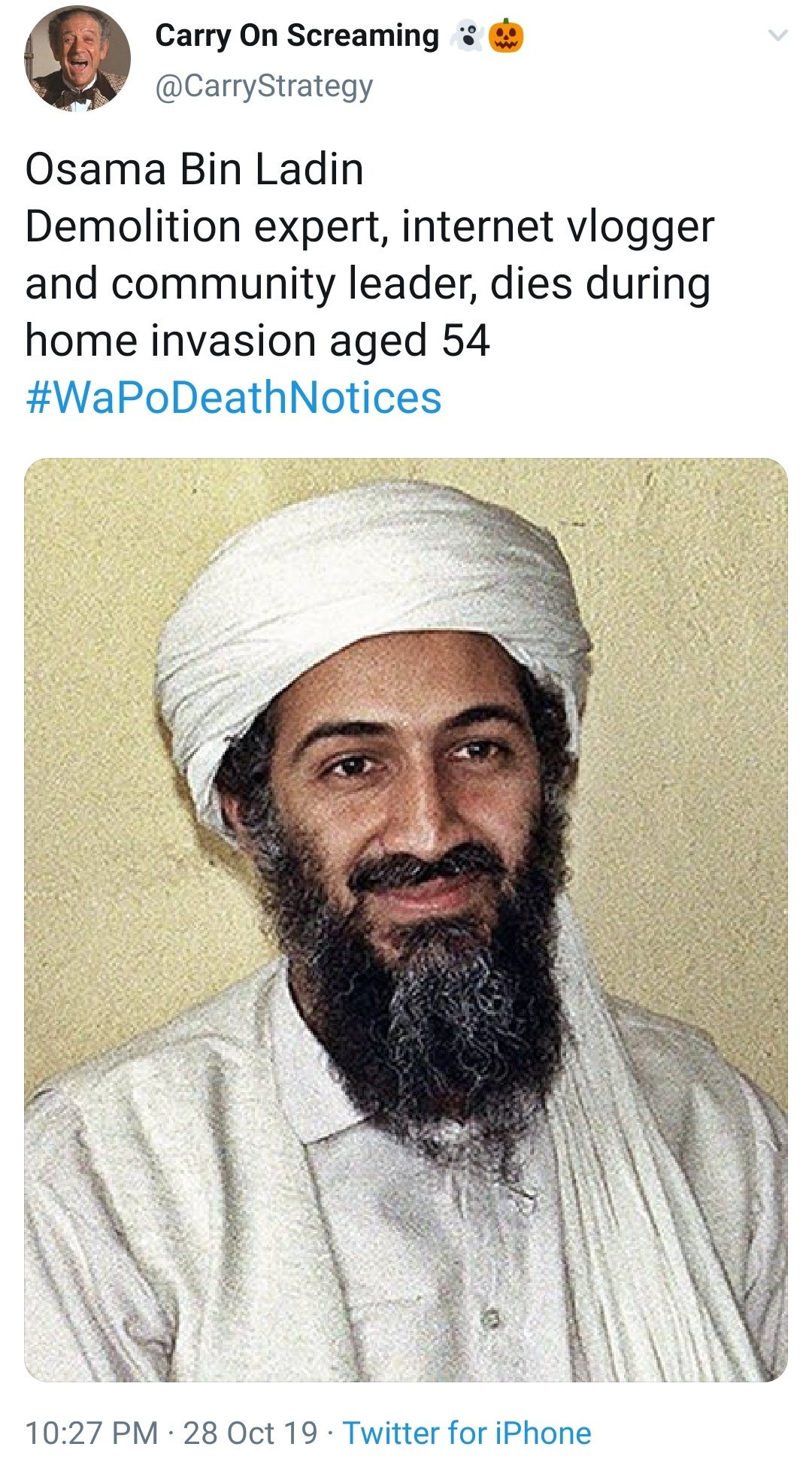
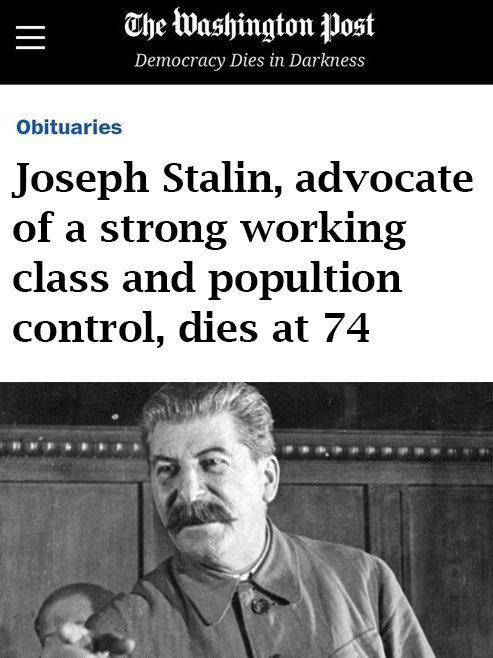
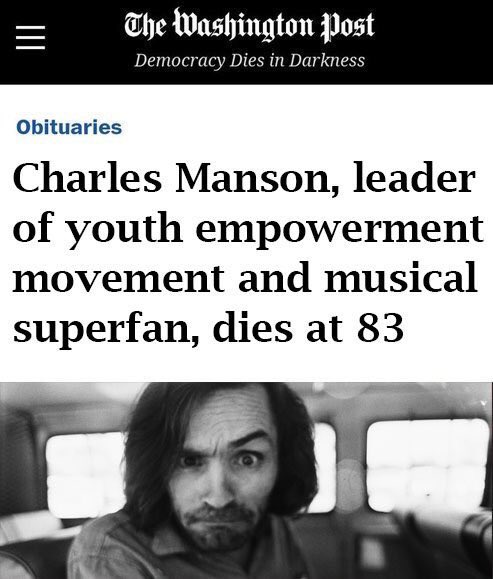
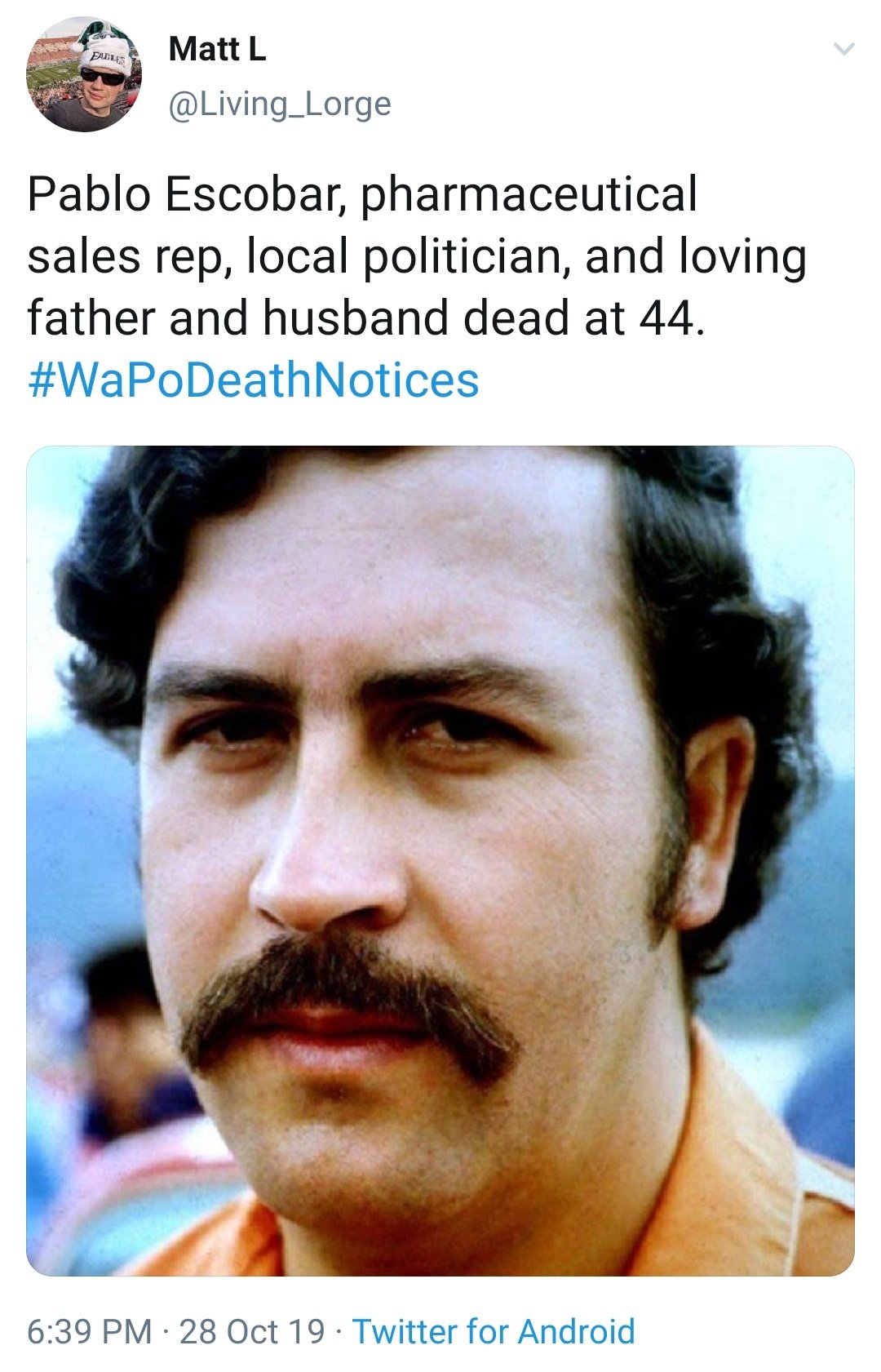
To be fair, WaPo soon corrected this. But not before the internet got ahold of a new meme: WaPo death notices:
Here are some others, sans pictures
Jabba the Hutt, daring, proactive and enterprising ladies man found asphyixiated at the hands of disturbed employee.
Darth Maul – Martial Artist, Excellent Student, Promising Young Leader, died tragically today at 25 in a brawl with two men wearing hoodies.
Judas Iscariot, a noted local coin collector and close friend of Jesus Christ found dead at 30.
Voldemort, austere wizard who overcame a severe facial deformity to achieve dark lordship, dead at 71
Thanos, noted rare gem collector and population control advocate, murdered during home invasion.
Jeffery Epstein, Child worker rights activist, dead by (assisted) suicide at age 66
Big Bad Wolf, lung capacity legend & bacon enthusiast, dead at 6
Coyote, entrepreneur, gravitational addict, avid birder, dies episodically.
Okay, there are hundreds of these. Just click #WaPoDeathNotices if you want more. Feel free to share of few of your own (no fair swiping them off twitter) in the comments.
Netflix tests a new feature that allows users to speed-watch titles. Directors don’t like the idea, obviously.
If you die in the same hospital you were born in, your average velocity is zero.
The following video is fake. I am posting it for a couple reasons. First, it is funny (at least if you watch the whole thing). Secondly it shows how good fake videos can be now, even ones made by people you’ve never heard of. A LOT of people this week took this as legit. Fake news has a very bright future.
Arthur Krystal surveys a handful of books on aging. They are mostly “chatty accounts meant to reassure us that getting old just means that we have to work harder at staying young.” Is that true?
“These authors aren’t blind to the perils of aging; they just prefer to see the upside. All maintain that seniors are more comfortable in their own skins, experiencing, Applewhite says, ‘less social anxiety, and fewer social phobias.’ There’s some evidence for this. The connection between happiness and aging—following the success of books like Jonathan Rauch’s The Happiness Curve: Why Life Gets Better After 50 and John Leland’s Happiness Is a Choice You Make: Lessons from a Year Among the Oldest Old, both published last year—has very nearly come to be accepted as fact. According to a 2011 Gallup survey, happiness follows the U-shaped curve first proposed in a 2008 study by the economists David Blanchflower and Andrew Oswald. They found that people’s sense of well-being was highest in childhood and old age, with a perceptible dip around midlife.
“Lately, however, the curve has invited skepticism. Apparently, its trajectory holds true mainly in countries where the median wage is high and people tend to live longer or, alternatively, where the poor feel resentment more keenly during middle age and don’t mind saying so. But there may be a simpler explanation: perhaps the people who participate in such surveys are those whose lives tend to follow the curve, while people who feel miserable at seventy or eighty, whose ennui is offset only by brooding over unrealized expectations, don’t even bother to open such questionnaires.”
What has been your experience regarding aging and happiness?
A Florida Democrat has put her face on condoms and revealed she plans to hand them out at a pride event in Orlando this weekend. State Rep. Anna Eskamani unveiled the design of her personalised prophylactics in a tweet Monday evening.
The former local Planned Parenthood director told Orlando Weekly that the custom condoms were not at all a juvenile attempt at publicity, but a “fun way to talk about courageous discussions” around sexuality and health.
Yep. Nothing like a politicians face on a condom to start “couragous discussions” around sexuality and health. You can just see it. A loving young couple…heat of passion…clothes coming off…breaks out the condom…sees politician’s mug…”hmmm, ya know, instead of shaking the sheets, let’s have a nice, courageous discussion of sexuality and health”.
Happens ALL THE TIME.
Wanna see a slow-mo of a water droplet hitting sand? Of course you do:
Can humans communicate brain-to-brain without language? A new study demonstrates we can, but boy is it inefficient:
“We present BrainNet which, to our knowledge, is the first multi-person non-invasive direct brain-to-brain interface for collaborative problem solving. The interface combines electroencephalography (EEG) to record brain signals and transcranial magnetic stimulation (TMS) to deliver information noninvasively to the brain. The interface allows three human subjects to collaborate and solve a task using direct brain-to-brain communication. Two of the three subjects are designated as “Senders” whose brain signals are decoded using real-time EEG data analysis. The decoding process extracts each Sender’s decision about whether to rotate a block in a Tetris-like game before it is dropped to fill a line. The Senders’ decisions are transmitted via the Internet to the brain of a third subject, the ‘Receiver,’ who cannot see the game screen. The Senders’ decisions are delivered to the Receiver’s brain via magnetic stimulation of the occipital cortex. The Receiver integrates the information received from the two Senders and uses an EEG interface to make a decision about either turning the block or keeping it in the same orientation. A second round of the game provides an additional chance for the Senders to evaluate the Receiver’s decision and send feedback to the Receiver’s brain, and for the Receiver to rectify a possible incorrect decision made in the first round. We evaluated the performance of BrainNet in terms of (1) Group-level performance during the game, (2) True/False positive rates of subjects’ decisions, and (3) Mutual information between subjects. Five groups, each with three human subjects, successfully used BrainNet to perform the collaborative task, with an average accuracy of 81.25%.”
Mourners at a funeral in Germany got an involuntary high when they were accidentally served hash cake, police said Tuesday. The funeral party went to a restaurant after the burial in Wiethagen for coffee and cake, a German tradition. After eating the cake, 13 people reported experiencing nausea and dizziness and needed medical treatment. The Rostock police said the person in charge of the cakes asker her 18-year-old daughter to bake them. The mother mistakingly gave the wrong cake to the mourners. She instead took the hash cake, which was made for a separate occasion.
They really need some sort of identification next time…
Well, that does it for this week. Don’t forget to add some WaPo death notices in the comments, and to send your mug to the robot face competition. Who knows, you could be the face of Skynet.
Baptism of St Francis (Cathedral of San Rufino, Assisi)
Wanted: Someone to inflame the romantic imagination of Christianity From Ron Rolheiser
[We] need a new Francis of Assisi: We need someone, man or woman, who can re-inflame the romantic imagination of Christianity. Francis was a saint, but he was more than that. He was also a man of rare imagination. He was someone who, like a great artist, could reshape the collective imagination. What Francis was able to do, among other things of course, was to give to the world a new and a more attractive vision of how Christianity is connected to nature, how a life of simplicity itself can be an aesthetic, and how the altruism which lies at the heart of Jesus’ message can be more attractively imaged and lived. What he said, did, and founded became, almost instantly, something analogous to a great work of art, it drew people to itself and inflamed their imaginations. Hundreds of years later, it is still doing the same thing. But his images no longer fire the imagination as powerfully as they once did. We need a new Francis, a post-modern man or woman, who can again inflame the romantic imagination of world in the same way that Francis once did. This is badly needed in an age that all but militates against simplicity, altruism, and nature. In a time of morally-authorized greed, where celebrity is divinity, and where restlessness and grandiosity have been taken to new levels, in a world of high-rise living, some great artist must again show us that what we really want is to live simply, altruistically, and in harmony with nature.
A Review of “Love and Quasars: An Astrophysicist Reconciles Faith and Science” by Paul Wallace
We are going to review the book, “Love and Quasars: An Astrophysicist Reconciles Faith and Science” by Paul Wallace. From the Amazon review: Paul Wallace teaches in the Department of Physics & Astronomy at Agnes Scott College in Decatur, Ga, and is Pastor for Adult Education at First Baptist Church of Decatur. He teaches occasionally at Emory University’s Candler School of Theology and at Columbia Theological Seminary. He holds a PhD in nuclear physics from Duke University and an MDiv with a concentration in historical theology from Emory.
Paul Wallace
For 10 years Paul was a professor of physics and astronomy at Berry College in Rome, Ga. He has twice been awarded a NASA Faculty Fellowship at Goddard Space Flight Center in Greenbelt, Md., and has twice served on the faculty of the Emory-Tibet Science Initiative in Dharamsala, India.
This is a very good book for the average Evangelical who struggles with faith and science issues. Paul grew up in the south in a Southern Baptist church. He was inculcated in the anti-science views that came from the strong anti-evolution viewpoints typical of churches in that geographical and cultural location of that time. Paul’s dad was a civil engineer specializing in hydrology and nuclear waste. He loved God and loved science and communicated those loves to Paul. Paul’s parents took Paul and his siblings to church every time the doors were open and he was taught Bible stories in a way that plainly conflicted with evolution.
A second grade field trip to Fernback Science Center and their astronomy room ignited a life-long love of astronomy in the young boy. Paul says:
After this, I learned all the astronomy I could. From there, with Dad’s help, I familiarized myself with the basics of evolution and natural history. I became the household dinosaur expert. My parents supported my obsession, buying me astronomy books and dinosaur books and a large collection of plastic tyrannosaurs and stegosaurs and apatosaurus. I slipped them into my pockets before leaving for school. At recess, I played with them on an outcrop of rock, which looked pretty prehistoric to me, at the far end of the playground.
Eventually, as he moved through high school and into to college the cognitive dissonance of what he was taught in church and what he was learning in his science classes came to fruition and he abandoned his childhood faith and finally embraced atheism. The book is about how he returned to faith in Christ and reconciled the faith vs. science issues for himself, and how others in a similar struggle might find the same path as he did.
The book is short, only 121 pages, and Wallace writes in a very personable style that doesn’t get too science-heavy. He is big on analogy and metaphor which I think is absolutely essential to help Evangelicals over the faith vs. science hump, much more so than discursive argumentation and apologetics. An example from the introduction:
Uranus
“Years ago, on a clear October evening, I saw Uranus with my naked eye. My lab assistant and I stayed behind at the college observatory after all the Astronomy 101 students had departed for the night, and we devoted ourselves to the project. It took some effort, but we both succeeded in spotting the seventh planet amid the stars scattered along the Aquarius-Pisces boundary, with no help from binoculars or telescopes.
Uranus sits just this side of visibility and moves slowly, taking eighty-four years to complete a single lap around the sun. For these reasons, it spent many years cataloged as a star. Then in 1781, an Englishman named William Herschel observed it through his homemade telescope, thought it looked odd, and recorded it as comet. Within a couple of years, however, astronomers overruled this assignment and announced the first discovery of a planet in recorded history.
Herschel named it George. Non-British astronomers, uninterested in honoring King George III of England, weren’t having it. Scientists haggled over the name for decades, and the planet was finally given its permanent moniker in 1850. Uranus jokes began appearing in print shortly thereafter.
In order to see Uranus with your naked eye, you must meet certain requirements. First you need to be under a truly dark sky. Humidity, city lights, moonlight, or any combination of these brighten the sky so much that Uranus will be wiped clean out. You must also have excellent vision, a star chart showing the exact location of Uranus among the stars at the time of observation, and plenty of patience.
With all this, however, you could still look and look and look and not spot it. In fact, you could stare directly at Uranus for hours without knowing it. The source of this puzzlement dwells not in the heavens but in your eye. The human retina contains two kinds of light-detecting cells, cones and rods. Cones respond to colors and bright lights and are concentrated at the center of the retina, opposite the lens. Rods detect low levels of light and are spread out around the cones, but the planet glows too faintly to be detected by these cells. You’ll never see Uranus by looking at it.
But if you look just to the side of it, its light falls on your rods, and the planet pops into view. Once this happens, you instinctively move you eye back toward it and poof, it disappears again. Resisting this reflex feels weird at first, but with practice, the technique becomes natural. Experience star-gazers are accustomed to using this so-called averted vision to see dim objects.
Much as some things can be seen not by looking at them but by looking at what is next to them, some things can be understood not by thinking about them but bye thinking about what is next to them. The more you think about these things or try to figure them out or nail them down, the more elusive they become. They can’t be grasped by head-on thinking. But if you relax a little and think to the side, you might come to know what you could never comprehend directly.”
I like his this way of not coming at a subject directly, but by approaching it “from the side” so to speak. It reminds of the C.S. Lewis quote:
I believe in Christianity as I believe that the sun has risen: not only because I see it, but because by it I see everything else.
There is something very Eastern Orthodox in Paul Wallace’s way of thinking and writing. He writes with both humility and wit. I think your Southern Baptist (or other Evangelical) friend will find it engaging and informative.
There, I said it. It used to be cool; now it’s jumped the shark.
Trick or treating is great. What kid doesn’t love dressing up, going door to door and getting candy! What adult doesn’t love seeing the kids in their costumes. You have to be Halloween’s version of the Grinch not to love trick or treat.
But the rest of it is rot.
Let’s start with the modern alternative to trick or treat: Trunk or treat. Instead of social time of neighborhood candy-soliciting, the kids can head to a PARKING LOT across town to grab handfuls of sugar from car trunks. Who thought this was an upgrade? No talking to the neighbors. No walking and talking with friends and siblings as you enjoy the jack-o-lanterns and decorations. No comparing notes about which houses give out the good stuff. Nope. None of that. Mom and Dad throw you in the minivan, you spend 8 minutes in a PARKING LOT, then return home with more candy than your little body can handle in a month. Again, WHO THOUGHT THIS WAS AN UPGRADE??
Besides, is it just me or doesn’t trunk or treat sound strangely menacing?
Next is the lawn decorations. Now, I’m not really a big fan of lawn decorations as a whole. I could live happily never seeing another half-inflated Santa flapping in the wind. But the Halloween decoration are getting out of hand and are often tasteless. This is a picture of a yard in my neighborhood.
You know, I had someone I loved dearly DIE THIS LAST YEAR. And LOTS of people driving past displays like this could say the same. Do you really think we want to see death made light of every time we drive down your street?
Death sucks. It’s real, yes, But it sucks. Seeing yard after yard filled with tombstones, the grim reaper, skeletons and other paraphernalia of death is, at worst, glorifying what should not be glorified. At best, it is making a joke out of what is not a joking matter.
Lastly…the costumes. Now, costumes themselves, especially on kids, is awesome fun. But whatever happened to homemade costumes? They, at least, took thought and creativity. Now four out of five kids are wearing some copy-righted, consumeristic pop-culture figure. Doesn’t Disney make enough money? Do we really need four Ironmen and six Wonderwomen soliciting candy on the same street? Do parents not know how to make a good pirate or ghost anymore?
Speaking of adults and costumes…when did Halloween turn into Whoreoween? The pervavacation [I just made that up] of America is complete. Think of the most unsexy thing imaginable…and someone will be selling a sexy version of that.
Sexy Corn? Of course:
Sexy Skunk? Why not?
Sexy Mr. Rogers? Who wouldn’t want to be a neighbor:
Sexy Donald Trump [my PC refused three times to type that]? Here ya go:
Can we just stop???
Can we go back to a time where Halloween was a day, not a season? Can we return to a time when it was about making kids happy, not making corporations money? Is it possible…Is it even conceivable to remember that “een” part of Halloween means the night before something: the night before a holy day?
Well, maybe I’m just getting old and cranky. I suppose pretty soon I’ll start yelling at clouds and warning kids off my lawn.
But for now I’ll just watch and enjoy the kids in costume as I hand out candy, and try to ignore the the parts I don’t like.
But if anyone shows up as sexy Donald Trump I’m turning the sprinkler on ’em.















 The Internet Monk Archives